
Editor’s note: This StarTree review covers StarTree Cloud’s pricing, deployment models and documented product behavior as sold in October 2026; it is not a hands-on performance benchmark. I weigh pricing transparency, setup effort, managed-layer value over open-source Apache Pinot, exit costs and momentum.
Quick verdict: I recommend StarTree for engineering teams that serve analytics to customers or agents at thousands of queries per second on streaming data and would rather pay $0.21 per vCPU-hour than staff a Pinot on-call rotation. The features that justify the bill are StarTree-only, and the trial, Iceberg tables and the MCP server go through StarTree’s team.
Key Takeaways
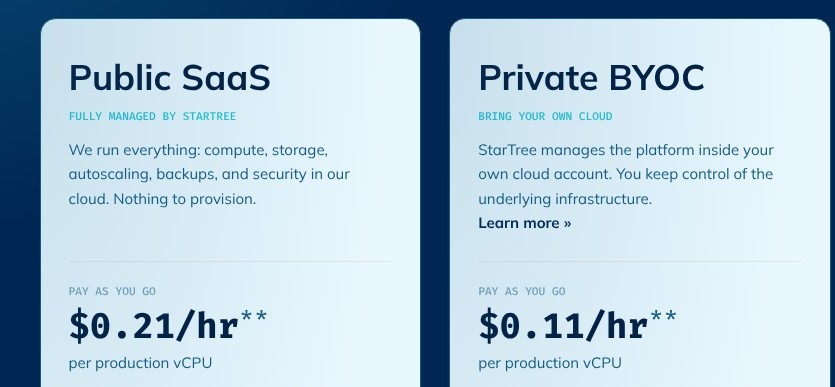
- Public SaaS costs $0.21 per production vCPU-hour, storage and ingest included; BYOC is $0.11 plus your cloud bill.
- Off-heap upserts and object-storage tiers fix open-source Pinot’s heap-bound upsert keys and storage tied to compute.
- No trial length, credits, free tier or SLA percentage is published; you request a trial.
- Iceberg tables need support to enable them, the MCP server needs a StarTree rep, and BYOK is in preview.
- SaaS and BYOC run on AWS, GCP and Azure with SOC 2 Type 2, ISO 27001 and 24/7 Slack-first support.
On Panoply, StarTree sits under Store > Real-time analytics databases > OLAP engine, next to Apache Pinot, ClickHouse and Imply.
In this review, I’ll take a closer look at StarTree’s pricing, the Data Portal, its upsert and storage extensions and the lock-in question, so you can see whether the managed layer is worth paying for over free Pinot.
StarTree Pros and Cons
Pros
- Published list rates of $0.21 (SaaS) and $0.11 (BYOC) per production vCPU-hour, with storage and ingest included on SaaS.
- Off-heap upserts move key metadata to RocksDB on disk; StarTree cites close to 1 billion keys on a 4-core, 30 GiB server.
- Tiered storage to S3 or GCS keeps old segments off the servers, so retention stops dictating compute.
- SaaS and BYOC on AWS, GCP and Azure, plus air-gapped BYOK on your own Kubernetes.
- 24/7 Slack-first support, SOC 2 Type 2 and ISO 27001.
Cons
- No published trial length, free tier or SLA percentage.
- Iceberg tables, the MCP server and ThirdEye sit behind support requests, a rep or a demo.
- The star-tree index still does not work on upsert tables.
- The extras that justify the bill are proprietary, so moving back to open-source Pinot means re-planning memory and storage.
How Much Does StarTree Cost?
StarTree Cloud prices compute per production vCPU-hour, sold in three operating models:
- Public SaaS ($0.21 per production vCPU-hour): StarTree runs compute, storage, autoscaling, backups and security in a dedicated, infrastructure-isolated environment, with no per-GB ingest or storage meter, a 3-AZ deployment and 24×7 support.
- Private BYOC ($0.11 per production vCPU-hour): the platform and managed service run inside your AWS, GCP or Azure account, and the cloud provider bills the infrastructure, so your savings plans apply.
- BYOK (custom terms): your own Kubernetes cluster, including air-gapped setups, with no delegated data-plane access; the docs still call it a preview.
Non-production vCPUs are discounted and annual and volume pricing exist, but StarTree lists no minimum commitment, non-production rate, trial length or SLA percentage.
| Plan | Rate | Who runs infrastructure | Billed separately | Best for |
|---|---|---|---|---|
| Public SaaS | $0.21 per production vCPU-hour | StarTree, dedicated per customer | Nothing for ingest or storage | Teams that want one bill and no cloud setup |
| Private BYOC | $0.11 per production vCPU-hour | StarTree manages it inside your AWS, GCP or Azure account | Cloud compute and storage | Teams with committed cloud spend or data-residency rules |
| BYOK | Custom | You, on your own Kubernetes | Everything you run | Regulated or air-gapped environments |
StarTree has no public cost estimator, so here is my arithmetic for an always-on cluster (730 hours) at list price:
| Production vCPUs | Public SaaS per month | BYOC platform fee per month |
|---|---|---|
| 8 vCPU | $1,226.40 | $642.40, plus cloud infrastructure |
| 16 vCPU | $2,452.80 | $1,284.80, plus cloud infrastructure |
| 48 vCPU | $7,358.40 | $3,854.40, plus cloud infrastructure |
Per vCPU, an always-on month is about $153 on SaaS and about $80 on BYOC, and discounted non-production vCPUs or an annual deal bring both below these figures. For BYOC, add your cloud provider’s price for the same vCPUs plus disks and object storage; that total, not the platform fee alone, is the number to set against the SaaS column.
Is StarTree Good Value for Money?
- Bundled storage: the SaaS rate includes storage and ingest, which ClickHouse Cloud meters separately at $25.30 per TB-month on its Enterprise rates in AWS us-east-1.
- No cheap entry tier: Imply Polaris starts at $100 a month (Starter, not meant for production) and $600 a month for Standard, while an always-on 8-vCPU StarTree SaaS cluster lists at $1,226.40 a month.
- BYOC math: BYOC cuts the platform fee from $0.21 to $0.11 per vCPU-hour, roughly half, but you still pay AWS, GCP or Azure for the compute, disks and object storage underneath.
- Upserts at scale: if your tables hold hundreds of millions of primary keys, off-heap upserts can shrink the server count open-source Pinot would need, which is where the vCPU-hour fee earns its keep.
- Marketplace billing: Public SaaS is listed on the AWS, GCP and Azure marketplaces, so you can buy it through a cloud account you already have.
- Versus free Pinot: Apache Pinot costs nothing to license, so the StarTree bill pays for not running controllers, brokers, servers, ZooKeeper and minions yourself.
Reviewer’s Notes: I’d start on Public SaaS with a trial-sized cluster, because the bill is a single line and nothing else needs provisioning. Move to BYOC once you have committed cloud spend or data-residency rules: the platform fee drops from $0.21 to $0.11 per vCPU-hour and your existing cloud discounts apply to the infrastructure.
My Experience With StarTree: From Trial Request to First Query
StarTree’s path in starts with a conversation, not a signup form: the pricing page sends you to “Request a Trial”, and an onboarding team takes it from there.
Requesting a Trial
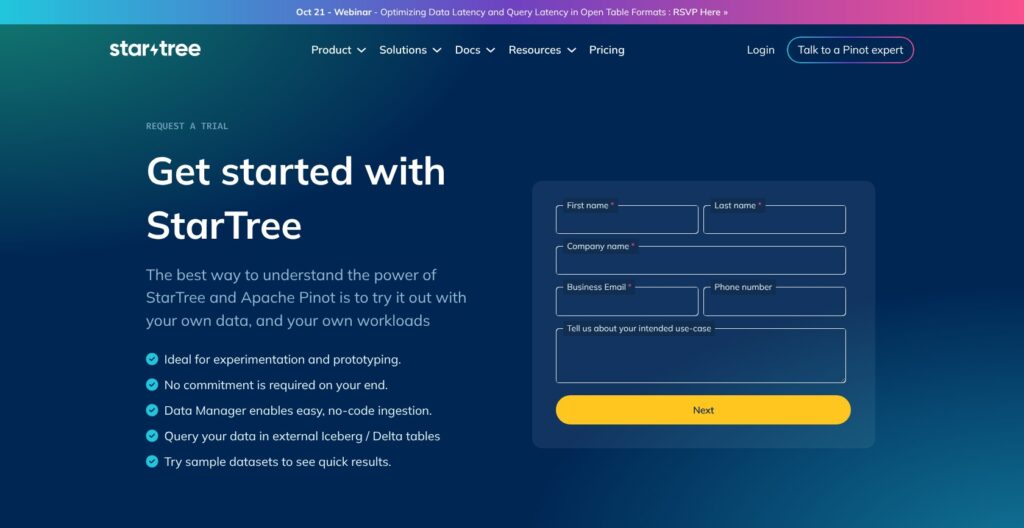
StarTree pitches the trial for experimentation and prototyping, with no commitment, no-code ingestion, queries on external Iceberg or Delta tables, and sample datasets to try. No trial length or credit amount is published, so I’d ask for both in writing at the first call. ThirdEye is not available in the SaaS trial, so if anomaly alerting is on your list, book that demo separately.
That’s a slower start than ClickHouse Cloud and Imply Polaris, which both let you sign up self-serve on trial credits ($300 and $500 respectively, each for 30 days) with no card.
Creating a Table in the Data Portal
Once the environment is up, the work happens in the Data Portal (the trial page still calls it Data Manager), where table creation runs as a guided flow:
- Pick a streaming source: Kafka, Confluent Cloud, Kinesis, Amazon MSK, Redpanda, WarpStream, StreamNative or Aiven Kafka, plus MongoDB CDC.
- Let it infer the schema: decoders cover JSON, Avro, Protobuf and Debezium, among others.
- Apply transformations: reshape fields before they land in Pinot.
- Review indexes and create the table: then query it straight from the console.
Batch sources include S3, GCS, ADLS, Delta Lake, Snowflake, BigQuery, a SQL connector and plain file upload. Release 0.16 added a Kafka 4.0 connector. Pulsar shows up in StarTree’s Pinot recipes but not among the Data Portal’s connector pages, so Pulsar shops should confirm the ingestion route before signing.
I like that this flow replaces the hand-written schema and table-config JSON that self-run Apache Pinot expects from you on day one.
Querying and Watching the Cluster
The query console has syntax highlighting, auto-complete, a live data preview, a table browser and saved query templates, and it reports latency and scanned-record stats for every query. Those two stats are the ones I’d watch first, because scanned records are what index choices change.
Around the console, the Data Portal bundles:
- Grafana dashboards for cluster metrics, built in
- Security Manager for access control
- Embedded Pinot tooling: the Pinot Cluster Manager, a ZooKeeper browser and Swagger, for when you need the raw knobs
Superset and Tableau have documented connections if your dashboards live outside StarTree.
Reviewer’s Notes: The guided flow removes the JSON busywork, but index choices still decide speed and cost on Pinot, managed or not. Bring your top five production queries to the first onboarding session and ask StarTree’s team to size indexes against them before you load real volume.
Off-Heap Upserts and Tiered Storage: What You Pay StarTree For
Off-heap upserts and object-storage tiers are StarTree’s proprietary answer to “why not just run Pinot”: they target the two limits that make self-run Pinot expensive at scale, upsert metadata on the JVM heap and storage tied to server count.
Off-Heap Upserts
Open-source Pinot keeps upsert metadata (the primary-key map) on the JVM heap and rebuilds it on every restart. StarTree moves that metadata into a disk-backed RocksDB store instead. By StarTree’s own figures, that lets a 4-core, 30 GiB server hold close to 1 billion primary keys, against tens of millions per server on open-source Pinot, and restarts finish in under 10 minutes with prebuilt snapshots.
StarTree’s Primer.AI case study shows the problem it targets: on self-run Pinot, Primer reported latency spikes of up to 30 seconds, out-of-memory crashes once unique records reached the hundreds of millions, and 30 to 60 minute restarts to rebuild upsert state. After the move to off-heap upserts, Primer’s mean time to recovery fell to under 60 seconds, by the vendor’s account.
One limit carries over: StarTree itself says the star-tree index still does not work with upsert tables, so upsert-heavy tables lose Pinot’s signature pre-aggregation.
Tiered Storage
Open-source Pinot can only move segments between tenants on local disk. StarTree adds S3 and GCS tiers, so older segments leave the servers entirely; the docs’ example keeps data younger than 30 days local. Azure Blob is not listed as a tier backend.
Setup is still engineering work: you set an age boundary, tag a dedicated remote tenant, add cluster configs, restart servers and add tierConfigs to the table config. StarTree documents these limits:
- File-ingestion and segment-import tasks don’t run on tiered tables
- Remote segments raise memory and CPU use and can slow queries on local data
- Server restarts take much longer
- Automatic caching is experimental
- Queries may need longer timeouts
Tiered storage stops retention from dictating server count, but with that setup work and those limits, off-heap upserts are the stronger reason to pay StarTree: they change how many primary keys a single server can hold.
Iceberg, AI and ThirdEye
StarTree shipped releases 0.14 (March), 0.15 (April) and 0.16 (July) in 2026, and the lakehouse and AI features they added range from GA to beta to demo-only.
Iceberg and Delta Tables
Iceberg Tables (StarTree calls them External Tables) went GA in release 0.15 in April 2026, but support has to enable the feature on request for your environment. Once on, you connect a catalog in the Data Portal or via API:
- Iceberg catalogs: AWS Glue, S3 Tables, Unity Catalog, Apache Polaris / Snowflake Open Catalog, Snowflake Horizon and Nessie
- Raw files: Parquet on S3 or GCS
- Delta Lake: through UniForm
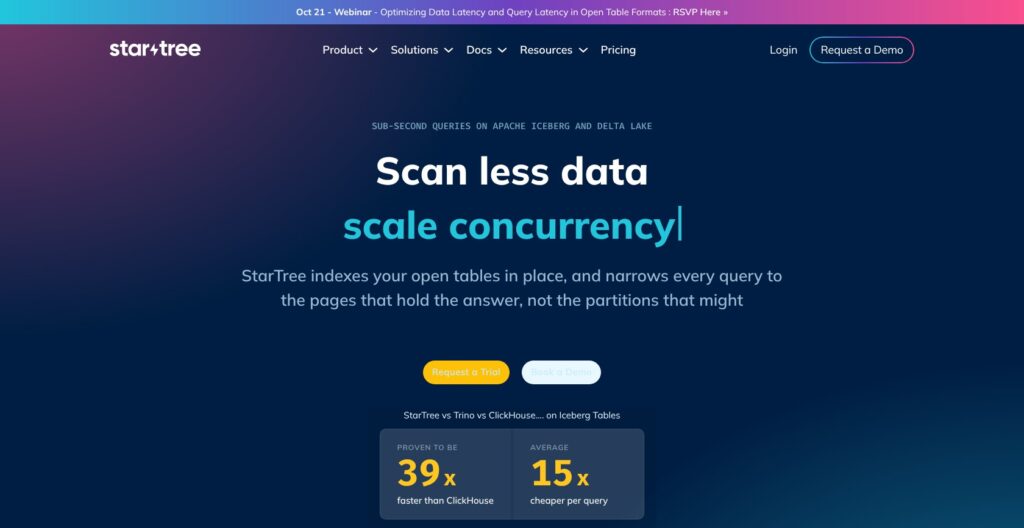
You then add Pinot indexes on selected fields to speed up queries. Release 0.16 added segment groups and Iceberg deletion vectors for large, frequently updated tables, plus multi-stage materialized views. StarTree’s homepage claims its engine runs up to 39x faster than ClickHouse and 21x faster than Trino on Iceberg; that is StarTree’s own benchmark, so rerun it on your own tables.
If Iceberg is your reason to buy, I’d make enabling External Tables a written condition of the trial.
AI Features: MCP Server, Query Analyzer, Vector Index
- MCP server: deploys inside your environment, is based on the open-source mcp-pinot project, uses OAuth and exposes tools such as list_tables, get_schema and read_query, with setup guides for Claude Desktop, Cursor and LibreChat. Installation goes through a StarTree representative.
- AI Query Analyzer: flags expensive queries and recommends changes, and a Proactive Analyzer runs those checks on a schedule.
- Vector index: supported for similarity search alongside regular Pinot indexes.
- StarTree Execution Engine: a Rust and DataFusion runtime for multi-stage queries, opt-in and still in beta; 0.16 added spill-to-disk and sort-merge joins.
ClickHouse Cloud and Imply Polaris let you test a query workload without a sales call; with StarTree, the agent-facing pieces need a conversation first.
ThirdEye
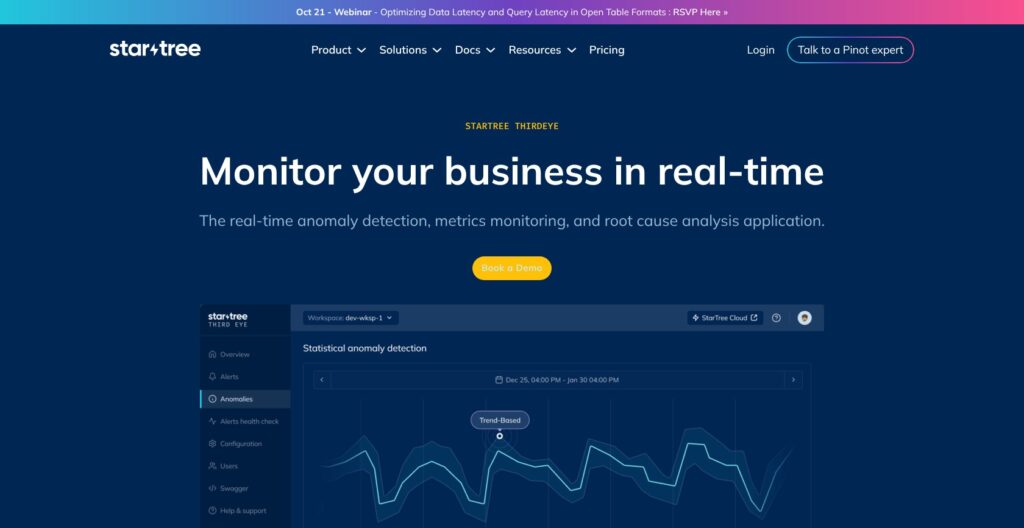
ThirdEye handles anomaly detection, alerting and root-cause analysis as a separate app, and StarTree still documents it in 2026 with alert templates and ETS, MSTL and matrix-profile detectors. DoorDash, by StarTree’s account, uses it to alert 500+ partners across 500+ dimensions. It is demo-gated and excluded from the SaaS trial, so price it as a separate line item.
BYOC, Security and the Lock-In Question
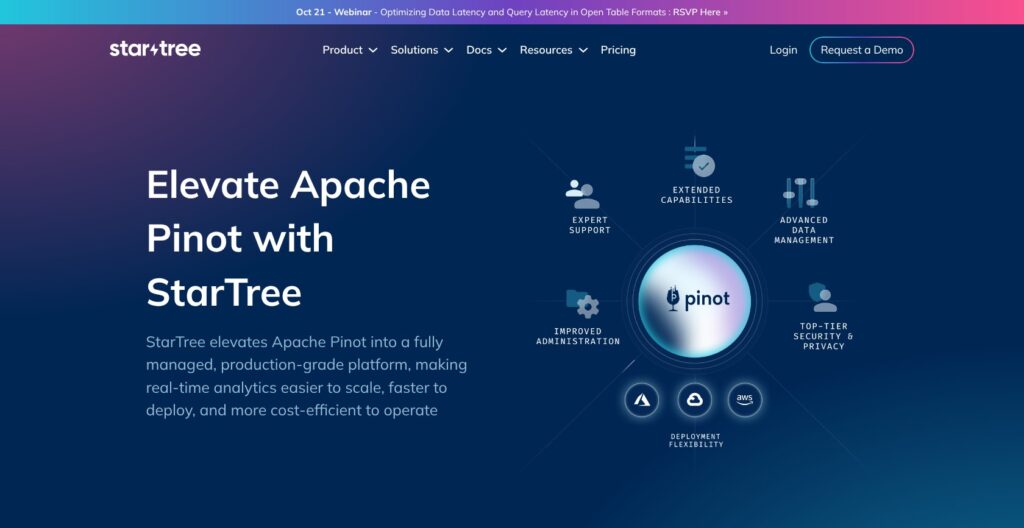
Public SaaS and BYOC run on AWS, GCP and Azure, BYOK runs on your own Kubernetes, and Public SaaS gives each customer an infrastructure-isolated data plane and Pinot cluster rather than a shared one. In StarTree’s V2 cloud architecture, an agent inside the data plane pulls configuration from StarTree’s control plane, so day-to-day management needs no inbound access to your account. StarTree upgrades the components on a roughly monthly cadence.
The security and support package:
- Certifications: SOC 2 Type 2 and ISO 27001; the docs say “HIPAA readiness”, which is not the same as a HIPAA attestation, so ask for a BAA if you need one
- Access: OIDC single sign-on and role-based access control
- Encryption: TLS 1.2+ in transit, AES-256 at rest
- Audit logging: on by default since release 0.16
- Support: 24/7/365 and Slack-first, with a vendor-published average first response under 90 seconds for mission-critical incidents
StarTree publishes no region list and no SLA percentage, though a BYOC doc says BYOC customers get the same SLA guarantees as SaaS. Imply Polaris, by contrast, prints a 99.9% SLA on its $600-a-month Standard plan.
Can You Leave StarTree?
StarTree’s core engine is Apache Pinot (Apache-2.0, release 1.5.1 in June 2026), so tables, schemas and queries carry over to a self-run cluster. What stays behind:
- Off-heap upserts: you’re back to sizing JVM heap for every primary key
- Object-storage tiers: old segments return to local disk
- Data Portal and ThirdEye: both StarTree-only
- Iceberg indexing: External Tables don’t exist in open-source Pinot
AWS’s own 2025 guidance draws the same line: teams with the expertise to run Pinot at scale may prefer self-managing, while teams that want less tuning and maintenance pick StarTree. The exit risk is operational, not a data-format trap, but if your workload depends on upserts at hundreds of millions of keys, leaving means buying a lot more memory.
How Does StarTree Compare to Competitors?
StarTree is the only managed service in this group built on Apache Pinot; its rivals run ClickHouse, Druid or StarRocks, or ask you to run Pinot yourself.
| Tool | Engine | Entry price (published) | Trial | Wins at |
|---|---|---|---|---|
| StarTree Cloud | Apache Pinot | $0.21 per vCPU-hour (SaaS), $0.11 (BYOC) | On request, terms not published | High-QPS serving on streaming data, upserts at scale |
| Apache Pinot | Apache Pinot | $0 license, you run it | Not applicable | Teams with Pinot ops expertise |
| ClickHouse Cloud | ClickHouse | Enterprise about $0.39 per compute unit-hour and $25.30 per TB-month (AWS us-east-1) | $300 credits, 30 days | Ad hoc SQL, self-serve start |
| Imply Polaris | Apache Druid | Starter $100/month, Standard $600/month (99.9% SLA) | $500 credits, 30 days | Druid shops, self-serve managed Druid |
| Tinybird | ClickHouse | Free plan (10 GB), paid plans from $25/month | Free plan | Developers shipping analytics APIs |
| PhoenixAI (formerly CelerData) | StarRocks | No published prices | 30 days, no card | StarRocks teams wanting BYOC or self-managed |
- Apache Pinot: wins when you already have engineers who know controllers, brokers and ZooKeeper, because the Apache-2.0 license is free and the core engine (release 1.5.1) is the same one StarTree runs. You inherit the heap-bound upsert limit and local-disk tiering, though.
- ClickHouse Cloud: wins for ad hoc SQL and analysts who want to start today on $300 of credit without a sales call. Enterprise compute lists at about $0.39 per compute unit-hour (2 vCPU, 8 GiB), but storage is metered on top, unlike StarTree SaaS.
- Imply: wins for teams already on Druid that want a self-serve managed start at $100 a month on Polaris Starter. Standard at $600 a month covers up to 9.6 TB and prints the 99.9% SLA StarTree doesn’t publish.
- Apache Druid: wins for self-run Druid shops; release 37.0 shipped in April 2026.
- Tinybird: wins for developers who want to turn a ClickHouse query into an API endpoint fast, starting on a free plan with 10 GB, 0.25 vCPU and 1,000 requests a day.
- PhoenixAI (formerly CelerData): wins for teams standardizing on StarRocks that want BYOC or self-managed deployment, with a 30-day no-card trial and quote-only pricing.
StarTree’s docs size user-facing analytics at 10,000 to 100,000 queries per second with 10 to 100 ms p95 latency, and ad hoc analytics at low QPS with single-digit-second responses. If your workload looks like the second profile, ClickHouse Cloud or Tinybird fits better. ClickHouse’s own case study has Constant Contact leaving self-run Pinot because it was “very component-heavy”; StarTree’s managed service exists to take those components off your plate.
StarTree also courts former Rockset customers with a page billing itself as the best Rockset alternative for real-time analytics; OpenAI acquired Rockset in June 2024 and shut the cloud service down after a September 30, 2024 deadline.
StarTree wins where the others don’t: thousands of queries per second against fresh, upsert-heavy streaming data, without running Pinot yourself.
How I Reviewed StarTree
I evaluated StarTree Cloud as a buyer would before requesting a trial. I priced all three operating models against StarTree’s list rates and the published rates of ClickHouse Cloud, Imply Polaris, Tinybird and PhoenixAI, and worked out the monthly costs myself at 730 hours. I followed the documented Data Portal flow from source selection to first query, and tracked releases 0.14 through 0.16 to sort GA features from beta, preview and request-gated ones. I also checked deployment, security and support terms, and what carries over to open-source Pinot if you leave.
I weighed pricing transparency, setup effort, the value of the managed layer over free Pinot, openness and exit costs, and development momentum.
Prices current as of October 2026.
Should You Run Your Real-Time Analytics on StarTree?
StarTree sells managed Apache Pinot at a published $0.21 per vCPU-hour, and its off-heap upserts and object-storage tiers fix the two limits that make self-run Pinot expensive at scale. The catch is access: trial terms, Iceberg tables, the MCP server and ThirdEye all go through StarTree’s team.
BYOC at $0.11 per vCPU-hour adds a strong option for teams that must keep data inside their own AWS, GCP or Azure account, as long as you budget the cloud bill on top.
Best for: engineering teams serving customer-facing or agent-facing analytics at thousands of queries per second on Kafka-style streams, especially with upsert-heavy tables, who would otherwise staff a Pinot on-call rotation.
Skip it if: you need internal BI for a handful of analysts or want a cheap self-serve tier; ClickHouse Cloud’s $300 credit or Imply Polaris Starter at $100 a month gets you started without a sales call.
My advice: request a StarTree trial with your top five queries and one upsert-heavy table, and get written trial terms plus External Tables enabled before the clock starts.
FAQ
How much does StarTree cost?
StarTree Cloud costs $0.21 per production vCPU-hour on Public SaaS, with storage and ingest included, and $0.11 per production vCPU-hour on BYOC, plus your own cloud infrastructure bill. BYOK on your own Kubernetes is priced on custom terms. Non-production vCPUs are discounted and annual and volume deals exist. An always-on 8-vCPU SaaS cluster works out to about $1,226 a month at list price.
Is there a free version of StarTree?
No. StarTree Cloud has no free tier on its pricing page; you request a trial, and StarTree does not publish its length or credits. Apache Pinot, the engine underneath, is free to self-host under the Apache-2.0 license, but you then run the controllers, brokers, servers and ZooKeeper yourself and give up StarTree-only features such as off-heap upserts.
What is the difference between StarTree and Apache Pinot?
Apache Pinot is the open-source real-time OLAP engine, created at LinkedIn. StarTree, founded by Pinot’s creators, runs Pinot as a managed service and adds the Data Portal, off-heap upserts, S3 and GCS storage tiers, Iceberg External Tables, an MCP server and ThirdEye, plus 24/7 support. Tables and SQL stay Pinot-compatible. See “BYOC, Security and the Lock-In Question” above for what you’d lose by leaving.
Does StarTree run on AWS, Google Cloud and Azure?
Yes. Public SaaS and BYOC both run on AWS, GCP and Azure, and Public SaaS uses a 3-AZ deployment. StarTree Cloud is also listed on the AWS, GCP and Azure marketplaces. StarTree says Public SaaS is available in all regions but publishes no region list, so confirm your region before you request a trial.
Is ThirdEye included with StarTree Cloud?
Not in the trial. ThirdEye, StarTree’s anomaly detection, alerting and root-cause analysis app, is a separate product that StarTree shows by demo, and its docs state it is not supported in the SaaS trial. StarTree still documents it actively in 2026, with alert templates and ETS, MSTL and matrix-profile detectors, so ask for pricing alongside your StarTree Cloud quote.