Editor’s note: This review evaluates Pinot’s capabilities, deployment requirements, and costs. It does not include a hands-on performance benchmark.
Quick verdict: I recommend Apache Pinot for engineering teams building customer-facing analytics where fresh data and responsive queries are part of the product. Its indexing options give you considerable control, but you need someone who can own the database, ingestion pipeline, and performance tuning. For a small team that mainly needs internal reports, I would look elsewhere first.
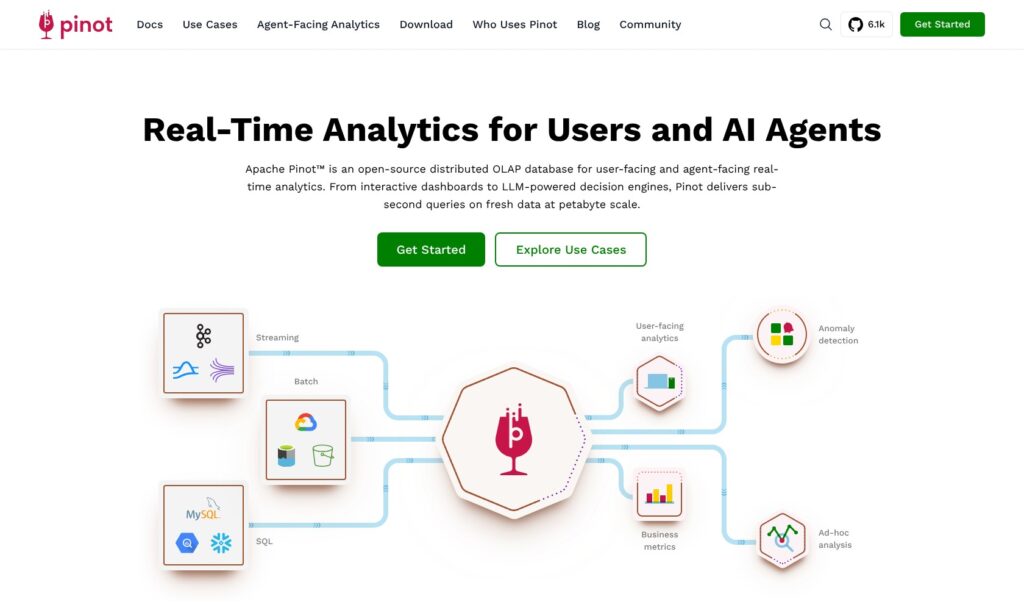
In this Apache Pinot review, I focus on whether its indexing and ingestion capabilities justify the setup for your application. Pinot supplies the analytical database; you still need a frontend or reporting tool to turn query results into something customers can use.
Key Takeaways
- Best for product analytics: Pinot suits applications that repeatedly filter and aggregate fresh event data for many users.
- The software is free: Apache Pinot has no license fee, but production infrastructure and operational work still cost money.
- Indexing is a major strength: You can tailor how Pinot finds and aggregates data to the queries your application runs.
- Setup requires engineering: Schemas, table configuration, stream partitioning, and cluster operations need an owner.
- Features involve trade-offs: Upserts and star-tree indexing cannot be combined on the same table; SQL joins also need their own performance evaluation.
I’ll take a closer look at pricing, getting started, and the features that could make Pinot worth the work.
Apache Pinot Pros and Cons
Pros
- Apache 2.0 licensing with no software subscription fee
- Streaming and batch ingestion for fresh and historical data
- Multiple index types for filters, aggregations, and nested JSON
- Upserts for analytical views of changing records
- Multi-stage SQL engine supports joins and window functions
Cons
- Production clusters require ongoing operational ownership
- Index selection adds configuration and storage trade-offs
- Upsert tables cannot use star-tree indexes
- Multi-stage queries keep intermediate results in memory without disk spill
How Much Does Apache Pinot Cost?
Apache Pinot costs $0 in software license fees. It is an open-source database, so there are no Apache Starter, Pro, or Enterprise subscriptions to choose between. You arrange the infrastructure and operations yourself, or pay a separate company to manage them.
StarTree offers commercial deployments built on Pinot, separate from Apache:
- Apache Pinot ($0 license fee): For teams that want to operate the database themselves.
- StarTree Public SaaS ($0.21 per production vCPU-hour): Managed service with dedicated infrastructure included.
- StarTree Private BYOC ($0.11 per production vCPU-hour): Managed platform in your cloud account; your provider bills infrastructure separately.
- StarTree BYOK (custom terms): For running the commercial stack in your Kubernetes environment.
| Option | Listed software or service cost | Budget implication |
|---|---|---|
| Apache Pinot | $0 license fee | Add infrastructure and engineering time |
| StarTree Public SaaS | $0.21/production vCPU-hour | Infrastructure included in the service rate |
| StarTree Private BYOC | $0.11/production vCPU-hour | Add your cloud infrastructure bill |
| StarTree BYOK | Custom terms | Obtain a deployment-specific proposal |
These unit rates are not monthly cluster quotes. Request an estimate sized for your workload.
Is Apache Pinot Good Value for Money?
I like the open-source option when database operations are already a core skill on your team. You get control over deployment and configuration without another software license charge. That becomes less appealing if one engineer has to learn the entire system while also delivering your product.
For self-hosting, I would budget for three things:
- Serving capacity: Resources to answer queries while ingestion continues.
- Reliability: Replication, recovery, monitoring, and enough capacity to handle failures.
- People: Time for upgrades, tuning, incident response, and changes to your data model.
My recommendation is to start with open-source Pinot for a focused evaluation. For production, choose self-hosting only if someone will explicitly own it. Otherwise, compare the managed bill with the staffing cost you would actually avoid.
Getting Started With Apache Pinot
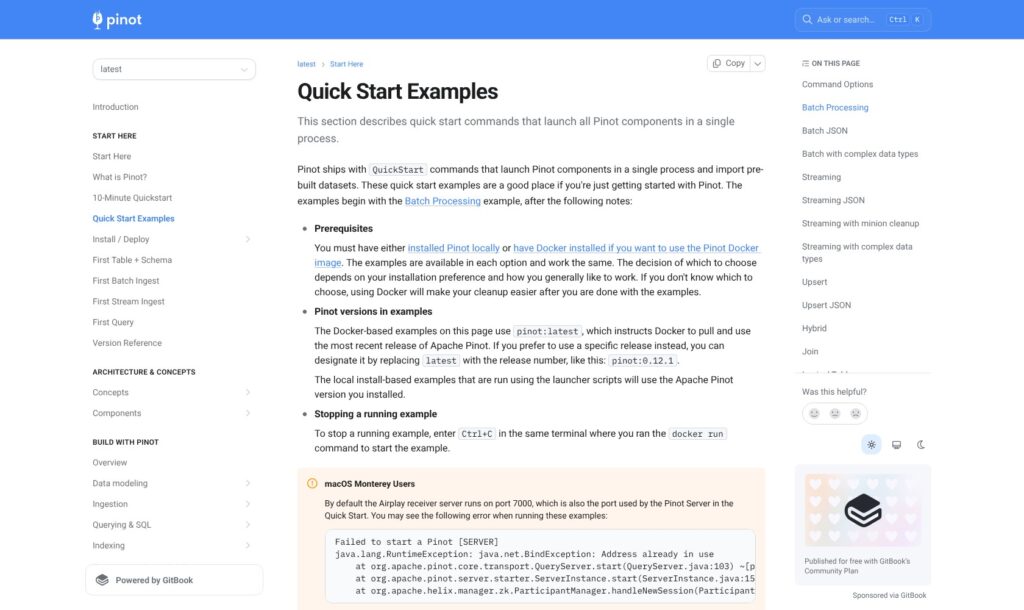
Pinot’s quickstart helps you learn the database before you design a production cluster. Pinot’s local examples let you explore sample tables and run SQL through its query console. I like that starting point because you can learn the vocabulary before connecting a business-critical stream.
The more revealing step is moving from sample data to one of your own application queries. I would keep that first project narrow: one event source, one dashboard, and a small set of filters your customers genuinely use.
- Define the schema. Identify the fields, types, and time information your queries need. Pay particular attention to IDs and timestamps; they affect far more than the labels in a dashboard.
- Configure the table. Decide how data arrives, how long it stays, and which indexes belong on which columns. These settings are part of the database design.
- Connect a representative source. Include realistic events and awkward cases such as missing values or changing records, rather than only tidy sample rows.
- Run the application queries. Check correctness before tuning speed. A fast count is not useful if its handling of duplicate or late events is wrong for your product.
- Increase simultaneous demand. Exercise ingestion and querying together, including expensive filters and longer date ranges.
My main concern is the distance between a working demo and a service your team can support. Knowing SQL helps with queries, but it does not remove the need to understand table configuration and distributed operations.
I would also agree on acceptance criteria before this exercise. Write down how fresh the data needs to be, how long a user can wait for a result, and which failures your application must tolerate. Otherwise, it is easy to finish with an impressive demo and no clear answer about whether Pinot solves your problem.
Reviewer’s Notes: Choose a query customers actually wait for. Proving that Pinot improves one valuable workflow tells you more than loading a huge dataset without a clear application requirement.
Fast Dashboards Need More Than Fast SQL
Indexing is the strongest reason I would shortlist Pinot. Rather than relying on one access pattern, you can choose indexes that fit the way your application filters and summarizes data.
I find that especially attractive for a product with recurring query shapes. If customers repeatedly filter events by account, time, and status, you have something concrete to optimize. For unpredictable analyst queries, I would also shortlist ClickHouse rather than choosing around a few favorable dashboard examples.
Pick Indexes for the Questions You Ask
- Inverted indexes: Useful for locating rows matching a particular column value, such as an account ID.
- JSON indexes: Help with filtering inside nested JSON data without making every possible property a separate top-level field first.
I like this flexibility, but I would resist enabling indexes everywhere. Each choice should earn its storage and maintenance cost by improving a query your product needs. The best configuration for a selective account lookup may differ from the one for a broad aggregate.
Star-Tree Indexes Favor Repeatable Aggregations
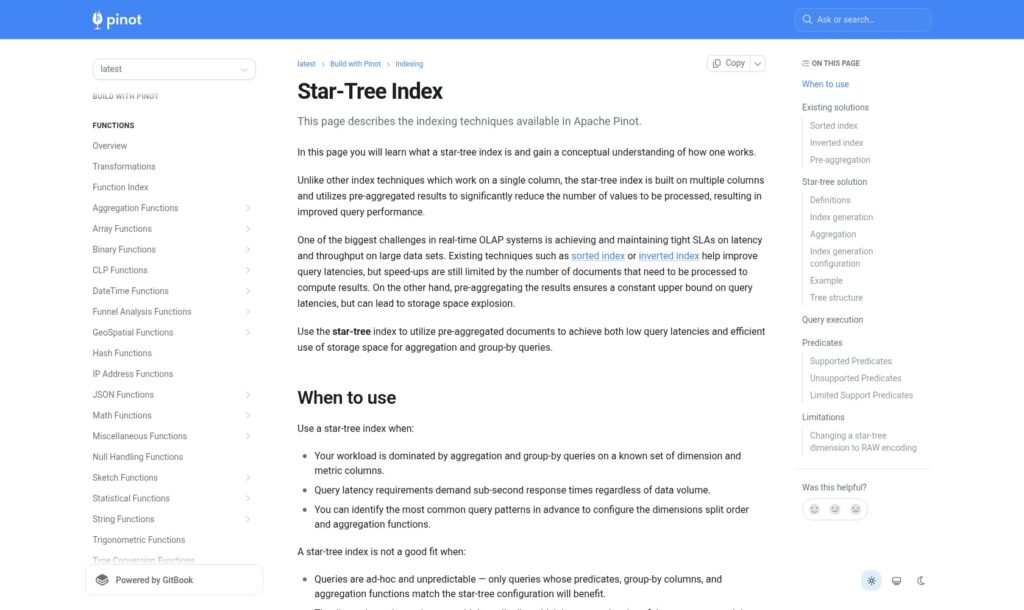
Star-tree indexing can pre-aggregate configured combinations of dimensions and metrics. For recurring breakdowns, that can reduce how much work must happen when a request arrives.
My reservation is that filters, grouping columns, and aggregations must match the index configuration. Exact distinct counts and exact percentiles cannot use star-tree, so a dashboard relying on those calculations needs another execution path. I would weigh the extra storage against the improvement to your recurring summaries.
There is another catch for live dashboards: star-tree works on completed, immutable segments, including completed segments from real-time tables. It does not accelerate the mutable segment still receiving events. Evaluate the freshest data as well as the history.
For time-based summaries, Apache Druid offers a different choice: roll up events during ingestion. I would consider that if you can give up individual-event detail in the rolled-up data. Retaining that detail matters if customers need to investigate the events behind a total.
Streaming Data and Upserts: Useful, With Conditions
Pinot can serve analytics over incoming streams and historical batch data. That fits a product where users want to see recent activity alongside a longer history, rather than switching between a live dashboard and yesterday’s report.
Supported streaming sources include Kafka, Pulsar, and Kinesis. Hybrid tables combine offline and real-time data behind one logical table, with a time boundary separating the portions queried from each side.
I like that approach for a dashboard that needs both today’s events and older records. You still need to align timestamps and ingestion behavior. Combining two paths into one query does not make their data definitions agree automatically.
Upserts Help When Records Change
Upserts let you maintain a latest-state analytical view, such as an order’s current status, instead of treating every incoming version as a separate record. I like this for operational dashboards, but would retain event history separately when users need to reconstruct what happened.
Full upserts work across real-time, offline, and hybrid tables; partial upserts are real-time only. Streaming input must be partitioned by primary key, and upsert metadata consumes heap memory. Many unique keys can therefore be expensive even when individual records are small.
The biggest compromise for me is that upsert tables cannot use star-tree indexes. You cannot assume that Pinot’s two appealing capabilities will work together on the same table. Choose your data model around whether current state or pre-aggregated summaries matter more.
I would keep the transactional order-processing system separate from this analytical view. Upserts make changing records easier to analyze; they do not make Pinot a substitute for your application’s transactional database.
SQL Joins and Day-to-Day Operations
Pinot supports joins through its multi-stage query engine. Describing it as a database that cannot join tables would miss a significant part of the current product. The multi-stage engine also supports window functions, widening the kinds of analysis you can express.
I welcome that flexibility because flattening every relationship before ingestion can create its own maintenance burden. Joining an event table with descriptive data may be a more useful model for your application.
The limitation I would take most seriously is that intermediate results stay in memory without spilling to disk. Large joins can put substantial pressure on memory, so I would not choose this engine for unbounded batch joins. For simple filters and aggregations, Pinot’s single-stage engine generally has lower overhead.
That distinction matters when estimating capacity. A cluster sized for account-level dashboard filters may need a different budget for joins across large datasets. Check those query types separately before committing to the design.
Someone Still Has to Run the Cluster
Pinot separates responsibilities across components. Controllers manage cluster administration, brokers receive and route queries, and servers store segments and process requests. ZooKeeper participates in coordination, while minions handle optional background tasks.
That division gives you useful control, but it also creates more to understand when something goes wrong. If a dashboard falls behind, the cause might be ingestion rather than the query itself.
I would want the operating team watching:
- Data freshness: Whether the stream is being consumed quickly enough for the product’s needs.
- Query behavior: Slow requests, errors, and the effect of concurrent demand.
- Resource pressure: Memory and capacity during ingestion, querying, and background work.
These responsibilities are why I would hesitate to recommend self-hosted Pinot to a team without an infrastructure owner. Managed StarTree is worth considering when you want Pinot’s analytics model but need help running the service. You still own the quality of your schema, queries, and application requirements.
How Does Apache Pinot Compare to Alternatives?
ClickHouse is my first alternative to compare; StarTree is the closest route to managed Pinot. Druid also deserves a place on your list if ingestion-time aggregation suits your data.
| Option | Where I would shortlist it | Main decision |
|---|---|---|
| Apache Pinot | Repeated queries over fresh application data | Are its indexing controls worth the operational work? |
| ClickHouse | Broader SQL analytics and event analysis | How does your complete query mix perform? |
| Apache Druid | Time-oriented event analysis | Does ingestion-time rollup fit your reporting needs? |
| StarTree | Managed analytics built on Pinot | Is the service worth its ongoing charge? |
- ClickHouse: My first comparison when the workload extends beyond a small set of dashboard queries. Test both rather than reducing the choice to a benchmark headline.
- Apache Druid: Worth evaluating for time-oriented analysis, particularly when aggregating events during ingestion fits the data you need to retain.
- StarTree: The most direct option to consider when you want managed Pinot. Compare the deployment responsibilities as carefully as the price.
If your existing warehouse already serves a few internal reports adequately, my recommendation would be to keep it. Adding another database needs a more specific justification than wanting something described as real-time.
How I Reviewed Apache Pinot
I evaluated deployment choices, ingestion, indexing, upserts, SQL capabilities, and operational requirements, with particular attention to customer-facing analytics. The recommendations reflect those trade-offs rather than measured performance in a production cluster. Pricing information was checked in October 2026; the infrastructure you need depends on your workload.
Should You Choose Apache Pinot?
Choose Pinot when analytics performance is a product requirement and you have the engineering capacity to support it. I particularly like its fit for recurring filters and aggregations over fresh events, where deliberate indexing can be part of the application design.
I would skip self-hosted Pinot if your main need is occasional reporting or nobody can take responsibility for operations. Free licensing is a weak reason to add a database that your team cannot comfortably maintain.
My next step would be a focused evaluation against one customer workflow, with realistic data and simultaneous queries. If it meets your correctness, freshness, and response-time requirements, compare self-hosting with a managed proposal. That is a much firmer basis for choosing Pinot than its largest customer deployments.
FAQ
Is Apache Pinot free?
Yes. Apache Pinot is open-source software under Apache 2.0 with no license fee. Infrastructure, operations, and any commercial managed service remain separate costs.
Is Apache Pinot a replacement for PostgreSQL?
I would not use it as a direct replacement for a transactional application database. Pinot’s role is analytical querying; your application may still need PostgreSQL for transactional records and updates.
Does Apache Pinot support joins?
Yes. Its multi-stage query engine supports joins. Evaluate the memory and performance of your specific queries rather than assuming they behave like simple single-table aggregations.
What is the difference between Pinot and StarTree?
Apache Pinot is the open-source database. StarTree sells a commercial platform built on it, including managed deployment options.
Who should avoid Apache Pinot?
I would look elsewhere if you only need occasional internal reports or lack an owner for database operations. Pinot becomes more compelling when fresh, responsive analytics matter directly to your product.

