Editor’s note: This Rivery review evaluates the pricing model, the documented product behavior and the plan ladder as Boomi sells it in October 2026. It is not a hands-on performance test.
Quick verdict: I recommend Rivery for data teams that want ingestion, SQL and Python transformations and scheduling in one tool and are moving under roughly a few hundred GB a month from databases and SaaS apps. Go in knowing the catalog is about 200 connectors against 700+ at Fivetran and Airbyte, and that only the Base rate ($0.90 per credit) is published.
Key Takeaways
- Credit rates are public: 0.5 credit per API table per run, 1 credit per 100MB from databases and files, 2 credits per 100MB for log-based CDC, and 0.5 credit per workflow run.
- Logic Flows run SQL, Python and REST actions with containers, conditions and loops, so most teams will not need Airflow or dbt Cloud alongside it.
- Base is thin: 60-minute syncs, 1 environment, 2 users, and no Python, CLI or API. The real product starts at Professional, which has no published rate.
- Log-based CDC covers 5 databases (Postgres, MySQL, SQL Server, MongoDB and Oracle), and Oracle CDC is Enterprise only.
- Boomi agreed to buy Rivery in December 2024, credits are now called BDUs and the docs live at help.boomi.com, but rivery.io still runs sales and the console.
Rivery sits in the Panoply directory under both Managed ELT and Transformation, because Logic Flows run SQL and Python on the same credit meter as ingestion.
In this review, I’ll take a closer look at Rivery’s pricing, what setting up a pipeline involves, its connectors and CDC, the Logic Flow engine, and how it stacks up against Fivetran, Airbyte and Hevo.
Rivery Pros and Cons
Pros
- Published credit rates: 0.5 per API table per run, 1 per 100MB from databases, 2 per 100MB for CDC.
- No per-connector, per-user or per-environment fees on any plan, and no cap on API integrations.
- Logic Flows run SQL, Python and REST steps with containers, conditions and loops.
- Automatic schema drift handling for 11 source types, with dropped columns kept as nulls.
- 14-day trial with 1,000 credits on Professional features, whichever runs out first.
Cons
- About 200 connectors against 700+ at Fivetran and Airbyte.
- Only the Base rate is published; Professional, Pro Plus and Enterprise rates are not listed.
- Base caps syncs at 60 minutes and locks out Python, CLI and API access.
- Python steps run Python 3.8.4 only, with a 13MB or 1,000-row variable cap.
How Much Does Rivery Cost?
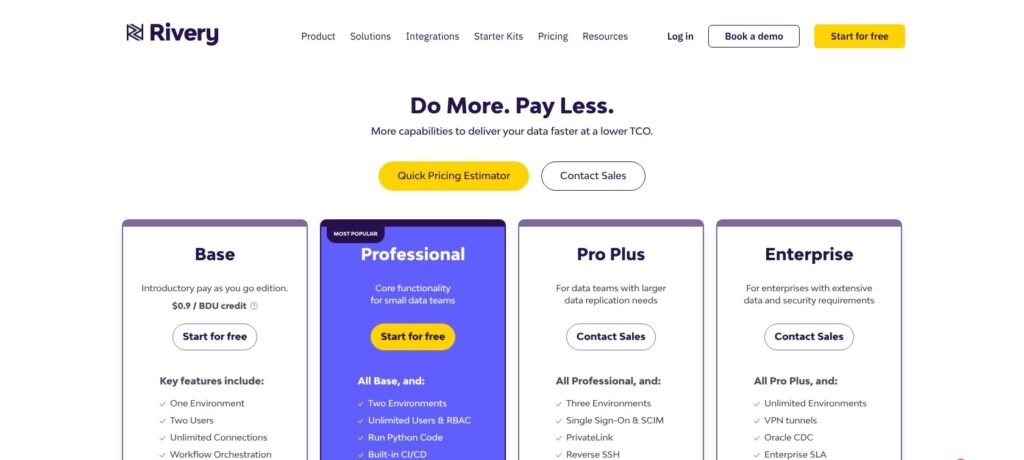
Rivery bills in BDU credits (Boomi Data Units, the renamed RPU). Base lists $0.90 per credit on monthly billing, and every plan above it is unpriced.
- Base ($0.90 per credit): for 1 environment, 2 users, unlimited connections, workflow orchestration, built-in version control and a 60-minute minimum sync.
- Professional (no published rate, free trial): for 2 environments, unlimited users with RBAC, Python steps, CI/CD, API and CLI access, and 15-minute syncs.
- Pro Plus (contact sales): for 3 environments, SSO and SCIM, PrivateLink, Reverse SSH, and high-frequency API syncs billed at 1 credit per 100MB.
- Enterprise (contact sales): for unlimited environments, VPN tunnels, Oracle CDC, an enterprise SLA and 5-minute syncs.
| Plan | Price | Environments | Users | Fastest sync | Standout gate |
|---|---|---|---|---|---|
| Base | $0.90 per credit, monthly | 1 | 2 | 60 minutes | No Python, API or CLI |
| Professional | Not published (14-day trial) | 2 | Unlimited, with RBAC | 15 minutes | Python, CI/CD, API and CLI |
| Pro Plus | Contact sales | 3 | Unlimited | 15 minutes | SSO, SCIM, PrivateLink, Reverse SSH |
| Enterprise | Contact sales | Unlimited | Unlimited | 5 minutes | Oracle CDC, VPN tunnels, enterprise SLA |
What a Credit Buys
- API sources: 0.5 credit per output table per run, plus 0.5 credit per extra 50MB. An empty run still costs 0.5 credit.
- Databases, files and webhooks: 1 credit per 100MB, pro rata, with a 1MB minimum. A run that moves nothing costs nothing.
- Log-based CDC: 2 credits per 100MB, double the standard database rate.
- Workflows: 0.5 credit per Logic Flow run.
- Python steps: 0.021 BDU per minute (XS) to 0.492 (XXXL), plus 0.4 BDU per 100MB of network, charged on failure too.
A 1,725MB Postgres load costs 17.25 credits, about $15.53 at the Base rate, and a 280MB SFTP file costs 2.8 credits, about $2.52.
Pulling 2 CRM tables 3 times a day on weekdays costs 15 credits a week, or $13.50 on Base.
The trial gives Professional features for 14 days or 1,000 credits, whichever runs out first. Rivery values those credits at $1,200, which puts the Professional rate near $1.20 per credit.
Annual billing promises “additional savings” with no percentage, while Fivetran publishes 5% to 22.6% and Hevo publishes 12%.
Is Rivery Good Value for Money?
- Good fit: database and SaaS loads under a few hundred GB a month, where 1 credit per 100MB stays predictable while Fivetran’s monthly active rows swing with every update.
- Less convincing fit: chatty API sources polled every 15 minutes, since each table costs 0.5 credit per run whether or not rows changed.
- Budget priority: get the Professional per-credit rate in writing. The trial’s $1,200 valuation implies about $1.20, the number I would plan against until the quote says otherwise.
- Rival entry points: Fivetran is free to 500,000 monthly active rows, Airbyte Standard starts at $20 a month, Hevo Starter at $299 and Stitch Standard at $100 a month.
Reviewer’s Notes: Skip Base unless 2 users and hourly syncs are enough. Run the 14-day trial against your largest database with CDC on, check the credit burn after a week, and multiply by the quoted rate before signing an annual contract.
Getting Started With Rivery
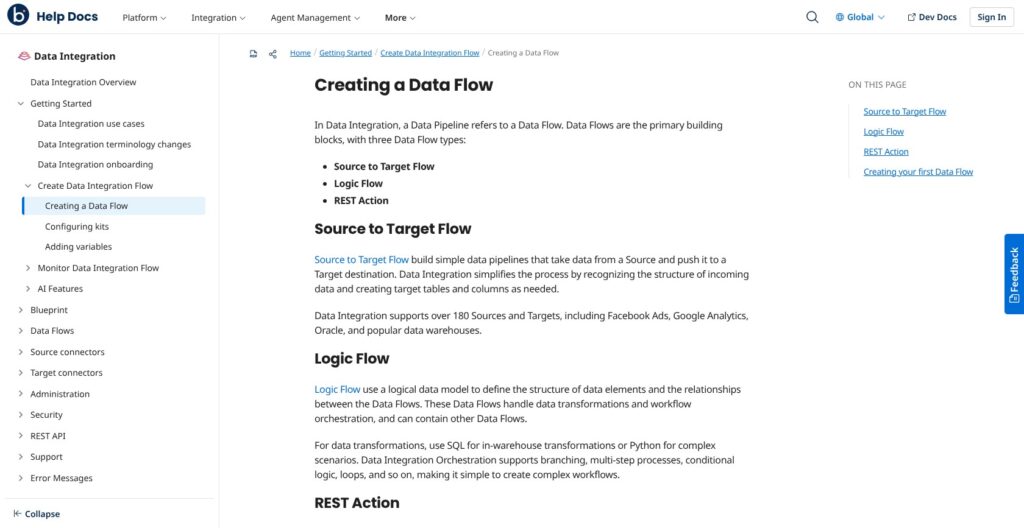
Setup is connection-first: you create a source connection and a target connection once, then build any number of pipelines on top of them. Each pipeline is a Data Flow, the new name for what older screens and marketing still call a River.
Signing Up and Choosing a Region
Click Start for Free in the console, sign up with an email address or a Google account, and pick a region before you reach the workspace. Hosting is on AWS, with a Sydney data center for Data Integration since July 2025.
Boomi also announced a European platform instance in March 2026. New accounts come with Production and Development environments, and I would build every flow in Development first.
Creating Connections
Open Connections and click New Connection. Pick the source from the catalog, or choose REST API Source when the app is not listed, then enter the credentials, name the connection and save.
Repeat for a target such as Snowflake, BigQuery, Redshift, Databricks or Azure Synapse. You need at least 1 source and 1 target before any flow will run.
Connections are decoupled from pipelines, so 1 Postgres connection can feed several flows on different schedules with different table sets. Fivetran ties each connector to its pipeline, so a Fivetran migration maps every connector to 1 connection plus 1 Source to Target flow.
Building a Source to Target Flow
Open Data Flows, click New Data Flow and choose from 3 types: Source to Target Flow, Logic Flow or REST Action. For a first pipeline, pick Source to Target.
Select the tables, then set the load mode per table: Overwrite, Append Only, or the default Upsert-Merge. Upsert-Merge maps to Fivetran’s Sync mode, and Append Only to Fivetran’s History mode.
Click Run, read the status and logs in Activity, and set a cron schedule once the run succeeds. A flow that fails 7 days in a row is suspended automatically, so a broken pipeline cannot retry its way through your credits.
Kits in the left menu offer a shortcut: preview a prebuilt flow, install it, then configure its connections and variables.
Promoting to Production
Deploy the finished flow from Development to Production with variables mapped to each warehouse environment. Manual column selections do not carry across on deployment, so re-check every table where you deselected columns before the first Production run.
Reviewer’s Notes: After you switch on Enable Stream for CDC, let the first run complete before you use Check Log Position to confirm where the stream picks up. Reinitialize and Manual Sync can lose data if misused, so treat them as recovery tools rather than routine buttons.
Connectors and Change Data Capture
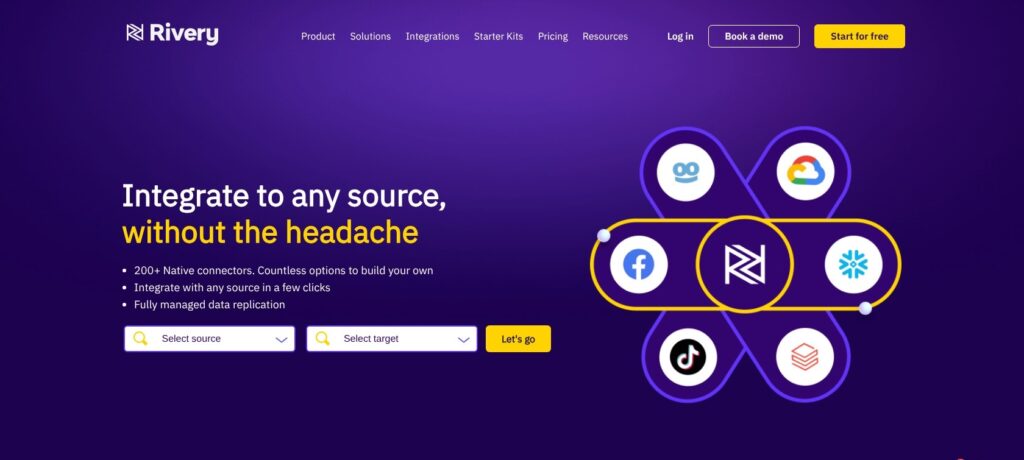
Rivery markets 200+ native connectors: roughly 146 applications, 14 databases, 9 file and storage sources, webhooks and a generic REST API source. The databases include Postgres, MySQL, SQL Server, Oracle, MongoDB, Redshift, BigQuery, Snowflake and Teradata.
Fivetran and Airbyte each list 700+ and Hevo 150+. For marketing, sales and ops stacks Rivery’s catalog is enough; for long-tail SaaS you will hit a gap.
Filling Gaps With REST and the Data Connector Agent
REST Action covers any authenticated endpoint inside a flow. The Data Connector Agent goes further: give it an API docs URL and an endpoint, and it generates a connector as editable YAML in a low-code editor.
Boomi claims 30X faster custom connector builds and says only the prompt, not your data, goes to the LLM. Treat the 30X as Boomi’s number. The editable YAML is the useful part, because you can fix a generated connector by hand.
Log-Based CDC
Log-based CDC covers 5 databases: Postgres, MySQL, SQL Server, MongoDB through change streams, and Oracle, with Oracle CDC gated to Enterprise. You switch it on per flow with the Enable Stream toggle.
CDC bills 2 credits per 100MB against 1 for standard replication. The November 2025 release rebuilt the Oracle CDC engine with added validation and recovery.
Fivetran prices by monthly active rows instead, so model both before you assume Rivery’s double rate is the expensive option.
Schema Drift and Targets
Schema drift is handled automatically on 11 source types, including Postgres, MySQL, SQL Server, Oracle, Snowflake, BigQuery and Salesforce. New columns are added, dropped columns stay filled with nulls, renames create a new column and type changes widen.
There are 16 targets, including Snowflake, BigQuery, Redshift, Databricks, Azure Synapse, Microsoft Fabric OneLake, S3 and Firebolt. Reverse ETL is marketed as activation, but its destination list is not publicly documented, so ask sales for the exact targets.
Best for teams whose sources are mainstream SaaS plus the 5 CDC databases. Skip it if a long-tail SaaS source is missing and you would rather not maintain a YAML connector.
Logic Flows: SQL, Python and Orchestration
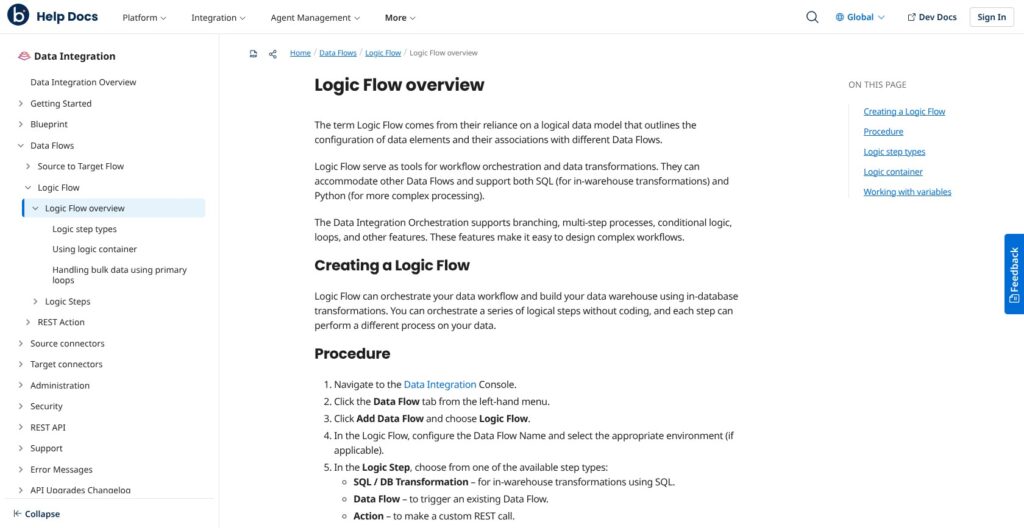
A Logic Flow chains SQL or database transformation steps, other Data Flows, REST Actions and Python steps inside containers that run in parallel, in sequence or on a condition. Loops and variables are shared across steps.
A workflow run costs 0.5 credit, and a plain source-to-target flow needs none. That bundling is the reason to pick Rivery over Fivetran, which prices each transformation model run separately.
SQL Transformations
SQL steps run in the warehouse and load results with Overwrite, Upsert-Merge or Append. Steps and whole containers can be switched off for testing, so you can rerun a flow without the expensive step in the middle.
SQL transformations are unlimited on every edition, and the Rivery-side cost is the 0.5-credit workflow run. Matillion bills task hours plus warehouse compute for the same push-down work, and dbt still wins for versioned model testing and lineage.
Python Steps
Python steps import flow variables with from rivery_variables import ... and take extra packages as package==version. NumPy, Pandas, Requests, scikit-learn and SQLAlchemy are preinstalled.
Only Python 3.8.4 runs, os and sys imports are blocked, variables cap at 13MB or 1,000 rows, and the CLI cannot run a Python step. Billing is by instance minutes from XS to XXXL plus network, after a 1-minute server start-up on every script.
My verdict: fine for enrichment and API glue, wrong for heavy processing. Anything that passes more than 1,000 rows between steps belongs in the warehouse or in Databricks.
DataOps: Environments, Versioning, CLI and Security
Version control is built in on every edition. CI/CD, the API, the CLI and RBAC start at Professional, SSO and SCIM at Pro Plus, and flows export as infrastructure-as-code.
Compliance covers SOC 2 Type II renewed yearly, ISO 27001:2013 and GDPR, with HIPAA controls benchmarked inside the SOC 2 report rather than a standalone attestation. Hosting is AWS SaaS only, with no self-hosted or own-cloud option, which Fivetran’s hybrid deployment and Airbyte’s self-managed Core both offer.
Diagnosis is the weak spot: users report that failed steps surface generic errors and that run logs make it hard to see what happened. Budget time with Download Logs in Activity before you trust a complex flow unattended.
I recommend Logic Flows as the replacement for a dbt Cloud plus Airflow pair on a mid-size stack, especially if your transformations are SQL with light Python around the edges.
What the Boomi Acquisition Changes
Boomi announced a definitive agreement to acquire Rivery on 12 December 2024, with terms undisclosed. Rivery was founded in 2019, had offices in Tel Aviv and New York, and had raised $48M, including a $30M Series B led by Tiger Global in 2022.
Since the deal:
- The product is sold as Boomi Data Integration (Rivery), and RPU credits are now BDUs.
- Docs moved from docs.rivery.io to help.boomi.com, with Data Flow replacing River.
- The console, signup and pricing still run at rivery.io.
- Boomi for SAP is the only source gated by plan, to Pro Plus and Enterprise.
- A Sydney data center opened in July 2025, and Boomi announced a European platform instance in March 2026.
- The November 2025 release added BigQuery, Redshift, Elastic and Vertica as sources, Azure Synapse as a target, and auto-suspension of flows that fail 7 days running.
Boomi’s stated plan is a single low-code platform spanning application integration, API management and data integration. A Logic Flow can already post JSON to a Boomi API listener.
My read: releases through 2026 and new regions are the momentum signal, and the product is safer to buy today than it was as a $48M-funded independent.
The risk is bundling pressure toward the wider Boomi platform and a credit price that could be reset once the integration finishes, so lock multi-year rates into the contract.
How Does Rivery Compare to Competitors?
Each rival wins a niche; Rivery wins when you want 1 bill for ingestion, transformation and scheduling.
- Fivetran: 700+ connectors, a Free plan to 500,000 monthly active rows, 15-minute syncs on Standard and hybrid deployment on Enterprise. It wins on catalog breadth and zero maintenance, and it charges per model run for transformation.
- Airbyte: 700+ connectors, self-managed Core for free, or Cloud Standard from $20 a month for 5 credits and Plus from $189. It wins for open source and self-hosting, and it has nothing like Logic Flow orchestration.
- Hevo Data: Free to 1M events, then Starter at $299 a month for 5M events with 12% off on annual billing. It wins for no-code teams that want a flat monthly number.
- Matillion: push-down transformation billed in credits by task hours, with warehouse compute extra and the credit price not published. It wins for heavy warehouse transformation.
- Stitch: Standard from $100 a month for 5M rows, 10 sources and 1 destination. It wins on price for small replication jobs and is light on transformation.
| Tool | Pricing model | Starting price | Connectors | Transformation and orchestration |
|---|---|---|---|---|
| Rivery | BDU credits per source type | $0.90 per credit (Base) | About 200 | SQL, Python and REST steps with loops in Logic Flows |
| Fivetran | Monthly active rows | Free to 500,000 MAR | 700+ | Priced per model run |
| Airbyte | Credits (Cloud) or self-managed | $20 a month | 700+ | No built-in orchestration |
| Hevo Data | Events | Free to 1M events, then $299 a month | 150+ | Event-billed ELT |
| Matillion | Credits by task hours, warehouse compute extra | Not published | Not published | Push-down transformation is the core product |
| Stitch | Rows per month | $100 a month | Not published | Light, replication focus |
Choose Rivery over Fivetran when you would otherwise be paying for Fivetran plus dbt Cloud plus an orchestrator. Choose Fivetran when a long-tail SaaS source is missing from Rivery’s catalog.
How I Reviewed Rivery
I evaluated Rivery on the areas Panoply weighs for every data tool: pricing transparency, openness and exit costs, setup and operating effort, connector depth, and development momentum.
For Rivery that meant working through the 4 editions and the credit metering line by line, pricing 3 example workloads at the Base rate, and mapping the setup path from signup to a deployed Production flow.
I also checked the connector catalog and the 5-database CDC list, weighed the Logic Flow and Python step limits, and traced what Boomi changed since December 2024.
I compared prices and plan features against Fivetran, Airbyte, Hevo, Matillion and Stitch at their current list rates. This is not a hands-on performance test. Prices current as of October 2026.
Should You Build Your Pipelines on Rivery?
Yes, if you want 1 tool and 1 credit meter for ingestion, SQL and Python transformation and orchestration, and your sources are mainstream SaaS plus Postgres, MySQL, SQL Server or MongoDB.
Start on Professional rather than Base. Base at $0.90 per credit is the only published price, and with 2 users, 1 environment and hourly syncs it is a trial tier in all but name.
Skip it if you need a connector outside the catalog (Fivetran or Airbyte, each at 700+), self-hosting (Airbyte), a flat monthly bill (Hevo) or heavy Python processing (Databricks).
Rivery replaces a Fivetran plus dbt Cloud plus Airflow stack for a mid-size team at the cost of a smaller catalog, and that is a trade I would make for most marketing, sales and ops warehouses.
Next action: start the 14-day trial on your largest database with CDC enabled, check the credit burn after 1 week, and ask sales for the Professional per-credit rate and a multi-year lock before any post-integration repricing.
FAQ
How much does Rivery cost?
The Base edition costs $0.90 per BDU credit on monthly billing. Professional has no published rate, and Pro Plus and Enterprise go through sales.
The free trial gives 14 days or 1,000 credits of Professional features, whichever runs out first, and Rivery values those credits at $1,200, which implies a Professional rate near $1.20.
Is Rivery the same as Boomi Data Integration?
Yes. Boomi agreed to acquire Rivery on 12 December 2024 and now sells it as Boomi Data Integration (Rivery).
Credits were renamed from RPU to BDU and the docs moved to help.boomi.com, while the console, signup and pricing still run at rivery.io. Boomi for SAP, on Pro Plus and Enterprise, is the only plan-gated source.
Which databases does Rivery support for CDC?
Log-based CDC covers Postgres, MySQL, SQL Server, MongoDB (through change streams) and Oracle, with Oracle CDC available only on Enterprise.
CDC bills 2 credits per 100MB, double the 1-credit rate for standard database replication, so switch on the per-flow Enable Stream toggle only for tables that need the freshness.
Can Rivery replace dbt and Airflow?
For most mid-size stacks, yes. Logic Flows cover SQL and Python steps, conditions, loops and scheduling for 0.5 credit per run, and Python steps start at Professional.
dbt still wins for versioned model testing and lineage, and Airflow wins for DAGs that span systems Rivery does not connect to or need a Python version newer than 3.8.4.
Is Rivery SOC 2 compliant?
Yes. Rivery holds a SOC 2 Type II report renewed yearly, ISO 27001:2013 certification and GDPR compliance, hosted on AWS.
HIPAA controls are benchmarked inside the SOC 2 report, so there is no standalone HIPAA attestation. Ask for the report under NDA if you need it.