Editor’s note: This Matillion review evaluates the Maia Foundation platform (the renamed Data Productivity Cloud) on its pricing model, documented product behavior and plan ladder as Matillion sells it in October 2026. It is not a hands-on performance test.
Quick verdict: I recommend Matillion for data teams on Snowflake, Databricks, Redshift or BigQuery that want a visual canvas for in-warehouse transformation and orchestration with Git and dbt built in, and can commit to an annual credit package. Go in knowing that no dollar price is published, transformation bills at 3 credits per task hour against 1 for orchestration, and the connector catalog is about 150 against 700+ at Fivetran and Airbyte.
Key Takeaways
- Every workload pushes down into Snowflake, Databricks, Redshift or BigQuery (GA July 2026), so Matillion sells orchestration, not compute.
- The rate card is public but the price is not: orchestration 1 credit per task hour, transformation 3, streaming CDC 1 or 2, extra developer users 70 credits a month, metered in 2-second increments.
- Developer, Teams and Scale are quote-only annual packages; the last published rates were $2.00 to $2.70 per credit, with monthly minimums from $1,000.
- Teams and Scale include only 5 developer users, and streaming CDC, hybrid deployment, SSO and lineage are Scale-only.
- Maia Team agents build and fix pipelines from prompts, the Migration Agent converts 14 legacy platforms, and the 14-day trial gives 500 credits with full Enterprise-level access.
In this review, I’ll cover Matillion’s pricing, first-pipeline setup, connectors and loading, its transformation and orchestration engine, the Maia agents, and how it stacks up against Fivetran, Airbyte, dbt Cloud and Rivery among data integration and transformation tools, so you can see whether it fits your stack.
Matillion Pros and Cons
Pros
- Pushdown transformation on Snowflake, Databricks, Redshift and BigQuery, with warehouse compute billed by the warehouse
- Visual canvas plus SQL, Python and dbt Core components, with Git branches on every edition
- Published credit rate card (1 credit per orchestration task hour, 3 per transformation hour), with validation and sampling never billed
- Hybrid SaaS agent keeps data and secrets in your own cloud on the Scale edition
- 14-day trial with 500 credits and full Enterprise-level access
Cons
- No dollar price published for any edition; annual credit packages are quote-only
- About 150 connectors against 700+ at Fivetran and Airbyte
- Teams and Scale include 5 developer users, and each extra seat costs 70 credits a month
- A single premium streaming CDC pipeline burns about 1,440 credits a month before any data moves
How Much Does Matillion Cost?
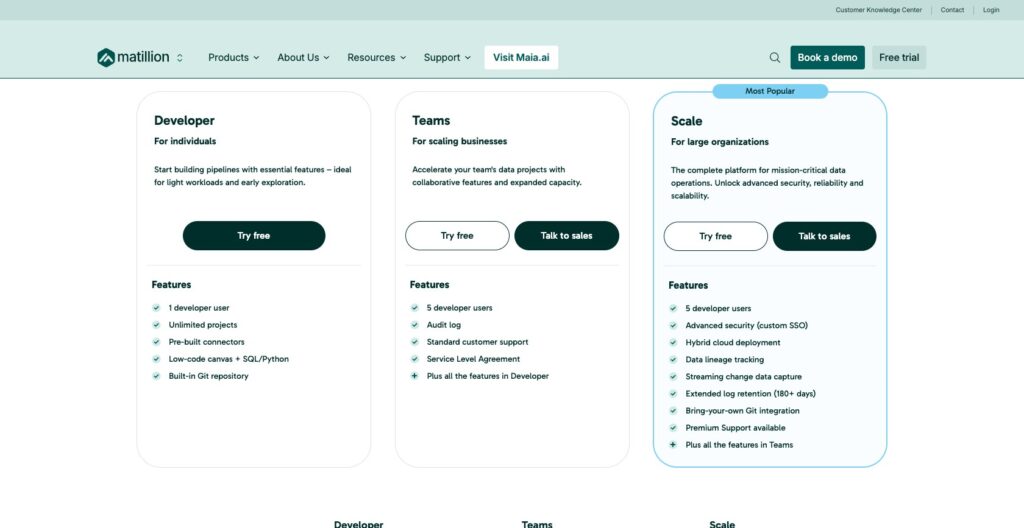
Matillion sells three editions of Maia Foundation as fixed annual packages of credits, publishes the credit consumption rates, and publishes no dollar figure for any of them. Admin users are unlimited on every edition; only developer users count as seats.
- Developer (quote): for a single engineer or a proof of concept, with 1 developer user, a built-in Git repository, community support and 90-day log retention.
- Teams (quote): for a small data team in production, with 5 developer users, an audit log, standard support and an SLA on annual contracts.
- Scale (quote): for regulated or multi-team environments, with 5 developer users, custom SSO, hybrid cloud deployment, data lineage, streaming CDC, bring-your-own Git, premium support available as an add-on, and 180-day log retention (365 available).
PrivateLink is a paid add-on.
| Edition | Price | Developer users | Support | Standout gates |
|---|---|---|---|---|
| Developer | Not published | 1 | Community | Built-in Git repository, 90-day logs |
| Teams | Not published | 5 | Standard, SLA on annual | Admin activity log, 4 more seats than Developer |
| Scale | Not published | 5 | Standard, premium add-on | SSO, hybrid agent, lineage, streaming CDC, BYO Git |
What a Credit Buys
| Workload | Credits |
|---|---|
| Orchestration pipeline | 1 per task hour |
| Transformation pipeline | 3 per task hour |
| Streaming CDC, essential | 1 per task hour |
| Streaming CDC, premium | 2 per task hour |
| Extra developer user | 70 per month |
| Matillion ETL (legacy VM product) | 1 per vCore hour |
Task hours accrue only while a pipeline runs, metered in 2-second increments, and validation and sampling on the canvas are free.
A transformation pipeline that runs 2 hours a day for 30 days uses 60 task hours, which is 180 credits at 3 per hour. The same schedule on an orchestration pipeline is 60 credits. One premium streaming CDC pipeline runs about 720 hours a month, so it draws about 1,440 credits whether or not a single row changes.
The last published rates were Basic at $2.00, Advanced at $2.50 and Enterprise at $2.70 per credit, with 500, 750 and 1,000 credit minimums ($1,000, $1,875 and $2,700 a month). The quote-only editions replaced that list, so I plan against $2.00 to $2.70 per credit until the order form says otherwise. Overage bills at the rate on that order form.
Budgets and alerts, added in July 2026, send email, Slack or webhook notifications and never stop a pipeline that overshoots. Warehouse compute is a separate line: pushdown means every transformation hour also runs on your Snowflake or BigQuery bill.
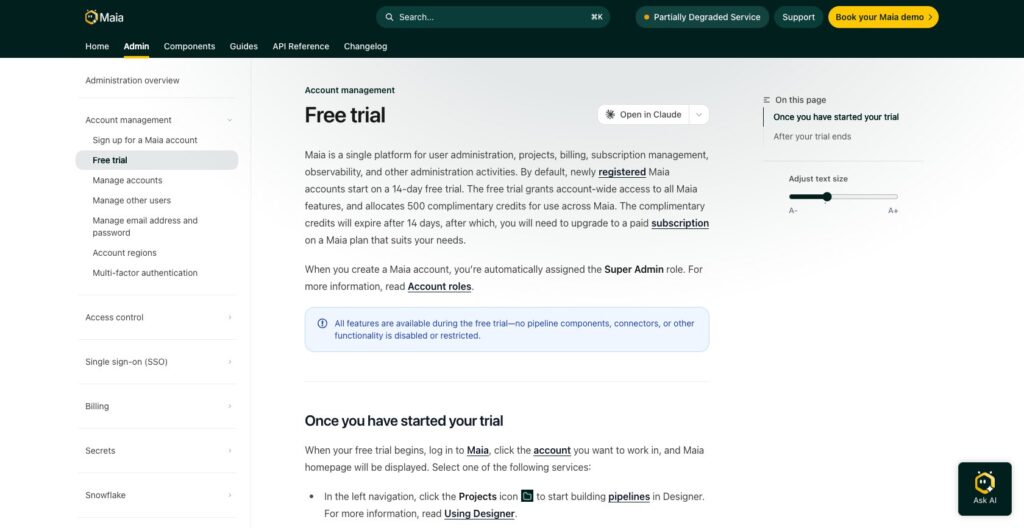
The trial runs 14 days with 500 credits and full Enterprise-level access, then the account expires or rolls onto pay-as-you-go if you saved payment details.
Is Matillion Good Value for Money?
- Good fit: steady daily batch transformation and orchestration on one warehouse, where 60 to 180 credits a month per 2-hour daily pipeline is easier to forecast than Fivetran’s monthly active rows, which climb with volume.
- Less convincing fit: always-on streaming CDC at 720 or 1,440 credits per pipeline, or a team of 8 to 10 developers paying 210 to 350 extra credits a month for seats past five.
- Budget priority: dbt Cloud Starter at $100 per user per month plus Airbyte Standard from $20 a month covers ingestion and SQL transformation for less than the last published $1,000 monthly minimum, up to 5 seats.
Reviewer’s Notes: Use the 14-day trial to run your heaviest transformation pipeline on a real schedule, read the Usage dashboard after a week, multiply the credits by the rate you were quoted, then add the warehouse compute line. Get the per-credit price, the overage rate and the Maia agent terms in writing before you sign an annual package.
Getting Started With Matillion
A Matillion project fixes three things at creation: the target warehouse, the agent model (Full SaaS, or Hybrid SaaS through Advanced Settings) and the Git repository.
Signing Up for the Trial
Register at hub.matillion.com or through Snowflake Partner Connect, which can set up a Matillion trial warehouse for your Snowflake account. Either route gives you 14 days, 500 credits and Enterprise-level features.
Existing Matillion ETL customers need a separate Maia account; the ETL account stays as it is.
Creating a Project
Name the project, add a description and pick Snowflake, Databricks, Redshift or BigQuery as the target. The default is Matillion-managed Full SaaS, where Matillion hosts the agent and your secrets.
Open Advanced Settings if you want Hybrid SaaS, which runs a containerized agent in your own cloud and is a Scale-edition feature. Then pick a Matillion-hosted Git repository (powered by GitHub) or bring your own: GitHub, or Bitbucket Cloud since August 10, 2026.
Finish by creating an environment with the warehouse credentials and setting user access. In my view, settle hybrid versus Full SaaS with your security team before you build anything, because that choice is made during project creation, not afterward in the Designer.
Branches and Your First Pipelines
Open the Branches tab and add a development branch from main. The Pipelines panel offers two types: orchestration, which loads and sequences work at 1 credit per task hour, and transformation, which chains SQL-generating components inside the warehouse at 3.
The Snowflake quickstart pattern makes a fair first test: an orchestration pipeline with a Table Iterator and an Excel Query, a Create Table and S3 Load step, then a transformation pipeline with Extract Nested Data, Join, Calculator and Aggregate components. The Copilot can attach a component such as Aggregate from a typed prompt if you prefer that to dragging.
Pull, commit and push on development, then merge into main.
Watching the Meter
The Usage dashboard, redesigned on July 7, 2026, carries budgets and alerts by email, Slack or webhook, all informational. Anomaly alerts, added on June 17, 2026, fire when a run’s duration drifts from its baseline, which is the closest thing to a spend brake, since budgets never block a run.
Reviewer’s Notes: Keep the trial inside one project and one warehouse, run the transformation pipeline on a real schedule for a week, and note the credits per run before you widen the test. 500 credits is about 166 transformation task hours, and a sprawling test burns through that without telling you anything about your steady-state bill.
Connectors and Data Loading
Matillion markets 150+ connectors on Maia Foundation, pre-built plus custom REST, and another Matillion page says 250+, against 700+ at Fivetran and Airbyte and 150+ at Hevo Data. In my view, 150 covers databases, files and mainstream SaaS; niche SaaS is where the Fivetran gap shows.
Batch Loading With Data Loader
Data Loader batch pipelines move files, databases and SaaS sources into the warehouse on a schedule. Inside orchestration pipelines, components such as S3 Load and Excel Query do the same job as steps in a larger flow.
Either way a load bills as orchestration at 1 credit per task hour, the cheapest line on the rate card.
Custom and Flex Connectors
Custom connectors hit any REST API that returns JSON, feed a Data Loader batch pipeline, and are built in the no-code Designer in under 10 minutes by Matillion’s claim. Flex connectors are built by Matillion to request, in 2 to 7 days by the same claim.
Neither figure is a measured build time, so budget your own time for any source with awkward pagination or auth. Airbyte ships its 700+ connectors on every plan, including the $20 Cloud Standard tier.
Streaming CDC
Log-based CDC needs a CDC agent in your own cloud and the Scale edition. Essential CDC bills 1 credit per task hour and premium 2, and because the pipeline runs continuously, that is about 720 or 1,440 credits per pipeline per month before volume enters the picture.
Rivery bills CDC at 2 credits per 100 MB, so a quiet source costs almost nothing there and 720 to 1,440 credits here. Fivetran prices by monthly active rows, so its bill tracks changed volume rather than hours.
Matillion’s own customer story claims 40,000 daily schema variations resolved automatically at Precision Medicine Group; that is a vendor figure, not a benchmark.
Best for: database and file loads landing on one warehouse. Skip if: a long-tail SaaS source is missing from the catalog, since Fivetran and Airbyte each list 700+.
Transformation, Orchestration and DataOps
A transformation pipeline is a chain of components (Table Input, Join, Calculator, Aggregate, Rewrite Table, Detect Changes, Assert View and so on) that Matillion compiles into SQL and pushes down into Snowflake, Databricks, Redshift or BigQuery. The compute line sits on the warehouse bill and the credit line on Matillion’s, at 3 credits per task hour.
Visual Canvas, SQL, Python and dbt
Low-code components cover joins, aggregates and change detection, and SQL and Python scripting take over where the canvas runs out. dbt Core runs inside the platform on a version Matillion controls: 1.10 on Full SaaS and 1.9 on Hybrid SaaS today, moving to 1.12 on November 10, 2026.
The Script Pushdown component reached Hybrid SaaS projects on July 15, 2026. dbt Cloud Starter sells SQL models and tests at $100 per user per month with 15,000 models, and Coalesce is the closest visual rival on Snowflake.
Orchestration and Scheduling
Orchestration pipelines sequence loads, transformations and iterators at 1 credit per task hour, so an hour of scheduling costs a third of an hour of transformation. Notification triggers for Cancelled and Skipped runs arrived on June 10, 2026.
Rivery charges 0.5 credit per workflow run, and Airbyte has no orchestration layer comparable to Matillion’s.
Git, Environments and Governance
Git branches come on every edition: a Matillion-hosted repository on Developer, bring-your-own GitHub or Bitbucket Cloud on Scale. Environments hold the warehouse credentials and user access, admin activity logging arrives on Teams, and custom SSO, data lineage and 180-day log retention are Scale features.
The Hybrid SaaS agent keeps warehouse credentials in your cloud, which is the deployment I’d pick for anything regulated.
Where It Gets Rough
Error messages and run logs are terse enough that diagnosing a failed component takes longer than it should. Git friction shows up on Matillion’s community forum, including a Designer Git button without a Push option and “Walk failure” errors after a project migration whose fix loses unpushed changes.
The proprietary pipeline format has no export path. Leaving means rewriting the logic elsewhere and running the replacement in parallel, which is the lock-in to price in before you sign.
If you would otherwise run Fivetran plus dbt Cloud plus an orchestrator, Matillion collapses the last two into one credit meter. If you only need SQL models, dbt Cloud Starter at $100 a seat costs less than the last published $1,000 minimum for up to 5 seats.
Maia Agents, Migration and What Changed in 2026
Maia now names the whole platform: Maia Team (the agents), the Context Engine and Maia Foundation, the execution layer formerly called the Data Productivity Cloud.
What Maia Team Does
Maia was announced on June 3, 2025 as a team of agents that plan, build, test and fix pipelines from natural-language prompts. The Context Engine, which stores your standards and business rules, reached general availability with Mission Control on July 29, 2026; permission levels arrived on July 8.
Agents cannot schedule or publish pipelines, cannot handle branching, conflict resolution or pull requests, need human approval before production, run at most 10 tasks at once, and read context files capped at 12,000 characters.
Maia trials free on a time-bound fair-use basis, and no credit rate for agent work is published, so get the agent terms in writing.
Migration Agent and the Matillion ETL Path
The Migration Agent, in public preview since March 26, 2026, converts pipelines from 14 platforms, including Informatica PowerCenter and IDMC, SSIS, DataStage, Alteryx, AWS Glue, Azure Data Factory, Qlik Talend, Pentaho, SAS and WhereScape. Limits are 10 MB per Git file and 10 files totaling 20 MB per upload, and the agent flags ambiguous constructs for human review.
Matillion ETL still sells at 1 credit per vCore hour. Each LTS release gets 18 months of support: 1.78 ends in November 2026, 1.80 shipped on March 4, 2026, and no end-of-life date is published.
The Upgrade Assistant, shipped July 31, 2026, converts ETL jobs into Maia pipelines, but the old Git history does not come across.
The Company in 2026
Girish Pancha, ex-Informatica chief product officer and StreamSets founder, became CEO on August 4, 2026, with ex-Informatica CTO Sanjay Krishnamurthi as Chief Development Officer. The last priced round was a $150M Series E at a $1.5B valuation in 2021, with $310M raised in total.
Monthly changelog entries through October 2026 and the BigQuery GA are the momentum signal. The risks are a pricing model that can be reset as Maia becomes the product and help content split across docs.matillion.com and docs.maia.ai, so lock multi-year rates and Maia terms into the contract. Fivetran announced a merger with dbt Labs in October 2025 and Rivery now sits inside Boomi, so ownership churn is category-wide.
How Does Matillion Compare to Competitors?
Matillion wins when visual in-warehouse transformation and orchestration matter more than connector count or a published price; each rival below wins a narrower niche.
- Fivetran: 700+ managed connectors, a Free plan up to 500,000 monthly active rows with 5,000 model runs a month, and transformations at $0.01 per run from 5,001 to 30,000 runs. It wins on catalog breadth and low maintenance, and leans on dbt Core for transformation depth.
- Airbyte: 700+ connectors on every plan, an open-source edition to self-host, and Cloud Standard from $20 a month with 5 credits, Plus from $189 with 40. It wins for open source and self-hosting, and has no transformation or orchestration layer comparable to Matillion’s.
- dbt Cloud: the Developer plan is free for 1 seat and 3,000 models, and Starter is $100 per user per month for up to 5 seats and 15,000 models. It wins for SQL-first teams on a budget, and it needs a loader such as Airbyte alongside it.
- Rivery (Boomi Data Integration): Base at $0.90 per credit, a 14-day trial with 1,000 credits, and orchestration at 0.5 credit per workflow run. It wins for teams that want a published per-credit rate before talking to sales, with 200+ native connectors and a Base tier capped at 2 users and 1 environment.
- Informatica IDMC: IPU consumption with no public rate, and enterprise contracts that run to tens of thousands of dollars a year. It wins for governance-heavy enterprises with hybrid estates, and it appears twice (PowerCenter and IDMC) on Matillion’s own Migration Agent list.
| Tool | Pricing model | Published starting price | Connectors | Transformation and orchestration |
|---|---|---|---|---|
| Matillion (Maia Foundation) | Annual credit packages, 1 to 3 credits per task hour | None published; last list $2.00 per credit | 150+ | Visual canvas, SQL, Python, dbt Core, orchestration pipelines |
| Fivetran | Monthly active rows | Free to 500,000 MAR | 700+ | dbt Core transformations, $0.01 per run after 5,000 |
| Airbyte | Credits per sync | Cloud Standard from $20 a month | 700+ | No comparable layer |
| dbt Cloud | Per seat | Free for 1 seat; $100 per user per month on Starter | None, transformation only | SQL models and tests |
| Rivery (Boomi) | Credits | $0.90 per credit | 200+ | Orchestration at 0.5 credit per run |
| Informatica IDMC | IPU consumption | None published | Not compared | Governance-focused IDMC services |
Choose Matillion over Fivetran when your pain is transformation and scheduling, not ingestion. Choose Fivetran when a long-tail SaaS source is missing from Matillion’s 150. Choose dbt Cloud plus a loader when your team already writes SQL and wants a $100 seat price it can see before a sales call.
How I Reviewed Matillion
I evaluated Matillion on the areas Panoply weighs for every data tool: pricing transparency, openness and exit costs, setup and operating effort, connector depth, and development momentum.
For Matillion that meant working through the three editions and the credit consumption rates line by line, pricing three example workloads in credits, mapping the setup path from signup to a merged first pipeline, checking the connector catalog and CDC terms, reading the Maia Team and Migration Agent limits, tracing the Matillion ETL support lifecycle, and following the 2026 changelog and the leadership change.
I compared prices and plan features against Fivetran, Airbyte, dbt Cloud, Rivery and Informatica at their current list rates. This is not a hands-on performance test, so run times and failure behavior are yours to measure on the trial. Prices current as of October 2026.
Should You Build Your Pipelines on Matillion?
Yes, if your sources are databases, files and mainstream SaaS landing in Snowflake, Databricks, Redshift or BigQuery, your pain is transformation and scheduling rather than ingestion, and you have the budget for an annual credit package. Scale adds hybrid deployment, lineage and SSO for regulated teams, and the whole canvas is Git-versioned from the Developer edition up.
Skip it if you need a connector outside the 150 (Fivetran and Airbyte each list 700+), if you are one or two engineers who write SQL (dbt Cloud Starter at $100 per user per month plus Airbyte from $20 a month), if you need a rate you can read before a sales call (Rivery Base at $0.90 per credit), or if your workload is always-on streaming CDC, where 1,440 credits a month per pipeline adds up fast.
Next step: start the 14-day trial through Snowflake Partner Connect or hub.matillion.com, run your heaviest transformation pipeline on a real schedule, read the Usage dashboard after a week, and ask sales for the per-credit price, the overage rate and the Maia agent terms in writing before the annual.
FAQ
How much does Matillion cost?
Matillion publishes no dollar price. Developer, Teams and Scale are sold as annual credit packages through sales, and the last published rates were $2.00 to $2.70 per credit with minimums from $1,000 a month. The 14-day trial gives 500 credits with full Enterprise-level access, so you can measure your own consumption before asking for a quote. Warehouse compute is billed separately by Snowflake, Databricks, Redshift or BigQuery.
What is a Matillion credit?
A credit is the smallest unit Matillion bills in. Orchestration pipelines use 1 credit per task hour, transformation pipelines 3, streaming CDC 1 or 2 depending on tier, and each developer user beyond the included count 70 credits a month. Task time is metered in 2-second increments, and validation and sampling are free.
Is the Data Productivity Cloud still a product?
It has been renamed Maia Foundation, the execution layer of Maia, Matillion’s agentic platform. The Designer, pipelines and Git workflow carry over under the new name, and the help content now lives at docs.maia.ai, which describes Maia as formerly Data Productivity Cloud. Existing Matillion ETL customers need a separate Maia account to use it.
Is Matillion ETL being discontinued?
No end-of-life date is published for Matillion ETL. Each LTS release gets 18 months of support, 1.78 LTS ends in November 2026 and 1.80 LTS shipped in March 2026. The Upgrade Assistant converts ETL jobs into Maia pipelines, which is the path Matillion is steering customers toward.
How is Matillion different from Fivetran?
Matillion leads on in-warehouse transformation and orchestration, with Git and dbt Core built into the canvas. Fivetran leads on 700+ connectors, a free plan up to 500,000 monthly active rows and low maintenance. The two split the job cleanly: Fivetran lands the data, and Matillion transforms and schedules it inside the warehouse, a pairing worth pricing when you need both breadth and transformation depth.