Editor’s note: This Talend review is based on my hands-on evaluation of Qlik Talend Cloud and Talend Studio during the 14-day trial in October 2026. I weighed pricing and editions, setup, pipeline building, data quality and governance, AI features, and rivals.
Quick verdict: I recommend Talend for large or regulated companies with hybrid estates (on-premises databases, SAP, mainframes, several clouds) that need change data capture, data quality and column-level lineage from one vendor. Go in knowing that only Starter has a public price and that Talend Studio, an Eclipse IDE that generates Java, has a real learning curve.
Talend is now Qlik Talend Cloud: Qlik closed its acquisition of Talend on May 16, 2023, sells the platform in four editions, and retired the free Talend Open Studio on January 31, 2024. Its edge over simpler ELT tools sits in Premium, where data quality, stewardship and lineage run next to the pipelines.
In this review, I’ll take a closer look at Talend’s pricing, features, and AI pipelines, so you can see exactly whether it is worth a quote-only commitment.
Key Takeaways:
- Four editions run from Starter for SaaS ingestion to Enterprise for SAP and mainframe connectivity.
- Only Starter has a public price: Qlik lists it on AWS Marketplace at $6,000 a year for up to 50GB a month.
- CDC starts at Standard; data quality, column-level lineage and the Trust Score require Premium.
- Free Open Studio retired on January 31, 2024. The commercial platform offers a 14-day trial, not an ongoing free edition.
- April 2026 added natural-language pipelines and a Studio AI Assistant, with access varying by edition and entitlement.
Pros and Cons
Pros
- Log-based CDC from Standard, including SAP and mainframe on Enterprise
- Data quality, stewardship and the Trust Score built in on Premium
- Column-level lineage and impact analysis on Premium
- Cloud, hybrid or client-managed deployment via Remote Engines
- Managed Apache Iceberg ingestion through Open Lakehouse from Standard
- 14-day trial with Talend Studio included, no credit card required
Cons
- No public price beyond Starter, which lists at $6,000 a year for 50GB a month
- Premium and Enterprise meter job executions and run time on top of data volume
- Free Open Studio retired January 31, 2024, with no patches since
- Studio jobs compile to Java, so leaving means rebuilding them
- Lineage and data quality require Premium, not Standard
How Much Does Talend Cost?
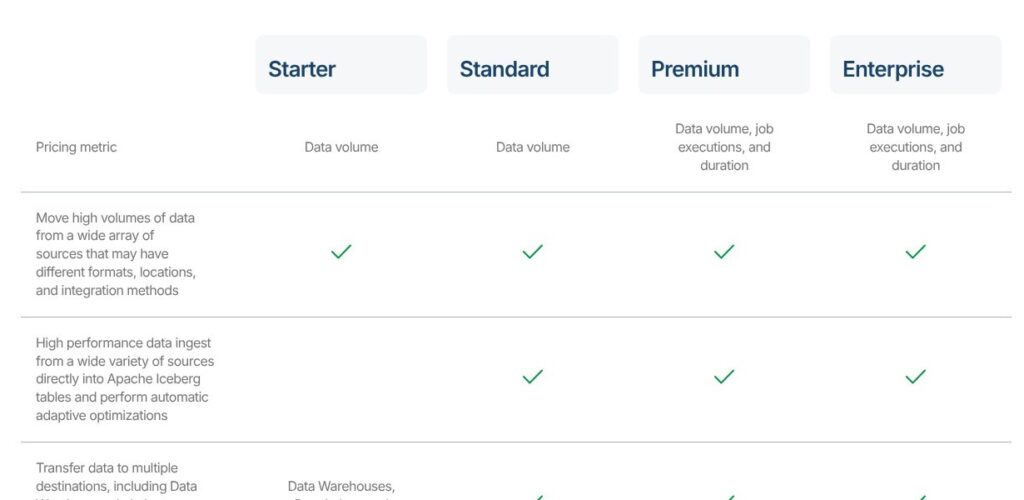
Qlik sells Qlik Talend Cloud in four editions, each a subscribed usage capacity. Starter and Standard are metered on data volume moved; Premium and Enterprise also count job executions and execution duration. Standard, Premium and Enterprise are quote-only; Starter is the one edition with a public price.
- Starter ($6,000/year on AWS Marketplace): for SaaS ingestion of up to 50GB a month, with managed cloud pipelines, ready-to-query schemas, a data catalog and field-level profiling. Overage is billed separately, so $6,000 is a floor, not a spending ceiling.
- Standard (quote): for database replication and hybrid estates. It adds log-based CDC, database and file connectivity, hybrid and client-managed deployment, private VPC access to on-premises systems, and Open Lakehouse ingestion for Apache Iceberg.
- Premium (quote): for teams consolidating transformation and governance. It adds ETL/ELT transformations, warehouse and lakehouse automation, Spark batch processing, API integration, data products, data quality, stewardship, column-level lineage, the Trust Score and AI pipelines.
- Enterprise (quote): for SAP and mainframe estates. It is Premium plus SAP application and mainframe connectivity, so a single SAP source pushes you to the top edition even if Standard covers everything else.
| Edition | Price | Best for | Key additions | Deployment |
|---|---|---|---|---|
| Starter | $6,000/year; up to 50GB/month | SaaS ingestion | Managed pipelines, catalog, profiling | Managed cloud |
| Standard | Quote | Database CDC | Hybrid connectivity, Iceberg ingestion | Cloud, hybrid, client-managed |
| Premium | Quote | Governed ETL/ELT | Transformations, quality, lineage, AI pipelines | Cloud, hybrid, client-managed |
| Enterprise | Quote | SAP and mainframe estates | SAP application and mainframe connectivity | Cloud, hybrid, client-managed |
Qlik also owns Stitch, a cheaper route for straightforward SaaS ingestion: Standard starts at $100/month, Advanced costs $1,500/month and Premium $3,000/month, both billed annually. Stitch Standard caps you at one destination, 10 standard sources and five users, so it fits a single-warehouse project, not an enterprise estate.
Talend’s 14-day trial needs no card and includes Talend Studio and unlimited replication. Your project stays available for 30 days after the trial ends, then Qlik deletes it unless you buy an edition.
Is Talend Good Value for Money?
- Starter is hard to justify for SaaS-only ingestion: $6,000 a year buys 50GB a month, while Stitch starts at $100 a month and Fivetran has a free plan.
- Premium is where the value shows: data quality, stewardship and lineage can replace a separate quality or catalog tool, but the saving is real only if you cancel that subscription.
- Growth raises the bill: more data draws on capacity in every edition, and on Premium and Enterprise more job executions and longer runs do too, and users report licensing costs rising since the Qlik acquisition. Get the quote priced on expected peak workload, not today’s.
- There is no free edition: the 14-day trial is the only free access, so former Open Studio users need a paid budget or a different platform.
Reviewer’s Notes: Run the trial on your real sources before you negotiate. Price Standard if CDC is the requirement, and move to Premium only if it lets you retire a separate data-quality or lineage tool or meets a written compliance requirement.
My Experience With Talend
Qlik Talend Cloud gives you two build surfaces: the browser-based Pipeline Designer and Talend Studio, an Eclipse-based desktop IDE. Pipeline Designer was the faster start for a simple transformation, and Studio was where I went for tMap’s finer control over joins and outputs.
Starting the Trial
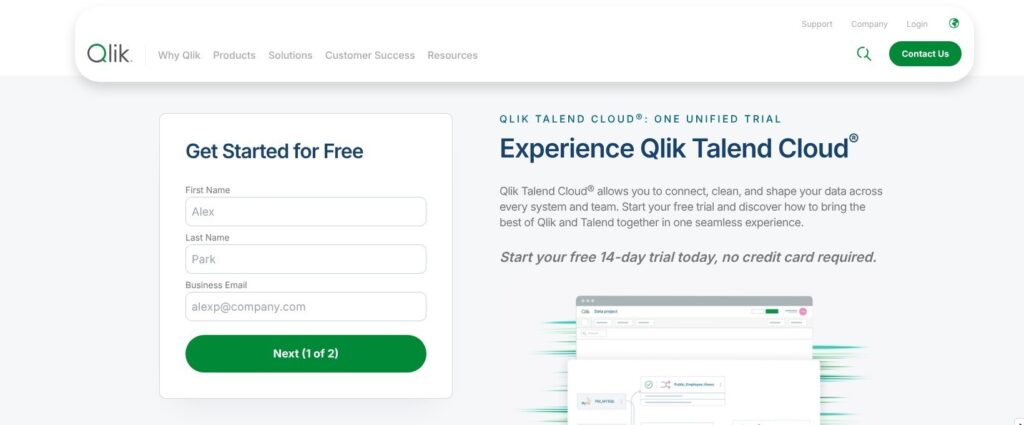
I signed up on the Qlik Talend Cloud trial page: 14 days, no credit card, with access to Talend Cloud and a Talend Studio download. The trial lets you invite teammates to view or contribute, so bring in the engineer who will own production deployment from the start.
Before building anything, an administrator has to assign Pipeline Designer roles in Talend Management Console, and at least one Remote Engine Gen2 must be running. Fivetran needs no engine install for a managed SaaS connection, so this extra work only pays off when private networking or hybrid execution is part of your requirement.
Building My First Pipeline in Pipeline Designer
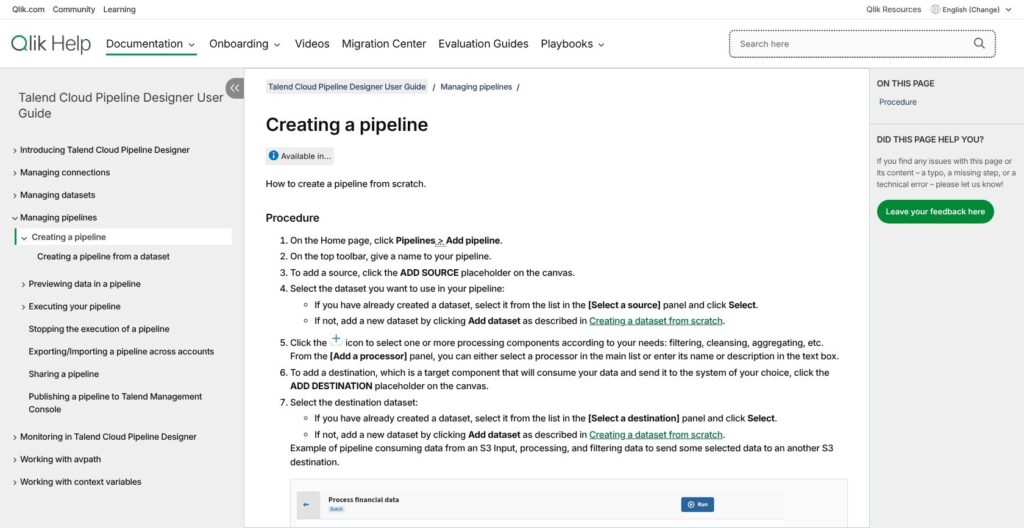
I used a small, familiar dataset for the first pipeline so I could check the output against what I expected. With roles assigned and the engine running, the build took six steps:
- From the home page, open Pipelines, add a pipeline, and name it in the top toolbar.
- Click ADD SOURCE, choose an existing dataset or Add dataset, then click Select.
- Click the plus icon and choose a processor, such as filtering, cleansing or aggregation.
- Click ADD DESTINATION, select or add the destination dataset, and confirm with Select.
- Preview data at each step, then click Run, choose a run profile, and click Run again.
- Open the Metrics panel to see processed records and execution time.
The per-step previews are the most useful part: I could confirm that a filter removed the intended records before looking at the destination. For throughput, rely on the Metrics panel, not on how responsive the canvas feels.
Designing a Job in Talend Studio
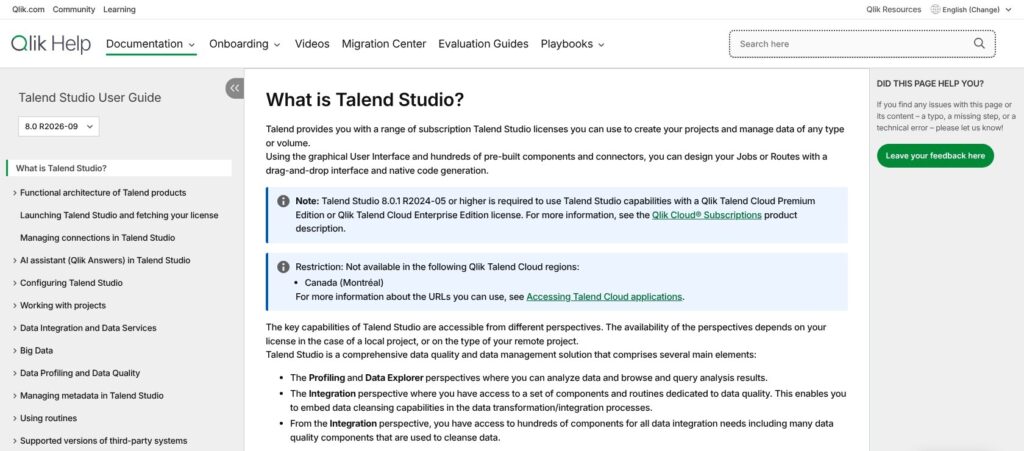
In Talend Studio, you drag components onto the Job Designer canvas and link them. The tMap component does the heavy lifting, handling joins, filters, multiple outputs and reject outputs. I built the classic tMap exercise: splitting a customer table by state, with a reject flow catching unmatched rows.
Studio generates Java for every job, so debugging needs someone on the team who reads Java. The desktop app needs several hundred MB of RAM, and large workloads can need JVM heap tuning to avoid memory errors.
Premium and Enterprise capabilities require Studio 8.0.1 R2024-05 or later; the current release line is 8.0 R2026-09.
Reviewer’s Notes: Pipeline Designer is the faster start for analysts, and Studio is where Talend’s depth lives. Sort out the Remote Engine before anything else: it is the first real hurdle, and Pipeline Designer cannot run a pipeline without one.
Ingestion, CDC and Hybrid Deployment
Agentless, log-based CDC arrives with the Standard edition and covers databases and SaaS sources, with SAP and mainframe connectivity added on Enterprise. SaaS-first tools like Fivetran and Airbyte Cloud do not match that SAP and mainframe reach.
Connectors and Destinations
Qlik does not publish a connector count, only “hundreds of sources and targets without custom code”, and names these integrations, so test every source you need during the trial:
- Snowflake and Databricks: warehouse and lakehouse targets.
- Microsoft Fabric and AWS: for estates centered on either cloud.
- Apache Iceberg: through Open Lakehouse, Qlik’s managed Iceberg service.
Confirm CDC behavior for each specific connector in the trial, since a SaaS source and a database log are captured differently, and SAP or mainframe sources will not appear at all below Enterprise.
Deployment and Iceberg
Standard adds hybrid and client-managed deployment through Remote Engines, plus private VPC access to on-premises systems, so pipelines can run inside your own network instead of only in Qlik’s cloud. The trade-off is an engine your team installs and operates.
Open Lakehouse launched in May 2025 as a fully managed Apache Iceberg service inside Qlik Talend Cloud. Standard includes Iceberg ingestion with adaptive optimization, and Open Lakehouse Streaming followed in April 2026. Streaming availability varies by entitlement, so get it named in your quote.
For plain SaaS-to-warehouse copying, Fivetran or Airbyte Cloud is less work. For an estate mixing on-premises databases with SAP or mainframes, Talend Enterprise belongs on the shortlist.
Best for: hybrid estates where on-premises databases, SAP or mainframes must feed a cloud warehouse or Iceberg lakehouse.
Skip if: the whole job is copying SaaS records into one warehouse; a managed ELT service like Stitch or Fivetran does that with less setup.
Data Quality, Lineage and the Trust Score
Premium bundles data quality with semantic types, stewardship workflows, column-level lineage and impact analysis, data products with a marketplace, and the Qlik Talend Trust Score. None of it comes with Standard, and this layer is the main reason to pick Talend over cheaper ELT.
- Data quality with semantic types: classifies fields by business meaning, not just technical data type. Test it on the customer or product fields that keep breaking downstream reports.
- Stewardship workflows: route data-quality issues to people for resolution, which matters when fixing a record takes business judgment rather than another validation rule.
- Column-level lineage and impact analysis: show which downstream outputs depend on a field before you change it or its transformation.
- Data products and marketplace: package curated datasets for discovery and reuse, useful when several teams maintain competing versions of the same table.
- Qlik Talend Trust Score: a trust indicator alongside the quality tools. Use it to decide what to investigate first, not to skip checks on business-critical data.
| Requirement | Minimum edition |
|---|---|
| Catalog and field-level profiling | Starter |
| Log-based CDC | Standard |
| Data quality and stewardship | Premium |
| Column-level lineage and impact analysis | Premium |
| Qlik Talend Trust Score | Premium |
Informatica IDMC is the other suite with this depth built in, and it adds master data management on top. With Fivetran, Airbyte or Matillion, add the cost of a separate quality or catalog tool before you compare quotes.
Premium pays off when lineage changes how engineers manage dependencies, stewardship gives unresolved data issues an owner, and the Trust Score gives analysts one signal to check before they build on a dataset. If you already run governance tooling you’re happy with, Standard plus that existing stack is likely the better buy.
AI Features: Agentic Pipelines and the Studio AI Assistant
At Qlik Connect in April 2026, Qlik made agentic data engineering generally available in Qlik Talend Cloud:
- Declarative pipelines: describe a pipeline in natural language instead of building it step by step. Check the result against known input and output before it touches production.
- Studio AI Assistant: AI help inside the Talend Studio desktop IDE. It works alongside your existing jobs but does not remove the need for Java skills when a job fails.
- Real-time routing for agentic processes: confirm that the connections and execution pattern you need are in the proposed entitlement.
- Open Lakehouse Streaming: streaming ingestion into the managed Iceberg service. Entitlement varies, so test it separately from Standard’s Iceberg ingestion.
- Agent tooling: an MCP server, pipeline building through coding agents, and specialized agents for data quality, stewardship and data products.
Premium includes pipelines for AI and GenAI with LLM extensibility, but availability varies by capability, region and entitlement. Make the quote name each AI feature you are paying for, and test each one during the 14-day trial before it goes into the contract.
My recommendation: choose Talend for its integration and governance fit, and treat the AI Assistant and natural-language pipelines as trial requirements, not reasons to accept Remote Engine administration or Java-generated jobs.
What Happened to Talend Open Studio?
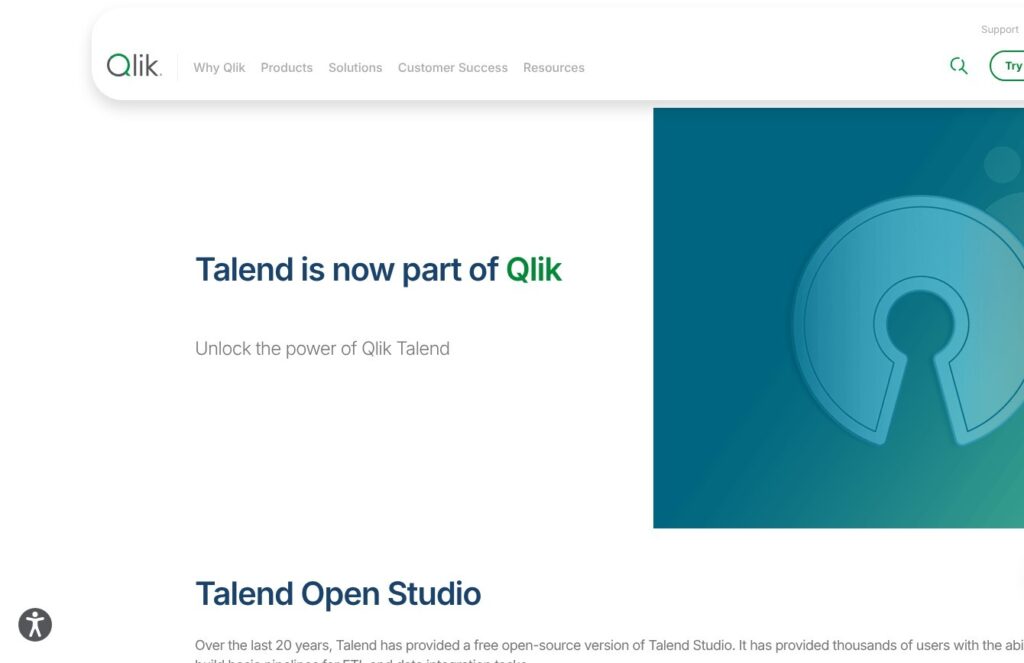
Qlik retired Talend Open Studio on January 31, 2024, citing diminishing community adoption and contribution. Qlik no longer hosts or updates it, installers are no longer provided, and existing installations receive no maintenance or security patches.
Qlik points former users to the commercial Talend Studio and the Qlik Talend Cloud trial. Your options:
- Move to commercial Talend: use the 14-day trial to test your existing Studio jobs and identify the edition you need before you ask for a quote.
- Try Talaxie: a community fork of Open Studio, not a Qlik product. Check who maintains it and how often it ships fixes before trusting it with production workloads.
- Rebuild elsewhere: Airbyte Core offers free self-hosted ingestion, but it does not replace Studio’s transformation jobs. Studio jobs are generated Java, so migration means rebuilding transformations and reject flows, not importing a project.
Do not keep unpatched Open Studio running against production data. Pick one of the three routes above and budget the rebuild, since every Open Studio job will need either a commercial license or a rewrite.
How Does Talend Compare to Competitors?
Talend and Informatica are the two suites here that pair integration with built-in data quality and lineage; the rest specialize in managed ingestion, self-hosted ELT or warehouse-native transformation. Talend Starter at $6,000 a year and Stitch at $100 a month are the two Qlik-owned entry points with public prices.
| Tool | Best for | Pricing model / entry | Deployment | Built-in data quality |
|---|---|---|---|---|
| Qlik Talend Cloud | Governed hybrid integration | Starter $6,000/year; otherwise quote | Cloud, hybrid, client-managed | Premium and above |
| Informatica IDMC | Enterprise data management and MDM | Quote | Cloud | Yes, plus MDM |
| Fivetran | Managed SaaS ELT | Free plan; paid on monthly active rows | Managed cloud | Separate tool needed |
| Airbyte | Self-hosted ingestion | Core free (self-hosted); Cloud paid | Self-hosted or cloud | Separate tool needed |
| Matillion | Warehouse-native transformation | Credits | Cloud warehouse | Separate tool needed |
| Stitch | Simple SaaS ingestion | From $100/month | Managed cloud | Separate tool needed |
| Azure Data Factory / AWS Glue | Single-cloud pipelines | Pay-as-you-go | Azure or AWS | Separate tool needed |
- Informatica IDMC: wins when master data management and broad enterprise governance matter as much as integration, and it is the closest like-for-like rival to Talend Premium. Both are quote-led, so get scoped quotes from each before assuming either is cheaper.
- Fivetran: my pick for hands-off managed SaaS ELT when you want no engine to run, with a wide managed connector library and a free plan to start on. Monthly-active-row billing still needs modeling, because busy sources raise the bill.
- Airbyte: wins on free self-hosted Core when deployment control matters more than convenience, which also makes it the natural landing spot for former Open Studio users. You run the platform yourself, and Studio jobs still need rebuilding.
- Matillion: wins when the cloud warehouse is the center of your architecture and you want transformation inside it. Compare its credit consumption with Talend Premium’s execution and duration metering.
- Stitch: the cheapest Qlik-owned route for simple SaaS ingestion at $100/month, with SOC 2 Type II and ISO 27001 and its own 14-day trial. One destination and 10 standard sources on Standard make it narrower than Talend, which is exactly right for a small warehouse project.
- Hevo Data: wins for small teams that want a simpler managed pipeline service, with less depth on hybrid deployment and governance.
- Azure Data Factory / AWS Glue: win when the workload already lives in Azure or AWS and pay-as-you-go matters most. Both tie you to one cloud, and neither offers Talend’s quality and stewardship layer.
For a broader shortlist, start with Panoply’s ETL tools guide. My buying order: Talend for combined integration and governance, Fivetran for managed ingestion, Airbyte for self-hosted control.
How I Reviewed Talend
I evaluated Talend as an enterprise integration purchase during the 14-day trial, covering:
- Trial signup, teammate invites and Remote Engine prerequisites.
- Building a pipeline in Pipeline Designer, with previews and the Metrics panel.
- Designing a tMap job in Talend Studio and what its generated Java means for debugging.
- The four-edition ladder and usage metering.
- CDC and hybrid deployment, Premium’s data quality and lineage, and the April 2026 AI features.
- What Open Studio’s retirement means for former users.
I weighed six areas: pricing and value, setup and ease of use, integration depth, governance, AI features, and support. Deployment fit and governance counted for more than connector breadth, because that is where Talend differs from Fivetran and Stitch.
Prices current as of October 2026.
Should You Choose Talend for Enterprise Data Integration?
Yes, if CDC, hybrid deployment and Premium’s governance tools solve requirements that would otherwise span several products. For basic SaaS ingestion alone, Talend’s Java learning curve and quote-led buying process are not worth it.
Choose Talend if:
- Your estate includes on-premises databases, with SAP or mainframes important enough to justify an Enterprise quote.
- You need data quality, stewardship and column-level lineage from the same vendor that runs your integration.
- You have Java-literate data engineers who can own Studio jobs and the Remote Engines that run them.
Skip Talend if:
- You need public pricing on every plan or an ongoing free edition.
- You only move SaaS data into a warehouse, where Stitch or Fivetran is a more focused purchase.
- Your small team cannot take on ETL development and Remote Engine administration.
Standard is my starting point for database CDC; Premium is my recommendation when governance has a named owner and purpose. Start the 14-day trial with your actual sources, then ask Qlik for Standard and Premium quotes side by side.
FAQs
Is Talend still free?
No. The free Talend Open Studio edition retired on January 31, 2024 and gets no security patches. Qlik Talend Cloud offers a 14-day trial with no credit card, and Talend Studio is included. Existing Open Studio installs still run, but I would not keep one on production data.
How much does Talend cost?
Talend is quote-only beyond Starter, which Qlik lists on AWS Marketplace at $6,000 a year for up to 50GB a month, with overage billed separately. Starter and Standard are metered on data volume; Premium and Enterprise add job executions and execution duration, so price a representative workload before signing.
Is Talend owned by Qlik?
Yes. Qlik announced the acquisition in January 2023 and closed it on May 16, 2023, when Talend had over 7,250 customers. Talend’s platform is now sold as Qlik Talend Cloud in four editions: Starter, Standard, Premium and Enterprise.
What is the difference between Talend Studio and Qlik Talend Cloud?
Talend Studio is an Eclipse-based desktop job designer that generates Java. Qlik Talend Cloud is the wider platform, with the browser-based Pipeline Designer, Talend Management Console and Remote Engines. The 14-day trial includes both.
Does Talend support CDC?
Yes. Log-based change data capture is included from the Standard edition up, covering databases and SaaS sources. SAP application and mainframe connectivity require Enterprise. Test the exact database or connector you need during the trial before you sign for an edition.
What are the best Talend alternatives?
Informatica IDMC for enterprise data management and MDM, Fivetran for managed SaaS ingestion, Airbyte for free self-hosted ingestion, Matillion for warehouse-native transformation, and Stitch for cheap Qlik-owned SaaS ingestion from $100/month. Pick by whether you are replacing Talend’s pipelines alone or its governance layer too.