Editor’s note: This Y42 review evaluates the platform on its pricing model, documented product behavior and plan ladder as Y42 sells it in October 2026. It is not a hands-on performance test.
Quick verdict: I recommend Y42 for 2-to-5-person data teams on BigQuery or Snowflake that want ingestion, dbt Core models, scheduling and Git branching in one managed workspace, starting at $500 a month for 3 users. Go in knowing that Asset Health Monitor, Data Catalog, UI-based pull requests, SSO and audit logging are Enterprise-only at a custom price, Python compute is metered per minute with no published rate, and the public changelog stops in July 2024.
Key Takeaways
- One Git-backed workspace runs CData, Airbyte and Python ingestion, Fivetran sync triggers, dbt Core models, cron schedules and column-level lineage.
- Business costs $500 a month for 2 spaces and 3 users, Enterprise is custom, the SQL ingestion add-on starts at $15 per million rows, and the 14-day trial needs no credit card.
- Virtual data builds promote a merged branch’s data without a rebuild and roll it back on a reverted commit, with physical tables kept 30 days by default.
- BigQuery and Snowflake are the only warehouses, each space also needs a GCS, S3 or Azure Blob bucket, and there is no self-hosted option.
- The product-updates feed ends July 11, 2024 and the blog July 12, 2024, with UI-based pull requests, data diff and anomaly tests still in public beta.
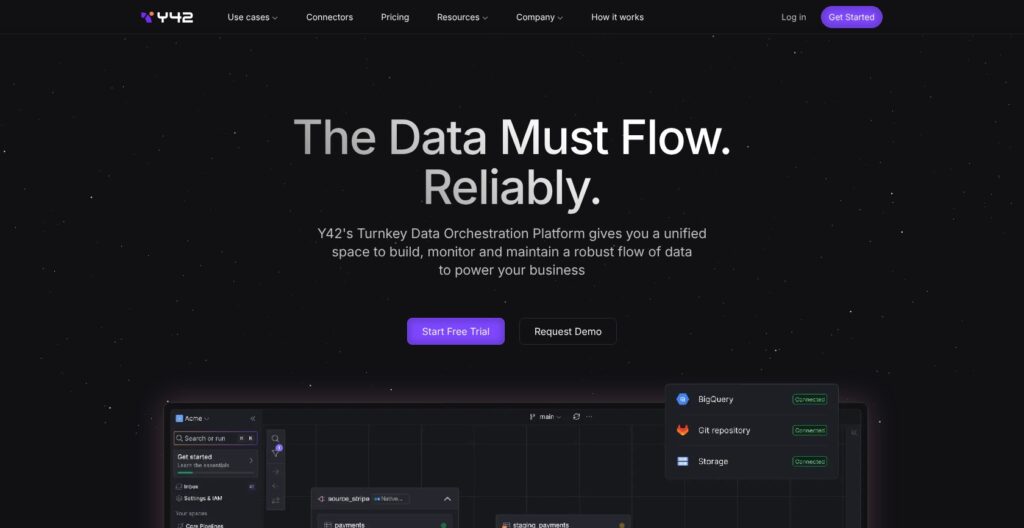
In this review, I cover pricing, setup, ingestion, the Git workflow, monitoring and momentum, then compare Y42 with dbt Cloud, Dagster+, Matillion, Fivetran and Airbyte among managed transformation tools.
Y42 Pros and Cons
Pros
- Ingestion, dbt Core, scheduling and column-level lineage in one Git-backed workspace
- Virtual data builds: merging deploys a branch’s data, reverting rolls it back, no rebuild
- Flat $500 a month for 2 spaces and 3 users, plus a 14-day no-card trial
- CI check on GitHub pull requests or GitLab merge requests reports modified and downstream asset health, plus row-level data diff
- Code OSS web IDE plus low-code asset list and lineage views
Cons
- BigQuery or Snowflake only, plus a GCS, S3 or Azure Blob bucket per space
- SSO and SCIM, audit logging, UI-based pull requests, time travel, Asset Health Monitor and Data Catalog are Enterprise-only
- Python assets bill per compute minute at no published rate, and extra seats are unpriced
- No product update since July 11, 2024, with data diff and anomaly tests still in public beta
How Much Does Y42 Cost?
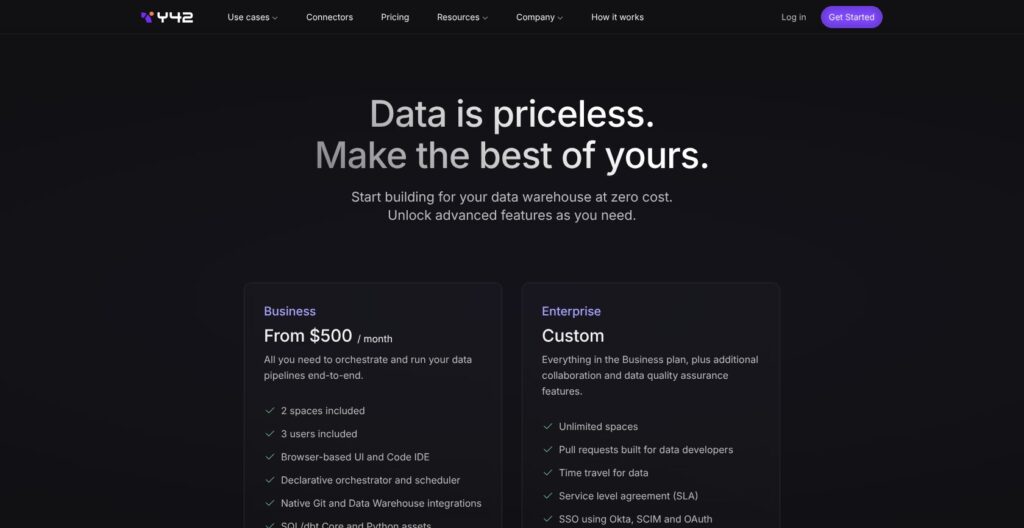
Y42 sells two plans and publishes one price: Business from $500 a month with 2 spaces and 3 users, and Enterprise at a custom price. The only other published number is the SQL-based ingestion add-on, from $15 per million rows ingested.
- Business ($500 a month): for a small team: 2 spaces, 3 users, the web IDE and low-code UI, the orchestrator and scheduler, GitHub or GitLab, SQL, dbt Core and Python assets, data tests, lineage, alerts and API access.
- Enterprise (custom): for regulated or multi-team setups, adding unlimited spaces, UI-based pull requests, time travel for data, an SLA, SSO via Okta, SCIM or OAuth, audit logging, Asset Health Monitor and Data Catalog.
- SQL-based ingestion add-on (from $15 per million rows): CData-powered hosted connectors or Python ingestion, billed on rows ingested.
| Plan | Price | Spaces | Users | Standout features |
|---|---|---|---|---|
| Business | $500 a month | Up to 2 | 3 included, extra per seat (price not published) | Data tests, column-level lineage, alerts, API access |
| Enterprise | Custom | Unlimited | Custom | UI-based pull requests, time travel, SSO and SCIM, audit logging, Asset Health Monitor, Data Catalog, SLA |
| SQL ingestion add-on | From $15 per million rows | n/a | n/a | CData connectors or Python ingestion |
What Business Does Not Include
| Feature | Business | Enterprise |
|---|---|---|
| SSO and SCIM | No | Yes |
| Audit logging | No | Yes |
| Advanced UI-based pull requests | No | Yes |
| Time travel for data | No | Yes |
| Asset Health Monitor | No | Yes |
| Data Catalog | No | Yes |
| Python ingestion and action assets | Per-minute compute, rate not published | Per-minute compute, rate not published |
With the health dashboard and the catalog reserved for Enterprise, a Business team monitors through build history, email alerts and lineage.
A 3-person team loading 20 million rows a month through CData pays $500 plus $300 in add-on fees at the $15 starting rate, or $800 a month, before any Python compute. A 5-person team needs two extra seats at a price Y42 does not publish, so get that figure in writing.
In Q3 2024, Y42 dropped Starter ($0 to start, then $1 per credit) and Scaling ($1,250 a month with 1,250 credits, 3 spaces and unlimited builder seats) for the flat Business plan. Your bill no longer swings with credit burn, but a team that needs a third space now needs Enterprise.
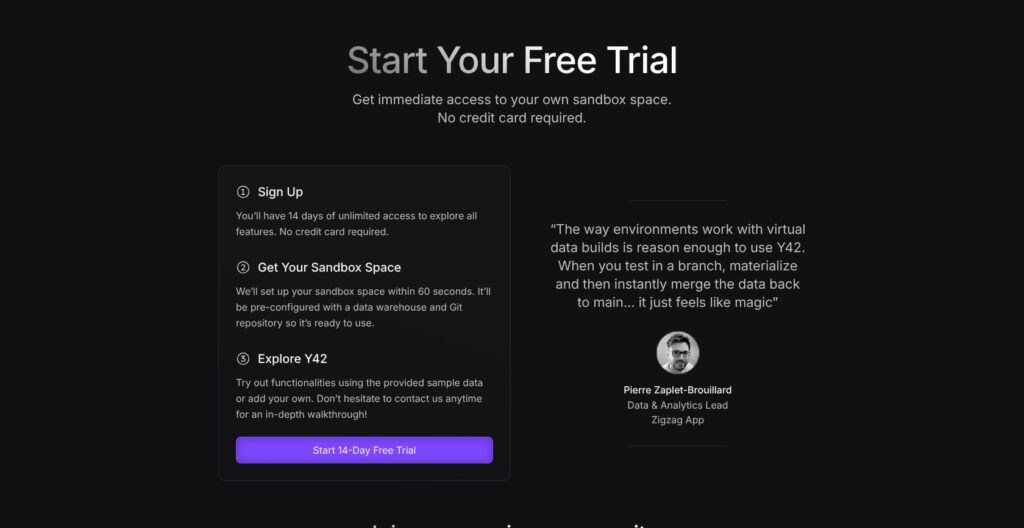
The Y42 free trial runs 14 days with no credit card and opens a sandbox with a pre-configured warehouse and Git repo in about 60 seconds. That sandbox auto-deletes after 14 days.
Is Y42 Good Value for Money?
- Good fit: a 3-person team on one warehouse that would otherwise pay for dbt Cloud Starter ($300 for three seats at $100 each), Airbyte Standard (from $20 a month) and Dagster+ Starter ($100 a month). That stack starts at about $420 across three tools, so Y42’s extra $80 buys one bill, one workspace and virtual data builds.
- Less convincing fit: teams that need SSO, audit logging or the health dashboard, which means a custom Enterprise quote, or Python-heavy ingestion, where per-minute compute is unpriced.
- Budget priority: dbt Cloud Developer (free, 1 seat, 3,000 models built a month) plus Fivetran Free (500,000 monthly active rows) costs nothing for a solo analyst.
Reviewer’s Notes: Use the 14 days on your own warehouse rather than the sandbox, run one CData source and one Python source on a daily schedule, and ask sales for the per-seat price, the Python compute rate and the Enterprise price before the trial ends. Those three numbers decide whether the $500 floor holds for your team.
Getting Started With Y42
A Y42 space is wired to three things before you build anything: a BigQuery or Snowflake warehouse, a cloud storage bucket that Y42 uses as a cache, and a Git repository. BigQuery pairs with a GCS bucket, Snowflake with S3 or Azure Blob, and the repo is Y42-managed GitLab by default or your own GitHub or GitLab, one repo per space.
Account, Organization and Space
Sign in with email, Google, Microsoft or SSO, then create an organization with a name and URL. Create a space in sandbox mode or connect your own warehouse and bucket, then pick the Git repo.
Settle the repo question before the first commit: Y42 lets you swap it later in Space settings, but only into a target repo that is empty or allows a transfer.
Each space offers three development modes: Asset List, Lineage and the Code Editor, which runs Code OSS (the open-source VS Code distribution) on WebAssembly.
Ingest a Source
Choose Create Asset, then a Connector, Airbyte, Python or Fivetran source, and add a connection or secret. For CData, write SELECT and WHERE queries per table; for Airbyte, whitelist Y42’s IP addresses first. Build the source, check the row count in the job drawer, and choose full or incremental sync.
Transform With dbt Models
Work on a feature branch. Create a models directory and a staging model such as stg_orders in SQL, then layer intermediate and mart models on top. Add dbt tests, and let the Documentation Wizard draft descriptions if GenAI is enabled for the space. Preview, build, commit and push.
Schedule and Merge
Open the bottom drawer, choose Build scheduler, then Add. Name the schedule, enter a selector such as y42 build -s +mrt_sales, set the cron frequency, save and commit, and use Trigger Run for an ad-hoc build. Green, yellow and red mark ready, partially invalid and invalid runs; add an email alert on orchestration status.
Open a GitHub pull request or GitLab merge request so the CI check reports the health of modified and downstream assets, then merge into main. The branch’s builds become main’s data with no rebuild, and reverting the commit rolls them back while the physical tables are inside the default 30-day window.
Reviewer’s Notes: Keep the trial inside one space and one branch, and before day 14, merge a change to a model with a downstream mart, then revert it on purpose so you know the rollback path before production depends on it.
Ingestion: CData, Airbyte, Fivetran and Python Sources
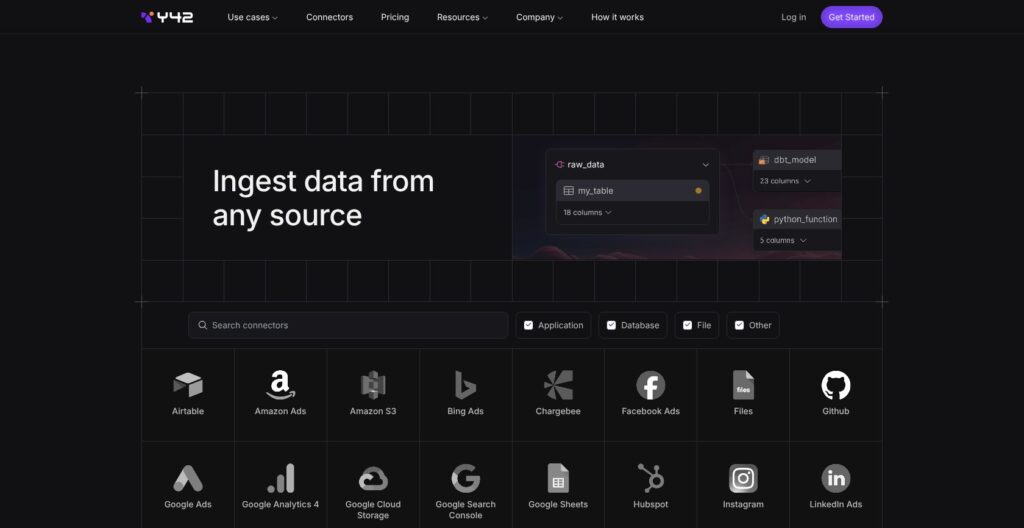
Y42 ingests through five source types: reference sources, Y42-managed CData and Airbyte connectors, Fivetran sources that trigger your own Fivetran syncs, and Python sources. Y42 claims over 500 connectors but names only about 48 sources, with setup guides for 26 CData and 18 Airbyte connectors.
CData and SQL Ingestion
Each CData job runs its own instance of the CData Python connector, and you select tables with SELECT and WHERE statements only; SELECT * FROM sys_tables lists what exists. The SQL Ingestion UI, shipped June 19, 2024 behind a per-space feature flag, previews those queries before a build. This is the path the $15-per-million-rows add-on prices.
Airbyte Connectors
Y42 runs the open-source Airbyte connector per job, so you need no Airbyte Cloud account, only Y42’s IP addresses on your allowlist. Scheduled builds run incremental imports by default; a full refresh needs the --full-refresh flag on y42 build.
App sources such as Facebook Marketing, HubSpot, Salesforce and Shopify use incremental append, so duplicates can land and need deduping in staging models. Airbyte Standard sells the same connector base standalone from $20 a month.
Fivetran and Python
Fivetran sources need your own Fivetran account and a connector that has synced once; Y42 calls the Fivetran API, waits for the sync, creates a view per updated table and builds downstream. A single table build triggers the whole connector, and failed tests on Fivetran tables stop the DAG without blocking the sync.
Python sources and actions bill per minute of compute at an unpublished rate. Python actions push data to Salesforce, Asana, Jira, Slack, Google Sheets or Make inside the same lineage graph. Freshness checks take error_after plus a mandatory loaded_at_field in YAML.
Best for: mainstream SaaS and database sources on the named list. Skip if: your sources are long-tail or you need a connector count you can verify before signing; Fivetran’s 700+ connector catalog is the safer bet.
Transformation and the Git Workflow: Virtual Data Builds, Branches, CI and Data Diff
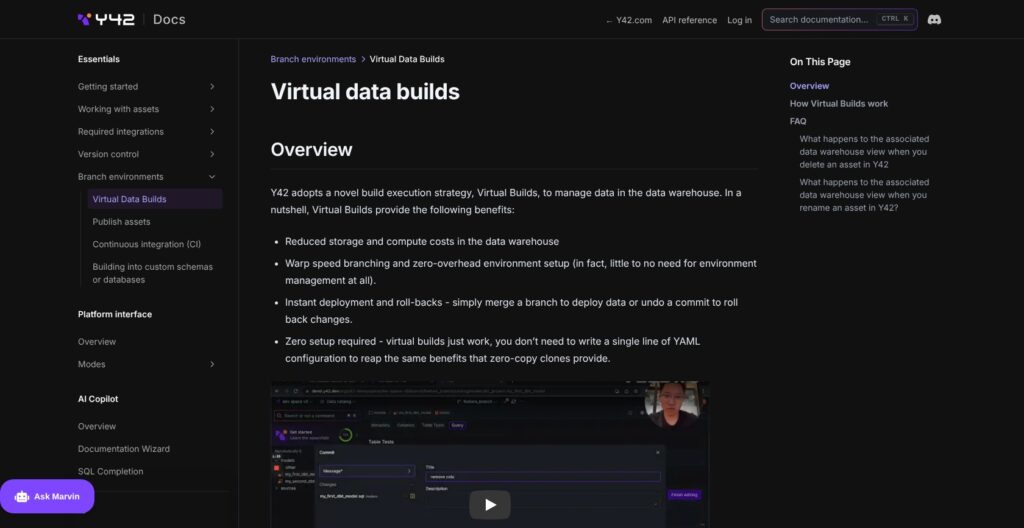
Y42 runs dbt Core models with materialization types, incremental models, snapshots, seeds, macros, packages, hooks, SQLFluff linting and BigQuery partitioning and clustering. Every model, source, orchestration, alert and exposure is a file in the space’s Git repo.
Virtual Data Builds
Each build writes a physical table with a UUID name, and the asset you query is a view pointing at the latest successful build. Merging a branch into main repoints main’s views to the branch’s tables with no rebuild, and reverting the commit points them back.
UUID tables are kept 30 days by default (configurable) unless they are still the latest valid build on a branch head, so rollback is time-boxed. Builds that fail tests are excluded from the view, which keeps failed data out of production.
Branch Environments and Published Assets
Any branch can be published as a warehouse dataset or schema named y42__{space_slug}__{branch_name}, and main is published by default, so a BI tool can read a feature branch before it merges.
CI Checks, Pull Requests and Data Diff
The CI check runs on a GitHub pull request or GitLab merge request, finds modified assets plus everything downstream, and reports healthy, pending, unhealthy or stale back to the Git host.
Y42’s own UI-based pull requests, in public beta since April 2024, put code and data diff side by side and are Enterprise-only. Y42 does not list CI checks or data diff as Enterprise features, so ask sales to confirm both run on Business.
Data diff, in public beta since May 2024, compares two materializations row by row through a full outer join on the keys you choose, and it needs org admin or space owner rights.
The Editor and the AI Copilot
The three development modes share one set of assets, and lineage has shown column-level links since February 6, 2024. The AI Copilot adds SQL completion and the Documentation Wizard, which drafts model and column descriptions once GenAI is enabled for the space.
dbt Cloud gives one development environment per project and leans on the Git host for CI/CD. Matillion pairs a visual canvas with SQL, Python and dbt Core.
The verdict: this workflow pays off for teams that ship model changes weekly and have been bitten by a bad merge, because a revert is a view swap rather than a rebuild. A solo analyst with one daily job will not notice it.
Monitoring, Testing and the Momentum Question
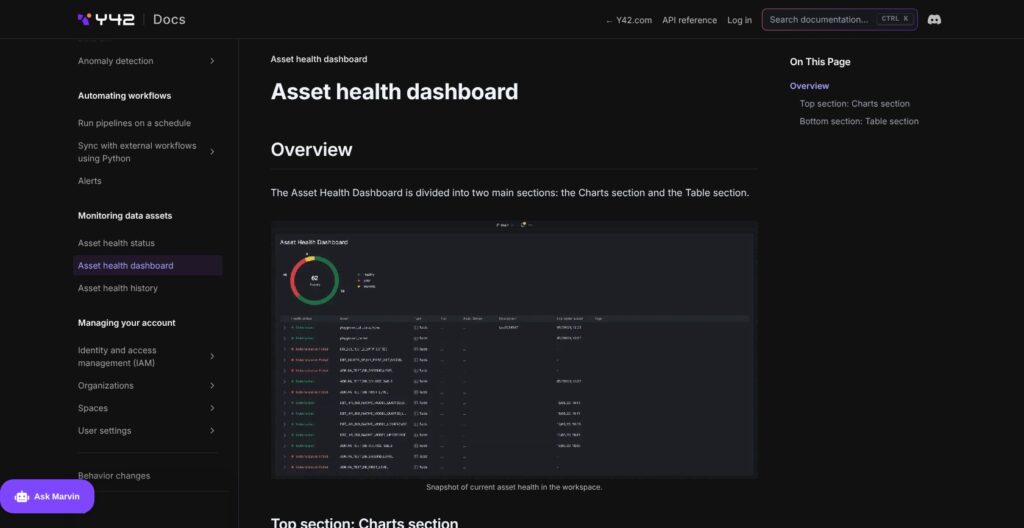
Asset health in Y42 covers code integrity (syntax errors, invalid references, uncommitted changes, SQLFluff warnings), test warnings, stale or never-materialized assets and deprecations. The Asset Health Monitor, which rolls those statuses into a pipeline-wide view, and the Data Catalog are Enterprise-only.
Tests, Anomalies and Alerts
dbt data tests run natively on both plans. Anomaly detection tests, in public beta since March 12, 2024, build on the open-source Elementary package with a Z-score method, flag outliers above 3 by default, and take anomaly_sensitivity, time_bucket, training_period and detection_period settings.
Alerts go by email on orchestration status, and Slack needs a Python action. Build retries (for example 5 retries every 10 minutes for sources) and timeouts (6 hours for sources, 1 hour for other assets by default) arrived in July 2024.
Exposures declare dashboards, notebooks and ML consumers with an owner, maturity and URL, and let you refresh everything upstream of one exposure.
Access runs on organization roles (Administrator, Limited Access, Limited Viewer), space roles (Owner, Viewer) and API keys with an expiry date and scoped roles. SSO via Okta, SAML or OAuth2, with an Enforce SSO switch that disables password login, is Enterprise-only.
Is Y42 Still Shipping?
Y42’s product-updates feed ends with Platform Interface Redesign on July 11, 2024, and the blog’s last post is dated July 12, 2024. At that point, UI-based pull requests, data diff, anomaly tests and CData connectors were all still in public beta.
Y42 is based in Berlin, was founded in 2020 by Hung Dang, raised a $31M Series A in October 2021 co-led by Atomico and Insight Partners ($36M in total by its own count), and claims 70+ employees. In October 2026 it still sells Business, runs the 14-day trial and cites a team of 40+ engineers.
No 2025 or 2026 release note, funding round or roadmap item is public, so ask sales for current release notes and a roadmap, and write the beta features’ support status into the contract.
My recommendation: sign no longer than a one-year term until sales shows you post-2024 releases, and host the repo in your own GitHub or GitLab so your dbt Core models stay in your hands if you leave.
How Does Y42 Compare to Competitors?
Y42 wins when one workspace that deploys and rolls back data through Git matters more to you than connector breadth or a free tier.
- dbt Cloud: Developer is free for 1 seat and 3,000 models built a month, and Starter is $100 per user per month for up to 5 seats and 15,000 models built. It wins for SQL-only teams and anyone who wants a free seat, but it has no ingestion and gives one development environment per project.
- Dagster (Dagster+): Solo is $10 a month and Starter $100 a month for up to 3 users, with credits at $0.035 to $0.040 per materialization plus $0.010 per serverless minute. It wins for Python-first orchestration, and you assemble ingestion and dbt yourself.
- Matillion: quote-only annual credit packages at 1 credit per orchestration task hour and 3 per transformation hour, with last published rates of $2.00 to $2.70 per credit and monthly minimums from $1,000. It wins for a visual canvas and four warehouses, including Databricks and Redshift.
- Fivetran: a 700+ connector catalog, a Free plan covering 500,000 monthly active rows and 5,000 model runs, and transformations at $0.01 per run from 5,001 to 30,000. It wins on catalog breadth and a free tier, and orchestrates nothing beyond its own syncs and dbt runs.
- Airbyte: Standard from $20 a month with 5 credits, Plus from $189 a month for 40 credits, and an open-source Core edition to self-host. It wins for cheap or self-hosted ingestion of the same connector base Y42 runs internally, and it has no transformation or orchestration layer.
- Coalesce: no published price and column-aware visual transformation built Snowflake-first. It wins for Snowflake-only teams that want a canvas rather than YAML.
| Tool | Pricing model | Published starting price | Free option | Scope |
|---|---|---|---|---|
| Y42 | Flat subscription plus row add-on | $500 a month | 14-day trial, no free plan | Ingestion, dbt Core, orchestration, monitoring on BigQuery or Snowflake |
| dbt Cloud | Per seat plus models built | $100 per user per month (Starter) | Developer plan free for 1 seat | Transformation |
| Dagster+ | Subscription plus credits | $10 a month (Solo) | None listed | Orchestration |
| Matillion | Annual credit packages | None published | 14-day trial with 500 credits | Visual ELT and orchestration on four warehouses, including Databricks and Redshift |
| Fivetran | Monthly active rows | No published price above Free | Free plan to 500,000 MAR | Ingestion plus dbt runs |
| Airbyte | Credits | $20 a month (Standard) | Open-source Core, 14-day trial | Ingestion |
Choose Y42 over dbt Cloud plus Airbyte when you want virtual data builds and one bill. Choose dbt Cloud plus Fivetran Free when you are one or two people and the $500 floor is the deciding number. Choose Matillion when you need Databricks or Redshift.
How I Reviewed Y42
For this Y42 review, I evaluated the platform on the areas Panoply weighs for every data tool: pricing transparency, openness and exit costs, setup and operating effort, connector depth, and development momentum.
That meant working through both plans and the Business-versus-Enterprise feature table line by line, pricing two example teams, mapping the setup path from account to a merged first pipeline, weighing ingestion, virtual builds, CI, testing and access control against each plan, and dating Y42’s last product update and blog post.
I compared prices and plan limits against dbt Cloud, Dagster+, Matillion, Fivetran, Airbyte and Coalesce. This is not a hands-on performance test, so build times, connector reliability and failure behavior are yours to measure on the 14-day trial. Prices current as of October 2026.
Should You Run Your Data Pipelines on Y42?
Yes, if you are a 2-to-5-person team on BigQuery or Snowflake with mainstream SaaS and database sources, you ship model changes often, and you want ingestion, dbt Core, scheduling, lineage and branch-level rollback in one subscription that starts at $500 a month for 3 users. The virtual data builds covered in the Git workflow section are the reason to pay $500 rather than assemble dbt Cloud, Airbyte and Dagster+ from about $420.
Skip it if you need Databricks, Redshift or self-hosting; if you need SSO, audit logging or the health dashboard without a custom Enterprise quote; if you are a solo analyst who can run dbt Cloud Developer free plus Fivetran Free; or if sales cannot show you a 2025 or 2026 roadmap, the gap covered in the momentum section.
Next step: start the 14-day trial on your own warehouse, run one CData and one Python source daily, merge and revert a branch on purpose, then ask for the per-seat price, the Python compute rate, the Enterprise price and current release notes in writing.
FAQ
How much does Y42 cost?
Y42 Business costs $500 a month for 2 spaces and 3 users, and Enterprise is custom-priced. The SQL-based ingestion add-on starts at $15 per million rows, Python compute bills per minute at an unpublished rate, and extra seats are sold per seat with no published price. The 14-day trial needs no credit card; see How Much Does Y42 Cost? above for worked examples.
Does Y42 have a free plan?
No, Y42 has no free plan; its zero-cost path is the 14-day trial, which opens a sandbox space that auto-deletes after 14 days. If you need a free option that lasts, dbt Cloud Developer gives 1 seat and 3,000 models built a month, and Fivetran Free covers 500,000 monthly active rows, enough for a solo analyst.
Which data warehouses does Y42 support?
Y42 supports BigQuery, paired with a Google Cloud Storage bucket, and Snowflake, paired with an AWS S3 or Azure Blob bucket. Databricks, Redshift and Postgres are not listed as warehouses, and there is no self-hosted deployment. If you need Databricks or Redshift, Matillion supports both.
Does Y42 replace dbt Cloud?
Yes, as the place your dbt project runs: Y42 runs dbt Core models, tests, packages and snapshots itself, then adds ingestion, orchestration and virtual data builds on top. Existing dbt projects can be cloned or pasted in, and Y42 claims a migration can take as little as 10 minutes. dbt Cloud gives one development environment per project, while Y42 can publish every branch as its own warehouse environment.
Is Y42 still being developed?
Y42 has published no product update since July 11, 2024, and its last blog post is dated July 12, 2024. Pricing and the 14-day trial are live in October 2026, but UI-based pull requests, data diff and anomaly tests were still labeled public beta at the last update. Ask sales for current release notes and a written roadmap before you sign.