Editor’s note: This data.world review is based on my hands-on test of the data.world catalog platform in November 2026. I weighed pricing, collector setup, lineage, governance, Archie and the MCP server, security, and rivals such as Collibra and Alation.
Quick verdict: I recommend data.world for large organizations, especially ServiceNow customers, that want glossary terms, lineage and access requests in one knowledge graph. There is no published price, free plan or trial, and approvals, ServiceNow handoff and Snowflake writeback cost extra as Governance Premium; DataHub Core and Collate’s free tier are the free routes.
My data.world review centers on one design choice: metadata lives in a knowledge graph that answers SQL and SPARQL, drives Eureka Explorer lineage and feeds a hosted MCP server. ServiceNow announced the acquisition on May 7, 2025, closed it in 2025, and listed ServiceNow Data Catalog as available on May 6, 2026.
In this review, I’ll take a closer look at data.world’s pricing, features, and lineage, so you can see exactly whether it fits your data team or whether a rival like Collibra or Alation is the better buy.
Key Takeaways
- Five modules (Catalog, Explorer, Marketplace, Governance, Workbench) share one SQL- and SPARQL-queryable knowledge graph.
- No published prices, free plan or trial; the free Open Data Community closed July 13, 2026.
- Supported collectors capture table, column and query-level lineage automatically; the rebuilt explorer is in beta.
- Governance Premium costs extra for multi-level approvals, ServiceNow handoff and Snowflake writeback.
- The hosted MCP server shipped September 22, 2026; Archie is a by-request preview.
Pros and Cons
Pros
- Knowledge-graph metadata queryable with both SQL and SPARQL in Workbench.
- Table, column and query-level lineage collected automatically by supported collectors.
- About 60 metadata collectors, most runnable in data.world’s cloud or on-premises.
- Hosted MCP server (September 2026) edits metadata under each user’s own permissions.
- Access requests with up to 5 approval levels that hand off to ServiceNow.
Cons
- No published prices, free plan or trial; demo request only.
- Free Open Data Community shut down on July 13, 2026.
- Approvals, ServiceNow handoff and Snowflake writeback need paid Governance Premium.
- Each cloud collector runs at most once a day.
- Latest SOC 2 Type II report year stated is 2022.
data.world Pricing: How Much Does It Cost?
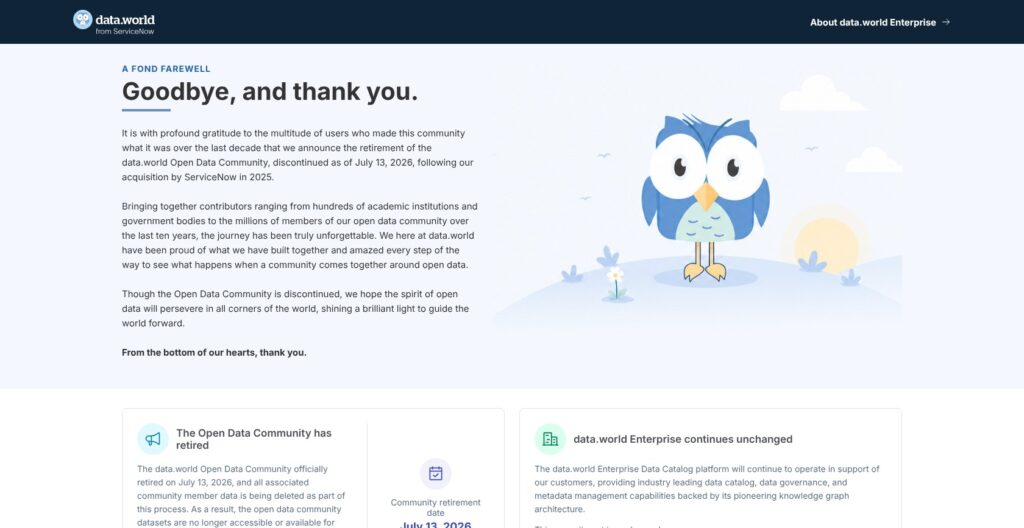
Buying starts with the “Get a demo” request and ends in a sales quote: data.world publishes no prices, and its Microsoft Azure Marketplace listing shows one SaaS plan with a “Contact me” button, no list price, no free trial and no free plan. Alation and Collibra both put a number on AWS Marketplace: Alation’s entry contract starts at $60,000 per 12 months, and Collibra lists $170,000 per 12 months.
- data.world Platform (quote): for the catalog, glossary, Explorer lineage, Marketplace, Workbench and the metadata collectors. Data Governance Core automations are included with the Standard version of the data.world Platform: inherited and default values, metadata freshness and completeness checks, query-based actions and access requests for datasets and projects.
- Data Governance Premium (add-on, quote): for multi-step workflows and task management: Approval: Access Request with up to 5 levels and ServiceNow handoff, Premium Metadata Completeness, Suggest changes, Suggest resources, Snowflake Writeback and Databricks Publisher.
- Archie AI (public preview): for Enterprise customers, who get Archie Chat and Archie Enrich switched on by request through their Customer Success Director; no separate price is published.
- Open Data Community (retired): the free tier for public datasets was discontinued on July 13, 2026, after the ServiceNow acquisition; member data is being deleted and its datasets are no longer available.
| Component | How it’s sold | Published price | What it adds |
|---|---|---|---|
| Platform | Sales quote | Quote | Catalog, graph, collectors, Core automations |
| Data Governance Premium | Paid add-on | Quote (add-on) | 5-level approvals, multi-step workflows, writeback |
| Archie | Enterprise public preview, by request | Not published | Chat and bulk metadata enrichment |
| MCP server | Hosted, works with a data.world login | Not published | AI clients search and edit the catalog |
| Open Data Community | Discontinued | Retired July 13, 2026 | No longer available |
Is data.world Good Value for Money?
| Tool | Published price | Free option |
|---|---|---|
| data.world | Quote only | None since July 2026 |
| Collibra | $170,000 per 12 months on AWS Marketplace | None published |
| Alation | From $60,000 per 12 months on AWS Marketplace | None published |
| Microsoft Purview | $0.0165 per asset per day (Data Catalog Standard); processing units $15 Basic, $60 Standard, $240 Advanced | Pay as you go |
| Atlan | Quote only | None |
| DataHub | Core free; Cloud by quote | DataHub Core, Apache 2.0 |
| Select Star | Not published | 14-day trial |
| Collate (managed OpenMetadata) | Paid tiers not published | Free tier: 5 users, 500 data assets |
- Purview’s meter scales with the estate: a 10,000-asset catalog on Data Catalog Standard costs 10,000 x $0.0165 x 365 = about $60,225 a year before processing units, roughly Alation’s $60,000 entry contract.
- Good value only as a bundle: data.world’s knowledge graph, governance automations and ServiceNow handoff together justify a quote with no public anchor; a searchable inventory alone does not.
- A small catalog needs no quote at all: DataHub Core carries no license fee under Apache 2.0, and Collate’s managed free tier covers 5 users and 500 data assets.
Reviewer’s Notes: I recommend starting with the platform and the Core automations, which already cover default and inherited values, completeness checks and access requests for datasets and projects. Add Governance Premium only for multi-level approvals, ServiceNow fulfillment or Snowflake writeback, and have Archie and the MCP server written into the quote, since neither carries a published price.
My Experience With data.world
Getting Access Through Sales
My access started with the “Get a demo” request: data.world has no self-serve signup, and the free Open Data Community that offered free accounts closed on July 13, 2026. Select Star, by contrast, offers a 14-day trial before any sales call.
The data.world team set up my initial metadata profile, and the Catalog Toolkit split my install into four organizations:
- Catalog Configuration: the metadata profile, custom fields and sections.
- Catalog Sources: where collector output lands.
- Catalog Sandbox: a QA preview, not a trial environment.
- Catalog Main: production, where stewards enrich metadata.
Connecting Snowflake With a Cloud Collector
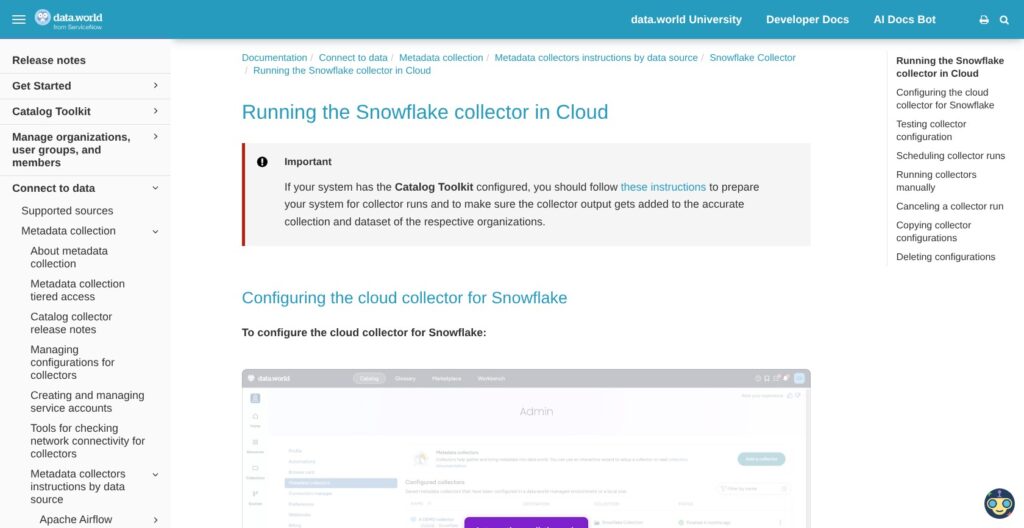
The Snowflake collector authenticates with username plus key-pair, because username and password support is being discontinued. Every run also needs a ddw-catalogs dataset for catalog files and an IP/domain allowlist.
- In the Catalog experience, I opened Admin > Metadata collectors > Add a collector and picked Snowflake.
- I chose Cloud: data.world as where the collector runs.
- I named the target collection and picked the dataset for automatic upload.
- I entered the server, database, Snowflake role and private key file, then selected the schemas to collect.
- I clicked Test to check the connection, then saved the configuration.
Optional settings and their defaults:
- Column statistics: a 100,000-row sample.
- Sample data: 10 rows per table, attached as a Parquet file.
- Access-history lineage: off, with a 7-day lookback when switched on.
- Sensitive data classification: a 1,000-row sample.
On-premises runs are the alternative: Docker or JAR files on a machine with 8 GB RAM and a 2 GHz CPU, plus Docker or OpenJDK 17.
Reviewer’s Notes: Full extended metadata and lineage from Snowflake need the ACCOUNTADMIN role. Any other role gets basic metadata unless it is granted USAGE on the warehouse, database and schemas and SELECT on tables, external tables and views, including future ones, so I recommend settling that security review with your Snowflake admin before the first run.
Scheduling Runs and Checking the First Collection
I clicked Run now once, then set a Daily, Weekly or Monthly schedule at a chosen time. One collector can run only once a day, and a scheduled run may start up to one hour late, so intraday refreshes are off the table.
The Last run summary showed total resources collected and a count by resource type, and logs appear about 5 minutes after a run starts. Organization-level webhooks report six run statuses:
- Pending
- Provisioning
- Running
- Completed
- Error
- Cancelled
Incremental Snowflake runs re-collect only schemas with changed objects, but data.world says to use them only under its team’s guidance and no more often than Snowflake’s account_usage lag of up to about 3 hours. Tag value, Streamlit, owner and column-statistics changes are not fully captured incrementally.
Adding My First Glossary Term
Only users with Edit or Manage access can create glossary terms. In the Glossary experience, I clicked New, chose Business term (an organization subtype can replace it), set a title and collection, and wrote a Markdown description and summary. Duplicate titles are allowed and flagged with up to 50 matches listed, so naming discipline stays with the stewards.
Knowledge Graph, Workbench and the Metadata Profile
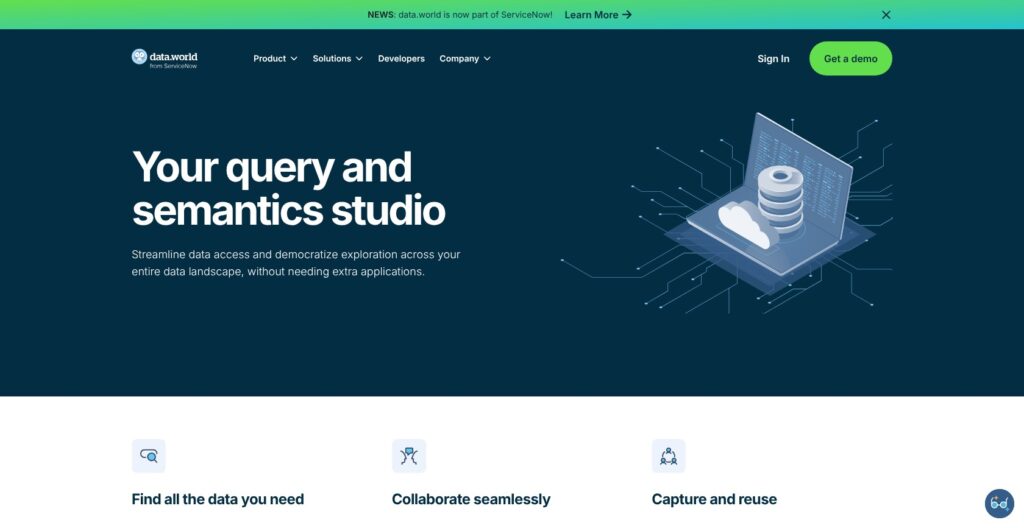
The knowledge graph models metadata, processes, policies, people and systems as nodes and edges. Workbench runs SQL against the data and SPARQL against the graph in the same studio, with shared, saved queries. The company positions data.world as the only data catalog and governance platform powered by a knowledge graph; the part that changes daily work is the customizable metadata profile.
The Catalog Toolkit’s metadata profile lets an admin change:
- Resource types: add organization-specific types beyond the supplied ones.
- Fields and sections: organize the properties shown on each resource record.
- Relationships: define how resources connect to one another.
- Glossary subtypes: split business terminology into distinct kinds.
Data Products is a module switched on under Catalog Configuration > Metadata profile > Other Modules > Data Products, with select-field values such as Criticality and Data Product Category loaded from an Excel template in the ddw-template-files dataset.
Marketplace shows published data products in a shopping-style view organized by domain, and reached general availability with the new navigation in the November 18, 2025 release. Glossary hierarchy followed on April 20, 2026.
The graph pays off for teams with ontology or semantic-modeling skills, who get custom relationships plus SPARQL to query them. For a team that only wants search, it is configuration overhead: DataHub Core (free under Apache 2.0) or Collate’s free tier (5 users, 500 data assets) is the cheaper start.
Lineage in Eureka Explorer: Table, Column and Query Level
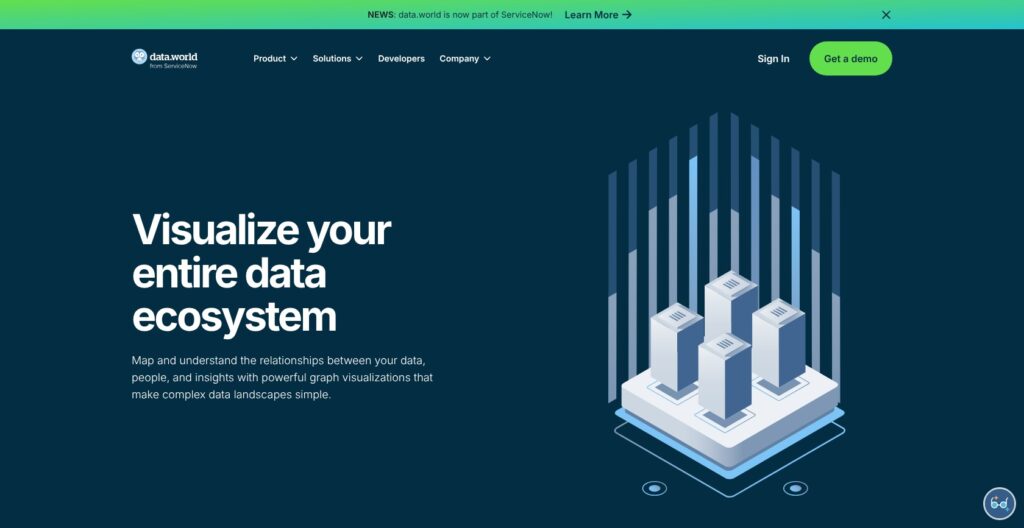
Collectors capture lineage and the knowledge graph stitches it across sources, so Eureka Explorer shows table, column and query-level technical lineage, collected automatically for Enterprise customers whenever a supported collector runs. Cross-system lineage appears only when both systems’ collectors harvest lineage, so a library of about 60 collectors does not mean column-level coverage for every source.
Controls in the Lineage tab:
- Sidebar groups: Upstream, Lineage Target, Downstream and Ignored, by degree of separation.
- Numbered edges: a badge counts bundled relationships; selecting the edge shows table and column dependencies.
- Expandable containers: database and schema nodes open into their contents.
- Focus: hides other assets to isolate one path.
Snowflake lineage can come from SQL parsing with a 60-second timeout, plus optional access history. Manta and Marquez collectors and custom lineage relationships add further sources.
The January 15, 2026 release put a data quality health badge on lineage elements, fed by a separate data quality provider. The End of Summer 2026 update added a rebuilt explorer in beta with dbt models as process nodes and a switch back to the legacy view.
Best for: estates where every critical hop has a supported collector. Skip if: a key lineage path runs through a source without one, or you need the rebuilt explorer out of beta.
Governance Automations: Core vs Premium
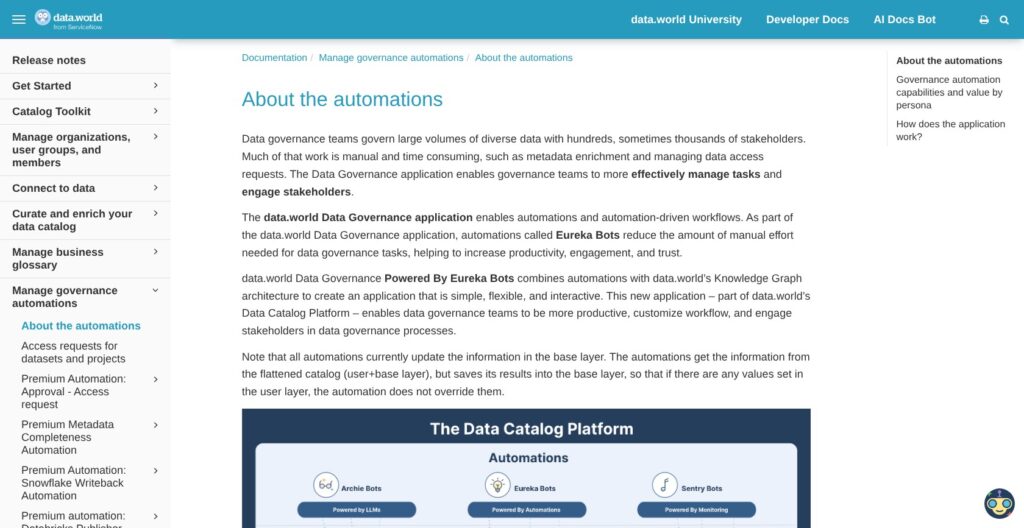
Eureka Bots come in two tiers: Data Governance Core, included with the Standard version of the data.world Platform, runs single-step automations, while Data Governance Premium, a paid add-on, adds task management, multi-step workflows and the ServiceNow integration.
Core Automations
- Inherited Value Assignment
- Assign Default Value
- Metadata Freshness Refresh
- Metadata Freshness Review
- Metadata Completeness check
- Metadata query-based actions
Premium Automations
- Approval: Access Request
- Premium Metadata Completeness
- Suggest changes
- Suggest resources
- Snowflake Writeback
- Databricks Publisher
Approval: Access Request lets admins pick resource types (not datasets or projects), name the request button and chain up to 5 approval levels, each mapped to a user group. Approved requests go to ServiceNow for fulfillment, to an email address, or both, and since the January 15, 2026 release ServiceNow sends status updates back, so the handoff runs both ways.
Snowflake Writeback pushes approved descriptions to database, schema, table and column comments only, when a user clicks Publish Metadata to Snowflake; sync is usually immediate and can take up to 15 minutes. The catalog becomes the source of truth, so comments edited directly in Snowflake are overwritten at the next sync, and each organization gets one Snowflake automation.
Inside the catalog the rule flips: automations write to the base layer and never override a value a user set.
Collibra lists $170,000 per 12 months on AWS Marketplace, a public number to hold a Premium-inclusive quote against. Buy Premium for approval chains, ServiceNow fulfillment or Snowflake writeback; Core already covers defaults, inheritance, freshness and completeness checks.
Archie AI and the data.world MCP Server
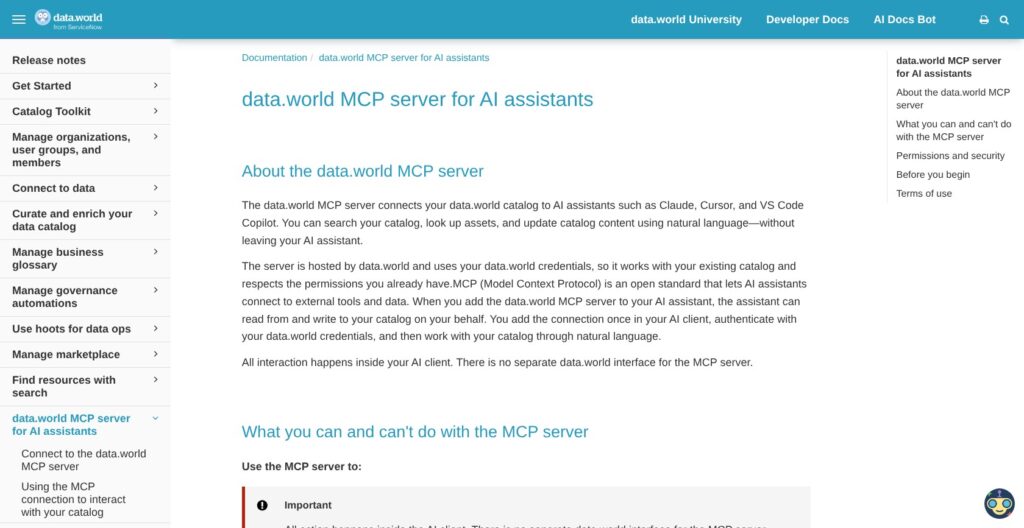
The data.world MCP server, released on September 22, 2026, is hosted at api.data.world/mcp with nothing to install. It connects Claude, ChatGPT, Gemini and other MCP clients through OAuth (recommended), a Public API token or a service account token, and lets them:
- Find: search the catalog and open a resource’s full record.
- Edit: update descriptions, tags and custom properties, or clear properties.
- Create: add resources one at a time or in bulk.
- Relate: create or remove relationships.
- Automate: trigger configured governance automations.
It cannot suggest changes, manage datasets and projects, or manage access and users, and relationship tracing goes one level per request. Every action runs under the user’s own permissions; OAuth authorization lasts 30 days, and sessions end after 30 minutes idle or 12 hours.
Archie is still an Enterprise public preview, switched on per organization or per user by request through the Customer Success Director:
- Archie Chat: multi-turn chat over catalog metadata, also from Slack.
- Archie Enrich: bulk AI descriptions, research questions and SQL help.
The SQL-explanation and research-question betas also need experimental features enabled. The company says it uses an internally hosted model and does not train on customer data, but Archie does not mask personal data placed in the catalog.
The MCP server is the AI feature to buy today: shipped and permission-bound. Atlan also runs an MCP server and states it carries no extra charge; data.world publishes no separate MCP price.
Security, Deployment and the ServiceNow Roadmap
The only SOC 2 Type II report year data.world states is 2022, alongside an affirmative HIPAA opinion (not a HIPAA certification) with a form BAA on request. Identity and infrastructure controls:
- SAML SSO with user provisioning, plus SCIM provisioning with Okta and Microsoft Entra.
- Role-based access control and sensitive data classification in collectors.
- Encryption in transit and at rest, with encrypted backups in geographically distributed data centers.
- Private network, host intrusion detection and file integrity monitoring.
- Annual external penetration test plus code analysis.
Deployment is multi-tenant SaaS with single-tenant offerings, and collectors run in data.world’s cloud or on-premises. No hosting regions are published and there is no ISO 27001 claim, so put both, plus a current SOC 2 report, into the procurement questionnaire.
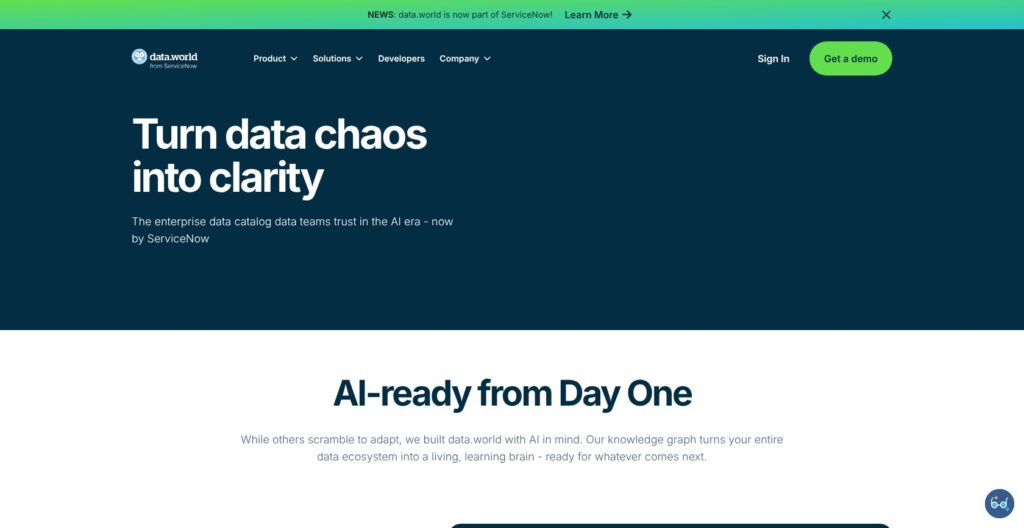
The data.world homepage carries the banner “data.world is now part of ServiceNow!”, linking to ServiceNow’s Workflow Data Fabric. At Knowledge 2026 on May 6, 2026, ServiceNow listed ServiceNow Data Catalog as available now alongside Autonomous Data Governance, and data.world’s own notice says the Enterprise Data Catalog platform continues to operate.
ServiceNow shops gain a native fulfillment path for access requests, with status updates flowing back. Everyone else should ask how long the data.world-branded product and its contracts will continue.
How Does data.world Compare to Competitors?
Against these rivals, data.world wins on semantic modeling, SPARQL access and ServiceNow-integrated access requests. It loses on price transparency to Collibra, Alation and Microsoft Purview, and on free evaluation to DataHub, Select Star and Collate.
- Collibra: the Collibra Cloud Platform subscription lists $170,000 per 12 months on AWS Marketplace, with 24- and 36-month contracts also listed. It wins for governance-led programs that want workflow depth and a public number to budget against.
- Alation: its AWS Marketplace contract starts at $60,000 per 12 months, about a third of Collibra’s figure. It wins when procurement needs the lower of the two published enterprise entry points.
- Atlan: pricing is quote only, like data.world’s, but Atlan states its MCP server carries no extra charge. It suits buyers who accept a negotiated platform price but want MCP inclusion settled before sales discussions.
- Microsoft Purview: Data Catalog Standard costs $0.0165 per asset per day, plus Data Governance Processing Units at $15, $60 or $240, pay as you go. It wins for Azure estates that want a forecastable meter instead of a negotiation.
- Informatica Cloud Data Governance and Catalog: billing runs on Informatica Processing Units (IPUs). It wins for teams already on Informatica’s IDMC and its IPU billing.
- DataHub: DataHub Core is free under Apache 2.0 and self-hosted; DataHub Cloud is custom-priced. It wins for engineering teams that can run their own catalog.
- Select Star: a 14-day trial, automated column-level lineage and an MCP server, with no published prices. It wins when you need to test lineage before talking to sales.
- OpenMetadata: open source, with Collate’s managed free tier at 5 users and 500 data assets and unpriced paid tiers. It wins for a small team that wants a free managed start.
My routing: data.world for graph-centered governance on ServiceNow, Alation or Collibra when procurement needs a published number, Select Star for a trial, and DataHub Core or Collate for a free start.
How I Reviewed data.world
I walked through the Snowflake cloud collector setup with key-pair authentication, the run schedule and Last run summary, glossary term creation, Eureka Explorer lineage, the Core and Premium governance automations, the MCP server connection and Archie’s preview scope.
The checks that moved my verdict:
- Lineage: supported-collector coverage, cross-system stitching and the beta explorer.
- Governance: what Core includes and what the paid Premium add-on adds.
- AI: MCP permissions and limits, and Archie’s public preview status.
- Security: identity controls, deployment options and the stated SOC 2 report year.
I weighed pricing transparency, setup effort and value against Collibra, Alation, Atlan, Microsoft Purview, Informatica, DataHub, Select Star and OpenMetadata.
Prices current as of November 2026.
data.world Review: Should You Buy data.world for Your Data Catalog?
The catalog pairs a knowledge graph with table, column and query-level lineage from supported collectors, about 60 metadata collectors, included Core governance automations and a hosted MCP server. The catch is quote-only pricing with no free path, and the approval and writeback workflows cost extra as Governance Premium.
Buy it if: you are a large organization, especially one running ServiceNow, that wants semantic modeling and governed access requests in one model. Custom relationships, SPARQL and 5-level approvals with ServiceNow fulfillment justify the quote; the collector count alone does not, since Select Star also automates column-level lineage.
Skip it if: you need a published price (Alation from $60,000, Collibra at $170,000 per 12 months), a trial (Select Star’s 14 days), a free start (DataHub Core or Collate’s free tier) or an Azure-native meter (Microsoft Purview at $0.0165 per asset per day).
Next, request a demo and ask for the platform, Governance Premium, Archie and the MCP server to be priced as separate lines. Have the demo run on your own Snowflake roles and one cross-system lineage path you depend on.
FAQ
Is data.world free?
No. The enterprise catalog has no free plan, no trial and no self-serve signup; access starts with a “Get a demo” request and ends in a sales quote. The free Open Data Community shut down on July 13, 2026, member data is being deleted, and its datasets are no longer available. DataHub Core and Collate’s free tier are the free alternatives.
How much does data.world cost?
The price is not published: you get a sales quote after a demo request, and Data Governance Premium is a paid add-on on top of the platform. Archie has no separate published price. For reference, Alation starts at $60,000 and Collibra lists $170,000 per 12 months on AWS Marketplace. See the pricing section above.
Is data.world part of ServiceNow?
Yes. ServiceNow announced the acquisition on May 7, 2025, and closed it in 2025. ServiceNow’s name for the product is ServiceNow Data Catalog, listed as available on May 6, 2026, while the data.world site and release notes keep the data.world name and the Enterprise Data Catalog platform continues to operate.
Does data.world have column-level lineage?
Yes. Eureka Explorer shows table, column and query-level technical lineage, collected automatically for Enterprise customers when a supported collector runs. Coverage depends on the source: cross-system lineage needs both systems’ collectors to harvest lineage, and the rebuilt explorer is still in beta. See the lineage section above.
Does data.world have an MCP server?
Yes. Released on September 22, 2026, it is hosted at api.data.world/mcp with nothing to install and connects through OAuth, a Public API token or a service account token. Every action respects the user’s permissions; it cannot suggest changes or manage access, users, datasets or projects, and relationship tracing covers one level per request.