Editor’s note: This Atlan review evaluates documented capabilities, pricing, and implementation requirements. It does not include a hands-on deployment.
Quick verdict: I recommend Atlan for organizations that need analysts, engineers, and data stewards to share a catalog across several systems. Its combination of discovery, lineage, and governed AI context is appealing, but the enterprise buying process and continuing stewardship work make it a demanding choice for smaller teams.
Key Takeaways
- Atlan connects technical assets with owners, business definitions, and lineage so people can judge whether data fits their task.
- Its own comparison material gives a starting point of $100,000 per year; your actual package requires a sales quote.
- Connector support does not guarantee complete lineage. Coverage depends on the source, transformations, and permissions.
- Context Agents can enrich documentation, but credits and collection limits affect how much work each run can accomplish.
- DataHub deserves a look when open-source control matters; Collibra and Alation are relevant enterprise alternatives.
In this review, I’ll look at pricing, rollout, and AI capabilities to assess its fit among catalogs and governance tools.
Atlan Pros and Cons
Pros
- Discovery combines ownership, certification, glossary terms, and technical metadata.
- Lineage supports dependency checks across connected systems.
- Personas and tag-based policies support different teams and sensitive assets.
- Context Agents help generate descriptions, READMEs, and SQL context.
- A remote MCP server makes permission-scoped metadata available to compatible agents.
Cons
- Enterprise pricing requires a scoped quote before you can compare total costs.
- Some connectors have substantial lineage gaps, including Matillion ETL.
- Context Agents runs select up to 500 parent assets per collection.
- Documentation, ownership, and AI-generated context still need human oversight.
Atlan Pricing
Atlan sells through a sales conversation, with scope agreed for your organization. Its own Atlan versus DataHub page lists managed SaaS starting at $100,000 per year, tied to users and data-estate size. I would treat that as a budgeting signal, not a complete offer with defined inclusions.
The public pricing route directs you to sales. Confirm the terms of any evaluation, including whether you can connect your own systems.
- Commercial platform (vendor-stated starting point: $100,000/year): for organizations evaluating a managed catalog and governance platform. Request a written scope for your users, sources, environments, and support.
- AI capabilities (quote-dependent licensing and credits): confirm enablement, included usage, and additional charges. Do not assume every advertised AI feature is bundled with the base platform.
| Purchase component | Public pricing information | What to confirm |
|---|---|---|
| Managed platform | Vendor comparison lists a $100,000/year starting point | Contract scope and annual price |
| Atlan AI | Additional enablement or licensing may apply | Features included in your proposal |
| Context Agents Studio | Documented credit consumption | Included credits, replenishment price, and limits |
| Evaluation | Product tours and sales discussions available | Whether your proposed evaluation includes your own sources |
Ask the sales team to map each quoted component to the workflows demonstrated during evaluation.
Is Atlan Good Value for Money?
I see the strongest case when multiple departments repeatedly need help identifying the right dataset or understanding a change’s downstream effects. Shared context can address those problems, provided people actually maintain and use it.
The value calculation should include your own operating effort:
- Source administration: credentials, permissions, and connector troubleshooting.
- Stewardship: ownership assignments, disputed definitions, and documentation review.
- AI consumption: enrichment scope and the credits required to sustain it.
- Adoption: whether intended users can complete real tasks through the catalog.
For an enterprise buyer, my recommendation is a scoped commercial proposal covering one important business domain, with expansion terms agreed before wider rollout. For a small team with a single warehouse and manageable documentation, I would first assess whether existing tools cover the immediate need.
Getting Started With Atlan
I would begin with a recurring business question, such as which revenue dataset finance should use. That gives the rollout a concrete outcome and makes it easier to recognize missing definitions or ownership.
Source connections and metadata ingestion are only part of the rollout. Your team still needs to configure access and curate useful business context.
- Choose a business domain. Select a manageable set of datasets and reports with identifiable users and owners.
- Connect its systems. Include the warehouse, relevant transformation tooling, and BI layer. Check permissions against each connector’s requirements.
- Inspect ingestion and lineage. Run the required crawlers and miners, then follow an actual dependency chain. A successful job does not prove every expected relationship exists.
- Add business context. Link useful glossary terms, assign owners, and clarify what trusted or certified means for your organization.
- Configure access. Give teams the appropriate catalog views and policies before making the rollout broader.
- Evaluate a real task. Have an intended user find the right dataset, identify its owner, and understand its downstream use.
That last step matters more to me than the total number of assets imported. An impressive inventory can still leave an analyst asking the same questions in chat.
Atlan connects to warehouses such as Snowflake and BigQuery, transformation tools such as dbt, and BI platforms such as Looker and Power BI. Confirm which asset types and relationships your specific connectors expose before setting the rollout scope.
Reviewer’s Notes: I would put the most disputed metric in the first rollout. If the team cannot agree on its definition and owner, adding more systems will multiply the same problem.
Data Discovery and Business Context
Atlan’s discovery tools bring technical metadata and business context into the same search experience. You can narrow assets by connection, type, domain, owner, certification, tags, terms, and other properties.
What I like is the ability to make a decision after finding an asset. A table name alone rarely explains whether it contains approved reporting data or an abandoned experiment. Ownership and definitions give the person searching a more useful starting point.
Consider an analyst looking for customer revenue. For example, they could filter to the relevant domain, inspect certification, check the associated business definition, and contact the owner if the scope remains unclear.
- Meaning: does revenue include refunds, taxes, or intercompany transactions?
- Responsibility: who can resolve a disagreement or approve a change?
- Use: which downstream reports rely on this asset?
- Suitability: is it approved for the analyst’s intended purpose?
Atlan can organize that context. Your organization has to supply the decisions behind it. I would be cautious about treating a populated description field as proof that a dataset is ready for important reporting.
Alation is a relevant comparison here because its catalog also emphasizes discovery and includes Compose for shared SQL work. If your biggest obstacle is helping analysts reuse queries, include that workflow in the comparison. If the obstacle spans technical dependencies and business ownership across systems, evaluate how well each catalog brings those pieces together.
Data Lineage and Change Impact
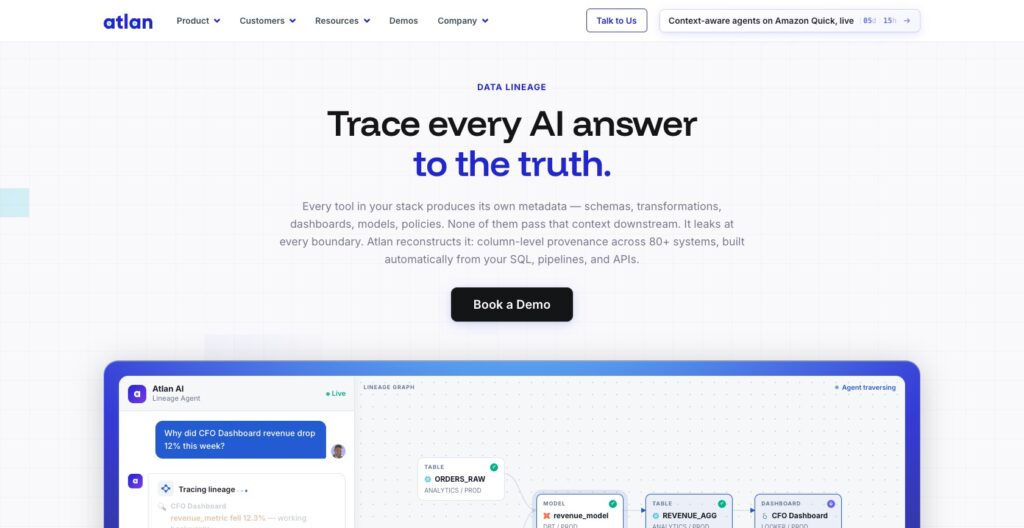
Atlan’s lineage can help you understand what a change might affect before it reaches a report. The documented approach combines source metadata with other signals, including query history where miners support it.
Before changing a field, an engineer needs to identify affected downstream assets and their owners. I would prioritize the paths feeding important reports when assessing how useful Atlan’s lineage will be.
A practical evaluation should follow one business-critical column through the systems you actually use. Include a transformation that is representative of your pipelines, rather than only a simple table-to-dashboard example.
Coverage is the limitation to examine closely. Atlan documents that its Matillion ETL connector does not provide end-to-end or column-level lineage because of source API limitations. Its Qlik Sense Cloud documentation also identifies gaps involving certain joins and calculated fields.
Other gaps can arise around stored procedures or unsupported cross-system relationships. Atlan provides routes such as mapping files, OpenLineage, and API or SDK work for applicable cases, but that adds implementation responsibility.
If your comparison includes DataHub, give both products the same representative dependency chain. Compare the missing edges and the work required to maintain them. I would not award either product the win solely from a feature checklist saying it supports column-level lineage.
Governance and Access Controls
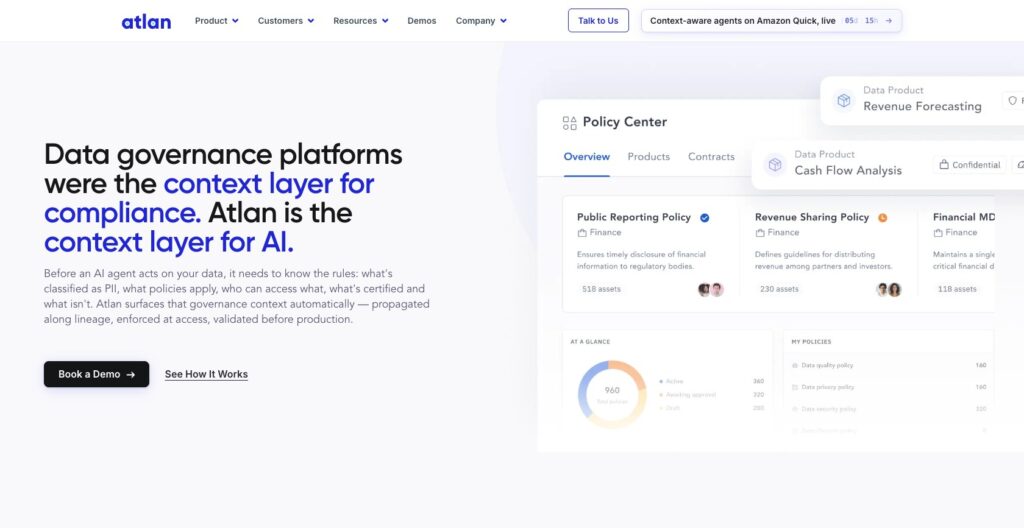
Atlan combines role permissions with Personas and Purposes. Personas organize access around teams and curated views; Purposes apply policies around tags, such as sensitive-data classifications.
Roles establish a permission ceiling, grants can combine, and an explicit deny overrides grants. Those rules matter when a user belongs to more than one group.
I like this flexibility for organizations where finance, marketing, and engineering need different views of the same estate. It also creates configuration work: administrators need to understand why a user can see an asset, not just whether the relevant checkbox looks correct.
Catalog permissions should not be assumed to enforce every restriction in every connected source. Ask for the behavior of the specific source and access workflow you intend to use.
Governance also reaches beyond permissions. Atlan’s data-contract capabilities support contracts created in its interface or imported through a CLI, with version history, SLAs, and quality rules. These can help make expectations visible alongside data products, but the responsible teams still need to agree on those expectations.
There is also a specific limit for AI governance: Atlan’s native Request Data Access workflow does not support AI Model or AI Application asset types. Its guidance directs you to govern those through Data Products. If model access is a core requirement, include that route in your evaluation.
Collibra belongs on the shortlist if formal governance processes are the main requirement. Its BPMN workflow framework offers a concrete comparison point for approval and stewardship processes. I would evaluate one real approval path in both systems before deciding which fits the organization better.
Atlan AI and Context Agents
Atlan’s Conversational AI can search assets, identify owners, trace lineage, and summarize metadata, with links back to source assets. It is available within Atlan and through integrations including Slack and Teams.
That is useful when someone does not know the catalog’s exact naming conventions. My reservation is that a fluent answer still depends on the quality of the underlying descriptions and definitions.
Documentation Agents and Their Limits
Context Agents Studio includes Description, README, and SQL Intelligence agents. SQL Intelligence requires tables or views with query history; administrative permissions are needed to operate the studio.
| Agent | Documented credits per enriched asset | Buying implication |
|---|---|---|
| Description | 10 | Count columns as well as their parent assets |
| README | 50 | Budget for the assets needing longer documentation |
| SQL Intelligence | 100 | Confirm useful query history is available |
Atlan’s example of one table with 50 columns consumes 510 Description credits. The credit count is useful for sizing work, but it does not give you a dollar cost without your contract’s allocation and replenishment terms.
Collections also have a meaningful execution limit: an agent run selects up to 500 parent assets, using popularity before checking which still need enrichment. Repeating the run therefore may not reach less popular assets further down the collection. Splitting a large collection is a practical way to address that behavior.
If a run exceeds its credit limit, that run completes, but new runs cannot start until credits are replenished. I would budget for recurring enrichment and agree who reviews the output before generating documentation across a large domain.
AI Descriptions and Agent Access
Atlan keeps source, user, and AI descriptions distinct, with user descriptions taking display priority. Accepting unchanged AI text preserves its AI status; editing and saving it creates a user description. Only user descriptions reverse-sync to sources.
That distinction matters if your goal is to update documentation in the originating system. Simply approving generated text is not the same operation as editing it for reverse sync.
Atlan’s remote MCP server also exposes metadata to compatible agents under the requesting identity’s existing permissions. I like the potential to reuse governed context across applications, provided the integration is evaluated against known business questions.
For security review, Atlan says underlying customer data is not sent to its AI services, while metadata and conversational inputs can be processed. It also states that customer metadata, prompts, and outputs are not used for foundation-model training; conversational observability retains prompts and completions for 30 days. Those boundaries should be checked against your organization’s requirements.
How Atlan Compares With Alternatives
Collibra, Alation, and DataHub deserve a place on the shortlist for different reasons:
- Collibra: worth prioritizing when structured governance workflows and policy processes drive the purchase. Compare the effort required to represent your actual approval process, rather than counting governance features.
- Alation: worth evaluating when analyst discovery and shared SQL work are central. Its Compose and Alation Anywhere capabilities offer concrete workflows to compare with Atlan’s discovery and collaboration features.
- DataHub: the clearer starting point when an Apache 2.0 foundation and the ability to self-host or modify the platform are requirements. Include deployment, upgrades, and maintenance in the comparison, and distinguish the open-source edition from commercial cloud capabilities.
For Atlan, the strongest case is bringing discovery, ownership, lineage, and AI context into a shared platform. I would still make the final choice on a small set of completed tasks: finding trusted data, identifying downstream impact, and handling an ownership or access question.
Price comparisons should use matching scope. A software quote and an open-source license cost describe different parts of the bill; your team’s ongoing work belongs in both calculations.
How I Reviewed Atlan
I evaluated Atlan’s published product information and documentation for pricing, discovery, lineage, permissions, AI enrichment, and rollout requirements. I also compared the documented approaches of Collibra, Alation, and DataHub.
The recommendations reflect that research and editorial analysis, without measured claims about deployment speed, search accuracy, or productivity gains. Pricing information was checked in October 2026; final commercial terms require a written quote.
Should You Choose Atlan?
I would choose Atlan for an enterprise with a clear cross-team discovery problem, an accountable governance owner, and the budget to support continuing curation. Its catalog and AI context capabilities are most persuasive when they serve the same agreed business definitions.
Before committing, require an evaluation using your own sources and a quote that includes the AI workflows you intend to run. If the critical lineage chain is incomplete or nobody owns the documentation after launch, I would resolve those issues before expanding the deployment.
FAQ
What Is Atlan Used For?
Atlan helps teams discover and govern data assets by connecting technical metadata with business definitions, owners, and lineage. It also provides context for AI applications.
How Much Does Atlan Cost?
Atlan publishes a $100,000/year starting point in its comparison material. Your package, AI entitlement, and final price require a custom quote.
Does Atlan Replace a Data Warehouse?
No. It adds catalog and governance context to your existing stack. You still need systems that store and transform analytical data.
Is Atlan an Alternative to DataHub?
Yes, both belong in a data-catalog evaluation. DataHub’s Apache 2.0 core is the clearer starting point if modifying and self-hosting the platform is a requirement. Compare its open-source and cloud editions separately.
Does Atlan Automatically Document Every Asset?
No. Agent eligibility, available context, credits, collection limits, and existing descriptions affect enrichment. Generated documentation also needs appropriate human review.