Editor’s note: This Select Star review evaluates documented product behavior. It does not include hands-on warehouse testing.
Quick verdict: I recommend shortlisting Select Star for warehouse and BI discovery if its available commercial offering covers your sources and access requirements. Select Star now describes itself as part of Snowflake, following the acquisition agreement announced on November 24, 2025. Current standalone purchase and trial availability still need to be established in the commercial proposal.
Among modern data catalogs, Select Star interests me most as a way to connect technical dependencies with business context. Its documented approach combines metadata with query history and activity logs. That gives you more to work with than an inventory of table names, but the usefulness depends on which sources and assets you include.
Key Takeaways
- Warehouse-to-BI context: Column-level lineage and downstream dashboard views support impact analysis.
- Discovery beyond names: Usage signals, ownership, and SQL examples provide context for choosing assets.
- Human-owned documentation: AI suggestions can help draft descriptions, but business meaning still needs an owner.
- Daily lineage limits: Refresh timing and source coverage prevent treating the graph as an instantaneous dependency map.
- Conditional buying route: Pricing requires a quote, and published trial terms do not establish current trial eligibility.
I’ll cover pricing and setup first, then discovery, lineage, AI documentation, and access controls. I’ll also explain where Atlan, DataHub, or Alation deserves a place on your shortlist.
Pros and Cons
Pros
- Column-level lineage with downstream dashboard views
- Search ranking incorporates usage signals
- Common queries and join conditions provide SQL context
- Editable AI-generated descriptions
- dbt impact reports can appear in GitHub pull requests
Cons
- No established public dollar price for budgeting
- Lineage refreshes approximately daily
- Connector capabilities vary by source
- Overlapping access policies favor the broadest matching grant
How Much Does Select Star Cost?
Select Star pricing is quote-dependent. Its public sales information does not provide a dollar price or named plan allowance for budgeting. I see that as a drawback if you need to compare costs before talking to sales: the available package and its scope need to be part of your proposal.
- Paid access: Quote-dependent; price, scope, and current availability belong in the commercial proposal.
- Published trial terms: A 14-day free trial, with longer periods at Select Star’s discretion; current eligibility is not established by those terms.
| Access route | Published price or terms | Appropriate use | Buying limitation |
|---|---|---|---|
| Quote-dependent paid access | No current public dollar figure established | A defined catalog deployment | Available offering and included capabilities need contractual scope |
| Published trial terms | 14 days free; extensions at vendor discretion | Evaluation, if currently offered | Terms do not prove that new trials are available |
The Snowflake relationship makes contract scope especially important. Snowflake’s announcement described plans to bring capabilities into Horizon Catalog. Those plans alone do not establish the offering available to a new customer today. For me, the proposal needs to identify the product being supplied and the applicable support and transition terms before a team commits to a rollout.
The quote also needs to cover the sources and controls your workflow needs. A proposal centered on metadata discovery is not interchangeable with one that supports your intended lineage, AI, and governance work.
Is Select Star Good Value for Money?
I see the strongest potential value when analysts repeatedly need to connect a dashboard question to warehouse tables and their owners. Select Star’s documented discovery and dependency features address that job directly. I cannot call it inexpensive, or calculate a return on investment, without a quote and evidence from your environment.
Your internal effort matters too. Source permissions, account classification, and description maintenance all require someone’s attention. I count that work alongside the subscription as an operating cost. AI does not remove the need for someone to maintain the catalog.
- Stronger fit: A defined warehouse and BI workflow with identified owners.
- Weaker fit: A buyer needing an immediate fixed price or universal connector parity.
Reviewer’s Notes
For a warehouse-plus-BI team, I recommend requesting the smallest commercially available package that covers one production warehouse, its relevant BI source, and the schemas needed for a complete dependency path. Include scoped catalog permissions where required. Keep optional data querying disabled initially, and expand only when another source serves a clear business question.
Getting Started With Select Star
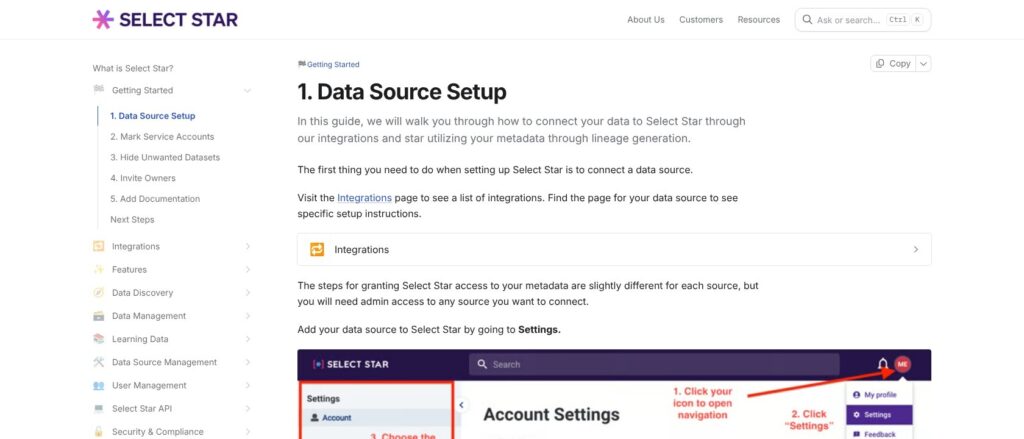
My starting point is one useful dependency path. Select Star’s documented onboarding recommends connecting the warehouse before BI tools, with administrative access to the source available for setup. That sequence fits a first deployment centered on understanding where a business-facing dashboard gets its data.
The documented entry point is Settings, Data, Add, where you select a source. Connection details then depend on the integration. Source setup belongs with someone who can authorize the required permissions. A catalog invitation alone does not give an analyst the access needed to configure ingestion.
For Snowflake key-pair setup, the instructions call for a dedicated service user and role, account and warehouse details, and selection of databases and schemas. Complete popularity and lineage generation is documented as taking 24 to 48 hours for that connector. That is a connector-specific onboarding estimate; it does not promise the same timing for every integration.
Scope deserves care before the first sync. In the Snowflake setup documentation, Select Star excludes unloaded databases, schemas, and tables from its metadata and query processing and does not generate their lineage. A narrow rollout can be sensible, but excluding an intermediate transformation can also remove context you wanted the catalog to explain.
Once the warehouse is connected, add the relevant BI source. The integration matrix lists tools such as Tableau, Power BI, and Looker, but separates metadata, popularity, and lineage coverage. A connector’s presence does not mean every catalog feature applies. I recommend choosing your source combination around the coverage needed for the first workflow.
The next stage is curation. The documented onboarding sequence includes marking service accounts, hiding test datasets, inviting owners, and adding documentation. I like that this makes catalog setup more than a credentials exercise: you are deciding which assets deserve attention and who can explain them when another analyst arrives.
Consider a hypothetical revenue dashboard whose underlying amount column needs to change. I would scope the initial catalog around that dashboard and its warehouse dependencies, then use the documented discovery path to inspect the relevant table, SQL context, and downstream consumers. This gives the rollout a specific question to answer.
Ownership should be part of this first workflow rather than a later cleanup project. The engineer proposing the change may understand its implementation, while a business owner understands what the dashboard promises its readers. I want both perspectives in a useful first catalog, even if the initial asset scope stays small.
Seeing metadata appear is one milestone; having a named person maintain a critical definition is another. Select Star supplies places for that context, but your team still decides who is responsible for keeping it meaningful.
Finding Useful Data Without Guesswork
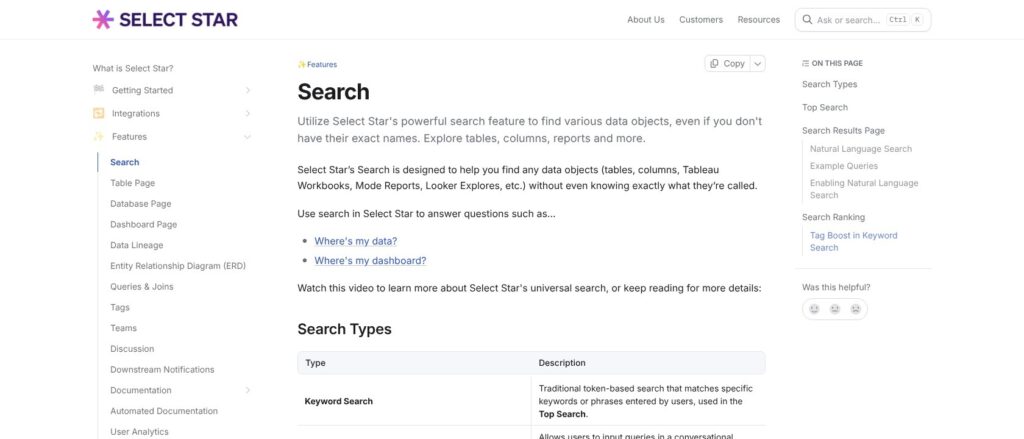
Search is most useful when it helps you choose between plausible results. Select Star’s keyword ranking considers matches alongside popularity, asset type, and tags. Natural-language search requires AI features to be enabled and runs from the main results page, while keyword search remains in the top navigation.
There is a small but practical search distinction: spaces divide terms, while an underscore preserves a compound token. I like having a predictable keyword route for technical names alongside a question-oriented route. The two ranking methods need not surface the same asset first.
Popularity is a usage signal, not an endorsement. Table and column popularity reflects query frequency and users over a period of up to 90 days; BI popularity uses views and users. Marking automated BI or ETL accounts as service accounts can prevent those workloads from distorting the signal.
That distinction matters if you are choosing between two similarly named datasets. A heavily queried table may deserve investigation, but frequent use alone does not establish the right business definition. My preference is to combine usage with ownership and documentation, rather than let the busiest asset become the default answer.
Table pages bring business and technical owners together with descriptions and other metadata. The timestamps require care: Last Update concerns metadata, and Last Refreshed can fall back to the latest metadata sync when a modification record is unavailable. Neither label independently guarantees that the underlying values are current.
Queries & Joins adds common SQL and join conditions; Recent Queries shows the 50 most recent queries since the last metadata sync. I see this as useful implementation context when a table description is too brief. It gives you examples to examine, not proof that a particular join is appropriate for every analysis.
For business meaning, documented metric objects can connect a measure field with its definition, calculation, SQL, and owners. My priority for those objects would be contested terms such as revenue or active customers. A searchable name is helpful, but a written explanation of the calculation is what lets another person assess whether it answers their question.
Alation deserves a comparison when approval of definitions is the main problem. Its documented workflow automation routes glossary changes through multi-step approval processes. Select Star’s asset context appeals to me for everyday discovery; Alation’s approval mechanics deserve attention when publishing an agreed definition is the more important job.
Tracing Lineage Before You Change a Table
Column-level lineage is Select Star’s clearest reason to make my shortlist. Its graph derives relationships from parsed SQL, with upstream, downstream, downstream dashboard, and exploratory views. I like seeing dependencies in the context of the reports they support.
For the hypothetical revenue change, my recommended route starts with affected reports, then follows upstream relationships and SQL. That context informs the engineering review; it cannot approve a deployment on its own.
The main constraint is approximately daily refresh, after metadata synchronization. Administrators can manually trigger a metadata sync; that does not promise immediate lineage reconstruction. A team making frequent changes needs to account for the difference between the current warehouse and the latest catalog view.
Columns without lineage do not appear in the graph. New relationships can come from DDL or DML, while removal requires new DDL. That makes a lingering relationship worth investigating before drawing conclusions from its appearance.
Coverage differs by source. PostgreSQL without query logs lacks popularity and lineage beyond relationships derived from views. The integration matrix also marks DB2 beta as metadata-only, without popularity or lineage, and Salesforce beta as lacking popularity. These are meaningful limitations if those systems sit on your intended dependency path.
The rollout scope needs to preserve relevant context. If a dashboard depends on transformations outside the loaded assets, the visible path cannot answer the entire impact question. That is a reason to include relevant intermediate assets, while still avoiding unrelated sources that add administration without helping the initial use case.
The dbt Impact Report offers a practical place to surface this information. It uses a GitHub Action to post downstream impacts into pull requests and requires a separately connected dbt source, an API token, and the corresponding source GUID. I like bringing dependency context into code review, provided you treat it as coverage-dependent evidence rather than a breaking-change prevention guarantee.
DataHub is my alternative for operational control. Its Apache 2.0 project supports self-hosting and column-level lineage, with a managed Cloud option as well. I recommend comparing it when operating and customizing the catalog matters more than following Select Star’s hosted service workflow. That is a deployment choice, not a judgment that DataHub produces more accurate lineage.
AI Documentation Still Needs an Owner
I see discovery and lineage as stronger reasons to buy Select Star than generated prose. AI-generated descriptions cover tables and columns as well as dashboards and charts, drawing on technical context and existing documentation. That can provide a starting point, but it does not establish the business intent behind a field.
Data managers can generate descriptions and choose whether to fill gaps or replace existing text. For a table, I recommend reviewing its purpose and intended use. For an individual column, the priority is whether the description makes the field’s meaning clear enough to avoid misinterpretation.
Suggested descriptions and tags are visually distinguished, and user edits can override them. Bulk generation and removal are also documented. I prefer filling documentation gaps first over broadly replacing owner-written text, because existing wording may contain business exceptions that are not obvious from a schema or query.
Ask AI is a separate capability that must be enabled for the organization. Its documented functions include answering catalog questions, recommending assets and join paths, and generating SQL. I see its answers as assistance for locating and explaining context. The owner still needs to decide whether a metric definition is appropriate.
The processing boundary deserves attention. AI use may share metadata, SQL, lineage, documentation, feedback, and user or team metadata with OpenAI and Anthropic. Select Star says those providers do not store the inputs or use them for training, and AI features can be disabled. Information can leave the catalog even when database values stay in the warehouse.
Metadata-only by default does not mean risk-free. Database values are not accessed by default, but explicitly authorized previews or AI querying may access them. Query SQL can also contain sensitive literals; the security documentation describes PII tagging that removes values from relevant query logs before saving.
My practical recommendation is to separate drafting permission from semantic authority. An AI description of “net revenue” might still need a finance owner to explain refunds or exclusions in your hypothetical business model. If formal approval is the priority, Alation’s documented glossary routing is a relevant comparison, rather than assuming either product’s AI establishes reviewed business truth.
Governance and Access Controls
Select Star’s access model needs attention before you invite the wider organization. Its policy-based access control, or PBAC, requires activation by Select Star staff. The documented roles are Admin, Data Manager, and Viewer, with description editing available to the first two rather than Viewer.
Policies scope users and teams to sources, warehouse databases or schemas, and BI folders or dashboards. Tag scoping is marked as coming soon, so I exclude it from the current feature recommendation.
The consequential rule is that the most permissive matching policy wins. Overlapping team membership therefore deserves particular care.
For example, a hypothetical analyst belonging to both a broad analytics team and a restricted project group retains the broader matching grant. I dislike that trade-off when the intent is to use project membership to reduce existing access.
Atlan makes a meaningful comparison here. Its personas scope access by team, purposes can scope policies through tags, and explicit deny overrides grants. I put Atlan ahead on the shortlist when that deny behavior is a firm requirement. Its roles, personas, and purposes still need to be considered together.
These are catalog access controls, not automatic warehouse row- or column-level enforcement. Catalog visibility, source credentials, and authorization for optional data access remain distinct decisions. Restricting who can edit a description answers a different question from restricting who can query the underlying records.
For security procurement, Select Star reports annual SOC 2 Type II audits since May 2021 and makes its report available under an MNDA. The report belongs in your security review; the public statement alone cannot establish that a deployment meets every internal requirement. My recommendation remains a deliberately scoped access design, not broad access followed by cleanup.
How Does Select Star Compare to Competitors?
I recommend choosing Select Star alternatives by the requirement that could rule out the purchase. Self-hosting, policy precedence, and glossary approval are different problems. Combining them into a vague “enterprise governance” score would hide the distinctions that matter to your team.
- DataHub: Choose it for operator control. DataHub offers an Apache 2.0 self-hosted option and managed Cloud. Self-hosting puts infrastructure operation on your team; an open-source license does not mean zero operating cost.
- Atlan: Compare policy behavior closely. Atlan documents tag-oriented purposes and explicit deny precedence. That differs materially from Select Star’s most-permissive matching grants.
- Alation: Consider approval-led governance. Alation documents low-code, multi-step glossary approval workflows with approvers and object scopes.
Select Star remains interesting to me when the core question is which warehouse asset supports a dashboard and who can explain it. Its documented combination of usage, SQL context, and lineage provides a concrete basis for that evaluation. That does not mean the alternatives lack those broader catalog functions.
My recommendation is to keep the comparison anchored to one primary job. A team prioritizing ownership of its software infrastructure may accept self-hosting work that another team wants to avoid. A governance group may value approval routing more than usage-based discovery. My recommendations concern those specific differences; I have not ranked the products on implementation speed or accuracy.
How I Reviewed Select Star
This is a documentary evaluation of source setup, catalog workflows, pricing information, and access mechanics. I assessed those behaviors against warehouse-plus-BI buying needs and compared specific documented differences with Atlan, DataHub, and Alation.
I did not operate a signed-in customer workspace or run a warehouse benchmark. My judgments concern fit and limitations, not measured usability, lineage accuracy, or AI output quality. I reviewed the commercial information in October 2026. The absence of a public dollar price limits the value assessment.
Should You Choose Select Star?
Shortlist Select Star conditionally if your main need is warehouse and BI discovery with column-level dependency context. I see a coherent documented workflow: find an asset, understand its usage, identify its owner, and examine its reporting dependencies. That is more compelling to me than buying a catalog primarily for AI-written descriptions.
I would skip it as a default choice if you require an immediate fixed public price, guaranteed real-time lineage, or operator-owned open-source code. DataHub deserves attention for that last requirement. Atlan and Alation belong in the comparison when policy precedence or formal glossary approval is the deciding factor.
The commercial recommendation is deliberately narrower than the feature recommendation. With Select Star now describing itself as part of Snowflake, my recommendation depends on a defined available offering and contract scope. For the right warehouse-plus-BI team, a focused package covering one complete business workflow is the sensible starting point, rather than a broad rollout built around assumed availability or future Horizon delivery.
FAQ
Is Select Star free?
Published terms describe a 14-day free trial, potentially extended at the vendor’s discretion. They do not establish that new trials are currently offered, and a permanent free plan is not established. Paid access requires a quote.
Is Select Star open source?
Select Star’s terms describe a proprietary, hosted service. If self-hosted open-source software is a requirement, I would start the comparison with DataHub’s Apache 2.0 project.
Does Select Star require Snowflake?
Its documented integrations include other warehouses and BI tools, with capabilities varying by source. Snowflake’s November 24, 2025 acquisition agreement announcement does not itself establish a Snowflake-only requirement or delivered Horizon integration.
Is Select Star lineage real-time?
The documented cadence is approximately every 24 hours after metadata synchronization, rather than real-time. Relationship removal also depends on detecting new DDL, so I would use the graph as dependency context rather than an instantaneous record of every change.