Editor’s note: This Alation review evaluates documented capabilities, pricing, and enterprise buying considerations. It is not a hands-on performance test.
Quick verdict: I recommend Alation for organizations that need analysts and data stewards to work from shared definitions, ownership, and trust signals across a complex data estate. I would budget for connector configuration and ongoing curation alongside the subscription.
Key Takeaways
- Alation combines a searchable data catalog with governance and lineage context.
- AI-assisted documentation can reduce the amount of metadata you write from scratch.
- Current data quality capabilities include native tooling and external integrations.
- The public AWS subscription starting point does not establish the cost of your complete deployment.
- Source coverage and deployment differences need checking before you commit.
In this review, I’ll take a closer look at pricing, the work involved in getting started, and where I would choose it over another catalog. For this enterprise catalog, my priority is whether its business context helps your team choose data with confidence.

Alation Pros and Cons
Pros
- Asset pages bring business definitions and technical context together.
- Compose supports SQL writing, sharing, and reuse.
- AI-generated descriptions can be edited and approved.
- Native data quality works alongside external quality integrations.
- APIs provide another route for adding lineage information.
Cons
- Marketplace starting pricing leaves deployment scope unresolved.
- AI consumption requires its own allowance and cost discussion.
- Connector functions and lineage coverage vary.
- Standard support excludes implementation and training.
Alation Pricing
Alation’s AWS Marketplace listing shows a $60,000 starting subscription for a 12-month Data Catalog contract. That is a useful budgeting reference, but it does not tell you how many users, sources, or additional capabilities your agreement includes.
Alation also uses Alation Consumption Units, or ACUs, as a shared pool for AI capabilities. The public ACU page directs you to request an estimate rather than publishing a dollar conversion rate.
The commercial options below are buying routes and pricing components, not three interchangeable subscription tiers:
- Data Catalog through AWS Marketplace (starting at $60,000 per 12 months): a public reference for an enterprise catalog purchase.
- Custom agreement (quoted): for the capabilities and deployment scope negotiated with Alation.
- AI consumption through ACUs (quoted): a pooled allowance whose sizing belongs in the commercial discussion.
| Pricing component | Public price | What to clarify |
|---|---|---|
| AWS catalog subscription | From $60,000 for 12 months | Included scope and contract entitlements |
| Custom agreement | Request a quote | Required capabilities, environments, and services |
| AI consumption units | Request an estimate | Included credits, consumption rates, and additional usage |
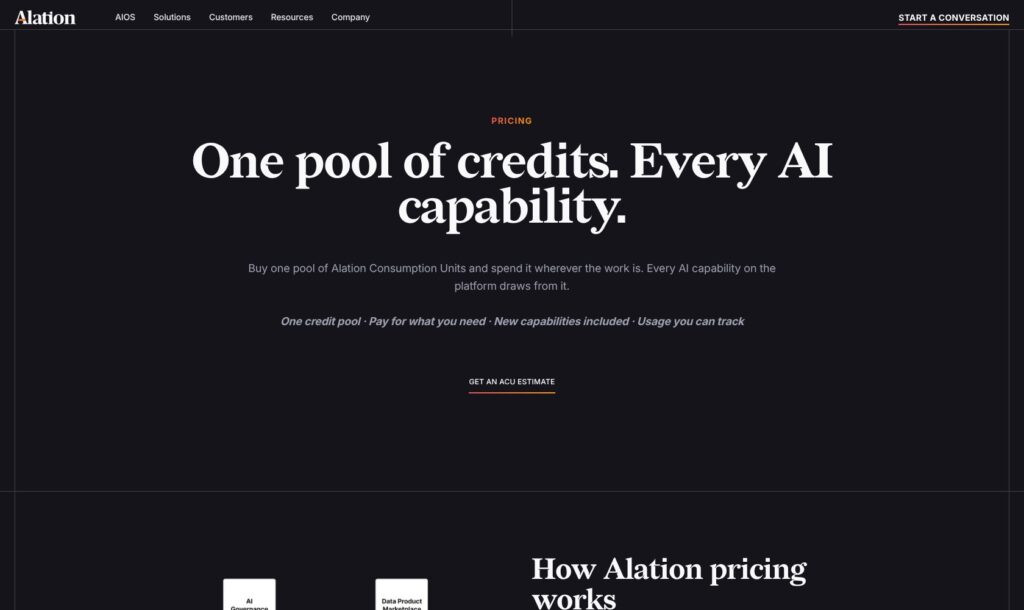
I would ask for a worked estimate based on an ordinary month and a busy onboarding month. Generating documentation for a large backlog is a different workload from maintaining descriptions afterward. A shared credit pool is flexible, but you still need to know which activities consume it.
Is Alation Good Value for Money?
Alation makes the strongest case when the cost of unclear data ownership is spread across many teams. It is harder to justify when a small group already understands the few datasets it uses.
- Good fit: an organization with stewards, repeated discovery problems, and several systems to catalog.
- Weaker fit: a team that mainly needs a basic inventory and cannot allocate anyone to maintain it.
- Budget separately: implementation and training, which Alation excludes from standard support.
Reviewer’s Notes: I recommend a scoped Cloud Service proposal for one business domain first. Include the AI allowance and rollout services explicitly. Expand only after users can complete the workflows that justified the purchase.
Getting Started With Alation
Getting a useful catalog requires source administration as well as business participation. I would start with a reporting domain whose owners can explain what the data means and whose analysts can judge whether search results are useful.
A practical rollout follows these steps:
- Choose the initial scope. Identify the warehouse objects and reports needed for a real business question, such as finding the approved revenue dataset.
- Check connector capabilities. Confirm metadata extraction, profiling, query-log ingestion, and lineage separately. Support for a source does not mean every operation is available.
- Configure credentials and permissions. Have the source administrator approve exactly what the connector may read.
- Extract metadata and schedule updates. Alation documents scheduled extraction, but automatic scheduling is disabled by default in the described setup.
- Add business ownership and definitions. Decide who approves descriptions and handles disputed meanings.
- Validate the user journey. Ask an analyst to find a suitable asset, identify its owner, and explain why it is appropriate for the question.
The Azure SQL DB connector illustrates why setup deserves attention. Its documentation distinguishes permissions for metadata extraction from those needed for sampling and profiling. Query-log ingestion adds auditing and configuration requirements, and metadata extraction must run first.
I like that this makes the work explicit. I would still involve the security team before enabling optional collection: permission to catalog schema information should not automatically become permission to collect sample records.
Cloud hosting also does not eliminate stewardship. Someone must maintain descriptions, review changes, and resolve duplicate terms. OpenMetadata is worth considering if you want more control over the platform itself, but self-management adds infrastructure responsibilities to that same governance work.
Data Discovery and Query Context
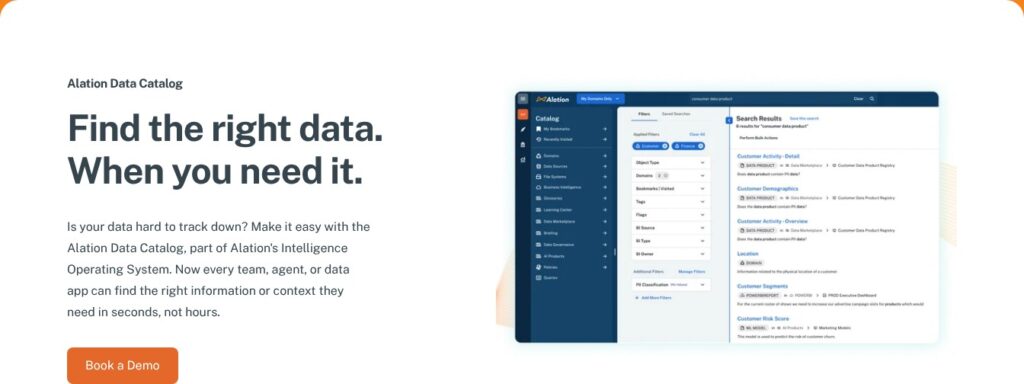
Alation asset pages combine technical and business context. Compose adds SQL writing, sharing, and reuse.
I would prioritize the everyday decision between two similarly named datasets. Finding both is easy to demonstrate; helping a new analyst choose correctly is the outcome worth paying for.
ALLIE AI search combines semantic, behavioral, and keyword signals. I like the potential to search using business language, but your own terminology should determine whether this earns a place in the rollout.
For a proof of concept, I would use queries such as:
- A familiar business term: can users reach the agreed dataset without knowing its schema name?
- An ambiguous term: can they distinguish definitions used by different departments?
- An outdated asset: is the warning clear enough to prevent accidental reuse?
Atlan belongs on the same shortlist when catalog automation is the priority. Its playbooks can apply bulk metadata changes, including ownership and certificates. I would compare the effort required to keep the catalog useful after initial onboarding, rather than choosing either product from a search demonstration alone.
Governance and Lineage
Alation connects governance information to the assets people use. Its governance offering includes ownership, glossary definitions, policies, and workflows, which can help stewards turn abstract rules into context analysts can inspect.
I would judge this capability by a specific handoff: a business owner changes a definition, a steward reviews it, and affected users can see the approved meaning. A long glossary is not much help if nobody knows whether its entries are current.
Collibra deserves particular attention when formal approvals drive the purchase. Its documented workflows focus on repeatable governance procedures. Alation is still a credible candidate here; I would ask both vendors to demonstrate the same ownership change and approval sequence.
Lineage Needs a Representative Test
Alation’s table-lineage documentation describes relationships derived from parsed queries, including query logs, Compose queries, and view definitions. APIs can supply lineage where automatic extraction does not cover the requirement.
That combination is useful, but API-supplied relationships introduce maintenance work. If your team owns the integration that supplies an edge in the lineage graph, it also needs a process for keeping that edge accurate when the pipeline changes.
My suggested evaluation is to trace an important report backward and a planned schema change forward. Include a transformation that resembles your actual code, rather than accepting a simple demonstration query as proof of coverage.
Deployment matters too. Alation documents differences in temporary-table lineage between customer-managed and cloud-native environments. Get the required table-level and column-level behavior confirmed for your connector, version, and hosting choice.
AI and Data Quality
Alation’s current positioning extends beyond a traditional catalog to its Intelligence Operating System, or AIOS. For a catalog buyer, I would assess each additional capability against a concrete task before expanding the contract.
AI-Assisted Documentation
ALLIE AI can suggest titles and descriptions that users approve, regenerate, or edit. That is a sensible division of labor: the software proposes wording, and someone who understands the data decides whether it is accurate.
My rule would be to review ambiguous terms before approving them. A column called “active” could describe an account or a subscription; polished wording alone cannot settle that distinction.
The broader platform also describes documentation agents and a data products marketplace. These may help a team move from isolated asset descriptions toward reusable data offerings. Confirm the capabilities included in your proposal rather than assuming every product mentioned on the website comes with the base catalog.
Native Quality and External Results
Alation offers native AI-powered data quality alongside its Open Data Quality Framework for outside quality and observability tools.
Trust Flags mark assets as endorsed, warned, or deprecated, giving analysts a visible selection cue.
An endorsed asset can develop a new fault. I would require a demonstration of how fresh test results reach the user and who responds to failures.
If you already use a quality platform, compare integration with replacement. Keeping an established testing process may be more practical than rebuilding it simply because the catalog offers another option.
Alation Alternatives
I would shortlist alternatives according to the work your team needs to improve:
- Atlan: worth prioritizing when repeatable metadata maintenance is the main challenge. Its administrative playbooks support bulk updates to owners, descriptions, certificates, and other metadata. Check who can create these automations and how changes are reviewed.
- Collibra: a strong candidate when stewardship procedures and approval workflows define success. Demonstrate the actual governance process you want to run, including exceptions and reassignment of responsibility.
- OpenMetadata: worth considering when control over an open-source metadata platform matters and engineering can operate it. Its core combines catalog, lineage, and quality capabilities, but self-hosting means budgeting for infrastructure and maintenance.
To make the comparison useful, give each vendor the same source list and ownership problem. I would choose based on the work your team can sustain after launch, including any integrations it must maintain itself.
How I Reviewed Alation
I evaluated Alation’s documented catalog workflows, connector requirements, lineage behavior, AI capabilities, and commercial structure. I also compared relevant capabilities in Atlan, Collibra, and OpenMetadata.
This assessment does not include a production deployment, a measured search-quality benchmark, or a purchased quote. Recommendations reflect feature fit and operating requirements, rather than a numerical performance score.
Pricing checked October 2026. Your signed proposal determines the scope and cost of your purchase.
Should You Choose Alation?
Choose Alation if you have a recurring discovery problem, clear business owners, and the budget to support adoption. I would put it on an enterprise shortlist when analysts depend too heavily on individual experts to choose appropriate data.
I would postpone the purchase if nobody can own the rollout or if your primary need is simply to move data into a warehouse. A catalog can support understanding and governance; it does not replace that underlying data infrastructure.
Before signing, ask Alation to demonstrate one complete workflow using your sources and agree on its commercial scope. A convincing search-to-decision journey is a better buying signal than a broad list of AI features.
FAQ
How Much Does Alation Cost?
The AWS Marketplace catalog listing starts at $60,000 for a 12-month contract. Obtain a proposal for your required scope and AI consumption.
Is Alation a Database?
Alation catalogs and adds context to data assets. It does not replace the warehouse or database that stores your business data.
Can You Self-Host Alation?
Alation documents customer-managed deployment alongside Cloud Service. Confirm current availability and feature coverage for the configuration you require.
Does Alation Include Data Quality?
Its current offering includes native AI-powered quality and integrations with external quality tools. Confirm the capabilities included in your agreement.
Does Alation Replace Data Stewards?
No. AI suggestions can help draft documentation, but owners still need to approve definitions and resolve disagreements about meaning and appropriate use.