
Editor’s note: This Superlinked review is based on my hands-on test of SIE (Superlinked Inference Engine) v0.11, on SIE Serverless and a local SIE server, in November 2026. I weighed pricing and the Serverless rate card, local and cluster setup, search and RAG models, GPU sharing, extraction and generation, security and release maturity, and how it compares with Hugging Face TEI, vLLM, Modal, hosted embedding APIs and RAG frameworks such as LlamaIndex.
Quick verdict: I recommend Superlinked for AI engineering teams running an embedder, reranker and extractor that want one Apache 2.0 server for all three, on SIE Serverless (Qwen3 Embedding 4B costs $0.06 per 1M tokens) or in their own cloud. SIE is pre-1.0, only 46 of 150 models run on Serverless, and scale-to-zero clusters take 3 to 7 minutes to wake. For one embedding model, Hugging Face TEI or Voyage AI is the better buy.
Superlinked (San Francisco, founded 2021) turned its vector compute framework into SIE, the inference server at the center of this Superlinked review. It exposes four primitives (encode, score, extract, generate), loads models onto shared GPUs on demand and plugs into LlamaIndex, LangChain, Haystack and vector databases without replacing them.
In this review, I’ll take a closer look at Superlinked’s pricing, features, and deployment options, so you can see exactly whether SIE fits your RAG stack or whether a single-model server or a hosted embedding API is the better buy.
Key Takeaways
- One Apache 2.0 engine serves embeddings, rerankers, extraction, OCR and small LLMs, with the same SDK and model IDs hosted or in your cloud.
- Search rates are low: Qwen3 Embedding 4B costs $0.06 and Qwen3 Reranker 4B $0.0425 per 1M tokens, plus $20 in free credits with no card.
- Only 46 of 150 models run on Serverless; Qwen3 Embedding 8B, ColPali and jina-colbert-v2 need your cloud.
- SIE is pre-1.0 (v0.11.1, November 12, 2026) and releases carry breaking changes, so pin versions.
- The Superlinked framework is deprecated; SIE is an inference server, not a RAG pipeline framework.
Pros and Cons
Pros
- Apache 2.0 engine, gateway, Helm chart and Terraform modules are free to self-host.
- Qwen3 Embedding 4B costs $0.06 per 1M tokens; OpenAI text-embedding-3-large costs $0.13.
- One cluster serves embedders, rerankers, extractors and LLMs on shared GPUs.
- $20 in free credits with no card, plus $500 in launch credits on application.
- SOC 2 Type 2, with US or EU data residency on Serverless.
Cons
- Only 46 of 150 models are callable on Serverless.
- Pre-1.0 upgrades ship breaking changes; about 65 releases since February.
- A scaled-to-zero cluster leaves first queries waiting 3 to 7 minutes.
- Dedicated T4s cost about 2.9x Modal’s per-second rate.
- Native Inference has no public price and Serverless publishes no SLA.
Superlinked Pricing: How Much Does It Cost?
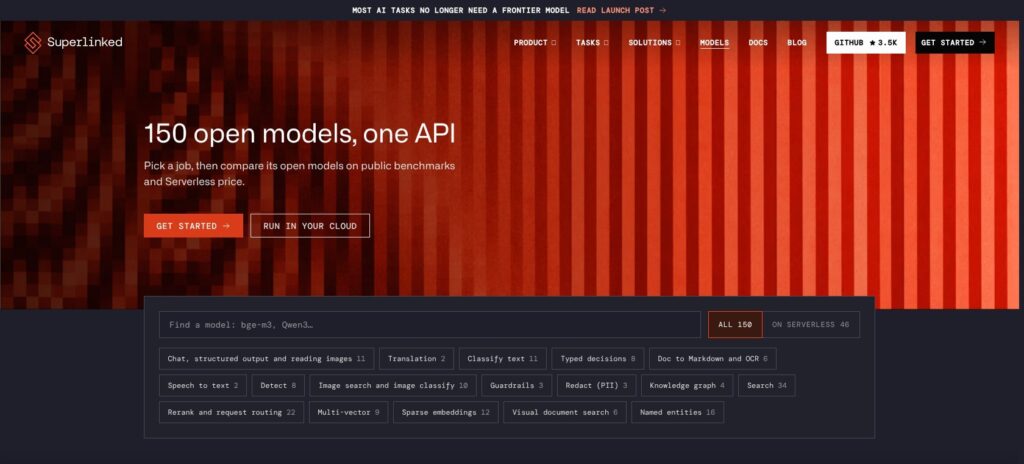
The SIE engine is free under Apache 2.0, whether you run SIE Local on a laptop or GPU VM or SIE Cluster in your own Kubernetes; you pay only for your GPUs. The one metered product is SIE Serverless, billed per model per 1M tokens, per 1,000 pages or images, or per audio minute, with no published platform fee or monthly minimum.
- SIE Local (free): for developers testing on an NVIDIA GPU or Apple Silicon, with the same SDK and model IDs as the hosted API; it runs offline once model files are downloaded.
- SIE Serverless (usage-based): for teams that want an API without running GPUs. New accounts get $20 in free credits with no card, and you can apply from the console for $500 more in launch credits. One credit is $0.00001; Superlinked says $20 covers about 530M tokens embedded, 50,000 pages parsed or 10M tokens generated.
- Dedicated GPU on Serverless (per GPU-second): for running your own weights on a reserved GPU: T4 $0.000481, L4 $0.000539, A10G $0.000623, A100 $0.00102 and H100 $0.00142 a second (about $1.73 to $5.11 an hour).
- SIE Cluster (free software, your cloud bill): for platform teams that self-host with the Helm chart and Terraform modules.
- Native Inference (quote only): for enterprises that want Superlinked engineers to pick and post-train models and agree service levels, priced per engagement.
| Plan | Price | Where it runs | Key limits |
|---|---|---|---|
| SIE Local | $0 | Laptop or GPU VM | Your hardware and GPU memory |
| SIE Serverless | Per model, per task unit | Hosted API, US or EU | 46 callable models, no public SLA |
| Dedicated GPU on Serverless | From $0.000481/GPU-second | Reserved hosted GPU | Memory of the chosen GPU |
| SIE Cluster | $0 plus your GPUs | Your Kubernetes | Kubernetes 1.29+, NVIDIA GPUs |
| Native Inference | Custom quote | Your cloud | Scope agreed per engagement |
| Model | Task | Serverless price |
|---|---|---|
| Qwen3 Embedding 4B | Dense embeddings | $0.06 per 1M tokens |
| bge-m3 | Dense / sparse / multi-vector | $0.0377 / $0.0408 / $0.0499 per 1M tokens |
| Qwen3 Reranker 4B | Reranking | $0.0425 per 1M tokens |
| Qwen3 Reranker 0.6B | Reranking | $0.017 per 1M tokens |
| Tomoro ColQwen3 4B | PDF page search | $0.20 per 1,000 pages |
| GLM-OCR | OCR | $0.25 per 1,000 photos |
| Qwen3.8 27B | Chat and generation | $0.25 in / $2.75 out per 1M tokens |
Is Superlinked Good Value for Money?
- OpenAI: text-embedding-3-large costs $0.13 per 1M tokens, more than double Qwen3 Embedding 4B on SIE.
- Voyage AI: voyage-4 matches SIE at $0.06 and voyage-4-lite costs $0.02 per 1M tokens, with 200M free tokens on most current models. Rerank-3 costs $0.05, so Qwen3 Reranker 4B at $0.0425 undercuts it.
- Fireworks AI: small embedders (up to 150M parameters) cost $0.008 per 1M tokens, cheaper for lightweight embedders.
- Modal: raw GPUs bill by the second at T4 $0.000164 and H100 $0.001097, so SIE’s dedicated GPUs cost about 2.9x on a T4 and 1.3x on an H100, but on Modal you write the serving code yourself.
- Cohere: publishes no Embed or Rerank rates.
On Serverless, Qwen3 Embedding 4B matches voyage-4 and undercuts OpenAI, Qwen3 Reranker 4B undercuts rerank-3, and self-hosting costs only your GPUs. Fireworks AI and voyage-4-lite are cheaper for lightweight embedders, and dedicated Serverless GPUs are the expensive way in.
Reviewer’s Notes: I recommend starting on the $20 credit with Qwen3 Embedding 4B and Qwen3 Reranker 4B. Move to SIE Cluster once steady traffic keeps an L4 busy, and skip dedicated Serverless GPUs unless you must run your own fine-tuned weights without a cluster.
My Experience With Superlinked
Running SIE Locally With Docker and pip
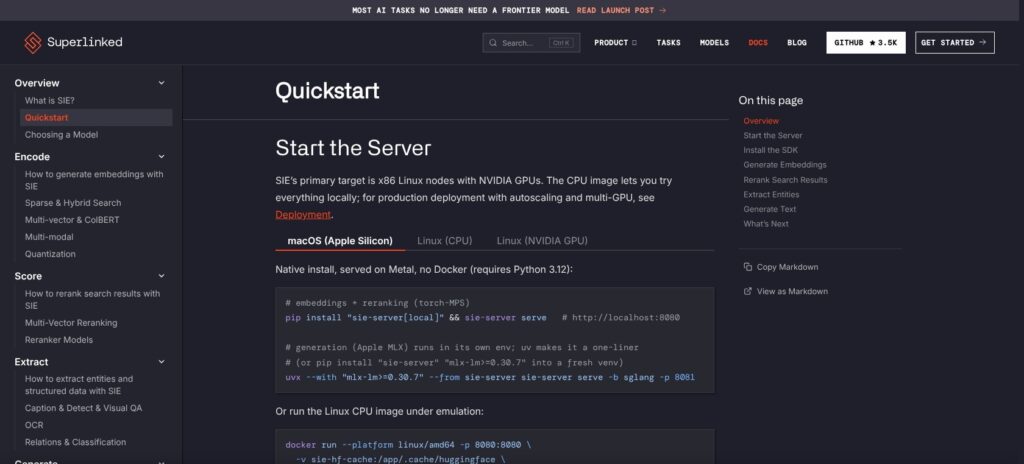
On an Apple Silicon Mac, I installed sie-server[local] with pip under Python 3.12 and ran sie-server serve, which listened on port 8080 with embeddings and reranking on torch-MPS. The local extra matters because it pins transformers below version 5, which the adapters need; a bare pip install sie-server can resolve version 5 and fail at runtime.
On a Linux GPU VM, I ran the cuda12 Docker image with all GPUs exposed. A CPU image also exists for development, but SIE’s production target is x86 Linux with NVIDIA GPUs. Generation needed a separate process: Apple MLX on port 8081 on the Mac, or the SGLang image on Linux.
Models downloaded from Hugging Face on first request: all-MiniLM-L6-v2 is about 90 MB, bge-m3 about 2.3 GB, and gated models need an HF_TOKEN. Hugging Face TEI is simpler for one model: a single container serving one embedder.
Encoding, Reranking and Extracting From One Client
I installed sie-sdk, which needs Python 3.12 or newer (the TypeScript SDK is @superlinked/sie-sdk), pointed SIEClient at the local server and made three calls:
- Encode: I called encode with all-MiniLM-L6-v2 and a text item; that model returns a 384-dimension vector.
- Score: I sent a query and candidate documents to a cross-encoder reranker, which returns them ranked.
- Extract: I defined labels per request (person, organization) for a GLiNER model.
Switching to bge-m3 was a change of model ID, not a new deployment, and bge-m3 returns dense and sparse output from the same call. Reranker scores are cross-encoder logits, not probabilities, so the order matters more than the raw number. TEI runs one model per instance and covers only embeddings and rerankers, so the same three calls need two TEI containers plus a separate extraction server.
Switching to SIE Serverless
I created a Serverless account, received the $20 credit without entering a card, generated an API key and pointed SIEClient at api.superlinked.com. I pinned the key to a single data region; the options are US and EU.
I also pointed an existing OpenAI client at the OpenAI-compatible endpoint by changing base_url and the model name to Qwen/Qwen3-Embedding-4B, which returns 2560-dimension vectors. Changing embedding models still means re-indexing your documents.
Each response reported the credits charged, and an estimate endpoint prices a call before you send it. There is no API for the remaining credit balance; it shows only in the console.
Planning for Cold Starts in My Own Cluster
When I planned the move to SIE Cluster, the only client change was the address: SIEClient pointed at an internal URL instead of api.superlinked.com. On a scale-to-zero cluster, first requests return 503 PROVISIONING with a Retry-After header while GPU workers start, and cold starts take 3 to 7 minutes.
I set wait_for_capacity on the Python client (waitForCapacity in TypeScript), which retries through those 503s for a default budget of 900 seconds, far too long for an interactive search request. On Serverless, SIE Relay can answer cold generation and extraction requests through a vetted inference partner at the same price, but embedding and rerank requests are never relayed and wait for dedicated capacity. An X-SIE-Remote: forbid header opts a request out of Relay.
Reviewer’s Notes: I’d pin the embedder and reranker so they never scale to zero. Relay does not cover either one, and a 3 to 7 minute wake-up on the query path is a user-facing outage.
Search and RAG Models: Embeddings, Rerankers and Hybrid Retrieval
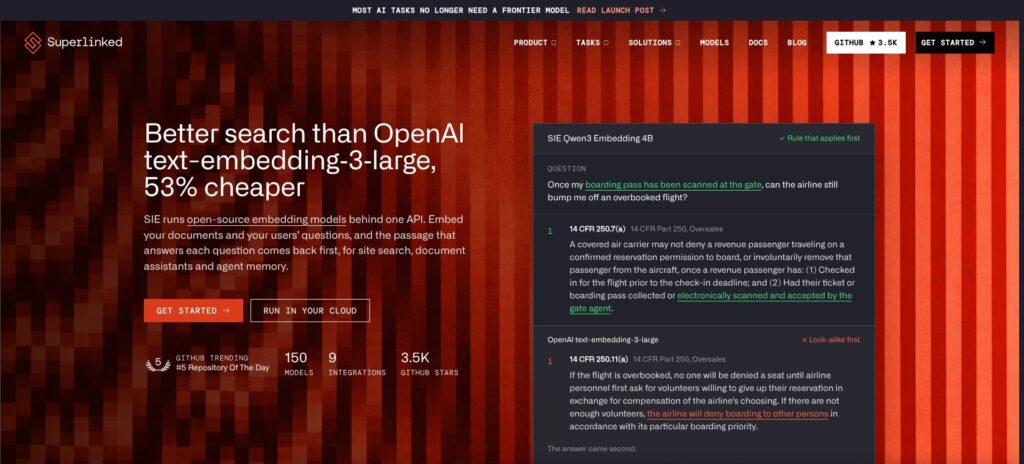
SIE’s 150-model catalog covers dense, sparse, multi-vector and visual-document retrieval plus rerankers, and bge-m3 alone returns dense, sparse and multi-vector output from one model.
- Dense embeddings: Qwen3 Embedding 4B outputs 2560-dimension vectors at $0.06 per 1M tokens.
- Sparse: Splade PP en v2 costs $0.0256 per 1M tokens.
- Multi-vector (ColBERT-style): GTE ModernColBERT costs $0.0332 per 1M tokens.
- Reranking: Qwen3 Reranker 4B costs $0.0425 per 1M tokens (Superlinked prices it at $15 per 100,000 queries); the 0.6B version costs $0.017.
- Images and PDF pages: SigLIP so400m costs $0.0233 per 1,000 images and Tomoro ColQwen3 4B $0.20 per 1,000 pages.
For hybrid search, bge-m3 returns dense and sparse vectors in one call. SIE stays the inference layer, with storage and retrieval logic in your vector database and framework, and it ships integrations for both:
- Vector databases: Chroma, LanceDB, Qdrant and Weaviate.
- Frameworks: LlamaIndex, LangChain, Haystack, DSPy and CrewAI.
- Migration guides: from OpenAI, Cohere, Hugging Face TEI, Infinity, FastEmbed and Modal.
In Superlinked’s own published tests at list prices, Qwen3 Embedding 4B embedded a query in 15.7 ms versus 238 ms for OpenAI text-embedding-3-large, and Qwen3 Reranker 4B reranked in 55 ms versus 179 ms for Cohere Rerank 4 Pro, with network round trips included in the hosted-API timings. On PDF page search, ColQwen3 scored 64.0 nDCG@10 against 64.8 for Cohere Embed v5 Pro, at $200 versus $740 per million pages.
Best for: hybrid or multi-stage retrieval with a reranker. Skip if: one off-the-shelf embedder with no reranking is the whole job; TEI handles that in a single container.
One Cluster for Every Model: GPU Sharing and Self-Hosting
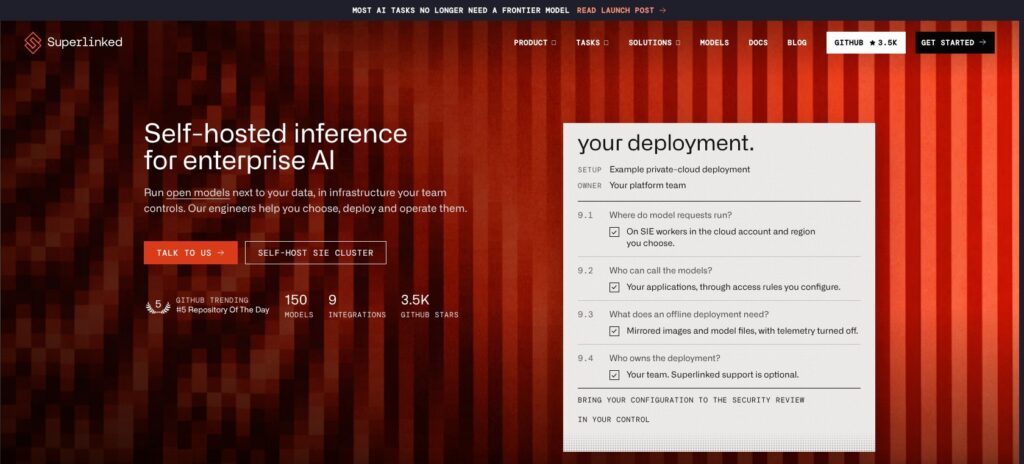
SIE loads models onto shared GPUs as requests arrive, evicts the least recently used model when memory runs short and keeps pinned models warm. An L4 with 24 GB holds several standard models at once, but every requested model must fit in GPU memory to load.
- Separate pools: embedding, scoring and extraction models never land in an LLM’s pool, and a pinned LLM stays resident.
- Out-of-memory handling: SIE frees cached memory, unloads the least recently used model and splits the batch, then returns a retryable error.
- Generation: SGLang runs inside the cluster, one process per model, reloaded after a crash.
- Scaling: each pool scales with its queue, down to zero when idle.
SIE Cluster installs with a Helm chart on Kubernetes 1.29 or newer, and Terraform modules for AWS, GCP, Azure and Alibaba Cloud create the cluster and GPU node pools. The stack is a gateway, a config service, NATS JetStream and GPU workers, with Grafana dashboards included. Superlinked recommends an L4 24 GB as the starting GPU and 16 GB or more of VRAM in general.
Weights can pre-load from an S3, GCS or Azure Blob cache bucket instead of Hugging Face, and air-gapped installs run on mirrored images and model files with telemetry off.
Standing up a GPU Kubernetes cluster with quotas, ingress and workload identity is real operations work; Native Inference exists so Superlinked engineers do it with you. vLLM and Hugging Face TEI run one model per server, which Superlinked calls the better choice when one model is enough. For one large LLM across many GPUs, Superlinked itself names llm-d or NVIDIA Dynamo the better fit.
Extraction, OCR and Small LLMs on the Same API
The extract primitive runs the side jobs of a RAG pipeline on the same client as retrieval, from entities with NuNER Zero at $0.05 per 1M tokens to speech to text.
- Classification: GLiNER2.5 Decide costs $0.28 per 1M tokens and classifies a message in 13.1 ms in Superlinked’s own test.
- PII redaction: GLiNER PII plus NuNER Zero costs $0.08 per 1M tokens.
- OCR and audio: GLM-OCR costs $0.25 per 1,000 photos and whisper large v3 turbo $0.00276 per audio minute; object detection is also covered.
- PDF to Markdown: docling costs $0.398 per 1,000 pages and LightOnOCR 2 1B $2.00 per 1,000 pages.
- Structure and safety: structured JSON output against a schema, plus guardrail models Qwen3Guard 4B and Granite Guardian 2B for prompt screening.
Generate runs open LLMs behind an OpenAI-style chat API with tool calling: Qwen3.8 27B at $0.25 in and $2.75 out per 1M tokens, GLM-5.3-Flash at $0.15 and $0.50, and Gemma 4 31B. Superlinked calls generate an early surface, and in November 2026 SIE’s GitHub tracker had open bugs for errors on some listed generation models on Serverless and uneven JSON-mode support. Chat requests lack reasoning-effort control.
Across 14 tasks, Superlinked’s own tests at list prices put open models on SIE at a median 98% of GPT-6.1 Sol’s score for 3% of its cost.
I’d move extraction and OCR first and keep frontier-model generation where accuracy matters until generate matures. For a single LLM, vLLM is simpler.
Security, Data Residency and Release Maturity
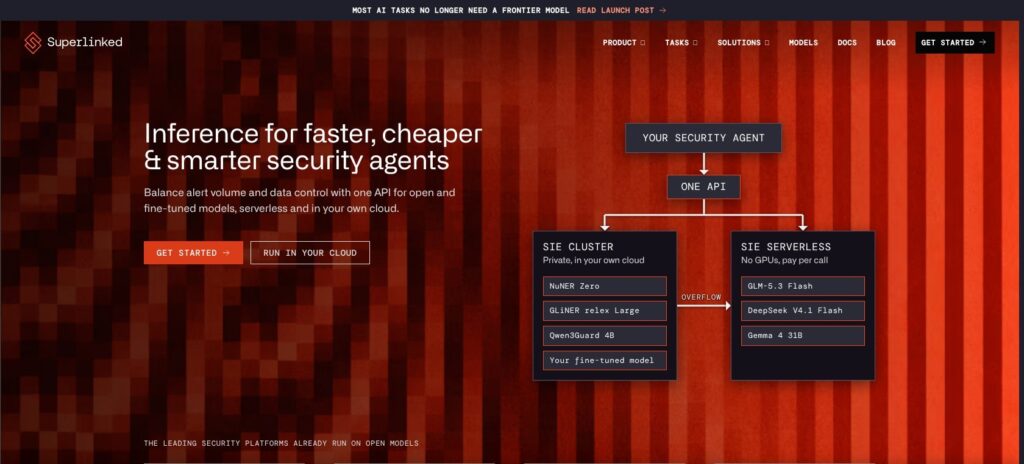
SIE Serverless is SOC 2 Type 2 with US or EU data residency pinned per API key, and it serves fixed weights, so requests never train the model. Serverless is not FedRAMP authorized, so federal data runs on SIE in your own authorized cloud, and on SIE Local or SIE Cluster your requests never leave your environment.
- Air-gapped installs: mirrored images and model files with telemetry off, plus separate worker pools per tenant.
- Telemetry: sie-server sends anonymous usage telemetry (versions, platforms, GPUs) by default in releases before 0.13.0, which includes today’s v0.11.1; DO_NOT_TRACK=1 or SIE_TELEMETRY_DISABLED=1 turns it off.
- Relay opt-out: the X-SIE-Remote: forbid header or an org setting keeps Serverless requests off partner capacity.
v0.11.1 shipped on November 12, 2026, after about 65 tagged releases since v0.1.0 on February 26, 2026, and the release notes carry breaking-change sections. I’d pin versions and follow the upgrade runbook on every bump. The GitHub repo (Apache 2.0) has about 3,500 stars.
The original Superlinked framework, with multi-attribute “spaces” for search and recommendations, is archived on GitHub with a deprecation banner pointing to SIE. Its last PyPI release, 37.5.2, shipped on June 8, 2026, so teams on the framework should plan a migration, not new builds.
How Does Superlinked Compare to Competitors?
-
Hugging Face TEI: Apache 2.0, one model per instance, embeddings and rerankers only. Superlinked’s own comparison calls TEI and SIE comparable for a single model and names TEI the better pick for one embedding model. It fits a team serving one embedder from a single container.
-
vLLM: Apache 2.0, high-throughput LLM serving, one model per server; SIE itself runs SGLang inside the cluster for generation. It fits a team whose traffic is one large LLM.
-
Modal: per-second GPU billing (T4 $0.000164, H100 $0.001097 a second) and $30 a month in free credits on the $0 Starter plan, but you write and operate the serving code. It fits bursty, custom compute.
-
Voyage AI and OpenAI: hosted-only embeddings with no infrastructure to run: voyage-4 costs $0.06 and voyage-4-lite $0.02 per 1M tokens, rerank-3 $0.05, and OpenAI text-embedding-3-large $0.13. They fit teams that never want to touch a GPU and accept data leaving their cloud.
-
Fireworks AI and Baseten: Fireworks lists small embedders at $0.008 per 1M tokens and an on-demand H100 at $8.00 an hour; Baseten rents an H100 at about $6.50 an hour and lists no embedding models. SIE’s dedicated H100 runs about $5.11 an hour. They fit teams that only need hosted endpoints.
-
LlamaIndex, LangChain and Haystack: orchestration frameworks (MIT, MIT and Apache 2.0) for chunking, retrieval logic and agents that still need a model endpoint, and SIE ships an integration for each. They fit the pipeline layer; pair one with SIE rather than choosing between them.
SIE wins where a retrieval or agent pipeline calls three or more different models and the team wants the same API hosted or in its own cloud.
How I Reviewed Superlinked
I ran SIE locally with pip on Apple Silicon and Docker on an NVIDIA GPU, called encode, score and extract from the Python SDK, and used the free Serverless credit. I planned a Helm and Terraform cluster deployment, priced the rate card against OpenAI, Voyage AI, Fireworks AI and Modal, and weighed SIE against TEI, vLLM and the RAG frameworks.
I weighted seven areas:
- Pricing and value: rates against hosted APIs and GPU clouds.
- Setup and operations: local install, Helm, Terraform, cold starts.
- Retrieval models: embedding types, rerankers, integrations.
- Multi-model serving: memory handling, pool isolation.
- Extraction and generation: task coverage, API gaps.
- Security and maturity: residency, telemetry, breaking changes.
- Alternatives: single-model servers, hosted APIs, RAG frameworks.
Prices current as of November 2026.
Superlinked Review: Should You Run Your RAG Models on SIE?
Yes, if your pipeline calls several models (an embedder, a reranker, an extractor, OCR or a small LLM) and you want one Apache 2.0 server with the same API on SIE Serverless or in your own cloud. Serverless is a cheap place to start: Qwen3 Embedding 4B costs $0.06 per 1M tokens, Qwen3 Reranker 4B $0.0425, and new accounts get $20 in credits with no card.
No, if the job is narrow:
- One embedding model: Hugging Face TEI or Voyage AI.
- One large LLM: vLLM.
- Bursty custom GPU code: Modal.
- Pipeline orchestration: LlamaIndex, LangChain or Haystack; among RAG frameworks, SIE is the model server they call, not a substitute.
Before you commit, check that your models are among the 46 on Serverless, pin search models against 3 to 7 minute cold starts, and name an owner for pre-1.0 breaking changes. My strongest recommendation goes to a platform team already running separate servers for an embedder, a reranker and an extractor: SIE collapses them into one API and one cluster, and moving from Serverless to your own Kubernetes changes only the client address.
Start with the free Serverless credit or a local server at Superlinked.
FAQ
Is Superlinked free?
The SIE engine is free under Apache 2.0 for SIE Local and SIE Cluster, but you pay for your own GPUs. SIE Serverless is usage-based, with $20 in free credits and no card, and you can apply for $500 more in launch credits from the console. Native Inference, where Superlinked engineers work on your deployment, is priced per engagement.
How much does SIE Serverless cost for embeddings?
Qwen3 Embedding 4B costs $0.06 per 1M tokens on SIE Serverless, and bge-m3 costs $0.0377 per 1M tokens for dense embeddings. A reranking stage with Qwen3 Reranker 4B adds $0.0425 per 1M tokens, or $0.017 with the 0.6B model. OpenAI text-embedding-3-large costs $0.13 per 1M tokens, and Voyage AI’s voyage-4 costs $0.06.
What happened to the Superlinked framework?
The Superlinked framework is archived and deprecated in favor of SIE, and its last PyPI release was 37.5.2 on June 8, 2026. Superlinked now describes the framework as a higher-level Python SDK with SIE as the inference layer underneath. If you run the framework today, plan a migration rather than new builds on it.
Does Superlinked replace LlamaIndex or LangChain?
No. SIE serves the models, while LlamaIndex, LangChain and Haystack handle chunking, retrieval logic and agents, calling model endpoints to do it. SIE ships an integration for all three, so pair it with whichever framework fits your application rather than treating them as competing purchases.
Can I run SIE on a Mac or without a GPU?
Yes, for local development. Apple Silicon runs embeddings and reranking natively on torch-MPS, with generation in a separate Apple MLX process, and a CPU Docker image also exists. Production targets x86 Linux with NVIDIA GPUs, with an L4 24 GB as the recommended starting point; CPU workers are not a supported production target.