
Editor’s note: We combine independent analysis, data collection, and hands-on testing to review data and AI tools. This LlamaIndex review weighs pricing transparency, real-world adoption signals, development momentum, openness and exit costs, practitioner sentiment, and our editorial verdict.
Quick verdict: We recommend LlamaIndex for retrieval-centric products that want purpose-built indexes, 160+ data connectors, and the shortest documents-to-query-engine path. Trade-off: a multi-year breaking-changes record (the official migration tool itself broke in one documented case), so version discipline is part of the price.
Key Takeaways 🔍
- MIT-licensed and free to self-host: 52.3k GitHub stars and 3.1M monthly PyPI downloads, checked September 2026
- LlamaCloud’s free tier is real: 10,000 monthly credits; Starter $50/month and Pro $500/month add pay-as-you-go caps, at 1,000 credits = $1.25
- Three products share the name: LlamaIndex is the open framework, LlamaCloud the managed platform, LlamaParse the parsing engine inside it
- Ten numbered breaking-change issues span 2023 to 2025, hitting storage, chat engines, and workflow streaming
- Default chunking drew hands-on criticism: one user saw words split mid-sentence, and an agentic approach beat the default splitter on a legal benchmark
Among document parsing and RAG frameworks, LlamaIndex is usually reviewed as LangChain’s foil; here it stands alone.
Pros and Cons
The framework’s best and worst, one spec per line:
Pros
- 160+ data connectors and 40+ vector store integrations
- Purpose-built index types (vector, summary, keyword, knowledge graph) instead of one-size retrieval
- MIT license, free to self-host
- LlamaCloud free tier includes 10,000 monthly credits before any card
- 3.1M monthly PyPI downloads with active releases
Cons
- Ten numbered breaking-change issues from 2023 to 2025, and the official migration CLI broke in at least one documented case
- Community roughly a third of LangChain’s by GitHub stars
- Default chunking split words mid-sentence in one hands-on account
- Independent standalone coverage is thin; most press reviews it only against LangChain
- Credit-based cloud pricing takes modeling to predict
How Much Does LlamaIndex Cost?
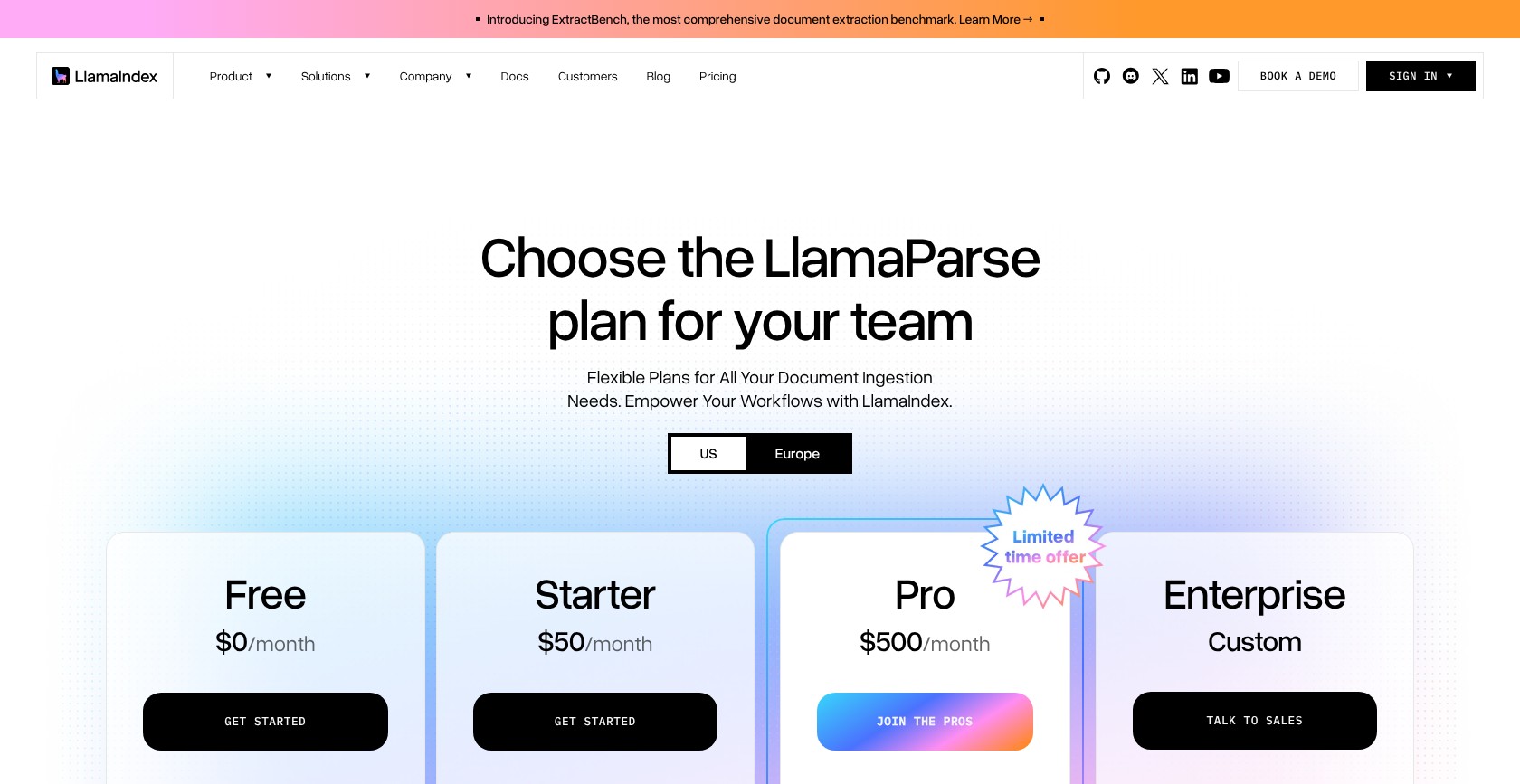
The framework costs nothing. It is MIT-licensed, and every index type, retriever, and connector ships in the open-source package. LlamaIndex pricing only starts with LlamaCloud, the managed platform, and its credit-metered plans, listed here as of September 2026:
- Free ($0): 10,000 credits per month, pay-as-you-go overage up to $500 per month, 5 concurrent parse jobs
- Starter ($50/month): 40,000 credits per month, pay-as-you-go up to $5,000 per month, 5 concurrent parse jobs
- Pro ($500/month): 400,000 credits per month, pay-as-you-go up to $5,000 per month, 20 concurrent parse jobs
- Enterprise (custom): custom credit volume, limits, and support
| Plan | Price | Credits included | Pay-as-you-go cap | Concurrent parse jobs |
|---|---|---|---|---|
| Free | $0/month | 10,000/month | $500/month | 5 |
| Starter | $50/month | 40,000/month | $5,000/month | 5 |
| Pro | $500/month | 400,000/month | $5,000/month | 20 |
| Enterprise | Custom | Custom | Custom | Custom |
The exchange rate is plain: 1,000 credits = $1.25. That prices the free tier’s 10,000 credits at $12.50 of processing a month, and both paid tiers at exactly face value: Starter’s 40,000 credits are worth $50, Pro’s 400,000 are worth $500. The subscriptions do not discount credits. Starter buys a pay-as-you-go ceiling ten times higher than Free’s, and Pro adds 20 concurrent parse jobs instead of 5 on the same $5,000 ceiling. Overage bills at the same rate, so a Starter team that burns 60,000 credits in a month pays $50 plus $25 for the extra 20,000, $75 in total.
Every tier, Free included, lists 100 users, 130+ supported file formats, and SOC 2, HIPAA, and GDPR compliance claims. Pro currently advertises a limited-time, one-time signup bonus of 800,000 credits (about $1,000 in credit value) for business-email signups; it is promotional and forfeited on downgrade. The vendor also claims its Auto Mode routing saves up to 80% on parsing cost. Treat that as a vendor claim, not an independent benchmark.
Is LlamaIndex Good Value for Money?
- The framework’s value is unambiguous: free, MIT-licensed, with 160+ connectors and the full index toolkit included
- The cloud’s value depends on parse volume and mode: our LlamaParse review breaks down the per-page mode math
- Rivals price the same way at the framework layer: Haystack is free, and deepset’s hosted platform has a free Studio tier; LangChain is free, and its LangSmith observability layer costs $39 per seat per month on the Plus plan
Author’s Testing Notes 📝
Self-host the framework; that decision costs nothing. Take the free LlamaCloud tier for parsing experiments, since 10,000 monthly credits covers a real document sample. Before committing $50 a month to Starter, model credit burn against your actual document mix; credit pricing punishes guesswork harder than flat per-seat pricing does.
— Panoply reviewer
My Experience With LlamaIndex
From Documents to a Query Engine
The official docs teach the pipeline in five stages, and each maps to a concrete piece of code:
- Loading: data comes in as Documents from files, APIs, databases, or websites through Readers (the 160+ connectors)
- Indexing: Documents are split into Nodes and turned into embeddings plus metadata
- Storing: indexes persist so you do not re-index on every run
- Querying: Retrievers and Routers pull back nodes, including sub-query and multi-step strategies, and Node Postprocessors refine them
- Evaluation: you measure response accuracy and speed
If you find an eight-stage breakdown while researching, it is 2024-era material that predates the current framework layout; the five-stage model is what the docs teach today.
Routers choose between retrievers, postprocessors rerank or filter, and a Response Synthesizer folds query, context, and prompt into an answer. The default path from a folder of files to a queryable engine is a handful of lines, which is the framework’s core pitch and its most honest one.
The Prototype Path
A Streamlit walkthrough on building a chatbot over custom data sources with LlamaIndex drew 99 points and 11 comments on Hacker News. Another HN user described building semantic search over Hacker News itself in a few hours, using LlamaIndex’s SentenceSplitter for chunking and ChromaDB for storage. Those are prototypes, not production systems, but both point the same way: documents to answers, fast.
Upgrades: Read Before You Bump
Budget real time for version upgrades. In GitHub issue #10747, one team’s working Vespa integration notebook stopped running after a major rewrite, failing with ImportError: cannot import name 'Response' from 'llama_index.core'. The official migration tool, llamaindex-cli upgrade-file, then failed on the same code with missing imports of its own. The tool built to smooth the upgrade path did not survive the upgrade.
The engineering context: LlamaIndex restructured its codebase into a monorepo of 650+ individually published PyPI packages and moved its build tooling to uv and LlamaDev, cutting full test-suite time by roughly 20% and some package test runs from 11 minutes to 4. That is real contributor-facing progress. For users, the visible side is package churn and import paths that move between major versions.
Author’s Testing Notes 📝
Pin your major versions, keep a smoke-test notebook that exercises your real pipeline, and read the release notes before any bump. The breaking-changes pattern is documented well enough to plan around; it only hurts teams who discover it in production.
— Panoply reviewer
The RAG Machinery: Indexes, Retrievers, and Chunking
Why pick a retrieval specialist over a general framework? Because retrieval shape varies by problem, and LlamaIndex ships a purpose-built index for each shape instead of one-size vector search:
- Vector index: semantic similarity search
- Summary index: whole-document synthesis
- Keyword index: exact-term lookup
- Knowledge graph index: relationship queries
Routers pick between retrievers at query time, and node postprocessors rerank or filter what comes back. With 160+ connectors, 40+ vector store integrations, and 40+ LLM integrations, ingestion is the easy part; retrieval composition is where the framework earns its keep.
Even agentic retrieval builds in LlamaIndex still sit on classic vector databases underneath, per one Hacker News commenter, so chunking and embeddings stay load-bearing.
One hands-on user who tried LlamaIndex alongside other open-source options reported poor results, with words and sentences split down the middle; that is a single account spanning several tools, not a systematic benchmark. A commenter working on legal-document retrieval reported that an agentic chunking approach outscored LlamaIndex’s recursive character text splitter on their benchmark. A third called one chunking code path “33x slower” than an alternative library, a narrow performance gripe about a single implementation.
One production team told Hacker News it uses LlamaIndex “very sparingly,” specifically for its context-aware document chunking, with permissions and filtering logic built custom outside the framework. My read: the defaults get you to a working demo, and production retrieval quality still demands your own chunking strategy and your own evaluation, with LlamaIndex as with every RAG framework. Evaluation is the fifth stage of the official pipeline, so the place to measure your own chunking against the defaults is already built in. If your corpus is legal documents, put an agentic chunker in that comparison.
Framework, Cloud, Parse: Which LlamaIndex Are You Buying?
“LlamaIndex” names three different purchases, and most coverage blurs them. LlamaIndex is the MIT-licensed open-source framework this review centers on. LlamaCloud is the commercial platform built on top of it, packaging three managed capabilities: Parse for document understanding and layout handling, Extract for context-aware data extraction with confidence scores, and Index for managed chunking and embedding. LlamaParse is the parsing engine inside LlamaCloud, and it has its own review in this directory.
For budgeting, adopting the framework obligates you to nothing; the credit meter only starts when you route documents through LlamaCloud. The free tier’s 10,000 monthly credits, covered in the pricing section above, make trying the managed side a cheap experiment rather than a commitment. The LlamaCloud page carries a Salesforce testimonial about prototyping and deploying production RAG applications with the framework; it is vendor-published, so weigh it as marketing.
The company behind all three was founded April 1, 2023 by Jerry Liu and Simon Suo, growing out of a side project Liu started in November 2022 as GPT Tree Index. Reported funding totals roughly $27.5 million: an $8.5 million seed led by Greylock in June 2023 and a $19 million Series A in March 2025 with Databricks and KPMG among the investors, per Wikipedia’s sourcing.
Evaluate the framework and the cloud as separate purchases. Strong framework adoption is not an argument for the credit meter, and the free tier means you never have to guess.
Adoption and the Standalone-Coverage Gap
As of September 2026, the main repo holds 52.3k GitHub stars and 8.2k forks, and the llama-index package pulls 3.1 million PyPI downloads a month (670,978 in the last week, 69,422 in the last day). For scale, LangChain’s repo carries 147.2k stars and 24.6k forks, about three times LlamaIndex’s fork count.
Professional standalone coverage is thinner than those numbers suggest. The one hands-on assessment from a major outlet is InfoWorld’s June 2024 review by Martin Heller, which praised the ease of setup and the breadth of integrations while listing “marketing claims slightly overstated” as a named con. That is a professional reviewer pushing back on vendor copy rather than repeating it, and its 160+ connector count still matches what the vendor docs list today.
Beyond that, most published coverage evaluates LlamaIndex as one side of a LangChain comparison. That lopsidedness measures mindshare, where LangChain’s lead pulls the spotlight, and says nothing about quality. Haystack, the third framework in this category, sits at 26.6k stars, about half LlamaIndex’s count. A 52.3k-star project moving 3.1M downloads a month is not a niche bet.
How Does LlamaIndex Compare to Competitors?
Which rival belongs on your shortlist? Each of the main LlamaIndex alternatives wins a different niche:
- LangChain: 147.2k GitHub stars, roughly 2.8x LlamaIndex’s community, plus an agent runtime in LangGraph that LlamaIndex does not match. The learning curve is steeper and the scope runs far beyond retrieval. Pick it when agents and orchestration outrank retrieval depth; our LangChain review covers it in full. Both are MIT-licensed, and production teams frequently run the two together, LlamaIndex for retrieval and LangChain for orchestration.
- Haystack: deepset’s Apache-2.0 framework, built around typed, YAML-serializable pipelines that audit-first production teams can review and version, backed by a company that builds production NLP tooling full time, with a free Studio tier on its hosted platform. It has the smallest community of the three at 26.6k stars, and no independent Haystack-vs-LlamaIndex benchmark is publicly documented, so the comparison rests on architecture and adoption metrics.
- Unstructured: a document parsing layer, not a RAG framework. It competes with LlamaParse rather than LlamaIndex and pairs with any framework here; it has its own review in this directory.
- LlamaParse: the parsing sibling covered above. If document parsing is your whole problem, read that review instead of this one.
- Raw embeddings plus pgvector: the null alternative. For a single corpus with simple retrieval needs, an embedding model and a Postgres table can be the honest answer, no framework required. You give up the index variety and the 160+ connector library, and you skip the upgrade churn along with them.
The decision rule: retrieval-centric products with heterogeneous data sources point to LlamaIndex, agent-first architectures point to LangChain, and compliance-audited pipelines point to Haystack. Parsing-only problems belong with LlamaParse or Unstructured.
How We Test RAG Frameworks
Panoply reviews combine independent analysis, data collection, and hands-on testing. For RAG frameworks, that means collecting public signals (GitHub activity, PyPI downloads, Docker Hub pulls, Stack Overflow volume, G2 and Gartner peer reviews), hand-checking vendor pricing pages ourselves and dating every price we print, and setting each tool up to run a real task end to end against its main rivals. For this review, that task was the framework’s own documents-to-query-engine pipeline.
We weigh sustained practitioner sentiment, deliberately keep third-party review scores a small factor, and mark unmeasurable areas N/A rather than scoring them zero. Signals are refreshed monthly and editorial verdicts quarterly. Sponsors and affiliate partners cannot change a score or a verdict. Prices current as of September 2026.
LlamaIndex Review: Should You Build Your Retrieval Stack on LlamaIndex?
We recommend LlamaIndex if your product’s core job is querying private data. Teams that need connector breadth (160+ sources), index variety beyond plain vector search, and the shortest path from documents to answers get exactly that, free, under an MIT license, with 3.1M monthly downloads’ worth of company. Prototypers are the clearest winners: community builds like semantic search over Hacker News went from documents to working search in a few hours.
Skip it, or supplement it, in three cases. Agent-first architectures are better served by LangChain and LangGraph. Compliance-audited pipelines fit Haystack’s typed, serializable design. And teams unwilling to own upgrade testing should not adopt a framework with ten documented breaking-change issues across three years; version discipline is part of the total cost.
So is LlamaIndex worth it? For retrieval-centric builds, yes, with eyes open and versions pinned. Next action: run pip install llama-index, build one query engine over your real documents, and test your own chunking against the defaults before trusting them. Take the free LlamaCloud credits as a separate parsing experiment, not part of the same decision.
FAQ
Is LlamaIndex free?
Yes. The framework is MIT-licensed and free to self-host, including all index types, retrievers, and connectors. LlamaCloud, the managed platform, is the paid product: a free tier with 10,000 monthly credits, Starter at $50 per month for 40,000 credits, and Pro at $500 per month for 400,000, with usage billed at 1,000 credits = $1.25.
Is LangChain better than LlamaIndex?
Neither wins outright. LlamaIndex is retrieval-first, with purpose-built index types and the fastest documents-to-answers path. LangChain is an orchestration framework with the stronger agent runtime in LangGraph. LangChain’s 147.2k GitHub stars against LlamaIndex’s 52.3k measure mindshare, not quality, and production teams frequently combine the two.
What are LlamaCloud and LlamaParse?
LlamaCloud is the commercial platform built on the open-source framework, bundling Parse (document understanding), Extract (structured data extraction with confidence scores), and Index (managed chunking and embedding). LlamaParse is the parsing engine inside LlamaCloud. See Framework, Cloud, Parse above for the full breakdown, and our separate LlamaParse review for parsing depth.
Does upgrading LlamaIndex break existing code?
It has, repeatedly. Ten numbered GitHub issues from 2023 through 2025 document breaking changes across storage backends, chat engines, provider integrations, and workflow streaming, and in one case the official llamaindex-cli upgrade-file migration tool failed with an ImportError of its own. Pin major versions, keep a smoke test, and read release notes before bumping.
Is LlamaIndex’s default chunking good enough?
Good enough for a demo, not proven for production. One hands-on user saw words split mid-sentence across LlamaIndex and other open-source splitters, and an agentic chunking approach beat the default recursive splitter on a legal-document benchmark in one commenter’s testing. Run your own retrieval evaluation on real documents before shipping the defaults.