Editor’s note: This Unstract review is based on my hands-on test of Unstract v0.204, the Unstract Cloud 14-day trial and the self-hosted Open Source edition, in November 2026. I weighed pricing, Prompt Studio, LLMWhisperer, accuracy controls, API, ETL and MCP deployment, the edition split, and rivals LlamaParse, Reducto, Unstructured, Docling and Amazon Textract.
Quick verdict: I recommend Unstract for operations and data teams that need prompt-defined JSON from invoices, statements, claims and contracts. The trade-off: Cloud starts at $499 a month before LLM tokens, and the free Open Source edition is one user without the paid accuracy controls.
The engine at the center of this Unstract review is Prompt Studio, where Zipstack’s platform treats every field as a prompt and deploys the project as a REST API, ETL pipeline or MCP server. In this review, I’ll take a closer look at Unstract’s pricing, features, and open-source edition, so you can see exactly whether it fits your document workflows or whether a parser like LlamaParse or Reducto is the better buy.
Key Takeaways
- Fields are prompts with a JSON key and output type, not layout templates or training sets.
- Starter costs $499 a month for 5,000 pages and Growth $2,249 for 25,000, with LLM tokens billed separately.
- LLMChallenge returns null when the extractor and challenger LLMs disagree on a field.
- Open Source is one user, without LLMChallenge, SinglePass, SummarizedExtraction, human review or built-in LLMWhisperer.
- SOC 2 Type II, HIPAA, SSO and audit logs need custom-priced Enterprise.
Pros and Cons
Pros
- Fields are prompts, with no layout templates or training sets.
- Bring your own LLM, from OpenAI, Anthropic and Bedrock to local Ollama.
- LLMChallenge nulls any field two LLMs disagree on.
- One project deploys as a REST API, ETL pipeline or MCP server.
- Standalone LLMWhisperer is free for 100 pages a day, then from $1 per 1,000.
Cons
- Cloud starts at $499 a month before your LLM bill.
- Open Source is one user, with no LLMChallenge, SinglePass or human review.
- SOC 2, HIPAA, SSO and audit logs require custom-priced Enterprise.
- Successful pages bill even when the extracted values are wrong.
Unstract Pricing: How Much Does It Cost?
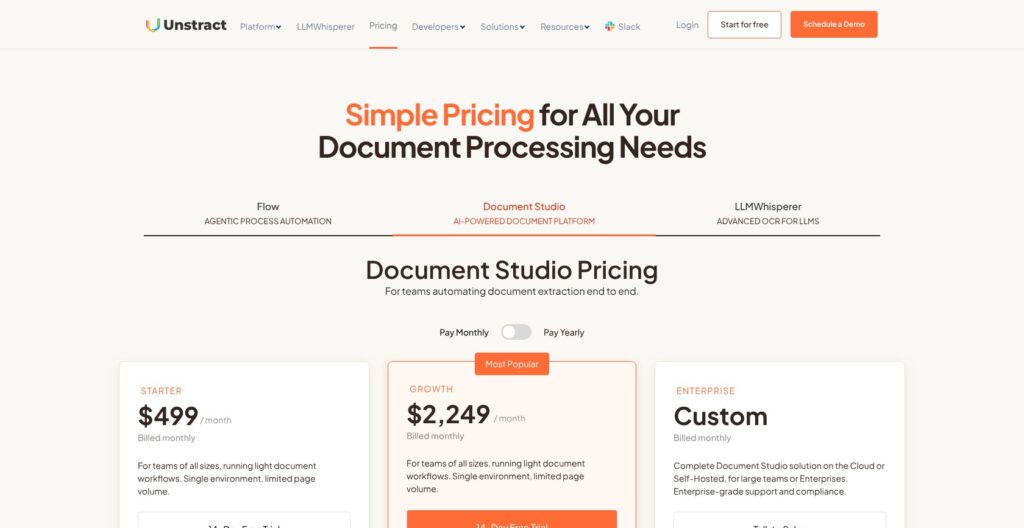
Unstract Cloud’s Document Studio plans start at $499 a month for 5,000 pages, billed by the physical page: a 10-page PDF is 10 pages, an image is one and each TIFF frame counts separately.
- Open Source (free, self-hosted): for one developer; AGPL-3.0, Slack community support and no paid extraction or review controls.
- Starter ($499/month, or $416/month billed annually): for light volumes; 5,000 pages a month or 60,000 a year, human review, one environment and no uptime SLA.
- Growth ($2,249/month, or $1,874/month billed annually): for higher volumes; 25,000 pages a month or 300,000 a year, with Starter’s features.
- Cloud Enterprise (custom): for regulated teams; SSO, SOC 2 Type II, HIPAA, three environments and a 99.9% uptime SLA.
- On-Prem Enterprise (custom): for your own AWS, Azure or GCP VPC; unlimited pages and a self-managed SLA.
The 14-day trial needs no credit card and includes LLMWhisperer and 1M Azure OpenAI GPT-4o tokens.
| Plan | Price | Pages included | Overage | Key limits |
|---|---|---|---|---|
| Open Source | Free | Unlimited, self-hosted | None | One user; no paid accuracy controls |
| Starter | $499/month; $416/month billed annually | 5,000/month; 60,000/year on annual | $0.10/page | One environment; no SSO or SLA |
| Growth | $2,249/month; $1,874/month billed annually | 25,000/month; 300,000/year on annual | $0.09/page | One environment; no SSO or SLA |
| Cloud Enterprise | Custom | Custom | Custom | Quote only; 99.9% uptime SLA |
| On-Prem Enterprise | Custom | Unlimited | None | Your own VPC; self-managed SLA |
Every Document Studio plan includes LLMWhisperer at no extra charge; standalone, it gives 100 free pages a day, then costs $1 to $15 per 1,000 pages by mode. On AWS Marketplace, Unstract costs $50,000 a year for 500,000 pages, then $0.10 a page.
Overage has no cut-off or throttling. Pages that fail on Unstract’s side are not charged, but successful pages bill even when the values are wrong.
Is Unstract Good Value for Money?
- Growth pays off above 22,500 pages a month: Starter plus overage reaches $2,249 there, and each plan costs about its overage rate ($0.10 or $0.09) per included page.
- LLM tokens are extra: after the trial, your own provider bills them. SinglePass and SummarizedExtraction cut usage (Unstract claims up to 8x and 6x), and include_metadata returns LLM cost per API call.
- Pay-as-you-go APIs cost less per page: Unstructured charges $0.015 a page after 10,000 free pages; Reducto Extract is $20 per 1,000 pages ($0.02 a page) with $150 of free usage.
- LlamaParse starts with 10,000 free credits: then $1.50 per 1,000.
- The premium buys workflow: Prompt Studio, LLMChallenge, human review and warehouse ETL in one product.
Unstract is good value for teams replacing manual keying or template-based extraction at a few thousand pages a month; for parsed text alone, LLMWhisperer or a pay-as-you-go API is cheaper.
Reviewer’s Notes: I recommend prototyping on the 14-day trial, or on Open Source with LLMWhisperer’s 100 free pages a day. Track LLM cost with include_metadata, start on Starter and move to Growth only past 22,500 pages a month. Budget Enterprise from day one for HIPAA, SOC 2 or SSO.
My Experience With Unstract
Starting the Unstract Cloud Trial
I signed up for the 14-day Cloud trial without a credit card. The account came preconfigured with Azure OpenAI GPT-4o (1M tokens), an embedding model, a Postgres vector database and LLMWhisperer, so I could extract on day one.
After the trial, the adapter settings take your own LLM keys, from OpenAI and Anthropic to Bedrock, Vertex AI and Ollama, and Cloud runs in US or EU regions. Reducto and LlamaParse, by contrast, are managed APIs billed per page or credit, with no adapters to configure.
Building My First Prompt Studio Project
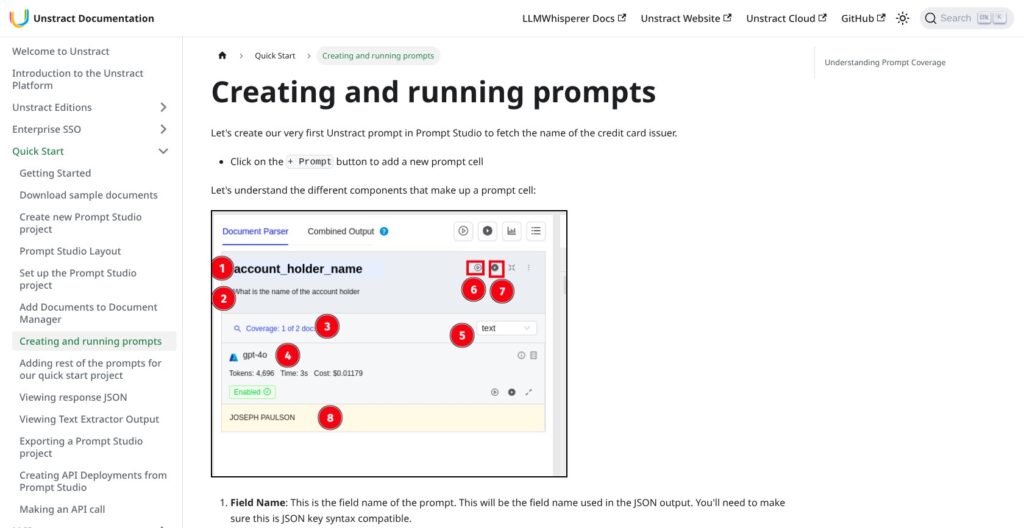
I followed Unstract’s quick start, which uses sample credit card statements from different issuers. Extraction runs on one project per document type, so I created a project (tool name, author, description, icon) and set it up:
- Settings > Manage LLM Profiles > Add New LLM Profile: I combined an LLM, vector database, embedding model and LLMWhisperer.
- Chunk size and overlap: I set both to 0, as the quick start recommends for statements.
- Preamble: I wrote instructions that wrap every field prompt; a Postamble is optional.
- Manage Documents > Upload New File: I uploaded three sample PDFs, shown as Not Indexed until the first prompt ran.
- Prompt cells: each took a Field Name, a Field Prompt and an output type.
The Field Name becomes the JSON key, and I switched numeric fields from the default Text type to number. A second LLM Profile let me compare models prompt by prompt, running the current document or all documents across profiles.
Coverage Info only counts non-null answers: it shows a prompt returned something, not that the value is right. I checked values in the Output Analyzer, which puts each document beside its full JSON.
Amazon Textract’s Forms and Analyze Expense APIs need no prompts, but they return fixed feature outputs, not fields I define.
Deploying the Project as an API
I selected Deploy as API and entered a display name, description and unique API name. The tool settings offered:
- Challenger LLM and LLMChallenge: the second model and its toggle.
- Highlight and word confidence: source references, with word confidence requiring highlight.
- SummarizedExtraction and SinglePass: the two token-saving toggles.
I downloaded the deployment’s Postman collection, which held an Extraction endpoint and a Status Check endpoint. Setting include_metadata to True returned LLM cost and debug data with the JSON.
Export as a Tool sends the project to Workflow Studio’s task and ETL pipelines instead, and JSON export moves it to another instance.
Running the Open Source Edition Locally
I cloned Zipstack/unstract, ran ./run-platform.sh under Docker and Docker Compose and changed the default login. The edition needs Linux or macOS and 8 GB RAM minimum.
I backed up the ENCRYPTION_KEY first, because losing it makes saved adapter credentials inaccessible. With no built-in LLMWhisperer, I connected the cloud API and its 100 free pages a day instead.
Unstract’s own walkthrough ran Ollama in a container on the Unstract Docker network and logged about 280 seconds for one invoice with DeepSeek R1 7B, so local models trade speed for privacy.
Reviewer’s Notes: I recommend judging a project on the trial with 10 or more real documents per variant before paying, checking values in the Output Analyzer rather than trusting the Coverage percentage.
LLMWhisperer: The Text Extractor Behind the Accuracy
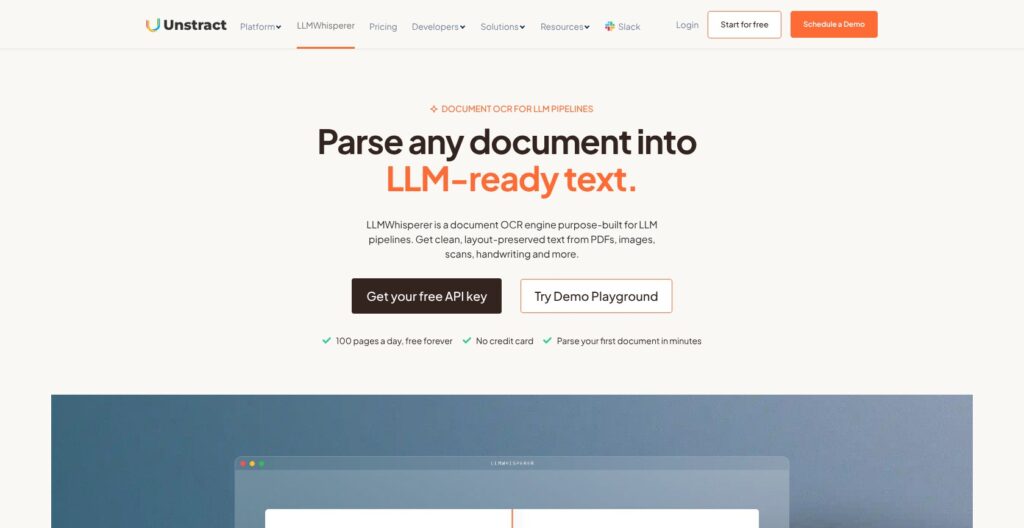
LLMWhisperer hands the LLM layout-preserving text, with columns and tables kept in place, rather than raw OCR output. It also sells as a standalone API with 100 free pages a day, so a text-only need does not require Document Studio.
- Native Text ($1 per 1,000 pages): for born-digital PDFs with a text layer, in any Unicode language.
- Low Cost ($5 per 1,000 pages): for clean printed scans and images, in 120+ languages.
- High Quality ($10 per 1,000 pages): for poor scans and handwriting; 300+ printed languages and handwriting in 12.
- High Quality + Form/Table ($15 per 1,000 pages): adds checkbox, radio button and table detection, with checkbox state returned inline as [X] or [ ].
Modes can change per request, and Unstract’s advice is to start a sample batch on Low Cost and move up only when output falls short.
| Requirement | Mode or capability | Limitation |
|---|---|---|
| Existing digital text | Native Text | Needs a text layer |
| Handwritten fields | High Quality | Handwriting in 12 languages |
| Checkboxes and radio buttons | Form | Top rate: $15 per 1,000 pages |
| Source location lookup | Highlight API | $0.01 per line lookup |
The API is asynchronous: submit, poll status and retrieve, or use webhooks. Integration options:
- 20+ file types: PDF, DOCX, XLSX, PPTX, HTML, PNG, JPEG, TIFF and more.
- Clients: Python and JavaScript, plus a Postman collection.
- Automation: an n8n node and the Highlight API.
On AWS Marketplace, LLMWhisperer SaaS costs $36,000 a year for 300,000 pages, then $0.05 a page, and the self-hosted build bills $0.001 to $0.015 a page plus your own AWS infrastructure.
Inside Unstract, Unstructured.io or LlamaParse can replace LLMWhisperer as the text extractor. Amazon Textract charges $0.05 a page for Forms, more than three times LLMWhisperer’s $0.015 Form/Table rate.
Best for: scanned forms with checkboxes and handwritten fields. Skip the High Quality modes for born-digital PDFs, where Native Text at $1 per 1,000 pages is enough.
LLMChallenge, Human Review and Agentic Prompt Studio
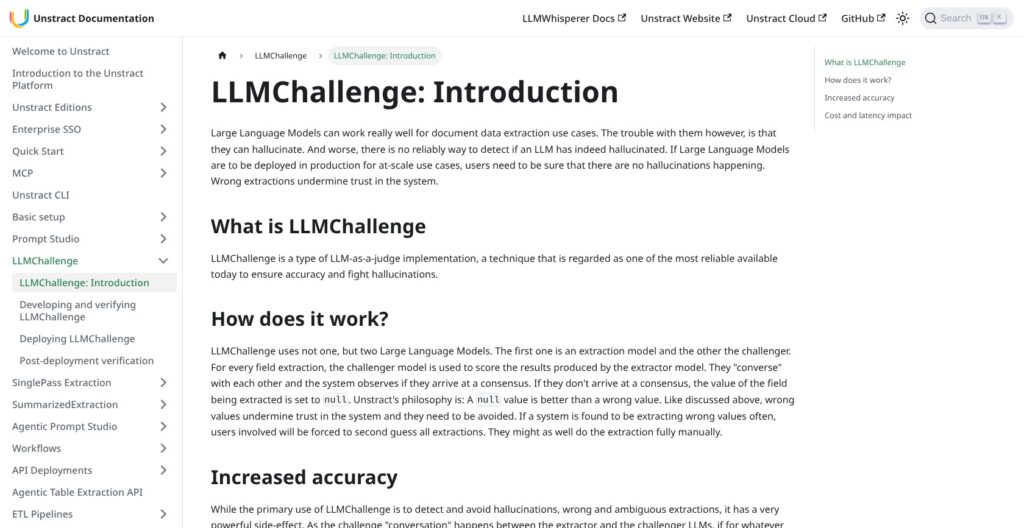
LLMChallenge runs an extractor LLM and a separate challenger LLM on every field, and when they fail to reach consensus, the field is set to null. Unstract’s rule is that “a null value is better than a wrong value.”
That suits workflows that route missing values to a person, but it adds a second model’s tokens and latency to every field, by a use-case-dependent amount. Two models agreeing is not proof that a value is right.
- LLMChallenge: pick the Challenger LLM at deployment; disagreement produces null.
- SinglePass Extraction: sends all prompts in one LLM pass; Unstract claims up to 8x fewer tokens.
- SummarizedExtraction: summarizes the document against your prompts before extraction; Unstract claims up to 6x fewer tokens.
- Human Quality Review: shows extracted values beside the source document with the source highlighted, so a reviewer can verify or correct each field. Every Document Studio tier includes it.
- Highlight and word confidence: line-level source references and confidence for each value.
Agentic Prompt Studio, in beta, generates a schema and an extraction prompt from sample documents, then scores output against hand-verified JSON baselines. Unlike Coverage Info, it checks values against a reference:
- Project and document scores: accuracy percentages against your baselines.
- Field comparisons: match or mismatch per field.
- JSON diff: expected versus extracted output.
The catch is manual baseline work. Unstract also lists these limits: beta behavior may change, deeply nested structures may need schema edits, documents should stay under 100 pages, and there is no built-in LLM cost tracking yet.
The verdict: Open Source has none of LLMChallenge, SinglePass Extraction, SummarizedExtraction or Human Quality Review, and this layer is my main reason to pay for Unstract Cloud.
Deployment: APIs, ETL Pipelines, MCP and Your Own LLMs
One Prompt Studio project ships as a REST API (document in, JSON out), an ETL pipeline that pulls files from storage and writes rows to a warehouse, or a Workflow Studio task pipeline. The API suits application requests; the ETL pipeline suits documents already sitting in storage.
- ETL sources: S3, MinIO, Azure storage, Google Drive, Dropbox, SharePoint, OneDrive for Business, GCS and SFTP.
- ETL destinations: Snowflake, BigQuery, Redshift, PostgreSQL, MSSQL, MySQL, MariaDB and Oracle.
- LLM adapters: OpenAI, Azure OpenAI, Azure AI Foundry, Anthropic, Amazon Bedrock, Vertex AI, Gemini, Mistral AI, Ollama, OpenRouter, NVIDIA Build and any OpenAI-compatible endpoint.
- Vector databases: Milvus, Pinecone, Postgres with pgvector, Qdrant and Weaviate.
- Text extractors: LLMWhisperer, Unstructured.io (Community or Enterprise) and LlamaParse.
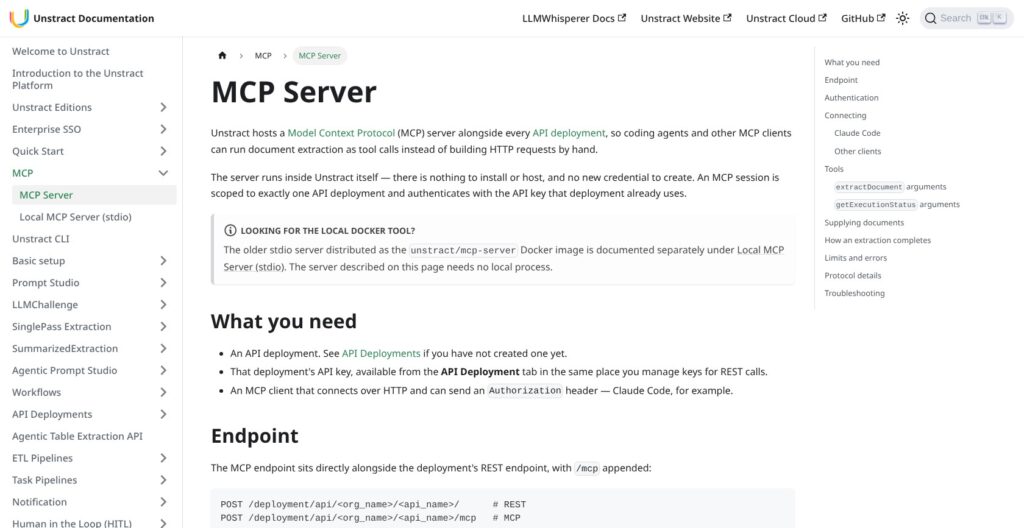
Every API deployment also exposes a hosted MCP server at its URL plus /mcp, authenticated with the deployment API key as a bearer token. Its tools:
- readMeFirst and getApiInfo: instructions and deployment details.
- extractDocument: up to 32 document URLs per call, as HTTPS URLs on S3.
- getExecutionStatus: polls a running execution until it completes or errors.
The catch: results can be read only once, and retrying extractDocument after an execution starts bills a second extraction. Store the first result and poll getExecutionStatus instead of resubmitting.
An n8n node covers no-code automation. Docling also ships an MCP server, but it returns converted documents, not prompt-defined JSON fields, so Unstract wins when an agent needs the same schema that feeds your warehouse.
Open Source vs Cloud vs Enterprise: What the Free Edition Leaves Out
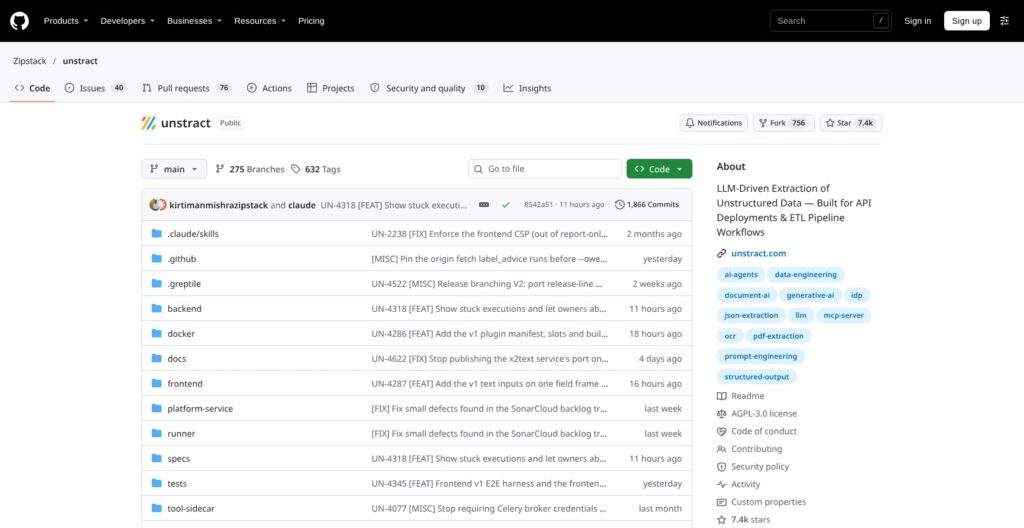
Unstract Open Source is AGPL-3.0 on GitHub (Zipstack/unstract), with about 7,400 stars and a public repository since February 2024. The latest release, v0.204.0, shipped on November 10, 2026.
It is a single-developer evaluation tool, not a free Document Studio:
- One user only: Unstract Cloud supports unlimited users.
- No LLMChallenge: disputed fields get no second-model check.
- No SinglePass Extraction or SummarizedExtraction: no token-saving controls.
- No Human Quality Review: no review queue.
- No built-in LLMWhisperer: you call the cloud API (100 free pages a day) or buy the on-prem version, sold only with On-Prem Enterprise.
- Slack community support: no dedicated success manager.
Starter and Growth add unlimited users, the paid extraction controls and US or EU data residency. Both keep one environment, standard compliance and no uptime SLA.
| Capability | Starter and Growth | Enterprise tiers |
|---|---|---|
| SSO, SAML and audit logs | Not included | Included |
| Environments | One | Dev, Staging, Production |
| SOC 2 Type II, ISO 27001, HIPAA, GDPR with a DPA | Not included | Included |
| Dedicated success manager | Not included | Included |
| Uptime SLA | None | Cloud: 99.9%; On-Prem: self-managed |
Compliance, not volume, can force Enterprise: a HIPAA workload needs Cloud Enterprise or On-Prem Enterprise even at Starter volumes.
Unstract says it never trains on customer data, Cloud is encrypted in transit and at rest, and LLMWhisperer API documents are encrypted, processed and discarded. Projects, workflows and deployments can move between Cloud and On-Prem later.
AGPL-3.0 is copyleft, so teams that modify Unstract and offer it over a network should have counsel review their obligations. On-Prem Enterprise is the vendor-supported self-hosted route; Docling, by contrast, is MIT-licensed.
Skip the free edition if more than one person needs access, or if disputed fields must pass through LLMChallenge and a review queue.
How Does Unstract Compare to Competitors?
-
LlamaParse: 10,000 free credits, then $1.50 per 1,000 credits; Pro is $500 a month. Basic parsing starts at one credit per page, and agentic modes cost more. It fits LlamaIndex-based retrieval workflows, and Unstract can use it as a text extractor.
-
Reducto: r-1 Parse costs $10 and Extract $20 per 1,000 pages, with $150 of free usage. Higher tiers add BAA, zero data retention and VPC or on-prem deployment. It fits developers who want pay-as-you-go extraction without a platform subscription.
-
Unstructured: 10,000 free pages, then $0.015 per page; the open-source library is Apache 2.0. It fits per-page preprocessing for retrieval and doubles as an Unstract text extractor.
-
Docling: the MIT-licensed library started at IBM Research Zurich, runs locally or air-gapped and exports Markdown, HTML and JSON. It fits engineers who want a free conversion library and will build extraction and review themselves.
-
Chunkr: AGPL-3.0 or a commercial license, self-hosted with Docker Compose on GPU, CPU or Mac ARM. The open-source build uses community models; the Cloud API uses proprietary ones. It fits teams that need layout analysis and chunking for retrieval.
-
Marker: Datalab’s Team plan costs $400 a month including $400 of usage, and conversion runs $0.375 to $7.50 per 1,000 pages by processor. It fits conversion-first workloads that do not need field review or warehouse delivery.
-
Amazon Textract: $0.05 a page for Forms and $0.01 for Analyze Expense (US West, first tier). Its fixed feature APIs fit AWS teams extracting standard forms and receipts.
Unstract wins where non-developers maintain extraction fields across many document variants and the output lands in a warehouse, with On-Prem Enterprise for data that cannot leave your network.
How I Reviewed Unstract
I ran the Unstract Cloud trial and the self-hosted Open Source edition, built a Prompt Studio project on the quick start credit card statements, compared LLM profiles and deployed it as an API with LLMChallenge and SinglePass options. I also reviewed the MCP server, ETL connectors, edition split and page-based pricing math.
I weighted these areas:
- Pricing and value: page allowances, overage and separate LLM charges.
- Setup: preconfigured trial versus self-hosted adapters.
- Extraction workflow: prompt fields, profiles and output inspection.
- Accuracy controls: LLMChallenge, human review and verified baselines.
- Text extraction: LLMWhisperer modes and alternatives.
- Deployment: APIs, ETL connectors and MCP.
- Security and licensing: Enterprise compliance and AGPL obligations.
- Alternatives: LlamaParse, Reducto, Unstructured, Docling, Chunkr, Marker and Amazon Textract.
Prices current as of November 2026.
Unstract Review: Should You Use Unstract for Document Extraction?
I recommend Unstract if an operations or data team needs structured fields from invoices, bank statements, claims or contracts across many layouts, wants to define them as prompts and needs the results in an API or a warehouse. Budget $499 a month for 5,000 pages plus your own LLM tokens, or Enterprise if HIPAA, SOC 2 or SSO is mandatory.
Skip it if you need:
- Parsed text for retrieval: LlamaParse, Unstructured or Docling fit better.
- Pay-as-you-go extraction: Reducto, at $20 per 1,000 pages for Extract, avoids a monthly platform commitment.
- Standard forms and receipts inside AWS: Amazon Textract’s fixed APIs cover them from $0.01 a page.
- Free multi-user self-hosting: Unstract Open Source supports one user, and On-Prem Enterprise is custom-priced.
Settle these before committing:
- Monthly volume: compare Starter plus overage with Growth at the 22,500-page crossover.
- LLM cost per document: capture representative costs through include_metadata, including LLMChallenge’s second model.
- Null handling: decide whether disputed values can wait for human review instead of entering downstream records.
Settle the last two on the Cloud trial, since the free edition lacks LLMChallenge and human review. Start the 14-day trial at Unstract with representative documents and expected JSON values.
FAQ
Is Unstract free?
Unstract’s Open Source edition is free under AGPL-3.0, but it supports one user and excludes LLMChallenge, SinglePass Extraction, SummarizedExtraction, human review and built-in LLMWhisperer. Cloud offers a 14-day trial without a credit card, then starts at $499 a month. Standalone LLMWhisperer includes 100 free pages a day, but it is a text extractor, not the full platform.
What is the difference between Unstract and LLMWhisperer?
LLMWhisperer extracts layout-preserving text; Unstract extracts structured fields and runs the workflow. Standalone LLMWhisperer starts at $1 per 1,000 pages in Native Text mode. Unstract adds Prompt Studio, LLMChallenge, human review and API or ETL deployment. Every Document Studio plan includes LLMWhisperer, but the free Open Source edition does not.
Can Unstract use local LLMs?
Yes. Ollama is a supported adapter, and Unstract accepts any OpenAI-compatible endpoint, with Milvus, Qdrant, Weaviate or Postgres with pgvector as the vector store. Unstract’s own walkthrough ran Ollama on its Docker network and logged about 280 seconds for one invoice with DeepSeek R1 7B.
Is Unstract HIPAA compliant?
HIPAA comes only with Cloud Enterprise and On-Prem Enterprise, alongside SOC 2 Type II, ISO 27001 and GDPR with a DPA. Starter and Growth carry standard compliance. Unstract says it never trains on customer data, and On-Prem Enterprise keeps documents inside your own VPC.
Is Unstract better than LlamaParse?
For prompt-defined fields and review workflows, Unstract is the better fit; LlamaParse is a credit-priced parsing API for retrieval. LlamaParse includes 10,000 free credits, then charges $1.50 per 1,000 credits, with usage varying by parsing mode. Unstract can also run LlamaParse as its text extractor. See How Does Unstract Compare to Competitors? above for the full comparison.