Editor’s note: This Portable review evaluates its pricing model, connector library, setup requirements and documented capabilities, and weighs them against Fivetran, Airbyte, Hevo and Stitch. It is not a hands-on performance test. I weigh price per flow, connector coverage, custom-build terms, sync mechanics and support.
Quick verdict: I recommend Portable for US data teams with six or more niche SaaS sources that Fivetran and Airbyte do not cover, who would rather pay a flat $1,800 to $4,200 a month than write and babysit API code. The trade-off: extract-and-load only, about $300 per flow at entry, and no sales outside the US.
Key Takeaways
- Portable claims 1,500+ prebuilt connectors, with custom connectors scoped and built by Portable’s own engineers
- Standard is $1,800/mo for 6 flows with hourly syncs, Pro $2,800/mo for 15 flows with 15-minute syncs, no volume charges
- Custom builds come through a $2,000/mo integration-services add-on, included on Pro and Advanced, and on Standard for the first 3 months only
- No free plan, only 14-day trials, and sales to US companies only
- No transformations, CDC or reverse ETL, so you still need dbt or another tool for those
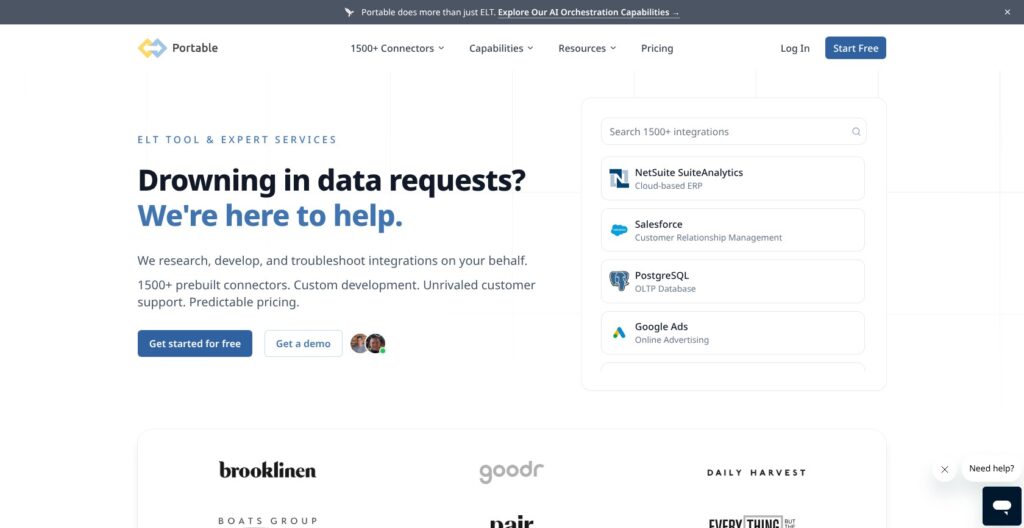
Portable is a managed ELT service for the long tail, the vertical SaaS and niche APIs mainstream pipelines skip, at a flat monthly price per flow. In this Portable review, I’ll take a closer look at Portable’s pricing, connector library, flow setup and support, so you can see exactly whether a flat-rate bill beats Fivetran’s monthly active rows for your sources.
Pros and Cons
Pros
- 1,500+ prebuilt connectors aimed at long-tail SaaS and vertical tools
- Custom connectors scoped, built and maintained by Portable’s engineers, included on Pro and Advanced
- Flat monthly price per enabled flow with no volume charges or caps
- 15-minute syncs, cron scheduling, API and webhooks from Pro ($2,800/mo)
- 24×7 support with a joint Slack channel on Pro and above
Cons
- $1,800/mo minimum for 6 flows, about $300 per flow, with no free plan
- Extract-and-load only, no transformations, CDC or reverse ETL
- US customers only, waitlist elsewhere
- Hourly sync floor on Standard and no published turnaround guarantee for custom builds
How Much Does Portable Cost?
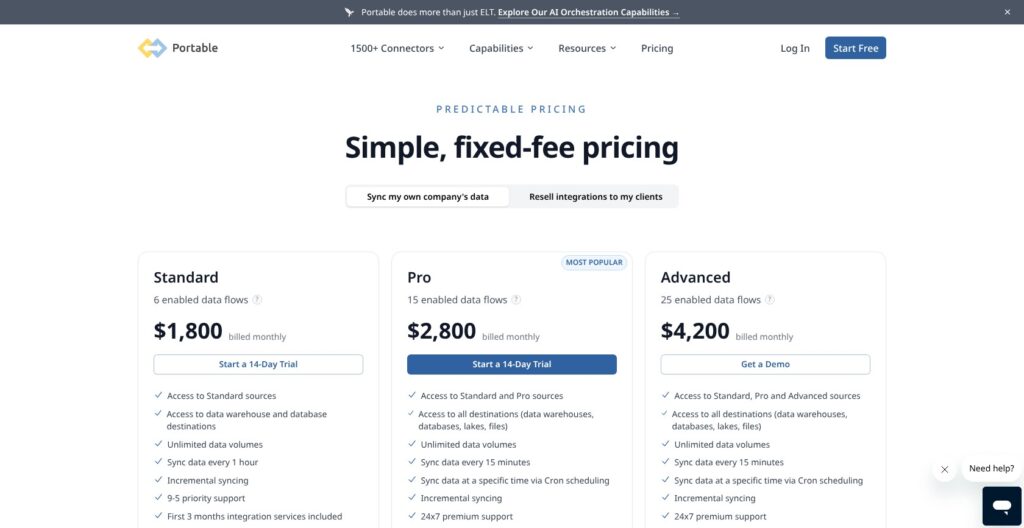
Portable sells four plans, three with published prices, all billed monthly, with no free plan and 14-day trials on Standard and Pro only. Every plan includes incremental syncing and unlimited data volume, so the price buys you flows, a sync floor and a support tier.
- Standard ($1,800/mo): 6 enabled flows, hourly syncs, warehouse and database destinations, 9-to-5 priority support, and the first 3 months of integration services included
- Pro ($2,800/mo): 15 flows, 15-minute syncs, cron scheduling, every destination type (warehouses, databases, lakes, files), developer API and webhooks, 24×7 support, a joint Slack channel, and integration services included
- Advanced ($4,200/mo): 25 flows plus Advanced-tier sources, otherwise Pro’s feature set; no self-serve trial is listed, so you ask sales for one
- Enterprise (custom): SAML/SSO, NetSuite and Dynamics 365 sources, and uptime and response-time SLAs
A flow is one unique source-destination pair. Stripe to Snowflake is one flow; Stripe to Snowflake plus Stripe to BigQuery is two, and both count against your plan cap.
| Plan | Monthly price | Enabled flows | Fastest sync | Custom connector services | Support |
|---|---|---|---|---|---|
| Standard | $1,800 | 6 | 1 hour | First 3 months, then $2,000/mo add-on | 9-to-5 priority |
| Pro | $2,800 | 15 | 15 minutes | Included | 24×7 + joint Slack channel |
| Advanced | $4,200 | 25 | 15 minutes | Included | 24×7 + joint Slack channel |
| Enterprise | Custom | Custom | Custom | Custom terms | Uptime and response-time SLAs |
Custom connectors live in the integration-services add-on. It costs $2,000/mo on Standard after month 3 and covers scoping and kickoff, a dedicated Slack channel, a fast-track build with QA, schema mapping and custom fields, and ongoing maintenance. So “custom connectors at no extra cost” holds on Pro and Advanced, and turns Standard into a $3,800/mo plan once the first quarter ends.
Per flow, Standard works out to about $300, Pro to about $187 and Advanced to about $168. Fivetran bills on monthly active rows plus a $5 base charge per connection instead, so a high-volume source pushes a Fivetran bill up while Portable’s stays flat, and a handful of quiet mainstream sources usually costs less on Fivetran or Airbyte Cloud.
Portable sells to US companies only. Companies elsewhere can join a waitlist, and Portable gives no date for wider availability.
Is Portable Good Value for Money?
- Good fit: six or more niche sources (Clio, MyCase, vertical SaaS) that Fivetran and Airbyte lack, or a few high-volume sources where Fivetran’s monthly-active-row bill would run past $1,800
- Weaker fit: three or four mainstream sources at modest volume, where Airbyte Cloud from $20/mo plus credits, Hevo free to 1M events a month, or Stitch from $100/mo costs a fraction
- Budget priority: if every source on your list is mainstream, start with a usage-priced rival and add Portable later for the gaps
Reviewer’s Notes: Pro at $2,800/mo is the plan to buy if you need custom builds at all. Standard’s $2,000/mo add-on erases its price advantage after three months, and its hourly floor rules out near-real-time dashboards. I’d use Standard only for a fixed set of six prebuilt connectors you never expect to extend.
Getting Started With Portable
Portable’s console is organized around three objects: a source (your authenticated instance of a connector), a destination, and a flow that joins the two on a schedule. There is no pipeline code to write, so an analyst who can paste an API key can own the setup.
Creating a Source and Destination
Signup is self-serve for the 14-day trial, open to US companies only. You search the source catalog, pick the system, and authenticate with the method that connector supports; across the catalog, connectors support API tokens, basic auth, OAuth-style authorization, client credentials and OIDC. Then you add and authenticate a destination the same way.
The documented destinations are Snowflake, BigQuery, Redshift, Postgres, MySQL and Google Sheets. Pro and Advanced list lakes and file targets only generically, so confirm Databricks or S3 with sales before you buy.
Building and Scheduling a Flow
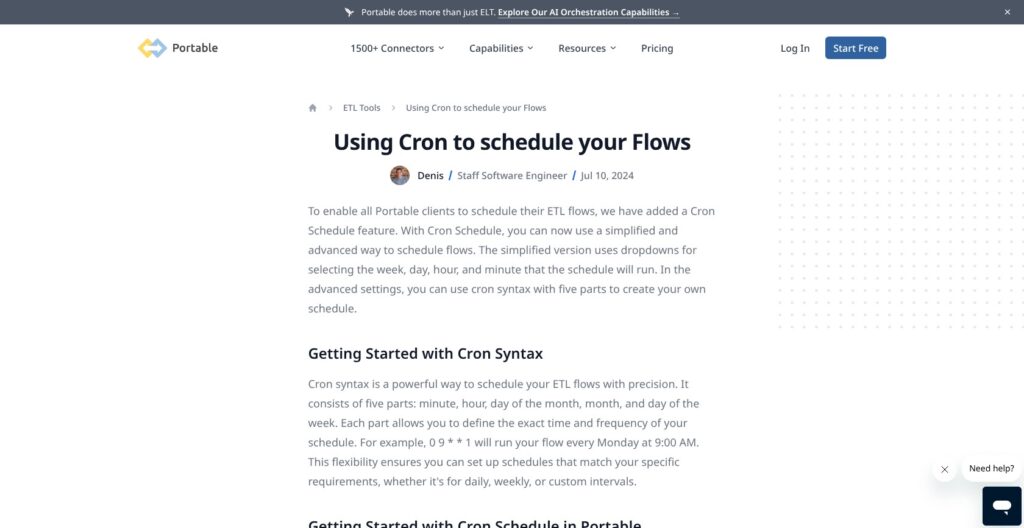
A flow connects one source to one destination. You run it once on demand, then set a cadence from a dropdown. Standard gives you the hourly floor. Pro adds 15-minute intervals and a Cron Schedule option with week, day and hour pickers or five-part cron syntax (0 9 * * 1 for 9am every Monday), showing the UTC value and the next run in your local time.
Pro’s developer API and webhooks let you trigger a run from GitHub, Stripe, Slack or a generic webhook instead of waiting for the schedule.
Watching Runs and Requesting a Connector
Portable records a run attempt for every run, with a start and end time, a result, counts of resources extracted, analyzed and loaded, and any errors; on Pro, the flow run-attempts endpoint in the developer API returns the same record. A failed flow triggers an email immediately, and Slack and webhook notifications are also available.
When a source is missing, you describe it after signup or on a demo call, and Portable scopes, builds and maintains it. Portable advertises builds within days, and nothing guarantees a build time outside Enterprise SLAs. Portable’s public developer reference is an API reference with no quickstart, so plan on asking support rather than reading your way through week one.
Reviewer’s Notes: The three-object model is simple enough that an analyst can own it without an engineer. With no quickstart in the public docs, the joint Slack channel on Pro is part of the product, not a perk, and I’d weigh that when choosing between Standard and Pro.
Connector Library and Custom Builds
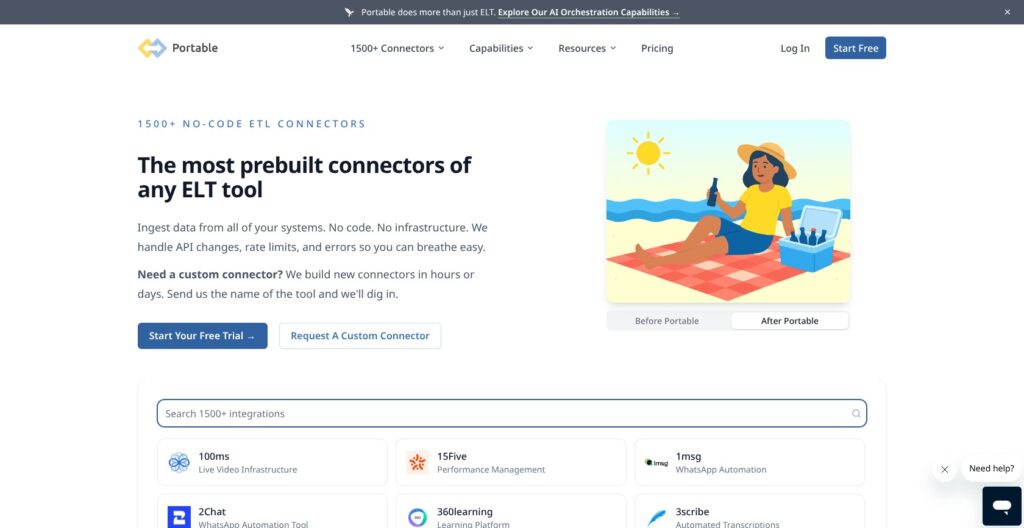
Portable claims 1,500+ prebuilt connectors, a figure its library passed in September 2025 with a stated goal of 10,000. Older Portable pages quote lower counts, so treat 1,500 as Portable’s own number and check your actual sources in the catalog during the trial.
Fivetran and Airbyte each cover the mainstream sources well; Portable aims at the long tail: legal practice tools like Clio and MyCase, vertical SaaS, and the niche marketing and finance apps that never make a rival’s roadmap. Every source spec carries a lifecycle label (ALPHA, BETA, STABLE or DEPRECATED), and an ALPHA or BETA connector with few users may need tuning before it runs cleanly.
On the connector side, the feature list includes a _portable_extracted freshness field, automatic schema migrations when a source changes, custom fields, and table-level masking for columns you do not want landing in the warehouse.
How Custom Connectors Work
You request a source. Portable’s engineers scope it, build and QA it, map the schema and any custom fields, then maintain and monitor it after launch. CEO Ethan Aaron says he has personally built 200+ connectors, and the team runs pager duty even for single-client builds.
The terms: included on Pro and Advanced, and on Standard for the first 3 months before the $2,000/mo integration-services add-on kicks in. Turnaround is advertised as within days or under a week, with no guaranteed timeline outside Enterprise SLAs, which matters if a board deadline depends on the build.
Database sources (PostgreSQL, MySQL) appear on the feature list, but Portable is not a CDC tool. For change data capture on a production database, plan on a separate CDC tool.
My recommendation: run your full source list against the catalog during the 14-day trial, and get a written turnaround estimate for every gap before you sign.
Flows, Scheduling and Destinations
The sync floor is 15 minutes on Pro and Advanced and 1 hour on Standard. That rules Portable out for operational dashboards, where Weld advertises 1-minute syncs; Portable is batch analytics tooling. Incremental syncing is on every plan, and volume is unlimited with no caps or overage charges.
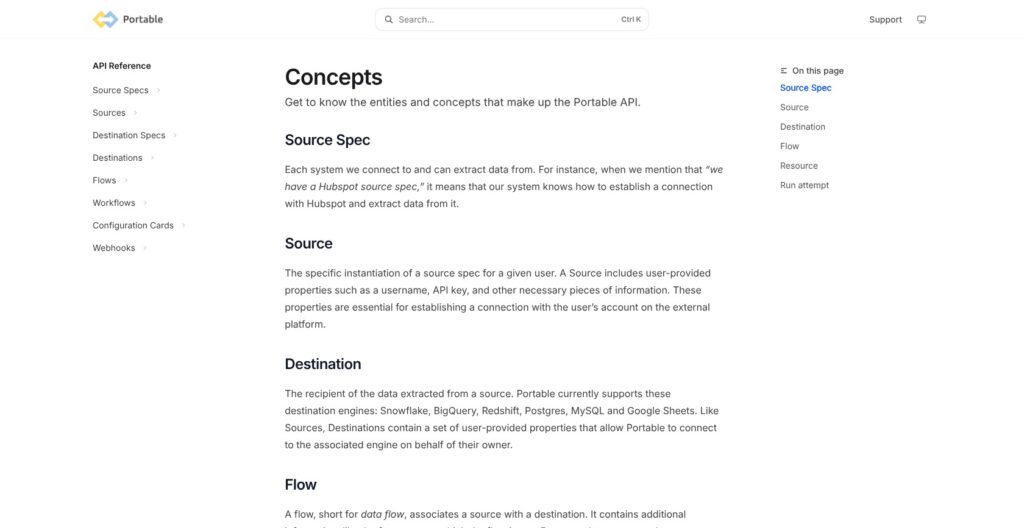
Documented destinations are Snowflake, BigQuery, Redshift, Postgres, MySQL and Google Sheets. Pro and Advanced add lakes and files as categories without naming products, so Databricks or S3 is a sales question.
The same source going to two destinations counts as two flows against the cap, so a six-flow Standard plan is six source-destination pairs, not six sources. A team landing Stripe in both Snowflake and a Postgres replica has used a third of Standard on one source.
Automation lives on Pro. The developer API (api.portable.io v2, bearer token) creates, runs, cancels and polls flows and run attempts, and refuses calls for features outside your plan. Webhook triggers accept Slack, GitHub, Stripe or a generic endpoint. Multi-user accounts, Google and Microsoft sign-in, an admin API and user access logs appear on the feature list, though the tier for some of those rows is not spelled out, so confirm with sales.
Three parts of the stack are missing:
- No in-platform transformations: pair Portable with dbt
- No reverse ETL: a tool such as Census or Hightouch handles the warehouse-to-SaaS leg
- No CDC: database replication by change capture needs a separate tool
Weld bundles transformations and reverse ETL with ingestion from $99/mo. Portable is the extraction leg of a stack, not the stack.
Support, Monitoring and the AI Orchestration Service
Standard gets 9-to-5 priority support. Pro and Advanced get 24×7 premium support with a joint Slack channel, and Enterprise adds uptime and response-time SLAs on top. Users consistently praise response speed and connector help; the recurring complaint is limited advanced configuration and a learning curve on complex setups.
Monitoring covers the basics: every failed run sends an email, Slack and webhook notifications are available, and each run attempt records counts and errors. Portable offers no lineage view, no retry controls and no orchestration visibility, so an engineering-heavy team that wants runtime control should look at Airbyte instead.
What the AI Orchestration Banner Actually Is
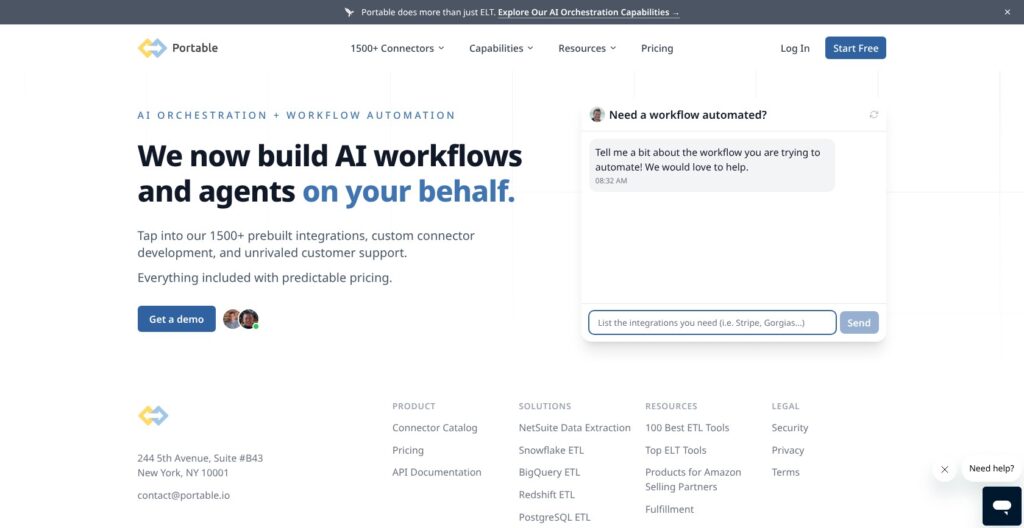
Portable now advertises AI orchestration and says it builds AI workflows and agents on your behalf. This is a demo-led service: no self-serve product, no feature list, no pricing and no public docs. The closest technical surface is a workflows API and the webhook triggers already on Pro. It does not change the ELT buying decision; treat it as a consulting upsell and price it separately if you want it.
Ethan Aaron founded Portable in New York in 2020; it raised a $3.2M seed in 2022, runs with roughly 18 to 23 employees, and has announced no later round or acquisition as of October 2026. That size cuts both ways: fast decisions on connector requests, and key-person risk if the founder who built 200+ connectors moves on.
How Does Portable Compare to Competitors?
Portable wins only when the source list is long-tail or the volume is high; each rival below takes a different niche.
- Fivetran: the mainstream default, with strong coverage of popular sources and thin coverage of the long tail. Pricing is monthly active rows plus a $5 base charge per connection, so the bill scales with your data and is hard to forecast. It wins on breadth of popular sources, and loses to Portable when one high-volume source makes MAR expensive or the source is obscure.
- Airbyte Cloud: Standard from $20/mo plus $5 per credit, Plus from $189/mo for 40 credits, and a 14-day trial with 400 credits. Custom connectors are yours to build on its open-source base, which is exactly the work Portable sells. It wins for engineering teams on a budget.
- Hevo: free to 1M events a month, Starter $265/mo and Professional $750/mo on annual billing. It wins for small teams on mainstream sources.
- Stitch: from $100/mo, Advanced $1,500/mo and Premium $3,000/mo on annual billing, with costs that rise with rows. It wins on cheap entry for a few standard sources and loses as row counts climb.
- Rivery (Boomi Data Integration): $0.90 per credit on Base monthly, with a 14-day or 1,000-credit trial. It wins for teams that want to start small on usage pricing, though credit burn is harder to predict than Portable’s flat bill.
- Meltano: open source, so you run and maintain the connectors yourself. It wins for engineers who want to own the pipeline code outright and pay nothing for the software.
| Tool | Pricing model | Entry price | Wins for |
|---|---|---|---|
| Portable | Flat per flow tier, unlimited volume | $1,800/mo (6 flows) | Long-tail sources, custom builds |
| Fivetran | Monthly active rows | $5 base per connection plus MAR | Mainstream breadth |
| Airbyte Cloud | Credits | $20/mo plus $5 per credit | Engineering teams building their own connectors |
| Hevo | Events | Free to 1M events/mo, then $265/mo annual | Small teams on mainstream sources |
| Stitch | Rows | $100/mo | Cheap entry for a few standard sources |
| Rivery (Boomi) | Credits | $0.90 per credit | Small starts on usage pricing |
The combination that pencils out is Fivetran or Airbyte for the mainstream and Portable for the three to six sources nobody else covers, provided closing those gaps is worth $1,800 a month to you. If the gaps number one or two, building them yourself on Airbyte is the cheaper route.
How I Reviewed Portable
I weighed Portable’s published plans and the per-flow math behind them, the connector catalog and the custom-build terms on each tier, the flow, scheduling and run-attempt mechanics exposed through the developer API, destination coverage, support tiers, and sustained user sentiment on turnaround and configuration limits. Each rival is priced from its own current plans.
I did not run a paid Portable account end to end, so throughput, build turnaround and support response times are reported as Portable states them, not as I measured them. Where Portable’s own figures conflict, such as the connector count, I use the current number and treat it as a claim. The verdict rests on the per-flow math and the feature gaps, both of which you can check against your own source list.
Prices current as of October 2026.
Should You Choose Portable for Your Long-Tail Connectors?
Portable charges a flat price per flow, claims 1,500+ connectors, builds the missing ones for you, and does extraction and loading only. That makes it a specialist for the long tail, not a replacement for Fivetran or Airbyte on mainstream sources, and the $1,800/mo floor means the specialty has to be worth paying for.
Buy Pro at $2,800/mo if you have 10 to 15 flows and at least a couple of sources no rival covers; the included integration services and 15-minute syncs are the whole reason to pay Portable prices. Use Standard at $1,800/mo only for a fixed six prebuilt connectors you will never extend, because the custom-build add-on pushes it to $3,800/mo after month 3.
Skip it if you are outside the US, need freshness under 15 minutes, want transformations or reverse ETL in the same tool, or your sources are all mainstream, where Airbyte Cloud, Hevo or Stitch cost a fraction.
Next action: list every source you need, check each one against the catalog during the 14-day trial, and price the same list on Fivetran’s monthly active rows before you sign anything. Start the trial at https://portable.io.
FAQs
Does Portable have a free plan?
No. Portable offers 14-day free trials on Standard ($1,800/mo) and Pro ($2,800/mo), and no free tier at any level; Advanced trials go through sales. If you need a free entry point for a few mainstream sources, Hevo covers up to 1M events a month at no charge.
What counts as a flow in Portable?
One unique source-destination pair. Stripe to Snowflake is one flow; adding Stripe to BigQuery makes two, and both count against your cap of 6 on Standard, 15 on Pro and 25 on Advanced. Frequency does not change the count, so an hourly flow and a 15-minute flow each use one slot.
Does Portable charge by data volume?
No. Portable charges a flat monthly price per plan tier, and the tier sets how many flows you can enable, not how many rows you move. There are no volume caps or overage charges, so a source that would run up Fivetran’s monthly active rows costs the same as a quiet one.
Can companies outside the US use Portable?
Not currently. Portable sells only to US-based companies, and anyone else can join a waitlist with no stated date for wider availability. Outside the US, Airbyte Cloud is the closest substitute for the long-tail job, since you can build the missing connectors yourself, while Hevo and Fivetran cover mainstream sources.
Does Portable do transformations or reverse ETL?
No. Portable extracts data from a source and loads it into a warehouse, database, lake or file target, then stops. Pair it with dbt for transformations and with a reverse ETL tool such as Census or Hightouch. Weld bundles ingestion, transformations and reverse ETL from $99/mo if you want one bill.