Editor’s note: This H2O.ai review is based on my hands-on test of open-source H2O-3 3.46.0.12, from pip install to two AutoML runs and a MOJO export attempt on my own laptop, in November 2026. I cover the licensed Driverless AI, Enterprise h2oGPTe, H2O-3 Secure and H2O AI Cloud through their capabilities, pricing and deployment, rather than hands-on results. I weighed licensing, the open-source engine, automated feature engineering, explainability, agents and compliance against DataRobot, Dataiku, Domino, SageMaker and Vertex AI.
Quick verdict: I recommend H2O.ai for regulated enterprises that need explainable AutoML and private GenAI on their own hardware or in air-gapped sites. The trade-offs are a $720,000 published Starter contract for 12 months and an open-source engine that has moved several production capabilities into paid H2O-3 Secure.
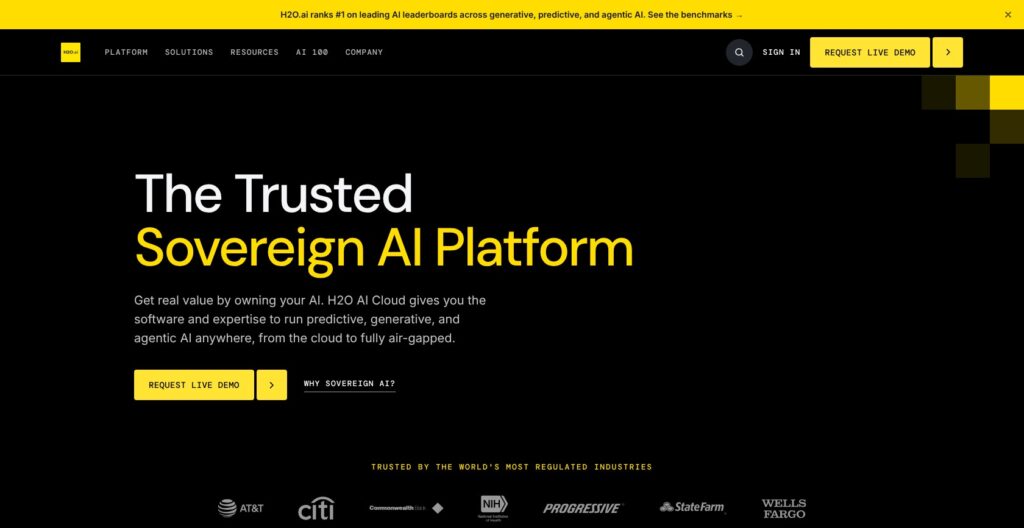
H2O.ai combines open-source AutoML, Driverless AI, h2oGPTe agents and tabH2O with managed, hybrid and government deployments. I would shortlist it for that breadth, not for transparent purchasing: DataRobot also publishes no prices.
In this review, I’ll take a closer look at H2O.ai’s pricing, features, and open-source engine, so you can see exactly whether it fits your data science team or whether a cloud AutoML service is the better buy.
Key Takeaways
- H2O-3 is free under Apache 2.0. My reproducible AutoML run on 10,000 rows finished in 53.1 seconds with a stacked-ensemble leader.
- Portable exports were blocked: version 3.46.0.12 moved MOJO runtime, Hadoop, Kubernetes and Sparkling Water into H2O-3 Secure.
- H2O AI Cloud uses annual licensing. The AWS Starter bundle costs $720,000 for 8 GPUs with services; separate per-GPU pricing is $225,000 per GPU for 1 to 64 GPUs.
- Driverless AI requires licensed scoring, despite providing automated feature engineering, interpretability and AutoDoc.
- H2O AI Cloud for Government reached FedRAMP High in May 2026. Enterprise h2oGPTe remains maintained commercially, while the open-source h2oGPT repository is archived.
Pros and Cons
Pros
- Free Apache 2.0 AutoML; my 10,000-row run finished in 53.1 seconds with a stacked-ensemble leader.
- Driverless AI releases roughly monthly, with interpretability and AutoDoc included.
- Enterprise h2oGPTe supports open-weight and hosted LLMs, including air-gapped deployments.
- H2O AI Cloud for Government reached FedRAMP High in May 2026.
- One annual platform license uses compute and memory, not per-token billing.
Cons
- AWS Starter costs $720,000 per 12 months for 8 GPUs with services.
- No public enterprise price or self-serve trial on h2o.ai.
- Driverless AI requires a license for scoring pipelines too.
- MOJO and POJO exports were blocked in my open-source 3.46.0.12 test.
- XGBoost had no backend on my Apple Silicon Mac.
H2O.ai Pricing: How Much Does It Cost?
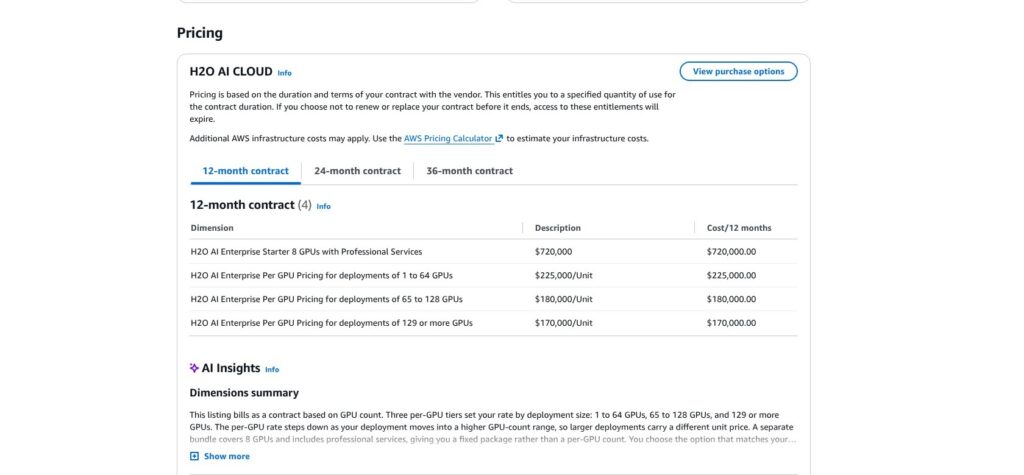
H2O.ai publishes no price on its website. H2O AI Cloud uses one annual license based on compute and memory, not per-token pricing; the pricing link leads to a demo request.
- H2O-3 (free): for Python or R AutoML under Apache 2.0. From 3.46.0.12, it excludes the MOJO runtime, Kubernetes packages, Hadoop support and Sparkling Water.
- H2O-3 Secure (quote): for production deployments needing portable scoring, distributed XGBoost, AutoDoc, SSO/RBAC, security patching and support SLAs.
- Driverless AI (license): for automated feature engineering and explainability. Running the application and its scoring pipelines requires a license. AWS images are bring-your-own-license; an evaluation license lasts 21 days.
- H2O AI Enterprise Starter ($720,000 per 12 months): for an 8-GPU deployment with professional services. The bundle works out to $90,000 per GPU, excluding infrastructure.
- H2O AI Enterprise per GPU ($225,000 per GPU annually): for 1 to 64 GPUs. The published rates are $180,000 for 65 to 128 GPUs and $170,000 for 129 or more.
| Plan | Price | Billing | What I get | Best for |
|---|---|---|---|---|
| H2O-3 | Free | None | AutoML, algorithms, Python/R clients | Notebook modeling |
| H2O-3 Secure | Quote only | Commercial subscription | Production scoring, security controls, SLAs | Production H2O-3 |
| Driverless AI | License (quote) | Contract terms | Feature engineering, interpretability, scoring | Automated model development |
| H2O AI Enterprise Starter | $720,000 | 12 months | 8-GPU bundle with professional services | Initial platform deployment |
| H2O AI Enterprise per GPU | $225,000 / $180,000 / $170,000 per GPU | 12 months | GPU-based platform licensing | Larger GPU fleets |
The AWS Marketplace offer bills AWS infrastructure separately and specifies no refunds. Platform access ends if the contract is not renewed or replaced. Starter is a distinct bundle, not 8 GPUs charged at the separate $225,000 rate.
Is H2O.ai Good Value for Money?
- Amazon SageMaker Canvas: $1.90 per workspace session hour, with training billed at SageMaker instance rates. Its 2-month free tier includes up to 160 session hours monthly.
- Google Vertex AI: AutoML forecasting training costs $21.252 per node hour, a narrower usage-based purchase.
- Domino Data Lab: AWS 12-month platform fees start at $50,000 for Domino Cloud and $150,000 for self-managed VPC Premium.
- DataRobot: publishes no prices, so it also requires a commercial conversation.
- H2O-3 or AutoGluon: I would choose either free engine before buying an enterprise platform for notebook-only AutoML.
I consider H2O.ai good value only when GPU-based private GenAI plus governed AutoML replaces several contracts, not as a first AutoML tool.
Reviewer’s Notes: I recommend proving the model with free H2O-3 first, pinning 3.46.0.11 if MOJO scoring matters. Price H2O-3 Secure or Driverless AI before committing to the $720,000 Starter bundle. Ask for 24- and 36-month terms alongside the published 12-month contract.
My Experience With H2O.ai
Installing H2O-3 and Starting a Local Cluster
I installed H2O-3 in a Python 3.9.6 virtual environment with Java 17 on my Apple Silicon MacBook:
pip install h2oThe installation resolved version 3.46.0.12, downloaded a 266 MB package containing the Java server, and finished in 37 seconds. It also installed pandas 2.3.3 and numpy 2.0.2, although H2O-3 officially supports only numpy below 2; every step in my test ran on numpy 2.0.2 without an error. The virtual environment was 351 MB after install.
My one-node cluster started in 6.1 seconds, versus 18.1 seconds on the first cold-JVM attempt. It used 8 cores and a 4 GB heap, with the Flow web interface on port 54321.
The client displayed a community-edition notice recommending H2O-3 Secure for commercial use. AutoML also skipped XGBoost because no backend was available on my Apple Silicon Mac. AutoGluon avoids the Java dependency; H2O-3 requires Java 8 through 17.
Running AutoML on 10,000 Rows
I imported H2O’s Higgs sample: 10,000 training rows, 28 numeric features and a binary response, plus 5,000 test rows. Importing both files took 2.6 seconds. Using a local copy of the training CSV, I started with this setup:
import h2o
from h2o.automl import H2OAutoML
h2o.init(max_mem_size="4G")
train = h2o.import_file("higgs_train_10k.csv")
y = "response"; x = [c for c in train.columns if c != y]; train[y] = train[y].asfactor()
aml = H2OAutoML(max_models=20, max_runtime_secs=600, seed=1)
aml.train(x=x, y=y, training_frame=train)
aml.leaderboard
My first run hit the 600-second cap, taking 601.1 seconds wall time. It produced 17 models across GBM, DRF, XRT (Extremely Randomized Trees), GLM and Deep Learning, without a stacked ensemble. The GBM leader scored 0.7823 test AUC.
For the second run, I followed H2O’s reproducibility guidance with max_models=10, seed=1 and exclude_algos=["DeepLearning"], removing the runtime cap. It finished in 53.1 seconds with 12 models: 10 base models and 2 stacked ensembles (AllModels and BestOfFamily).
The StackedEnsemble_AllModels leader scored 0.7919 test AUC, beating the first run’s GBM leader at 0.7823. On cross-validated AUC, the leader reached 0.7882 and GLM finished last at 0.6826. The leaderboard sorted models by cross-validated auc and also reported logloss, aucpr, mean_per_class_error, rmse and mse.
The leading GBM’s top features were x26 (1.0 scaled importance), followed by x28 (0.421) and x27 (0.374). Excluding Deep Learning is the first setting I would change for this small tabular workload. SageMaker Canvas charges $1.90 per workspace session hour; my local runs incurred no software charge.
Exporting the Leader as a MOJO
My MOJO export stopped at “H2O-3 SECURE REQUIRED – THIS ACTION IS BLOCKED”, then raised “MOJO export requires H2O-3 Secure.” POJO export on the best GBM was blocked too, with “POJO download requires H2O-3 Secure.” The blocking notice offered a free MOJO license for non-commercial use.
Binary saving with h2o.save_model and reloading with h2o.load_model worked. The reloaded leader retained its 0.7919 test AUC, and in-cluster prediction on 5,000 rows took 0.31 seconds.
Binary models remain tied to the H2O version that saved them. On 3.46.0.12, my free installation scored inside the running cluster, not through portable artifacts. I would pin 3.46.0.11 or license Secure for portable scoring.
What My Local Test Does Not Cover
I did not run Driverless AI, Enterprise h2oGPTe, H2O-3 Secure or H2O AI Cloud, which require licenses or contracts. I also did not test multi-node clusters or GPU XGBoost; the following sections describe product capabilities rather than my results.
Driverless AI: Automated Feature Engineering and Explainability
Driverless AI 2.5.2 shipped October 30, 2026, the ninth release after 2.4.0 on March 5, 2026, or about one a month.
Dials Instead of Hyperparameters
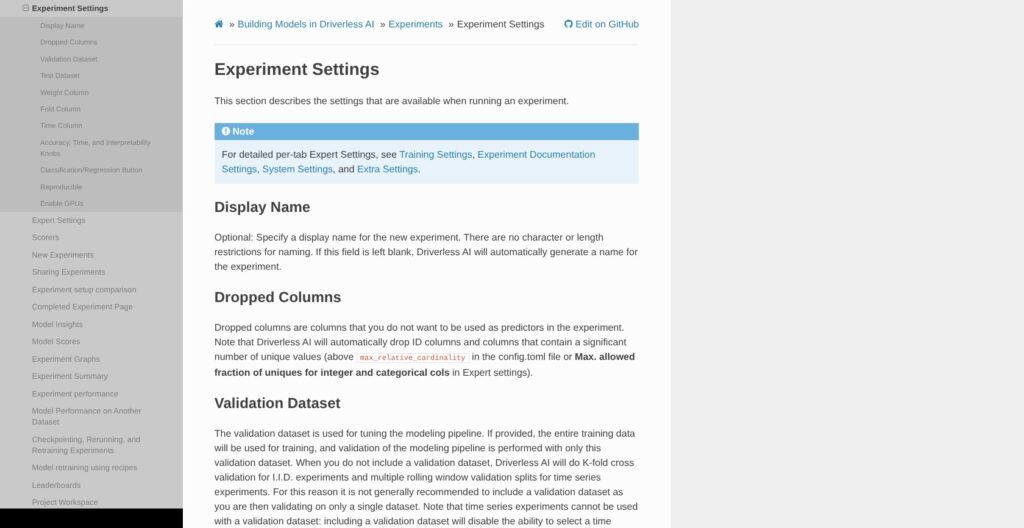
Driverless AI exposes three experiment controls:
- Accuracy: higher settings increase data use, tuning, cross-validation and ensembling.
- Time: higher settings allow longer runs and more patience for convergence.
- Interpretability: higher settings simplify generated features and models.
Experiment setup also accepts a target and validation/test datasets; without a validation dataset, it runs K-fold cross-validation. Weight, fold and time columns control how observations contribute and how validation works; Expert Settings and scorers expose more detailed choices.
Driverless AI automates feature engineering, validation, tuning and model selection. DataRobot also automates feature engineering and, like H2O.ai, publishes no prices.
Interpretability, AutoDoc and Scoring
Driverless AI combines Machine Learning Interpretability with AutoDoc, which documents each model automatically. Its explanation tools include:
- Shapley values for feature contributions.
- K-LIME for local explanations.
- Disparate-impact analysis.
- Reason codes for individual predictions.
Python scoring pipelines and Java MOJOs support deployment, but scoring still requires a license. Bring Your Own Recipe supports custom transformers and models; in 2.5.2, recipes using pkg_resources must migrate to importlib.metadata.
What 2.5 Added
- Version 2.5.0 (August 28, 2026): experimental DAICatBoost with MOJO, CPU/GPU experiment queues, automatic time-series seasonality and trend detection, CUDA 12.8.1 and NVIDIA Blackwell support.
- Version 2.5.2: experimental Docker-only Linux ARM64 support, 30 fixed CVEs, and Snowflake password authentication deprecated in favor of key pairs or OAuth.
- Deployment: Docker, native Linux and AWS/Azure/Google Cloud images. Supported native systems include RHEL/CentOS 7 and 8 and Ubuntu 16.04 through 22.04 on x86_64.
On macOS, Driverless AI runs only in Docker, without GPUs or MOJOs. I recommend it for governed modeling with repeatable explanations; I would skip it for inexpensive Mac-based experimentation.
Enterprise h2oGPTe and the H2O AI Super Agent
Enterprise h2oGPTe is an agentic retrieval-augmented generation system powering the H2O AI Super Agent. Its Python client reached 1.7.5 on October 1, 2026, and deployments run on Kubernetes in public, private or air-gapped infrastructure.
Collections and Models
h2oGPTe collections ingest several content types:
- Documents, spreadsheets and presentations.
- Images, text and code.
- Email and archives.
- Audio and video.
Collections use bge-large-en-v1.5 embeddings by default, or bge-m3 for multilingual content. A query searches one collection at a time.
Vex is the default vector store, built on hnswlib indexes with SQLite text. Experimental external options include:
- Milvus
- Redis
- Qdrant
- Elasticsearch
Deleting a document removes its metadata, PDFs and embeddings with no soft delete, and the deletion confirmation ID is valid for 5 minutes.
Model choices include:
- Open-weight: Llama, Gemma 4, Qwen3, DeepSeek and gpt-oss-120b.
- Hosted: OpenAI, Gemini, Claude, Mistral and xAI.
Administrators can add other supported models. For an air-gapped deployment, I would choose locally hosted models rather than external APIs.
Agents and Accuracy Levels
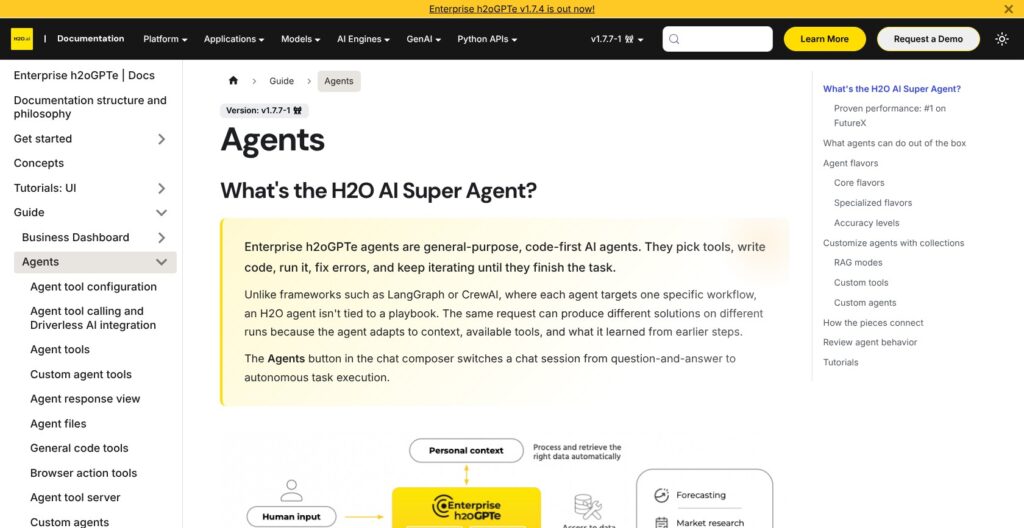
The chat composer’s Agents button exposes these agent types:
- General, Deep Research, Data Science and Code.
- Deep Research Zero and Web search.
- Tool Builder and Agents Builder.
- MCP-only Runner.
Data Science connects to Driverless AI. Built-in tools cover AutoML and data analysis, web and academic search, code execution, GitHub and MCP-server connections. Accuracy levels set execution budgets, not guaranteed answer accuracy:
| Level | Turns | Time per turn |
|---|---|---|
| Quick | 10 | 30 seconds |
| Basic | 20 | 60 seconds |
| Standard, default | 40 | 120 seconds |
| Maximum | 80 | 240 seconds |
Agents Builder generates custom agents using LangGraph, OpenAI Agents SDK or CrewAI. ZIP uploads support custom implementations; Claude agents require manual packaging.
H2O.ai reported 79.7% accuracy and first place on GAIA in June 2025.
The open-source h2oGPT repository is archived, with its last push on October 9, 2025. Dataiku and Domino also host LLM applications; h2oGPTe’s air-gapped deployment is the stronger reason for my shortlist.
The H2O-3 Open-Source Split and H2O-3 Secure
H2O.ai announced on August 12, 2026 that version 3.46.0.12 moves the MOJO runtime, Hadoop support, Kubernetes deployment and Sparkling Water from open source into H2O-3 Secure.
- Still open source: Apache 2.0 licensing, AutoML, the algorithm library, Python/R clients, the REST API, single-node and local-cluster use, in-cluster scoring and community support.
- Delayed features: new capabilities reach open source later than Secure.
- Security fixes: critical and actively exploited vulnerabilities receive immediate fixes; others follow the standard patch cycle.
- Telemetry: collection is opt-in and off by default.
- Older releases: existing URLs and checksums remain available, so 3.46.0.11 pins keep working.
- Sparkling Water: the open-source integration stays at 3.46.0.6 for Spark 3.5.
- Nonprofits and academics: H2O.ai invites those needing Secure features to contact it.
H2O-3 Secure adds:
- Production MOJO scoring for Hadoop, Spark, Teradata and Oracle.
- Hadoop and Kubernetes packages, plus managed distributed XGBoost.
- Model reproducibility and AutoDoc.
- SSO, secrets management, RBAC and activity records.
- Commercial CVE patching and premium support SLAs.
Its controls are aligned to the FedRAMP High baseline, which is not certification; the certified option is H2O AI Cloud for Government. Secure has no public price.
My blocked MOJO and POJO exports showed the practical effect of this split. AutoGluon and MLflow remain open-source alternatives for modeling and lifecycle tooling, respectively, rather than drop-in MOJO replacements.
For an existing production MOJO pipeline, I would pin 3.46.0.11 and price Secure before upgrading.
Deployment, Compliance and tabH2O
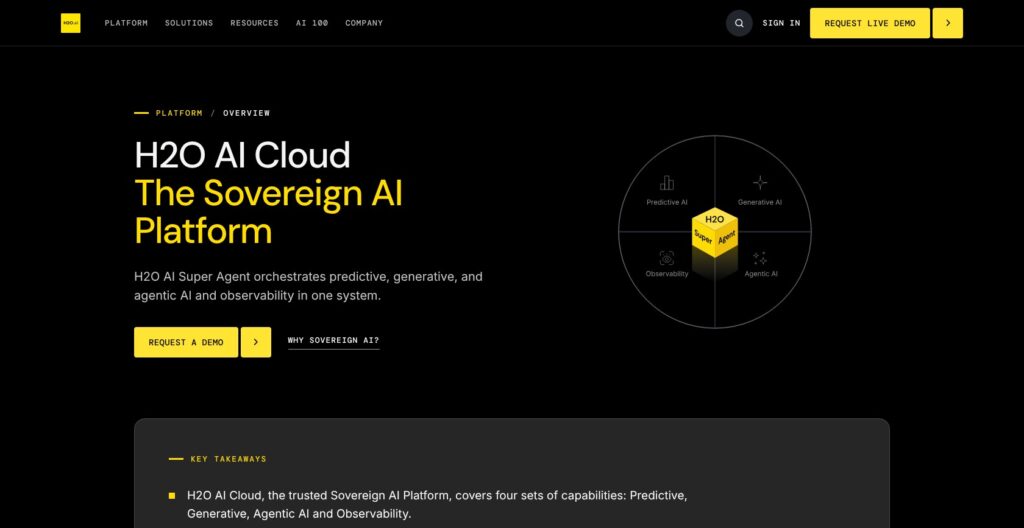
H2O AI Cloud offers three deployment models, with different responsibility boundaries:
- H2O AI Managed Cloud: H2O.ai operates a dedicated single-tenant environment in a chosen region. Its compliance labels are SOC 2 Type 2 and HIPAA/HITECH.
- H2O AI Hybrid Cloud: the customer runs the platform in its own cloud, on-premises or air-gapped, and manages updates.
- H2O AI Cloud for Government: H2O.ai announced FedRAMP High on May 20, 2026, following “In Process” at High in May 2025.
The Trust Center lists these frameworks and programs:
- FedRAMP High
- HITECH
- IRAP
- ISO/IEC 27001:2022
- SOC 2 Type 2
The AWS platform bundle includes:
- Drive, Secure Store and Orchestrator.
- Model Hub, Notebooks and Telemetry.
- Eval Studio and LLM Studio.
- Danube3 and H2OVL Mississippi small models.
FedRAMP High covers H2O AI Cloud for Government, not the Managed or Hybrid Cloud deployments.
tabH2O
Announced May 18, 2026, tabH2O returns tabular predictions through an API without training or feature engineering. It is pre-integrated into the Dell AI Factory with NVIDIA and supports private, hybrid, on-premises and air-gapped deployment.
No price or general-availability date was announced. Unlike the cloud-native SageMaker and Vertex AI services, this deployment flexibility makes tabH2O relevant to buyers keeping inference inside their own facilities.
How Does H2O.ai Compare to Competitors?
- DataRobot: combines AutoML, MLOps and governance without publishing prices. I would shortlist it for a managed AutoML vendor with a broad deployment layer, then compare model operations and contract scope against Driverless AI.
- Dataiku: combines visual and code workflows, with a 14-day cloud trial for up to five users and a downloadable Free Edition. I prefer it for collaboration between analysts and data scientists rather than primarily automated modeling.
- Domino Data Lab: AWS annual platform fees start at $50,000 for Domino Cloud and $150,000 for self-managed VPC Premium. I would choose it as a governed workbench when a team brings its own frameworks.
- Amazon SageMaker: Canvas costs $1.90 per workspace session hour, with training billed separately at instance rates. It is my more practical shortlist choice for AWS-native teams wanting usage-based purchasing instead of H2O’s annual platform contract.
- Google Vertex AI: AutoML forecasting training costs $21.252 per node hour. I would favor it for Google Cloud teams that want forecasting alongside their existing cloud services, rather than independently deployed infrastructure.
- Databricks: AutoML covers classification, regression and forecasting. I would keep modeling there when the training data already lives in the lakehouse instead of adding another platform.
- KNIME: its free, open-source Analytics Platform includes 300+ connectors. I recommend it for drag-and-drop data workflows when H2O-3’s code-first interface is the obstacle.
- AutoGluon: version 1.6.3 is free and open source, supports Python 3.10 through 3.13, and needs no Java. I would try it for notebook AutoML without a commercial platform.
- ClearML and MLflow: provide open-source experiment tracking and MLOps capabilities. I would evaluate them when tracking and deployment matter more than automated feature engineering.
H2O.ai wins my shortlist when explainable AutoML and private GenAI must run inside the company’s own perimeter under one platform relationship.
How I Reviewed H2O.ai
I installed H2O-3 3.46.0.12 with Python 3.9.6 and Java 17 on my Apple Silicon MacBook. I ran AutoML twice on the 10,000-row Higgs sample: with a 600-second cap, then without Deep Learning.
I scored 5,000 test rows, checked variable importance, and attempted MOJO, POJO and binary exports. My buying assessment compared H2O.ai’s licensing and deployment with DataRobot, Dataiku, Domino, SageMaker and Vertex AI.
I weighed:
- Pricing and licensing: platform and scoring costs.
- Open-source engine: training, reproducibility and exports.
- AutoML and explainability: automation, model explanations and AutoDoc.
- GenAI and agents: retrieval and execution controls.
- Deployment and compliance: infrastructure ownership and product scope.
- Alternatives: fit for narrower workloads.
Prices current as of November 2026.
Should You Use H2O.ai?
I recommend H2O.ai for regulated enterprises that need model explanations and AutoDoc while keeping training and GenAI inside their own cloud, data center or air-gapped site. Driverless AI and h2oGPTe make the strongest combined case when the budget supports an annual compute-based contract.
For Python or R AutoML alone, I would start with free H2O-3. My reproducible run finished in 53.1 seconds, but MOJO and POJO exports were blocked on 3.46.0.12. Pin 3.46.0.11 if existing MOJO scoring matters, then assess Secure before upgrading.
I would skip H2O AI Cloud for a first pay-as-you-go experiment. SageMaker Canvas at $1.90 per workspace session hour, plus training charges, or Vertex AI offers a more suitable purchasing model for cloud-native workloads.
Before signing, I would settle:
- GPU count: required capacity and applicable pricing tier.
- Professional services: whether implementation work is included.
- Contract duration: 12-month pricing versus 24- or 36-month terms.
- Product coverage: whether Driverless AI, h2oGPTe and H2O-3 Secure are included.
- Infrastructure and renewal: separate hosting charges and access after expiration.
If that enterprise profile matches your team, request a demo at H2O.ai with those requirements attached.
FAQ
How much does H2O.ai cost?
H2O.ai publishes no website price for its enterprise platform, which uses an annual compute-and-memory license. Its AWS Starter bundle costs $720,000 for 12 months, including 8 GPUs with professional services, but excluding AWS infrastructure. Separate per-GPU pricing is $225,000 for 1 to 64 GPUs, with lower rates for larger fleets. Open-source H2O-3 is free.
Is H2O.ai free?
H2O-3 is free under Apache 2.0, including AutoML, its algorithm library and Python/R clients. Driverless AI, Enterprise h2oGPTe, H2O-3 Secure and H2O AI Cloud are licensed commercial products. Driverless AI offers a 21-day evaluation license, but production scoring pipelines also require licensing. Free H2O-3 remains useful for model development and in-cluster predictions.
What changed in H2O-3 3.46.0.12?
H2O-3 3.46.0.12 moved the MOJO runtime, Hadoop support, Kubernetes deployment and Sparkling Water into commercial H2O-3 Secure. My installation also blocked MOJO and POJO exports. The release added optional telemetry, disabled by default. Earlier releases remain available; pinning 3.46.0.11 keeps MOJO export, Hadoop and Kubernetes support under Apache 2.0.
What is the difference between H2O-3 and Driverless AI?
H2O-3 is an open-source modeling engine with AutoML, typically controlled through Python or R. Driverless AI is a licensed product that adds automated feature engineering, Accuracy/Time/Interpretability controls, Machine Learning Interpretability and AutoDoc. It also produces Python and Java scoring pipelines, which require a valid license. I would pick H2O-3 for free code-first AutoML, and Driverless AI when automated feature engineering and AutoDoc justify a license.
Is H2O.ai FedRAMP authorized?
H2O.ai announced FedRAMP High for H2O AI Cloud for Government on May 20, 2026, following its May 2025 “In Process” milestone. That status applies to the government offering, not automatically to every H2O.ai product or deployment. H2O-3 Secure describes controls aligned to the FedRAMP High baseline; alignment is not authorization.