
Hevo is the stronger fit if your small data team wants managed, visual pipeline operation. Meltano Open is the better choice when you need self-hosted deployment and repository-controlled pipelines, and have engineers available to maintain them.
There is also a third option: Meltano Cloud. It manages infrastructure and provides a UI, so Hevo Data vs Meltano is not simply a choice between a hosted product and a command-line tool.
Your decision should start with the responsibility you want to retain. Then compare the actual source objects, recovery requirements and billing units involved. A subscription can be worthwhile if it removes operational work; a free engine can be worthwhile if control matters more than convenience.
Hevo vs Meltano at a Glance
Start with these differences, then evaluate the connector and workload that will be hardest to support. The easiest source rarely settles the choice.
Key takeaways
- Setup: Choose Hevo for a straightforward visual workflow; Meltano Cloud also offers UI-based pipeline management.
- Control: Choose Meltano Open when owning the runtime and project configuration is a requirement.
- Pricing: Hevo publishes event-based starting prices; Meltano Cloud requires a compute-based quote.
- Connectors: Hevo manages its connectors; Meltano offers Singer flexibility, but variants and maintenance ownership need scrutiny.
- Operations: Hevo and Meltano Cloud reduce infrastructure duties; Meltano Open leaves production operation with your team.
| Decision factor | Hevo: managed visual pick | Meltano: Open for control, Cloud for managed operation |
|---|---|---|
| Ownership | Vendor-managed pipeline service | Open: self-managed; Cloud: managed infrastructure |
| Interface | Visual setup and operation | Open: CLI/configuration; Cloud: UI workflows |
| Billing unit | Destination events, with source-specific rules | Open: operating costs; Cloud: active compute hours |
| Entry cost | Limited Free plan; paid Starter from $299/month, billed monthly | Open: no license fee; Cloud: quote-only |
| Connectors | Managed connector offering | Singer taps/targets; verify variant and Cloud availability |
| Transformation | dbt Core from Git; SQL Models | Configurable project tooling, including dbt |
| Deployment | Managed service | Open: your environment; Cloud: managed workspaces |
| Monitoring ownership | Managed service, with customer data validation | Open: your team; Cloud: managed monitoring |
The decisive difference is often who investigates a failed run, not who can create the first pipeline. Evaluate that responsibility alongside the subscription.
Is Hevo or Meltano Easier to Set Up and Run?
Hevo wins over Meltano Open for straightforward setup because you configure connections without deploying a pipeline runtime. Meltano Open requires more production preparation, although Meltano Cloud removes much of that infrastructure work.
Hevo
Hevo’s setup follows a visual sequence: select a source, configure its connection, select a destination and configure that connection. Your team still needs the correct permissions and network access; a managed interface cannot grant database privileges for you.
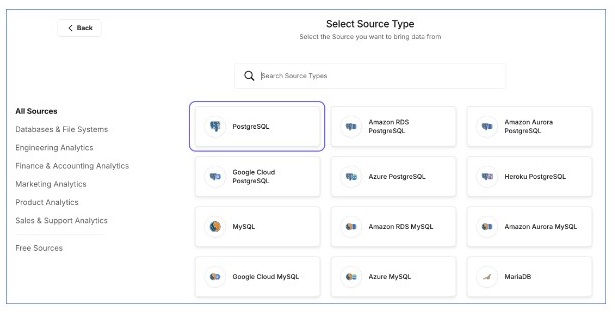
That workflow suits a team where the pipeline owner also handles analytics or warehouse administration. You can focus on connection settings and loaded data rather than deciding where the extraction process runs.
The limit appears when your requirements extend beyond the supported workflow. If a connector cannot expose the object or behavior you need, easier setup does not resolve that mismatch.
Meltano Open and Cloud
Meltano Open involves deploying the project and its plugins, then configuring execution. Before treating it as production-ready, you need to establish:
- Persistent state and logs so incremental progress and failures remain inspectable.
- Environment configuration and secrets appropriate to the deployment.
- Scheduling and ownership through cron or an orchestration tool, with someone responsible for failures.
Plugin discovery also has an account boundary: fetching definitions from Meltano Hub requires a Cloud login. Direct or custom definitions can be installed without an account, and locked projects can install and run without Hub login.
Meltano Cloud offers UI workflows for plugin installation, pipeline creation and scheduling, plus live logs and alerts. Its workspaces are Git-backed, while infrastructure and secrets management are handled by the service.
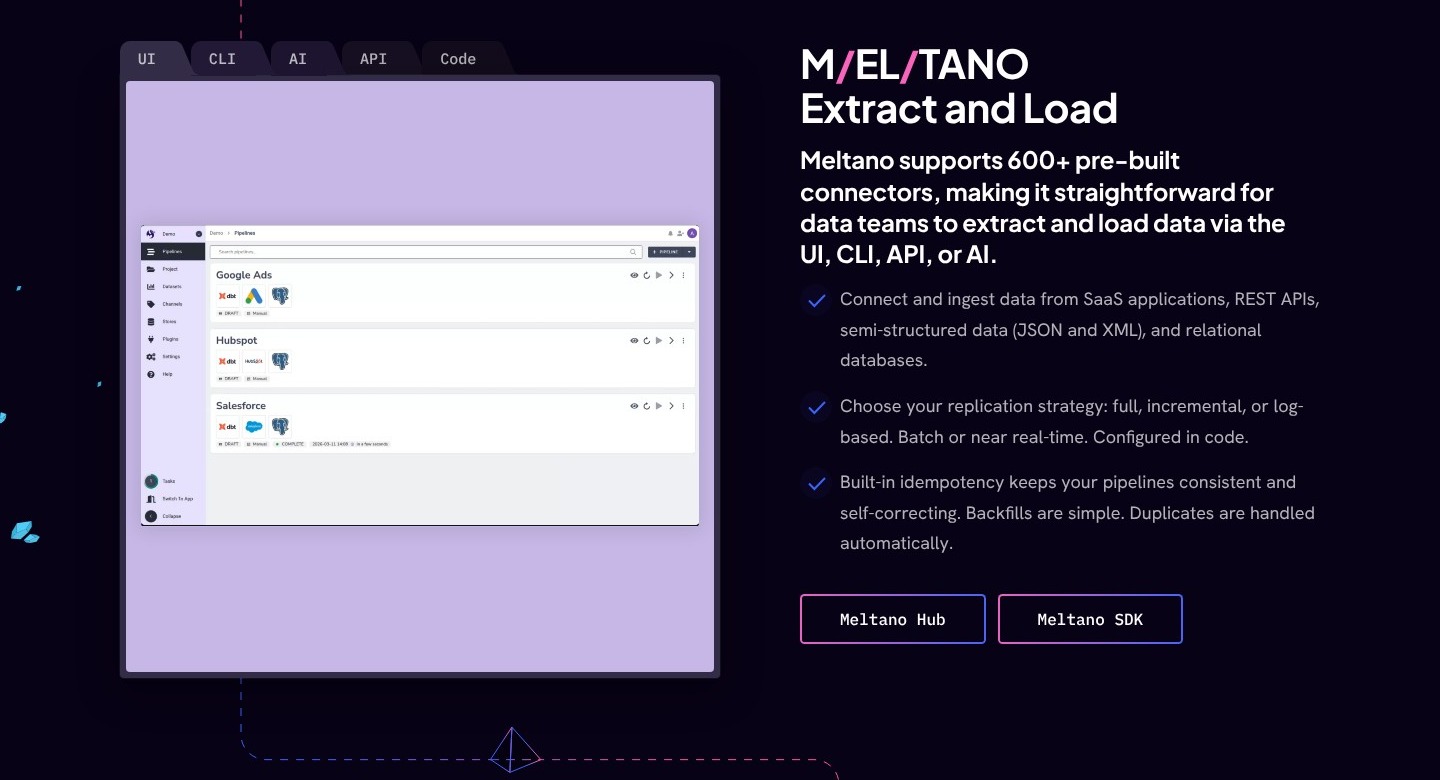
For Meltano Cloud vs Hevo, judge the configuration burden of your actual connector. Both provide an interface; neither makes every source simple.
Meltano Open remains attractive when your team already has an execution environment and wants to standardize pipelines within it. Without that foundation, include deployment work in your budget, even though no license purchase is required.
Which Offers Better Value for Your Workload?
There is no universal price winner because Hevo bills by events, Meltano Cloud uses compute allowances, and Meltano Open shifts costs to your infrastructure and staff. Compare a representative operating month and a recovery-heavy month before choosing.
Hevo pricing

These are starting prices at the stated base event bands, not flat prices across every volume selection.
| Plan | Monthly billing | Annual billing, monthly equivalent | Base allowance and relevant limits |
|---|---|---|---|
| Free | $0 | $0 | Up to 1 million events/month; limited connectors; up to 5 users; 1-hour scheduling |
| Starter | From $299/month | From $265/month | Lowest band: 5 million events/month; dbt integration |
| Professional | From $849/month | From $750/month | Lowest band: 20 million events/month; unlimited users; pipeline automation APIs |
| Business Critical | Custom | Custom | SSO, role-based controls and multiple workspaces |
Hevo’s billing generally counts events loaded into the destination, including inserts, updates and deletes. An event is not necessarily a unique source row: JSON child records, transformations and append-only repeats can increase usage.
History needs separate treatment. Hevo markets no-cost historical loads and backfills, but historical-use restrictions apply. Usage above 10 times the plan allowance can trigger review and ordinary-plan charges or changes. Confirm treatment of your initial load, resyncs and full refreshes before budgeting.
The REST API source is a specific exception: every ingested event is billable, including the initial load. It rereads responses because it cannot identify only new or changed records. A repeatedly fetched response can therefore have a different cost profile from an incremental database source.
Meltano Open and Cloud pricing
| Edition or plan | Software or subscription price | Included capacity | Relevant scope |
|---|---|---|---|
| Open | No license fee | Your provisioned resources | You fund hosting and operation |
| Cloud Starter | Quote-only | 200 compute hours/month | 25 workspaces; unlimited users |
| Cloud Growth | Quote-only | 2,000 compute hours/month | 100 workspaces; 8 monthly engineering-support hours |
| Cloud Scale | Quote-only | 5,000 compute hours/month | Unlimited workspaces; 15 monthly engineering-support hours |
| Cloud Enterprise | Quote-only | Negotiated allowance | Confirm capacity and commercial terms |
Meltano Cloud’s compute measure covers active extraction, loading or transformation runtime. Its Enterprise offer advertises custom or unlimited capacity, but that wording should not be treated as unconditional unlimited scale. Confirm the applicable allowance and terms.
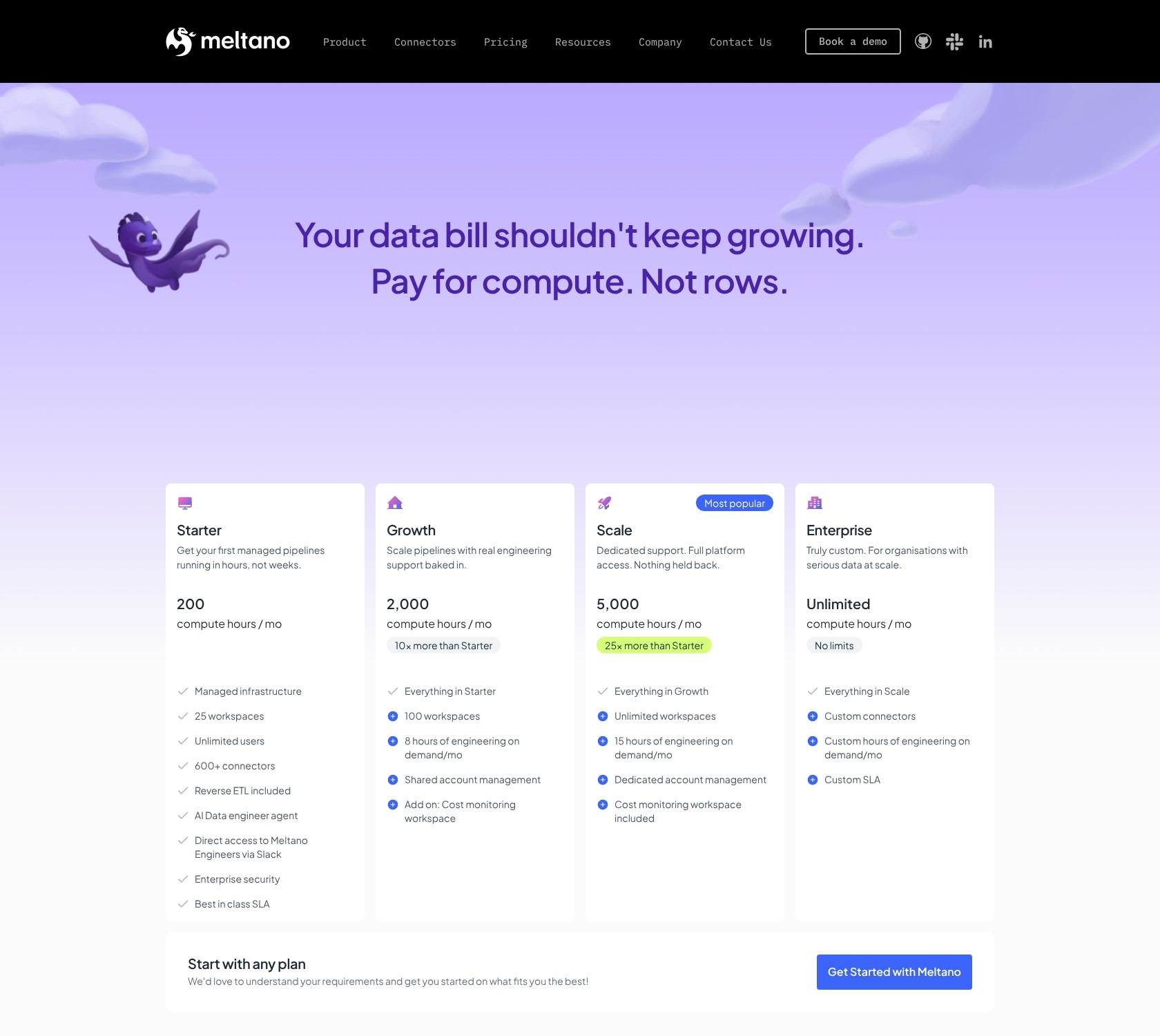
Compute billing changes the forecasting question. With Hevo, estimate billable events; with Meltano Cloud, estimate active runtime for the same workload, including recovery. Neither number can reliably be inferred from database size alone.
Compare total cost, not just the invoice
Use this planning formula:
Monthly total cost = subscription + runtime/storage + warehouse costs + staff time + recovery costs, without counting bundled services twice.
For a deliberately hypothetical Meltano Open budget, assume $150/month for hosting and logs, plus 6 maintenance hours at an assumed internal cost of $100/hour. That produces $750/month before warehouse costs and exceptional recovery work.
Those inputs are assumptions, not measured averages. If maintenance instead takes 2 hours, the same arithmetic produces $350; at 12 hours, it produces $1,350. Managed options also need staff time for configuration and data validation.
Hevo offers a public starting point, but your event volume and feature tier determine the relevant price. Meltano Open can offer excellent value when you already operate the infrastructure and need customization. Meltano Cloud requires a quote before a defensible dollar comparison is possible.
Which Has the Right Connectors for Your Sources?
Hevo is preferable when its managed connector covers your exact requirements; Meltano Open is preferable when you need connector-level flexibility. Catalog size alone cannot settle this round.
Hevo
Hevo Starter advertises more than 150 connectors, compared with Meltano Cloud’s advertised 600-plus across sources and destinations. Those totals describe different catalog scopes, not equivalent numbers of supported source-to-destination combinations.
A recognizable source name is only the start. Your purchase depends on whether the connector includes the required tables or API objects and preserves the semantics your downstream models expect.
Hevo’s managed offering reduces the connector maintenance your team takes on. That advantage is strongest when the standard connector meets your requirements without workarounds; it does not establish equal behavior across every connector.
Meltano Open and Cloud
Meltano uses Singer taps to extract data and targets to load it. Different variants of a connector can have different capabilities and maintenance arrangements, so selecting a source is also a choice of implementation.
Meltano Open lets you take responsibility for direct or custom plugin definitions. That is useful when you need a behavior you can maintain yourself, but owning a fix also means owning its future compatibility.
For Meltano Cloud, confirm that the particular tap, target and variant you need are supported in the managed environment. A Hub listing should not be treated as a Cloud support commitment.
Validate the connector pair
Ask both finalists to demonstrate the same requirements:
- Needed objects: Include custom fields, archived records and relevant API endpoints.
- Delete handling: Establish how deletions become visible in the destination.
- Incremental state: Verify what prevents omissions or unnecessary rereads.
- Schema changes: Check added columns and changed data types.
- Maintenance owner: Identify who fixes a connector when the source changes.
Give a difficult source more weight than several easy ones. Hevo’s managed ownership can justify paying more, while Meltano Open’s flexibility can justify more engineering work. Neither advantage compensates for missing business-critical data.
Which Gives You More Control Over dbt and Pipeline Changes?
Meltano Open wins for repository-controlled projects and runtime flexibility because your team owns the deployment. Hevo remains a credible option for Git-managed dbt transformations without taking on the entire ingestion environment.
Hevo
Hevo supports dbt Core projects from a Git repository as well as SQL Models. You do not have to abandon dbt or version-controlled transformation code to choose its managed pipeline service.
The important distinction is scope. Git integration for dbt does not mean the entire ingestion configuration is managed as code. If your engineering policy requires every source setting to pass through pull-request review, validate that requirement separately.
Professional adds pipeline automation APIs, giving teams another route to automation. However, API availability alone does not establish that every configuration can be reproduced, reviewed and deployed through your preferred workflow.
Meltano Open and Cloud
Meltano Open’s project-centered approach gives your team more control over configuration and the tools used around extraction, loading and transformation. It fits organizations that want pipeline changes reviewed alongside other engineering work.
That freedom makes deployment discipline your responsibility. Decide how plugin changes will be approved, how environments will differ and how a failed change will be reversed before you rely on the project for reporting.
Meltano Cloud retains Git-backed workspaces while managing infrastructure. It therefore deserves consideration if repository-based workflows matter but operating the runtime does not. Confirm which project and plugin changes your proposed Cloud setup permits.
Choose according to what must be reviewable:
- Transformation code only: Hevo’s dbt/Git support may satisfy the requirement.
- Pipeline project and execution environment: Meltano Open offers more direct ownership.
- Git-backed workspace with managed operation: Evaluate Meltano Cloud’s supported workflow.
A rollback also needs a data plan. Reverting code does not by itself repair rows already loaded or undo incremental state changes. Whichever platform you choose, make recovery procedures part of the change review rather than treating Git history as a complete safety net.
Which Can Meet Your Freshness and Recovery Requirements?
Neither product wins on freshness without a connector-specific evaluation. Hevo Standard and Edge have different scheduling models, while Meltano Open and Cloud depend on the selected plugins and execution configuration.
Hevo Standard and Edge
Hevo Standard separates source ingestion from destination loading. For teams created after Release 2.21, its minimum scheduled ingestion interval is 30 minutes, with defaults of 6 hours for table mode and 30 minutes for log-based ingestion.
Kafka and webhook sources ingest continuously, but destination loading still adds latency. These exceptions should not become a blanket real-time claim.
Hevo Edge uses one sync schedule, defaulting to 6 hours, with presets including 5 minutes. Loading follows source-connector completion, and a scheduled run can be skipped if the previous job remains active. A 5-minute schedule is not a 5-minute end-to-end freshness guarantee.
Meltano Open and Cloud
Meltano Open gives you responsibility for scheduling and provisioned resources; Meltano Cloud manages infrastructure and provides scheduling workflows. In both cases, freshness depends on source behavior, plugin capabilities and the work required to complete extraction and loading.
Do not assume a tighter schedule solves slow extraction. A connector that repeatedly rereads data can consume runtime without delivering the incremental behavior your workload needs.
Evaluate recovery alongside normal operation
Change data capture, or CDC, identifies database changes for replication; it does not guarantee a particular delivery speed. Hevo supports database log replication, but replication modes differ: SQL Server Change Tracking can identify changed keys and operations without retaining old row values.
Use the same pilot requirements for both finalists:
- Initial load: Verify completeness before relying on incremental results.
- Updates and deletes: Confirm destination behavior for both.
- Schema change: Introduce a representative column or type change.
- Interrupted run: Establish where processing resumes and what is reread.
- Catch-up: Measure destination freshness after an interruption, plus associated usage.
Define freshness as the delay until data is usable in the destination, not merely captured from the source. If transformed tables drive decisions, include that step too. Reject a configuration that meets its schedule but cannot recover within your reporting deadline, regardless of which platform runs it.
Which Deployment and Support Model Can Your Team Own?
Hevo and Meltano Cloud are better fits when you want managed infrastructure; Meltano Open wins when deployment control is mandatory. The managed vs self-hosted ELT decision should include security and incident ownership, not just hosting preference.
Hevo
Hevo operates the pipeline service, removing runtime deployment from your team’s responsibilities. You still own source permissions, destination access and the business consequences of incorrect data.
Security-related features also affect plan selection. Business Critical adds SSO, role-based controls and multiple workspaces, so a security requirement can determine your tier before event volume does.
Ask for a clear support responsibility boundary. A managed connector is valuable, but your agreement should establish how connector defects and production incidents are handled rather than leaving your team to infer service commitments.
Meltano Open and Cloud
Meltano Open gives you control over the environment in which the engine runs. It also leaves your team responsible for maintaining that environment and arranging dependable production coverage.
Self-hosting does not automatically establish compliance or guarantee that no data leaves your network. Sources, destinations and supporting services still determine data flows. Map those flows and apply your organization’s access and retention requirements.
Meltano Cloud manages infrastructure, workspaces, secrets and monitoring. Its plan-based engineering-support allowances can help with technical work, but they are not interchangeable with guaranteed incident response times.
Put responsibilities in writing
Before committing, establish:
- Incident ownership: Who investigates a failed extraction, and who repairs incorrect destination data?
- Support scope: Does assistance cover your exact connector variant and configuration?
- Security boundaries: Where can data and secrets travel, and who controls access?
- Recovery ownership: Who authorizes a resync and accepts any additional charges?
Meltano Open remains a strong choice if your organization needs direct operational control and can staff it. For a team without reliable production coverage, Hevo or Meltano Cloud may be the more defensible purchase, even when the subscription exceeds self-hosting infrastructure costs.
How This Comparison Was Evaluated
This documentation-based comparison assesses workflow, billing, connector fit, deployment control, maintenance responsibility and product limits. It does not include hands-on performance benchmarks.
Recommendations distinguish Hevo Standard from Edge and Meltano Open from Cloud. Your source permissions, connector variant and recovery workload can change the outcome, so use a representative pilot to make the final selection.
Prices current as of October 2026.
Should You Choose Hevo or Meltano?
Choose Hevo if managed visual operation is your priority and its connectors meet your requirements. Budget for your actual event volume and required security features, not just the starting price.
Choose Meltano Open if deployment control and customization justify maintaining the runtime yourself. Consider Meltano Cloud if you want Git-backed workflows with managed operations, subject to connector confirmation and a workload-based quote.
Before signing, run the same representative pipeline in your finalists. Include an update, a delete and an interrupted run, then compare usable destination data, recovery responsibility and expected monthly cost.
FAQs
Is Meltano free?
Meltano Open is MIT-licensed and has no license fee. Hosting, storage and engineering remain your responsibility. Meltano Cloud is a separate paid service with quote-only dollar pricing.
Does Meltano have a GUI?
Meltano Cloud has UI workflows for plugin installation, pipelines and schedules, plus live logs and alerts. Meltano Open is oriented around CLI and configuration-based operation; do not assume the Cloud interface comes with self-hosting.
Do I need Airflow to use Meltano?
No. Meltano Open can run through cron or an orchestration tool. Airflow is an option, not a prerequisite. Meltano Cloud provides scheduling workflows within its managed service.
Can Hevo and Meltano do reverse ETL?
Meltano Open and Cloud offer reverse ETL connections for sending warehouse data back to applications, subject to connector-specific behavior. Hevo Activate’s UI is available only to users with existing Activations, and targets are limited to HubSpot and Salesforce. New buyers should confirm eligibility with Hevo rather than assuming reverse ETL is available with a pipeline subscription.
Comments 0 Responses