
Editor’s note: This BentoML review is based on my hands-on test of BentoML v1.4.40, served locally, containerized with Docker and deployed to BentoCloud, in November 2026. I weighed pricing and the Modular editions, setup and the service API, LLM serving, batching and task queues, autoscaling and BYOC, ownership and release cadence, and how it compares with Ray Serve, KServe, Seldon, Triton, Baseten, Modal and Replicate.
Quick verdict: I recommend BentoML for Python ML teams that want to turn models, including LLMs on vLLM, into autoscaling APIs without writing Kubernetes manifests, starting on the free Apache 2.0 framework and moving to Modular’s managed editions or their own cloud when traffic grows. BentoCloud is being phased out: its guides are archived, and new signups go to Modular’s console. Managed GPU capacity has no published rate, and Yatai, the self-hosted Kubernetes operator, is archived, so self-hosting at scale means building your own deployment around the container.
One Python class decorated with @bentoml.service and @bentoml.api becomes an HTTP API with Swagger UI, a Docker image via bentoml containerize and a BentoCloud deployment with scale-to-zero via bentoml deploy, the path I followed for this BentoML review. Modular announced it acquired BentoML on February 10, 2026, and the framework stays Apache 2.0. BentoML now labels BentoCloud as being phased out in its archived BentoCloud guides.
In this review, I’ll take a closer look at BentoML’s pricing, features, and the Modular acquisition, so you can see exactly whether it fits your serving stack or whether a rival like Ray Serve or Modal is the better buy.
Key Takeaways
- Free Apache 2.0 framework: v1.4.40 shipped October 23, 2026, the repo has about 8,900 GitHub stars, and one decorated class becomes an API, a Docker image and a cloud deployment.
- LLM serving: a Bento wraps vLLM, SGLang or TRT-LLM, vLLM services expose OpenAI-compatible endpoints, and class-level models download at build time to cut cold starts.
- Managed scaling: BentoCloud’s features include concurrency-based autoscaling, scale-to-zero and BYOC on AWS, Google Cloud, Azure and Oracle Cloud; Modular Cloud lists auto-scaling and scale to zero for new deployments.
- No published GPU rate: dedicated capacity and BYOC are quote-only, and the Pricing link opens Modular’s editions page.
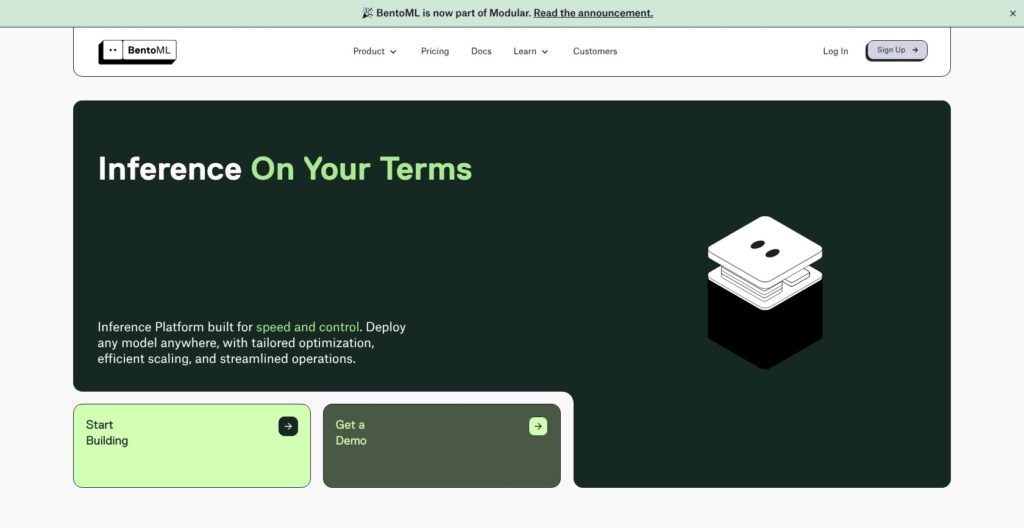
- Self-hosting and roadmap risk: Yatai is archived, and BentoCloud’s archived guides say it is being phased out with no date given; new signups go through Modular’s console.
Pros and Cons
Pros
- Apache 2.0 framework, free to self-host anywhere Docker runs.
- One decorated Python class becomes an API with Swagger UI on port 3000.
- Adaptive batching, async task queues and multi-model composition are built in.
- OpenAI-compatible LLM endpoints through vLLM, with SGLang and TRT-LLM also supported.
- Scale-to-zero on BentoCloud, plus BYOC on AWS, Google Cloud, Azure and Oracle Cloud.
Cons
- No public rate for managed GPU capacity; get a sales quote.
- Dedicated GPUs bill for GPU time (per hour or per minute), idle time included.
- Yatai is archived, so self-hosted Kubernetes is a DIY job.
- Autoscaling falls back to CPU usage unless you set a concurrency value.
- BentoCloud is being phased out, and new signups go to Modular’s console.
BentoML Pricing: How Much Does It Cost?
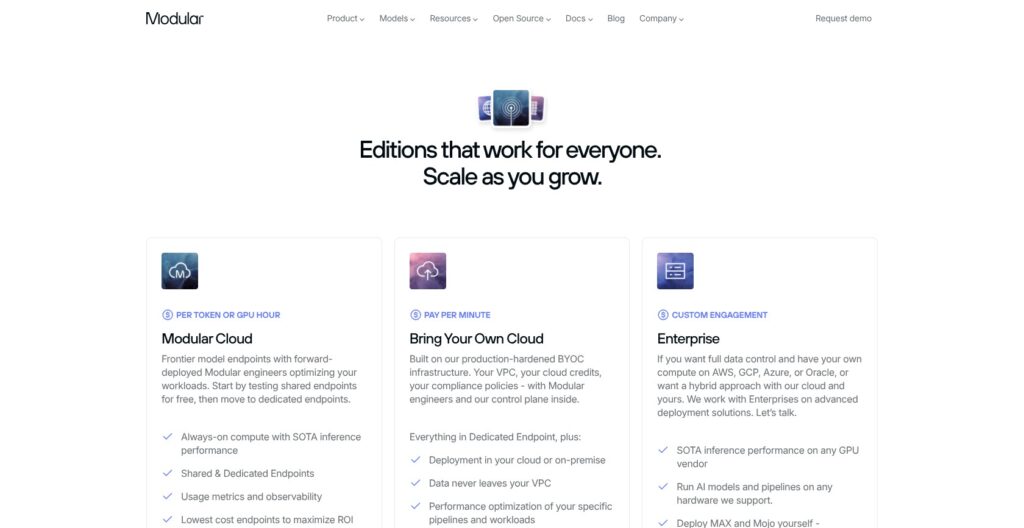
The BentoML framework costs $0 under Apache 2.0. The Pricing link on bentoml.com opens Modular’s editions page, which bills managed capacity per token, per GPU hour or per minute and publishes no GPU rate for custom deployments.
- BentoML open source (free): for teams that run their own containers. The full framework (serve, build, containerize, adaptive batching, task queues, composition) runs anywhere Docker runs, and you pay only for your own compute.
- Shared model endpoints (per token): for teams that only need hosted open models. Per million input/output tokens, GPT OSS 120B costs $0.10/$0.50, Qwen 3 235B costs $0.20/$0.60 and DeepSeek V4 costs $1.74/$3.48; the endpoints are OpenAI API compatible and can be tested free.
- Modular Cloud dedicated endpoints (quote): for custom models and fine-tunes on dedicated GPUs, billed for GPU time (per hour or per minute), idle time included. Existing BentoCloud deployments use instance types from
cpu.1tocpu.8plusgpu.t4.1,gpu.l4.1andgpu.a100.1; BentoCloud is being phased out. Idle replicas cost money unless scale-to-zero is on. - Bring Your Own Cloud (per minute, quote): for running in your own AWS, Google Cloud, Azure or Oracle Cloud account, as part of the Enterprise plan. Modular bills per minute of reserved GPU capacity through sales, and you can spend existing AWS, Google Cloud and Azure credits and commits.
- Enterprise (custom): for teams that need a negotiated contract, with SOC 2 Type 2, standard and custom SLAs, support over email, Slack and video calls, forward-deployed engineers, and committed-use and volume discounts.
| Plan | Price | Billing unit | Best for |
|---|---|---|---|
| BentoML open source | $0 | Your own compute | Self-managed containers |
| Shared model endpoints | From $0.10 per 1M input tokens | Input and output tokens | Hosted open models |
| Modular Cloud dedicated | Quote | GPU time | Custom models and fine-tunes |
| Bring Your Own Cloud | Quote | Minute of reserved GPU capacity | Your own cloud account |
| Enterprise | Custom | Negotiated engagement | SLAs and volume discounts |
Is BentoML Good Value for Money?
- The framework is strong value: Apache 2.0 BentoML needs no production license, while Seldon Core has required a commercial one since its January 22, 2024 switch to Business Source License 1.1.
- Managed value needs a quote: Modal, Baseten and Replicate publish per-second or per-minute GPU rates you can compare before any sales call; neither BentoCloud nor Modular publishes a dedicated GPU rate.
- Scale-to-zero is the main cost lever: dedicated GPUs bill idle time, so set minimum replicas to 0 on any service that sits idle between requests.
- BYOC spends existing commits: it draws on AWS, Google Cloud and Azure credits and commits, which suits teams with prepaid cloud budgets.
| Provider | T4 | A100 80GB | H100 | Billing |
|---|---|---|---|---|
| Modular Cloud dedicated (BentoCloud’s successor path) | Quote | Quote | Quote | GPU time, quote only |
| Modal | About $0.59/hr | About $2.50/hr | About $3.95/hr | Per second; $30 free monthly credits on Starter |
| Baseten | About $0.63/hr | About $4.00/hr | About $6.50/hr | Per minute |
| Replicate | $0.81/hr | $5.04/hr | $5.49/hr | Per second; private models billed while online |
Modal posts the lowest published rate on all three GPUs, and Replicate’s H100 at $5.49 an hour undercuts Baseten’s at about $6.50.
Reviewer’s Notes: I recommend starting on the free framework and containerizing to your own cloud. Move to Modular’s dedicated endpoints or BYOC only after you get a written GPU-capacity quote you can hold against Modal’s H100 at about $3.95 an hour, and turn on scale-to-zero for anything that idles. Get a written answer on how existing BentoCloud deployments move to Modular Cloud.
My Experience With BentoML
BentoML needs Python 3.9 or later and supports 3.9 through 3.12; I used Python 3.11, the version the quickstart recommends.
Setting Up and Writing My First Service
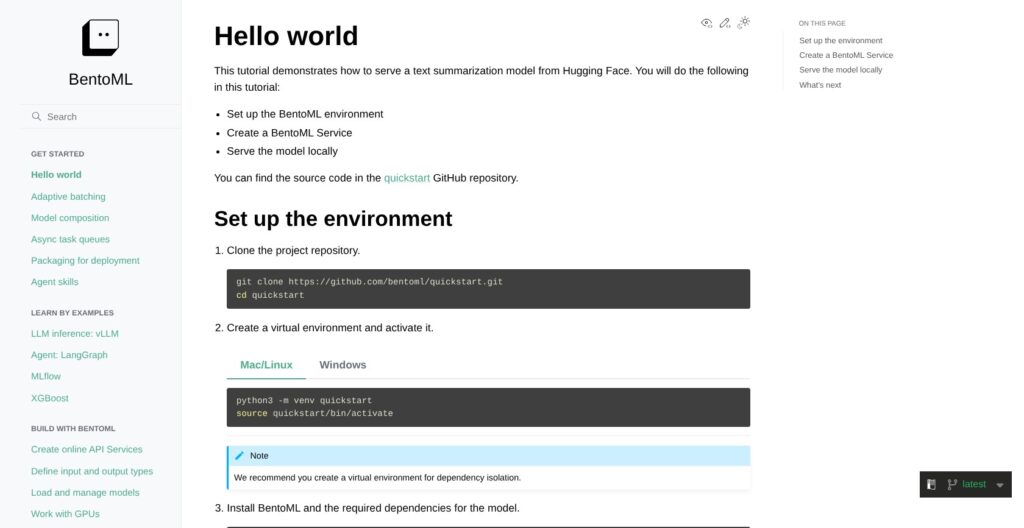
I created a virtual environment and ran pip install bentoml. My service.py held a class decorated with @bentoml.service and a summarize method decorated with @bentoml.api, wrapping a Hugging Face summarization pipeline, with the heavy imports inside bentoml.importing().
This class-and-decorator API arrived in v1.2 on February 2, 2024. It replaced Runners and the BentoService class and moved configuration from YAML files into the decorator, so older tutorials no longer match. Bentos built with v1.1 keep working, and BentoCloud accepts deployments from both versions. The same decorator carries the resources and traffic settings that BentoCloud reads at deploy time.
Running bentoml serve started the API on http://localhost:3000, with Swagger UI at the root. A hand-rolled FastAPI wrapper gets you that endpoint too, but not the container build, adaptive batching or deploy command.
Packaging the Bento and Building a Container
I defined the runtime in Python with bentoml.images.Image(python_version='3.11').python_packages('torch', 'transformers') and passed it as image= to @bentoml.service. bentofile.yaml and pyproject.toml still work, but they are the older options.
bentoml build produced the Bento, bentoml list showed it, and bentoml containerize summarization:latest built the Docker image, which I ran with docker run on port 3000. On Apple silicon, add --platform=linux/amd64 to the containerize step.
pip install bentoml
bentoml serve
bentoml build
bentoml containerize summarization:latest
bentoml cloud login
bentoml deploy -n my-first-bento
That image is the self-hosting path: it runs on any container host without a BentoCloud account.
Deploying to BentoCloud
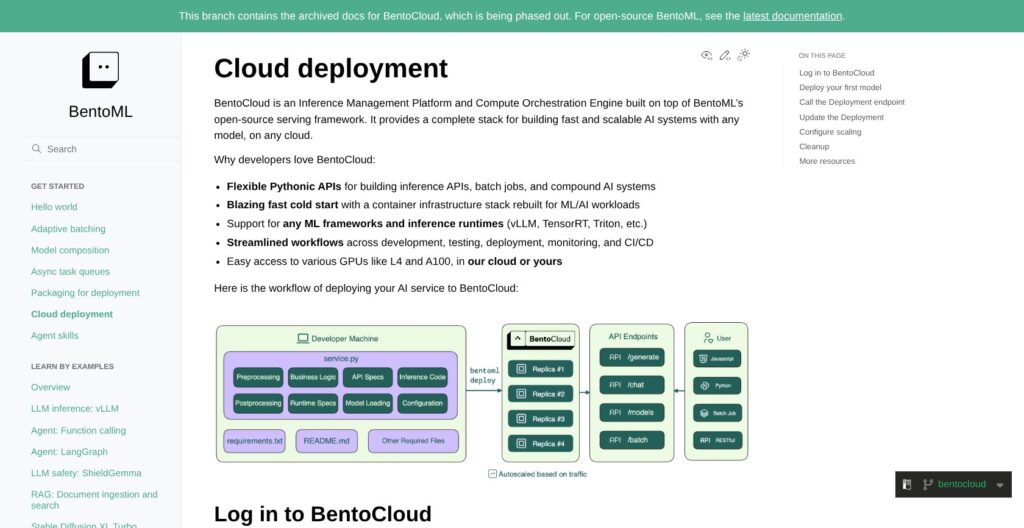
The Sign Up button on bentoml.com now opens Modular’s console signup; Log In and Start Building open cloud.bentoml.com, where BentoCloud accounts deploy. BentoML now labels its BentoCloud guides as archived and says BentoCloud is being phased out. I logged in with bentoml cloud login and created an API token in the browser; the command also accepts an existing token.
From the cloned quickstart project, bentoml deploy -n my-first-bento built the Bento, pushed it and created the deployment on the sample cluster, google-cloud-us-central-1. A .bentoignore file keeps local files out of the upload.
I set deployment controls through bentoml deploy options:
- Replica bounds:
--scaling-minand--scaling-max. - Hardware:
--instance-type, such asgpu.l4.1orgpu.a100.1. - Environment:
--envfor environment variables. - Access:
--access-authorizationfor the endpoint. - Repeatable config:
bentoml deploy -fwith a config file. - Rollout: the RollingUpdate or Recreate strategy.
I opened the deployment from the console’s Deployments page, where the Playground Form tab sends test requests, and bentoml deployment get my-first-bento -o json returns the endpoint URL. From Python, I called the endpoint with bentoml.SyncHTTPClient, passing the URL and then the text argument to summarize.
I shipped a new version with bentoml deployment update, set --scaling-min 0 --scaling-max 3 for scale-to-zero with a 3-replica ceiling, and removed the deployment with bentoml deployment terminate my-first-bento. Secrets and API tokens have their own commands, bentoml secret and bentoml api-token.
Reviewer’s Notes: Declare models as class variables with
bentoml.models.HuggingFaceModelorBentoModel, never inside__init__. A model loaded in__init__is not referenced by the Bento, so the deployed service fails with aNotFounderror. Class-level models download at build time, are cached and mounted into containers, and load in parallel with safetensors.
LLM Serving: vLLM, OpenAI-Compatible APIs and Cold Starts
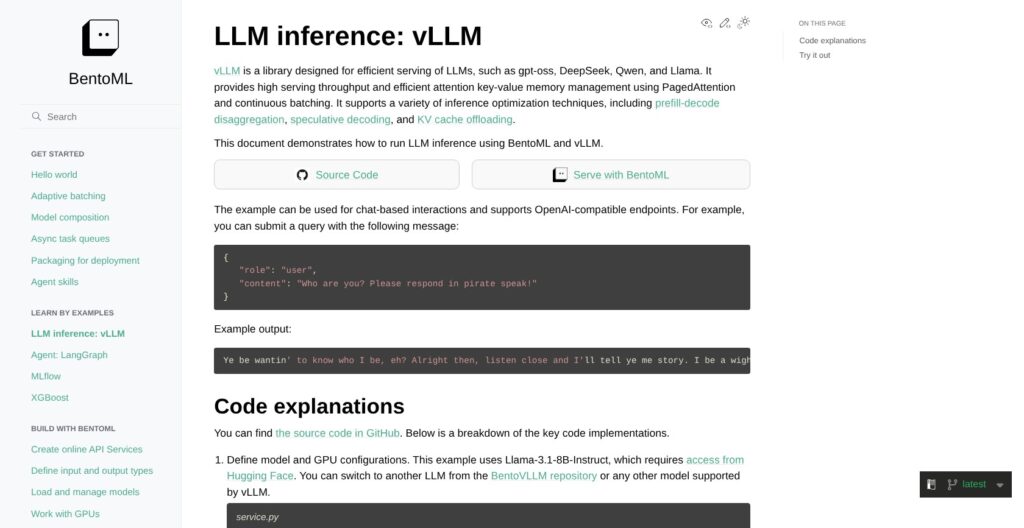
BentoML’s vLLM example serves Llama 3.1 8B Instruct on one H100 80GB by starting vLLM’s own HTTP server through the service’s __command__, which returns a vllm serve call and exposes OpenAI-compatible endpoints, with a 300-second timeout. The decorator’s resources set one GPU with gpu_type nvidia-h100-80gb, and the model is a class-level bentoml.models.HuggingFaceModel.
BentoML wraps vLLM in a deployable service rather than replacing it as the inference engine. The managed platform on bentoml.com lists NVIDIA and AMD GPUs, including B200, H100 and MI300X.
Beyond vLLM, BentoML serves models on five more frameworks and ships its own LLM projects:
- Engines: TRT-LLM and SGLang, with the BentoVLLM and BentoSGLang example repos.
- Custom models: JAX, PyTorch and Transformers.
- OpenLLM: Apache 2.0, about 12,600 GitHub stars, runs open models as OpenAI-compatible APIs with
openllm serve. - Open Model Catalog: one-click deploys of Llama 4, DeepSeek, Qwen, GPT-OSS and Flux.
- Platform: distributed LLM inference across multiple GPUs, an LLM Gateway with one API across LLM providers and centralized cost control, LLM-specific metrics, and Dev Codespace, which runs local edits on cloud GPUs.
A HuggingFaceModel declared at class level downloads during the image build, is cached and mounted into containers, and loads in parallel with safetensors to cut cold-start and build time. On BentoCloud, the Bento Compute Engine adds cold-start acceleration on top.
KServe also offers vLLM and llm-d backends with an OpenAI-compatible protocol, but on a Kubernetes cluster you run yourself.
- Best for: Python teams deploying custom or fine-tuned LLMs that want control over the serving engine and GPU type.
- Skip if: you only call hosted open models; Modular’s shared endpoints price GPT OSS 120B at $0.10 per million input tokens with no deployment at all.
Batching, Task Queues and Multi-Model Pipelines
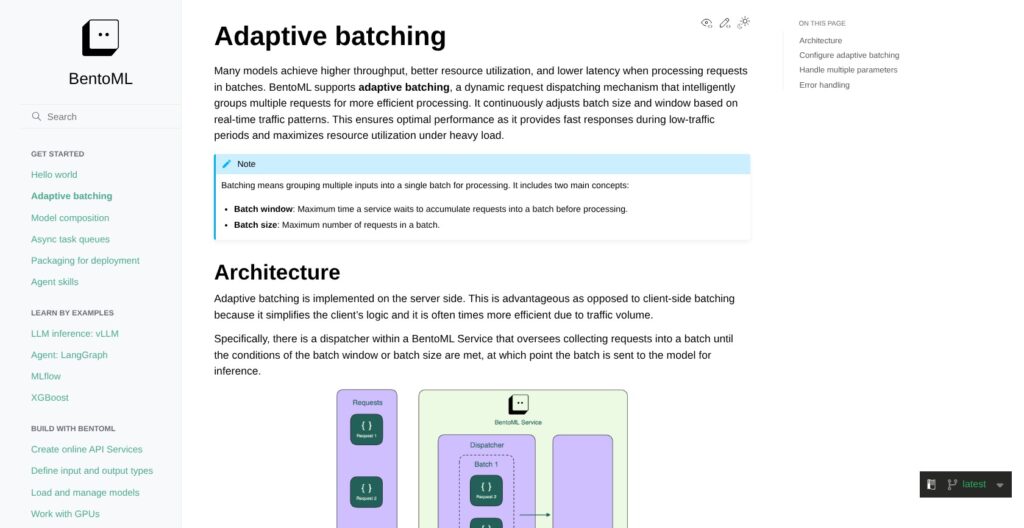
Adaptive batching is off by default. @bentoml.api(batchable=True) turns it on, and the API then needs a batch-capable input such as List[str] or numpy.ndarray, with only one parameter besides bentoml.Context.
batch_dim, max_batch_size and max_latency_ms tune the batcher; set the service’s traffic concurrency to match. Order within a batch is not guaranteed, so never rely on position to match results to requests. These primitives cover the four serving patterns BentoML targets: interactive sub-second APIs, async long-running tasks, large-scale batch inference and multi-model RAG or compound AI workflows.
@bentoml.task turns a method into an asynchronous task queue with five generated endpoints:
POST /submit: submits a job.GET /status: reports its status.GET /get: returns the result.POST /cancel: cancels it.PUT /retry: retries it.
BentoML’s example is long-running image generation: the client submits a job, polls GET /status, then collects the output from GET /get. Results are kept 24 hours by default. Locally, the queue lives in non-persistent memory and is for development only.
For RAG and compound AI pipelines, one service can run several models on the same GPU, or separate services linked with bentoml.depends can each scale on their own hardware. Examples cover LangGraph agents, MLflow and XGBoost models, ControlNet and SDXL Turbo image pipelines, and ShieldGemma. Ray Serve is the better fit only if your team already runs Ray clusters; BentoML needs no cluster at all for local or Docker serving.
Quick comparison: a FastAPI service leaves batching, task queues and dependency scaling to your own code; BentoML ships all three as decorators and bentoml.depends.
Autoscaling, Scale-to-Zero and Self-Hosting
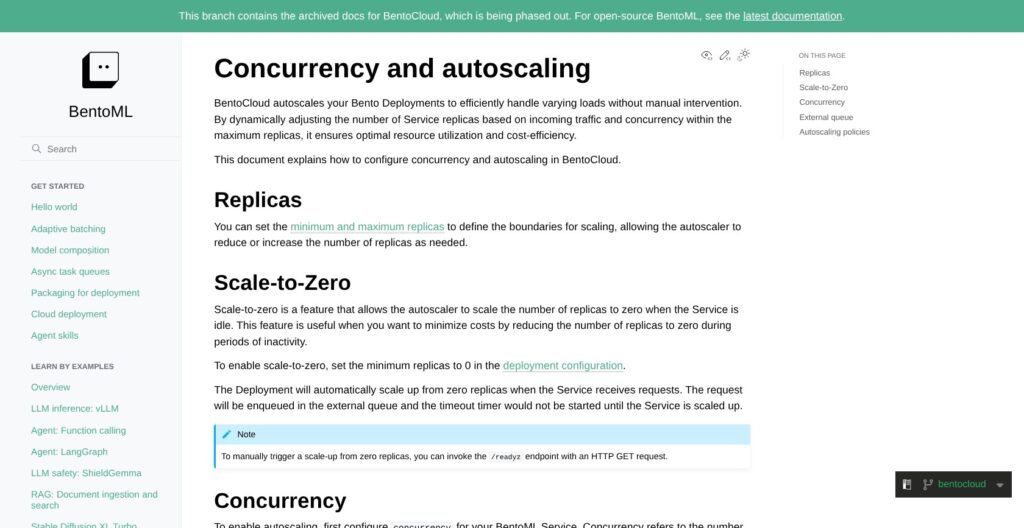
BentoCloud autoscales on the traffic={'concurrency': N} value set on @bentoml.service; without it, scaling uses CPU utilization only. In BentoML’s example, concurrency 32 under 100 concurrent requests scales to 4 replicas. Pick N from a load test, for example with Locust, instead of copying 32.
Setting minimum replicas to 0 turns on scale-to-zero. Requests wait in an external queue, the timeout clock starts only once a replica is up, and a GET /readyz request triggers scale-up. Keep at least 1 replica on interactive endpoints where the first request cannot wait for scale-up.
With no instance type set, BentoCloud infers one from the resources field. Release tooling covers rollbacks plus canary, shadow and A/B testing, and the Bento Compute Engine underneath adds cross-region scaling and multi-cloud compute orchestration.
BYOC is part of the Enterprise plan and runs on AWS, Google Cloud, Azure or Oracle Cloud Infrastructure. Bento operators and deployments run in your VPC, while the BentoCloud control plane stays outside your environment, and infrastructure-as-code creates the Kubernetes clusters (EKS or GKE), object storage and key-value stores. Modular’s own BYOC is built on BentoCloud’s BYOC infrastructure.
Self-hosted services expose Prometheus metrics by default, such as bentoml_service_request_in_progress, accept custom metrics through prometheus_client and include OpenTelemetry tracing. Yatai, the Kubernetes operator, is archived, and its BentoML 1.2 version was still marked “under construction,” so self-hosted Kubernetes means writing your own manifests and autoscaling around the container. KServe gives request-based autoscaling with scale-to-zero, but on a Kubernetes cluster you run yourself.
My recommendation: use Modular Cloud or BYOC for new managed deployments, because BentoCloud is being phased out. BentoCloud’s concurrency autoscaling and scale-to-zero remain the reference behavior above; Modular Cloud lists auto-scaling, scale to zero and burst capacity. If your platform team already runs clusters, compare KServe before writing manifests around a Bento.
The Modular Acquisition: Ownership, License and Release Cadence
Modular, the company behind MAX and Mojo, announced it acquired BentoML on February 10, 2026. BentoML stays Apache 2.0 with the same community and contribution process, and BentoML’s CEO said BentoCloud stays fully supported with nothing changing for customers.
Modular and BentoML say BentoCloud’s multi-cloud foundation will become the basis of Modular Cloud and that the two will merge into one product, with no date and no pricing change announced. Signup and pricing already route through Modular.
By November 2026, BentoML had archived its BentoCloud guides, with a banner saying BentoCloud is being phased out, without a phase-out date. The latest BentoML guides no longer include the cloud deployment, BentoCloud scaling, BYOC or BentoCloud CLI pages.
The CEO also promised to keep shipping new features “at the same pace if not faster”; since then, v1.4.38 shipped April 2, 2026 and v1.4.39 May 7, then v1.4.40 not until October 23, a gap of more than five months. v1.4.40 added a certifi security fix, hash-pinned uv in generated Dockerfiles, and agent skills for creating BentoML projects and deploying to Kubernetes and EC2. The repo shows about 8,900 GitHub stars, 278 open issues and a last push on November 2, 2026.
Seldon also changed hands: TrueFoundry announced it acquired Seldon’s business on June 24, 2026, after Seldon moved Core to the Business Source License in January 2024, while BentoML kept Apache 2.0.
The verdict: license risk is low, because Apache 2.0 is unchanged; the roadmap risk is BentoCloud’s phase-out, so get migration terms to Modular Cloud in writing before standardizing on managed BentoML.
How Does BentoML Compare to Competitors?
BentoML sits between Kubernetes-native serving such as KServe and serverless GPU clouds such as Modal that publish per-second rates.
- Ray Serve: Ray is Apache 2.0 (2.60.0, November 4, 2026); Anyscale runs it pay-as-you-go with a $100 starting credit, hosted or in your own cloud. It fits teams already running Ray.
- KServe: Apache 2.0 and CNCF incubating, v0.21.0 (September 25, 2026), with vLLM and llm-d backends, an OpenAI-compatible protocol and scale-to-zero. It fits platform teams that want a free Kubernetes standard on their own clusters.
- Seldon: Core has been under Business Source License 1.1 since January 22, 2024, so production use needs a commercial license; TrueFoundry announced it acquired Seldon’s business on June 24, 2026. It fits existing Seldon licensees.
- NVIDIA Triton Inference Server: BSD-3-Clause, v2.74.0 (November 2, 2026), serving TensorFlow, ONNX, PyTorch and TensorRT. It is a server, not a deployment platform, so it fits teams that will build deployment around it.
- Baseten: per-minute dedicated GPUs, H100 at $0.10833 a minute (about $6.50 an hour), MIT-licensed Truss packaging. It fits teams that want a managed GPU endpoint at a public rate.
- Modal: per-second billing, H100 at about $3.95 an hour, $30 in free monthly credits on Starter, Team at $250 a month plus compute. It fits Python teams that want serverless GPUs without a quote.
- Replicate: per-second billing, H100 at $5.49 an hour, Apache 2.0 Cog packaging; private models bill for all online time, idle included. It fits teams that keep private models busy.
- TrueFoundry: a Kubernetes deployment platform plus an LLM gateway (Developer free for up to 3 users, Pro $25 per user a month), with the platform sold through sales. It fits teams that want one control plane over their own clusters.
- Amazon SageMaker:
ml.g5.xlargereal-time endpoints at $1.408 an hour in US East (N. Virginia), billed while running. It fits AWS-only teams that want no cluster to run.
BentoML wins where a Python team wants one framework that runs locally, in Docker, on Modular’s managed cloud or in its own cloud without rewriting the service.
How I Reviewed BentoML
I installed BentoML v1.4.40 in a Python 3.11 environment, built the summarization quickstart service, served it locally, containerized the Bento and deployed it to BentoCloud with the CLI. I then worked through the vLLM example, adaptive batching, task queues, autoscaling and scale-to-zero settings, the BYOC requirements and the Modular editions, and priced BentoML against Ray Serve on Anyscale, KServe, Seldon, Triton, Baseten, Modal, Replicate, TrueFoundry and SageMaker.
I weighted these areas:
- Pricing and value: the free framework, token rates and quote-only GPUs.
- Setup and developer experience: decorators, runtime images and the CLI.
- LLM serving: vLLM integration and model loading.
- Serving features: batching, task queues and composition.
- Scaling and deployment: autoscaling, scale-to-zero and BYOC.
- Ownership and release cadence: the Modular deal, the BentoCloud phase-out and the 2026 release gap.
- Alternatives: the nine rivals above.
Prices current as of November 2026.
Should You Use BentoML for Model Serving?
Yes, for Python ML teams that want models and LLMs served as APIs, containers and autoscaling deployments from one codebase. The framework is free to self-host; for scale-to-zero and managed GPUs as traffic grows, use Modular’s managed editions, with dedicated endpoints or BYOC, because BentoCloud is being phased out.
No, if one of these applies:
- You need public GPU rates before talking to sales: Modal, Baseten and Replicate publish them.
- You want a maintained Kubernetes operator on your own clusters: choose KServe, since Yatai is archived.
- You already run Ray: Ray Serve avoids adding a second serving framework.
- You only call hosted open models: Modular’s shared endpoints bill per token, from $0.10 per million input tokens for GPT OSS 120B.
Settle three things before signing for managed capacity:
- A written per-GPU-hour quote that states how idle time is billed.
- A load test showing whether scale-to-zero fits your latency budget.
- A written migration path from BentoCloud, which is being phased out, to Modular Cloud.
Prove the model API and container on the free framework first; under Apache 2.0, that work stays yours whichever host you pick: Modular’s cloud, your own cloud or any Docker host.
Start with the free framework at BentoML.
FAQ
Is BentoML free?
Yes. The BentoML framework is free under Apache 2.0, including self-hosting anywhere Docker runs, and you pay only for your own compute. Managed dedicated GPUs and BYOC in Modular’s editions have no published rate and go through a quote. Modular’s shared endpoints bill per token, from $0.10 per million input tokens and $0.50 per million output tokens for GPT OSS 120B, separately from custom model deployments.
Is BentoML still open source after the Modular acquisition?
Yes. Modular announced the deal on February 10, 2026 and says BentoML stays Apache 2.0; v1.4.40 shipped under that license on October 23, 2026. BentoML’s CEO said BentoCloud stays fully supported, and its planned merger into Modular Cloud has no announced date and no announced pricing change. BentoML now labels BentoCloud as being phased out, while the framework’s license is unchanged.
Does BentoML need Kubernetes?
No. bentoml serve runs a service locally, bentoml containerize builds a Docker image for any container host, and managed scaling now comes from Modular Cloud, with BentoCloud being phased out. Yatai, the Kubernetes operator, is archived, so self-hosted Kubernetes needs your own manifests and autoscaling around the container. See Autoscaling, Scale-to-Zero and Self-Hosting above.
Can BentoML serve LLMs with an OpenAI-compatible API?
Yes. BentoML’s vLLM example runs vLLM’s server inside a BentoML service and exposes OpenAI-compatible endpoints, serving Llama 3.1 8B Instruct on one H100 80GB. OpenLLM, an Apache 2.0 BentoML project with about 12,600 GitHub stars, does the same for open models with openllm serve, and SGLang and TRT-LLM are also supported as serving engines.
What happened to BentoCloud?
BentoML’s archived guides label BentoCloud as being phased out, without a date. New signups go to Modular’s console; existing users still log in at cloud.bentoml.com. Modular said in February 2026 that BentoCloud’s foundation becomes the basis of Modular Cloud. Managed GPU capacity has no public rate and bills for GPU time on a quote. See BentoML Pricing: How Much Does It Cost? above.