Editor’s note: This Seldon review is based on my hands-on test of Seldon Core 2 v2.10.2, installed with Helm on a kind Kubernetes cluster with MLServer and Triton, in November 2026. I weighed licensing and pricing, installation, multi-model serving, experiments and pipelines, monitoring, the LLM Module, ownership and cadence against KServe, BentoML, Ray Serve and managed endpoints.
Quick verdict: I recommend Seldon for Kubernetes platform teams that already hold a Seldon license and want multi-model serving, A/B and shadow experiments and Kafka-logged pipelines on their own clusters. Production needs a commercial license, last stated in September 2024 at a flat $18,000 a year, and Core 2 has shipped nothing since v2.10.2 (December 19, 2025). New buyers get an Apache 2.0 equivalent in KServe.
Core 2 schedules many models onto shared MLServer and Triton servers with memory overcommit, routes A/B and mirror experiments, chains models into Kafka-backed pipelines and speaks the Open Inference Protocol over REST and gRPC, which is the strongest case this Seldon review makes for it.
In this review, I’ll take a closer look at Seldon’s pricing, features, and licensing, so you can see exactly whether it belongs in your serving stack or whether an open-source alternative is the better buy.
Key Takeaways
- Shared model servers: least-recently-used models are evicted to disk, with a default 10% memory overcommit.
- Traffic experiments: weighted splits, shadow mirroring and sticky sessions, for models and whole pipelines.
- Paid production use: Core and Alibi are BSL 1.1 since January 22, 2024, free outside production, each version turning Apache 2.0 after four years. MLServer stays Apache 2.0.
- No public price list: Core+, the LLM Module, MPM and Enterprise Platform are quote-only.
- Stalled cadence, new owner: no Core 2 release since December 19, 2025, and no roadmap from TrueFoundry, which announced the deal on June 24, 2026.
Pros and Cons
Pros
- Multi-model serving on shared MLServer and Triton servers, with LRU eviction and 10% default overcommit.
- Experiments support weighted A/B splits, 100% mirror traffic and sticky sessions for models and pipelines.
- Kafka-backed pipelines log every step’s input and output by default.
- Open Inference Protocol over REST and gRPC, with MLServer runtimes for sklearn, XGBoost, LightGBM, MLflow and Hugging Face.
- Alibi drift, outlier and explainer models deploy as ordinary Model resources.
Cons
- Production use needs a BSL license, last stated in September 2024 at a flat $18,000 a year.
- No public price list for Core+, the LLM Module, MPM or Enterprise Platform.
- No Core 2 release since v2.10.2 on December 19, 2025.
- Pipelines need Kafka 3.4 to 3.8, and the dataflow engine logs errors until it connects.
- No automatic payload logging for models called directly over REST or gRPC.
Seldon Pricing: How Much Does It Cost?
Seldon publishes no price list, and seldon.io no longer shows any plan prices. Core 2 is free for development, testing and staging; production use needs a commercial license.
- MLServer (free, Apache 2.0): for running the inference server on its own, production included.
- Core 2 non-production (free under BSL 1.1): for development, testing and staging. Non-profit educational institutions also get a production grant if they do not commercialize it.
- Core production license (flat annual fee): for production deployments. Seldon last stated the fee in September 2024 as $18,000 a year flat; one license covers Core 1 and Core 2 from versions 1.18 and 2.7 onward, and government agencies pay like commercial buyers.
- Core+ (quote): for teams that want a Customer Success Manager, a response-time SLA, an annual health check, warranted binaries and IQ sessions.
- Modules (quote): for the LLM Module, Model Performance Metrics (MPM), Alibi Detect and Alibi Explain add-ons.
- Enterprise Platform (quote): for a PostgreSQL-backed model catalog, authentication and authorization, a record of user actions, GitOps, Argo Workflows batch jobs, monitoring and alerting.
| Tier | License | Price | Production use |
|---|---|---|---|
| MLServer | Apache 2.0 | Free | Yes |
| Core 2 (non-production) | BSL 1.1 | Free | Educational grant only |
| Core license | Commercial | $18,000 a year flat (last stated Sept 2024) | Yes |
| Core+ | Commercial, with support | Quote | Yes |
| LLM Module / MPM / Alibi modules | Commercial add-ons | Quote | Yes, paid |
| Enterprise Platform | Commercial | Quote | Yes |
Is Seldon Good Value for Money?
- KServe costs $0 in license fees: it is Apache 2.0 and runs on the same Kubernetes cluster, so Seldon’s $18,000 a year has to be earned by multi-model packing, experiments and contracted support.
- SageMaker swaps the license for instance hours: real-time endpoints in US East (N. Virginia) cost $0.115 an hour on ml.m5.large and $1.408 an hour on ml.g5.xlarge, so one always-on ml.m5.large runs about $1,007 a year, with no license fee but AWS-only hosting.
- Infrastructure is always on top: Kubernetes nodes, Kafka for pipelines and any GPUs bill separately, because a Core license buys usage rights, not a hosted endpoint.
- Apache conversion takes four years: Core 2.7.0, the first BSL release (January 22, 2024), converts in January 2028.
TrueFoundry’s public prices cover its AI Gateway only: Developer $0 for up to three users, Pro $25 per user a month and Enterprise custom, with no Seldon line. Existing Seldon customers are promised continuity of support on TrueFoundry’s AI Deploy platform.
Reviewer’s Notes: If you already run Core 2 in production, keep it and get the renewal price and support terms from TrueFoundry in writing before the next renewal. New teams that only need serving should start on KServe or free MLServer instead of budgeting around a September 2024 figure.
My Experience With Seldon
Core 2 needs Kubernetes 1.27 to 1.33, kubectl and Helm. For learning, Seldon recommends a kind cluster on a machine with at least 32GB of RAM plus a load balancer such as MetalLB.
How I Installed Core 2
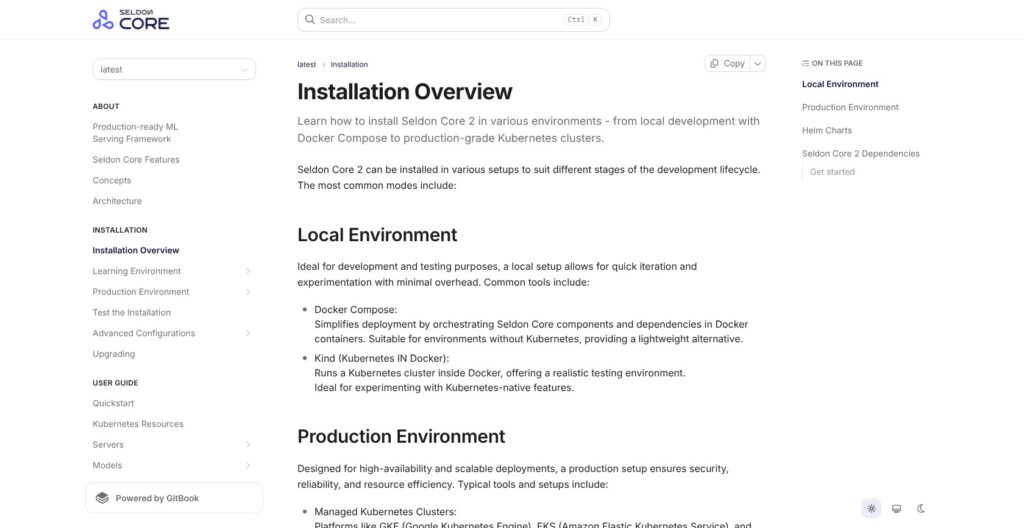
I created the seldon-mesh and seldon-monitoring namespaces, added the seldon-charts Helm repo and installed the four charts in order: CRDs, setup (the operator plus a default SeldonConfig and ServerConfig), runtime, then the example servers. Seldon also ships Ansible playbooks that install kind, Kafka, Prometheus, OpenTelemetry and Jaeger in one run; I stayed on plain Helm.
helm repo add seldon-charts https://seldonio.github.io/helm-charts/
helm upgrade seldon-core-v2-crds seldon-charts/seldon-core-v2-crds --namespace default --install
helm upgrade seldon-core-v2-setup seldon-charts/seldon-core-v2-setup --namespace seldon-mesh --set controller.clusterwide=true --install
helm upgrade seldon-core-v2-runtime seldon-charts/seldon-core-v2-runtime --namespace seldon-mesh --install
helm upgrade seldon-core-v2-servers seldon-charts/seldon-core-v2-servers --namespace seldon-mesh --install
The servers chart gave me one replica each of mlserver-0 and triton-0, and Envoy and Rclone came bundled in the images. kubectl get pods -n seldon-mesh listed:
- Scheduler: places Models on matching Servers.
- Controller manager: reconciles the Kubernetes resources.
- Envoy: routes inference traffic.
- Model gateway, pipeline gateway and dataflow engine: the Kafka-connected pipeline components.
The dataflow engine and both gateways log errors until Kafka connects; Seldon points to Strimzi for testing and managed Kafka for production, so I ran Strimzi for the pipeline steps. Kafka is needed only for pipelines, so a models-only install can skip those three components. kubectl get servers -n seldon-mesh then listed mlserver and triton.
Loading My First Model
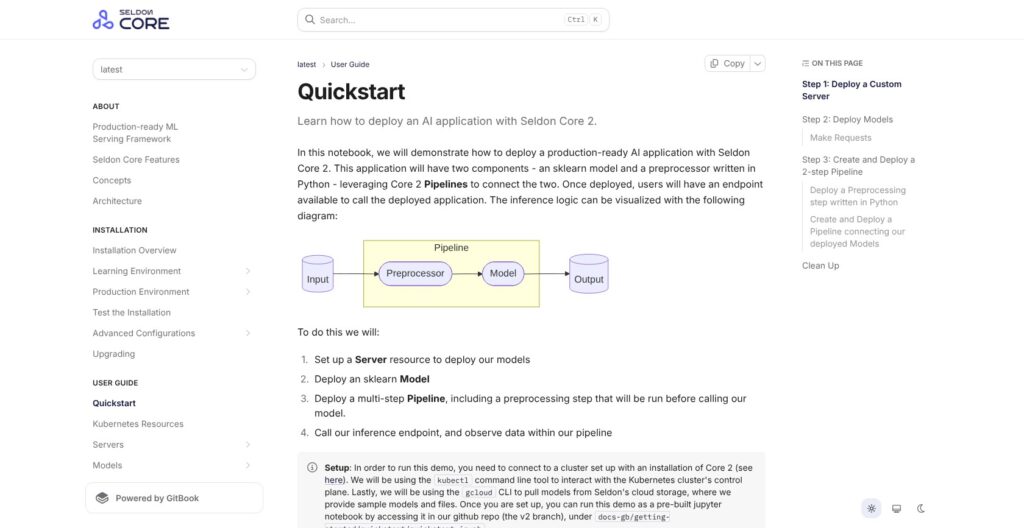
I applied a Server named mlserver-custom (image seldonio/mlserver:1.6.0) with the capability income-classifier-deps, then the Model income-classifier, which points to Seldon’s sample sklearn artifact and declares 100Ki of memory. The scheduler matched the Model’s requirements to the Server’s capabilities and placed it there.
I called the model with:
- Endpoint: a POST to
/v2/models/income-classifier/inferon theseldon-meshservice, whose load-balancer address I read withkubectl get svc seldon-mesh -n seldon-mesh. - Header:
Seldon-Model: income-classifier. - Body: an Open Inference Protocol input named
income, datatypeINT64, with 12 values.
The response carried the sample’s expected prediction of 0. MLServer also ships an MLflow runtime, so the same Model resource takes MLflow artifacts as well as sklearn ones.
The seldon CLI (seldon model load, status, infer) drives local Docker Compose setups and cannot change manifests inside Kubernetes, so I did all cluster work with kubectl. On macOS ARM the CLI needs a local Go build.
Building a Pipeline and an A/B Test
I added a preprocessor Model and the Pipeline income-classifier-app, with steps preprocessor then income-classifier and the classifier as output, and called the chain with the header value income-classifier-app.pipeline. Every step’s input and output landed in Kafka.
For the experiment I applied candidates iris and iris2 at weight 50 each, with iris as the default, so the existing iris endpoint split traffic evenly. The mirror variant sent 100% shadow traffic to iris2 and returned only the iris response to the caller. A standalone experiment takes the header suffix .experiment instead, and kubectl delete -f on each manifest cleaned everything up.
Reviewer’s Notes: Everything in Core 2 is a manifest under
mlops.seldon.io/v1alpha1, which suits GitOps teams. The cost is five resource types to own (Server, Model, Pipeline, Experiment and SeldonRuntime), so I recommend Core 2 only to teams that already version their Kubernetes manifests in Git.
Multi-Model Serving, Experiments and Pipelines
Core 2’s scheduler places each Model on a Server whose capabilities and memory match, so many models share MLServer and Triton replicas instead of getting a pod each. KServe offers that kind of packing only through ModelMesh, an optional install, which makes the scheduler Seldon’s strongest reason to buy.
Multi-Model Serving and Overcommit
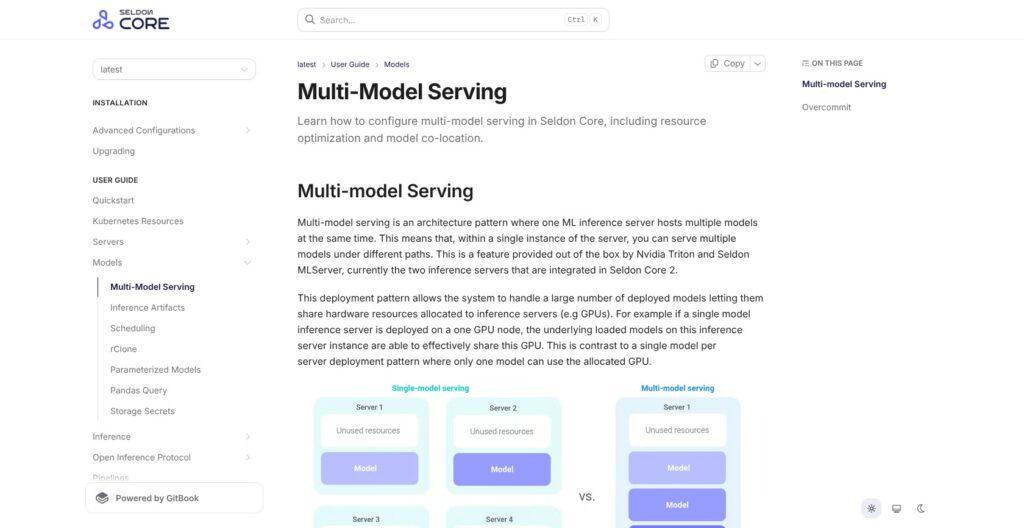
Hot models stay in memory and least-recently-used models are evicted to disk. SELDON_OVERCOMMIT_PERCENTAGE defaults to 10%, letting a Server register models whose total memory requirement exceeds its memory by that share; setting it to 0 disables overcommit.
Reloading an evicted model from the local cache adds latency with a stated floor of about 100ms, so overcommit suits many low-traffic models, not a hot path. Memory requirements are user-specified per Model, like the 100Ki on my income classifier.
Autoscaling
Native model autoscaling scales on inference lag, incoming minus outgoing requests. It is off by default and needs minReplicas or maxReplicas on the Model; Servers then scale from model demand.
HPA with Prometheus Adapter is the custom-metrics alternative. KServe’s request-based autoscaling scales to zero, which makes it the better fit for idle-heavy workloads.
Experiments
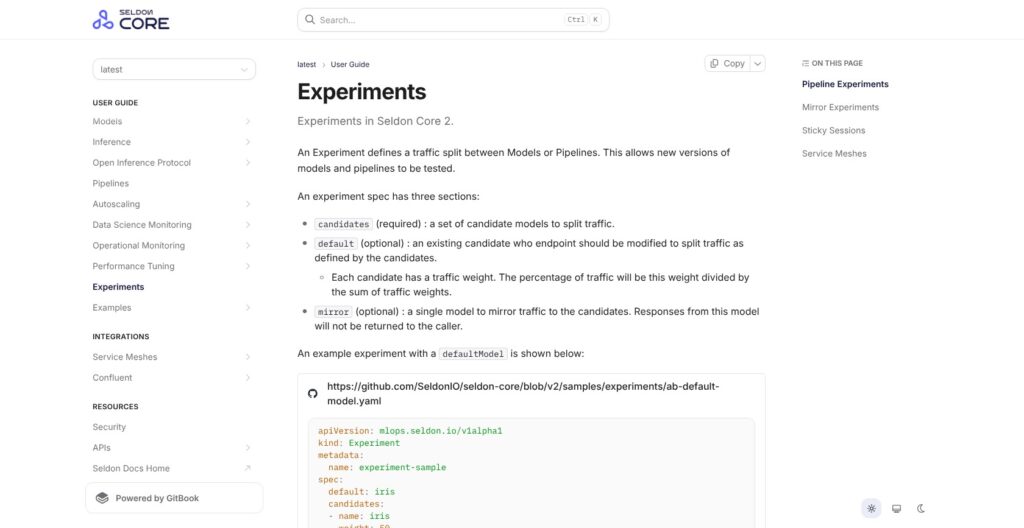
Core 2’s Experiment resource routes traffic for single models or whole pipelines:
- Weighted candidates: each candidate’s share equals its weight divided by the sum of weights.
- Default routing: re-routes an existing model’s endpoint through the experiment.
- Mirroring: sends shadow requests and never returns the shadow model’s response.
- Sticky sessions: clients resend the
x-seldon-routeresponse header on later requests.
Pipeline-level experiments matter most when a rollout changes preprocessing as well as the model, because both changes then run on the same traffic split.
Kafka-Backed Pipelines
The dataflow engine streams each pipeline step through Kafka topics and logs every step’s input and output by default, which makes data-centric debugging straightforward. Models called directly over REST or gRPC get no automatic payload logging; requests have to go through a pipeline to land in Kafka.
An open GitHub issue from October 2025 reports sporadic pipeline invocation failures when a dataflow-engine pod rolls during a node drain, on Core 2.10 with EKS and MSK, while the models stayed ready. A Seldon engineer attributed part of the degradation to Kafka cooperative rebalancing, so I recommend running a node-drain test before production.
Monitoring, Explainability and the LLM Module
Alibi Detect drift and outlier detectors and Alibi Explain explainers deploy as ordinary Model resources and wire into pipelines like any other step. Production use of both libraries needs the same paid license as Core.
Metrics and Tracing
Core 2 exposes Prometheus metrics with Grafana dashboards, and both are optional installs (Prometheus 2.x, Grafana 10+). Tracing runs through Jaeger and an OpenTelemetry collector, which needs cert-manager, with the exporter endpoint and protocol set in SeldonConfig.
Alibi Detect and Explain
Both libraries have been BSL 1.1 since January 22, 2024, starting with Alibi Detect 0.11.5 and Alibi Explain 0.9.5, so adding an explainer Model is a licensing decision as well as a deployment one. Seldon’s examples include a CIFAR10 image classifier with drift and outlier monitoring, an income classifier with an anchor_tabular explainer and a Hugging Face speech-to-sentiment pipeline with explanations.
LLM Module
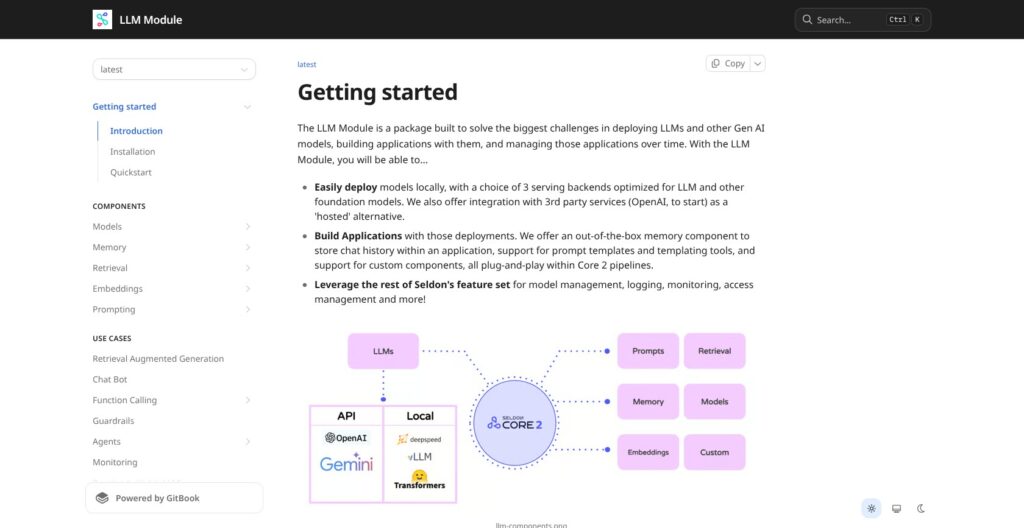
The LLM Module ships as a set of MLServer runtimes:
- API: OpenAI and Gemini, including Azure OpenAI deployments.
- Local: vLLM, DeepSpeed and Hugging Face Transformers, with multi-GPU and AWQ/GPTQ quantization.
- Prompts: Jinja2 templates.
- Conversational Memory: persisted chat history.
- Retrieval: PGVector and Qdrant clients, plus local embeddings.
Its use cases cover RAG, chatbots, function calling, agents, LiteLLM routing and guardrails, and the guardrails tutorial runs Mistral-7B-Instruct-v0.2 locally. The latest module release, 0.7.0 (June 6, 2025), added agentic workflows through the OpenAI API. LLM Module images come only from Seldon’s private registry on request, and MPM onboarding runs through Seldon support, so I covered both from their specs and did not run them.
KServe ships vLLM and llm-d backends with an OpenAI-compatible protocol under Apache 2.0, with no registry request and no module fee.
Model Performance Metrics (MPM)
MPM computes classification and regression metrics from predictions plus ground-truth feedback over Kafka, with Grafana views, and plugs into Core 2 pipelines and the Enterprise Platform. Seldon itself warns that small feedback volumes give insignificant metrics and that swapping the artifact behind the same model URI produces misleading ones.
Licensing, Ownership and Release Cadence
Seldon moved Core 1, Core 2, Alibi Detect and Alibi Explain from Apache 2.0 to BSL 1.1 on January 22, 2024. The first BSL releases were Core 1.18 and Core 2.7.0; earlier versions stay Apache 2.0, and MLServer stays Apache 2.0 and free in production. The BSL covers source and binaries alike.
- Production: any model outside development, testing or staging needs a commercial license.
- Additional Use Grant: non-profit educational institutions only, and only if they do not commercialize the software.
- Change Date: four years after each version’s release.
- Change License: Apache 2.0.
- Redistribution: modified versions cannot be redistributed under another license, and partners embedding Core must contact Seldon.
KServe’s maintainers responded in January 2024 by proposing to remove Alibi explainer support and Seldon MLServer references from KServe.
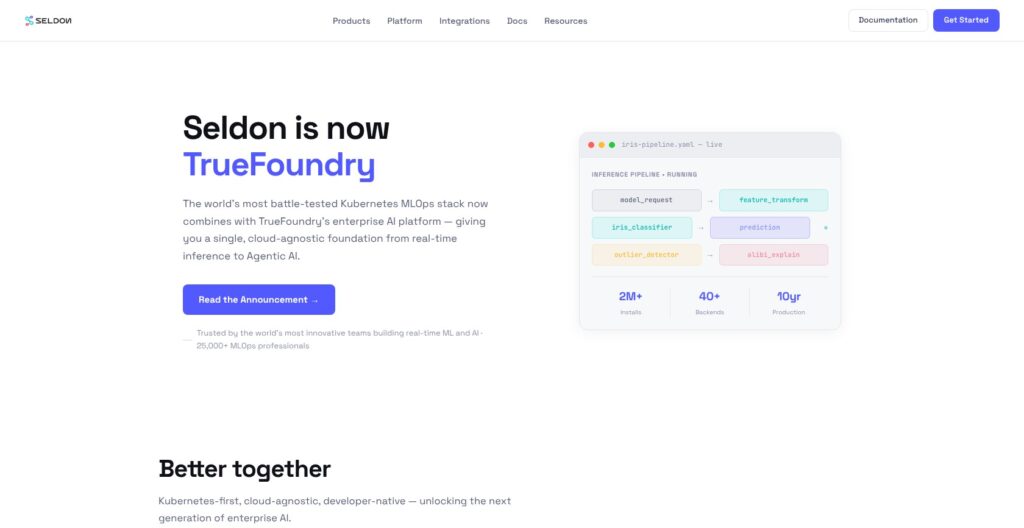
TrueFoundry announced it acquired Seldon’s business and customers on June 24, 2026, for an undisclosed price, and seldon.io now opens with “Seldon is now TrueFoundry.” TrueFoundry promises continuity of support and says Seldon customers’ ML keeps running on its AI Deploy platform, but it has announced no Core 2 roadmap, end-of-life date or license change.
| Project | Latest release | Release date |
|---|---|---|
| Seldon Core 2 | v2.10.2 | December 19, 2025 |
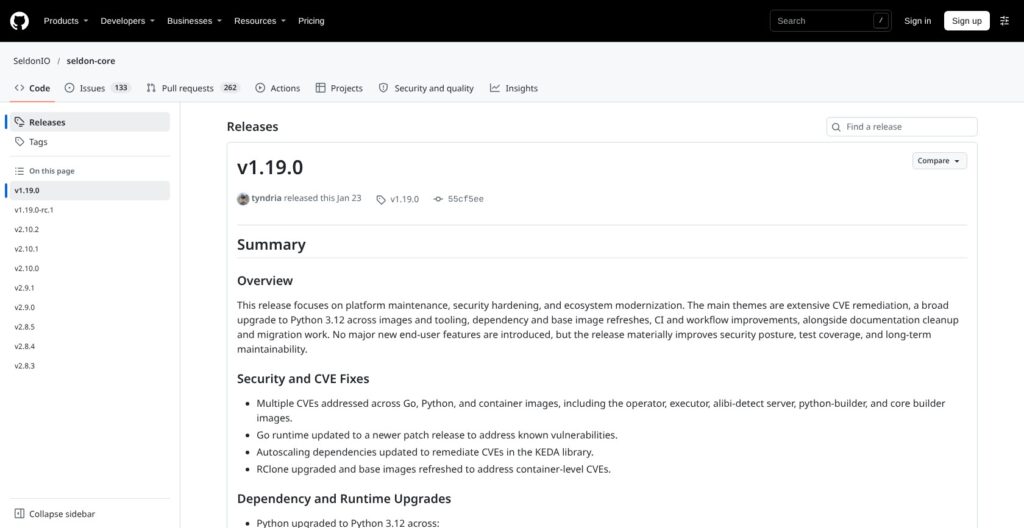
| Seldon Core 1 | v1.19.0 | January 23, 2026 |
| MLServer | 1.7.1 | June 6, 2025 |
| KServe | v0.21.0 | September 25, 2026 |
| NVIDIA Triton | v2.74.0 | November 2, 2026 |
The last commit on Core 2’s v2 branch landed on January 19, 2026, and the repository holds about 4,785 stars and 395 open issues and pull requests. That is no release in nearly 11 months, while KServe and Triton both shipped in autumn 2026. Core 1 is in maintenance mode with no active development, and Seldon recommends Core 2 for all new deployments; the two can run side by side. Alibi Detect saw its last push on December 11, 2025.
Reviewer’s Notes: Before signing a multi-year deal, get the support term, renewal price and Core 2 roadmap from TrueFoundry in writing. Until TrueFoundry publishes one, plan upgrades with v2.10.2 as the current baseline.
How Does Seldon Compare to Competitors?
Seldon competes with Apache-licensed Kubernetes serving and managed endpoints, and each rival wins a different niche.
- KServe: Apache 2.0 and CNCF incubating, with v0.21.0 released September 25, 2026. It adds vLLM and llm-d backends, an OpenAI-compatible protocol and request-based autoscaling with scale-to-zero, with Knative and ModelMesh as optional installs; the Knative serverless install is heavier than a raw deployment. It wins for teams that want a free, actively released Kubernetes standard alongside open tooling such as Kubeflow.
- BentoML: an Apache 2.0 Python framework, v1.4.40 (October 23, 2026), with managed BentoCloud on top. Modular announced it acquired BentoML on February 10, 2026 and says BentoCloud stays supported. It wins for Python teams packaging models without writing Kubernetes manifests.
- Ray Serve on Anyscale: Ray is Apache 2.0, with 2.60.0 released November 4, 2026. Anyscale is pay-as-you-go with a $100 starting credit, hosted or in your own cloud. Ray Serve handles model composition and multiplexing in Python, and it wins for teams already running Ray.
- NVIDIA Triton: BSD-3-Clause, v2.74.0 (November 2, 2026), serving TensorFlow, ONNX, PyTorch and TensorRT models. Core 2 installs Triton by default, so teams that only need a GPU inference server can run Triton alone and skip the Core license.
- TrueFoundry: Seldon’s new owner. Its AI Gateway costs $0 on Developer (up to three users), $25 per user a month on Pro and a custom fee on Enterprise, and it wins for teams that want one managed control plane for LLM traffic and model deployment.
- Amazon SageMaker real-time endpoints: ml.m5.large costs $0.115 an hour, ml.c5.xlarge $0.204 and ml.g5.xlarge $1.408 in US East (N. Virginia), with 125 free hours a month for the first 2 months and Savings Plans up to 64%. It wins for AWS-only teams that want no cluster to run.
How I Reviewed Seldon
I installed Core 2 v2.10.2 from the four Helm charts on a kind cluster and loaded models on the default MLServer and Triton servers. I ran the income classifier over the Open Inference Protocol, built the preprocessor pipeline and ran the weighted and mirror experiments. I tested the models-only path and the pipeline path separately, because Kafka changes both the dependencies and the payload logging. I also read the license terms for Core, Alibi and MLServer and priced the license against KServe, BentoML, Ray Serve, Triton, TrueFoundry and SageMaker.
My verdict weighs:
- Licensing and price: production rights, support scope and infrastructure costs.
- Installation: prerequisites, charts and Kafka dependencies.
- Serving features: multi-model packing, autoscaling, experiments and pipelines.
- Monitoring and LLM support: included integrations versus paid modules.
- Vendor stability: ownership and release dates.
Prices current as of November 2026.
Should You Use Seldon for Model Serving?
Core 2 still packs many models onto shared servers, runs A/B and shadow experiments and logs every pipeline step through Kafka. A paid production license, quote-only modules and no release since December 19, 2025 make it a hard sell for anyone not already running it.
I recommend Seldon for existing licensees with many models, A/B and shadow needs and Kafka already in place, provided TrueFoundry confirms support terms in writing. Ownership change alone is no reason to rip out a working Core 2 install, and the shared-server scheduler has no equal in KServe’s default setup without ModelMesh.
For new teams, start with KServe: Apache 2.0, a September 2026 release, scale-to-zero and vLLM backends at no license cost. Pick SageMaker real-time endpoints instead if you want no cluster to run and can accept AWS-only hosting.
MLServer is the piece anyone can use in production for free under Apache 2.0, without Core’s control plane, when a single model server is enough. Teams already on Ray should look at Ray Serve on Anyscale before either.
Before renewing or buying, contact Seldon for one written proposal covering the production license, support term, required modules and Core 2 roadmap.
FAQ
Is Seldon Core open source?
No. Current Seldon Core releases are source-available under BSL 1.1 since January 22, 2024, starting with Core 1.18 and Core 2.7.0; earlier versions stay Apache 2.0. Each BSL version converts to Apache 2.0 four years after its release, so Core 2.7.0 converts in January 2028. MLServer remains Apache 2.0 and free in production.
How much does Seldon cost?
Seldon publishes no price list. A production Core license was last stated by Seldon, in September 2024, as a flat $18,000 a year, covering Core 1 and Core 2. Core+, the LLM Module, MPM, the Alibi modules and Enterprise Platform are quote-only, so ask TrueFoundry for a current figure before renewing.
Who owns Seldon now?
TrueFoundry, which announced on June 24, 2026 that it acquired Seldon’s business and customers, at an undisclosed price. TrueFoundry promises continuity of support and says Seldon customers’ ML keeps running on its AI Deploy platform. It has announced no Core 2 roadmap, end-of-life date or license change.
Does Seldon Core 2 require Kafka?
Only for pipelines. Direct model serving works without Kafka, and a models-only install can skip the model gateway, pipeline gateway and dataflow engine. Pipelines need Kafka 3.4 to 3.8 and log every step’s input and output there, while models called directly over REST or gRPC get no automatic payload logging.
Seldon vs KServe: which should I use?
KServe for new Kubernetes serving projects: it is Apache 2.0, supports scale-to-zero and shipped v0.21.0 in September 2026. Seldon is stronger at multi-model packing and pipeline-level experiments, which suits existing licensees. See How Does Seldon Compare to Competitors? above for BentoML, Ray Serve, Triton and SageMaker.