Editor’s note: This review assesses TruLens through its documented capabilities, workflows, and costs.
Quick verdict: I recommend TruLens for Python developers who want evaluation scores connected to application traces. Its appeal is control over what gets measured and how, but instrumentation and judge calibration remain your responsibility.
For this TruLens review, I focus on a practical buying question: will it help you investigate weak answers, or add another system to maintain? Among LLM observability and evaluation tools, TruLens makes the most sense when developers own both the application and its quality checks.
The MIT-licensed software has no license fee. That makes it accessible, but free software does not mean free evaluation. Model calls and the engineering needed to maintain meaningful metrics belong in the budget.
Key Takeaways
- Trace-connected evaluation suits developers investigating RAG answers and agent behavior.
- $0 software license: TruLens is open source under the MIT license.
- Developer-led setup: Captured application data must be mapped to metric inputs.
- Judge costs and calibration can become substantial ongoing work.
- Snowflake is optional, and its TruLens integration differs from local deployment.
I’ll cover cost and setup first, then explain the evaluation workflow and deployment trade-offs. I’ll also point out where Ragas, DeepEval, Langfuse, or LangSmith would be my better fit.
TruLens Pros and Cons
Control is the main advantage; ownership is the price. I like TruLens most for developers who want to define quality in application code rather than rely on a generic score.
Pros
- MIT licensing means no software license fee.
- Three-part RAG evaluation separates different answer-quality questions.
- Configurable judges support different evaluation requirements.
- Version comparison supports investigation of application changes.
- Local trace storage does not require Snowflake.
Cons
- Instrumentation and metric mapping require developer ownership.
- Judge inference adds workload-dependent operating costs.
- Scores need calibration before becoming release gates.
- Snowflake deployment has specific feature differences.
My biggest reservation is not the number of features. It is the possibility of collecting scores that look useful but measure the wrong data. TruLens gives developers the configuration controls; it does not remove the need to decide whether those controls represent the product’s actual requirements.
How Much Does TruLens Cost?
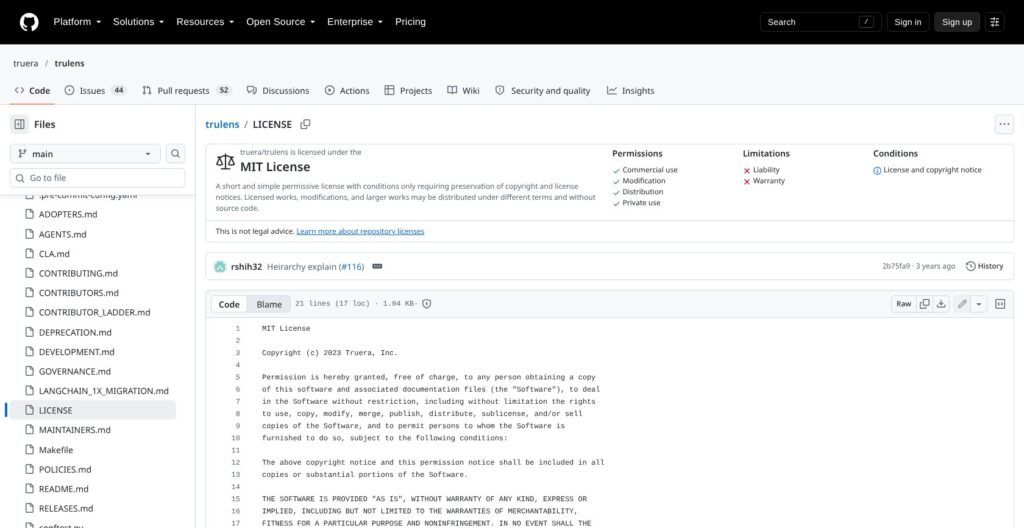
TruLens pricing starts at $0 for the software license. Its operating costs depend on your setup. The cost model is easier to understand as software plus operation, rather than as a choice between SaaS tiers.
- Open-source software: $0 license fee. Suitable for developers who want to use or modify TruLens under the MIT license.
- Self-managed operation: variable cost. Budget for judge inference, infrastructure, storage, and engineering.
- Snowflake integration: usage-based costs. Suitable for existing Snowflake users, with platform consumption and applicable inference charges budgeted separately.
These are cost categories, not TruLens subscription plans.
| Cost component | Pricing basis | Practical implication |
|---|---|---|
| TruLens software | $0 MIT license | No software subscription required |
| Hosted evaluation judge | Provider and model usage | Evaluation inputs and outputs contribute to inference spending |
| Local judge | Your compute and operation | Avoiding a hosted API bill does not eliminate infrastructure cost |
| Self-managed trace storage | Database and infrastructure usage | Retention and trace volume affect resource requirements |
| Snowflake deployment | Usage-based platform charges | Compute, storage, transfer, and applicable feature costs vary |
| Engineering | Internal time or contracted work | Instrumentation and metric maintenance remain your responsibility |
Judge inference is the expense I would watch first. An evaluation can send the question, answer, and retrieved material to another model. Longer contexts and more metrics create more evaluation work, even when the user-facing application has not changed.
For an illustrative workload, 100 answers evaluated against three metrics create 300 metric evaluations. That is not necessarily 300 model calls: implementations can split work differently. It also cannot establish a dollar bill without knowing the model and token usage.
TruLens supports online sampling and throttling, plus a daily evaluation cost cap when the provider reports costs. That cap is not an application-wide budget guarantee. It does not replace budgeting for the application’s own inference or infrastructure.
Storage deserves separate attention. Keeping detailed retrieval context can help diagnosis, but it also increases retained data. I would set a retention policy around investigation needs rather than assume every trace should remain indefinitely.
Is TruLens Good Value for Money?
- Good value for code-owning developers: The license leaves room to invest in application-specific evaluation.
- Less attractive without engineering capacity: Configuration and maintenance can outweigh subscription savings.
- More predictable with a defined scope: A focused set of useful metrics is easier to budget than evaluating everything.
My recommendation is to start with local storage and a bounded evaluation dataset if you are developing a Python RAG application. Add broader production evaluation after establishing which metrics influence decisions. Choose Snowflake first only when its existing environment already fits the intended workflow.
Getting Started With TruLens
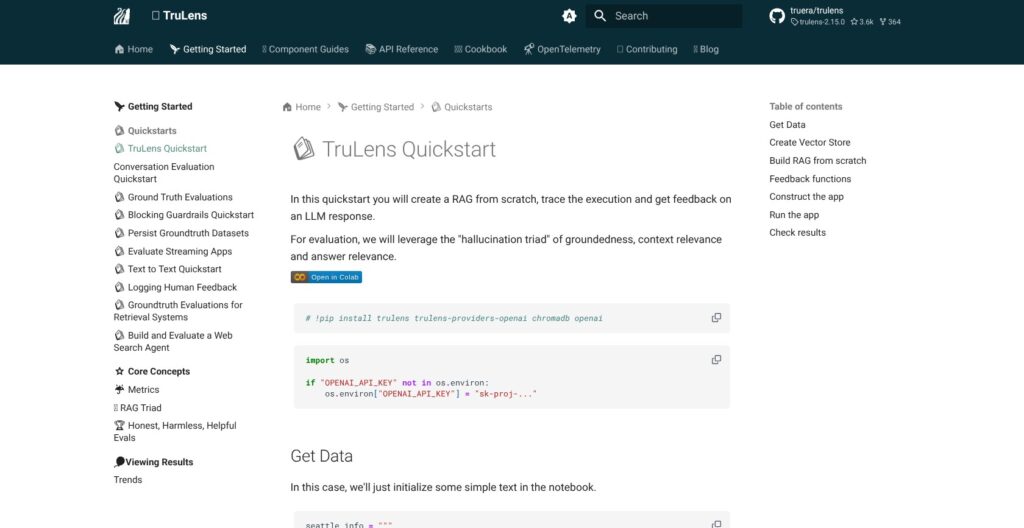
Getting started is a coding task, not a signup flow. The documented quickstart connects an instrumented application to metrics and a dashboard. I would judge setup by the work required to expose meaningful application data, not simply by package installation.
A sensible implementation follows this sequence:
-
Choose storage and a judge. The default local database is
default.sqlitein the working directory. Other SQLAlchemy-compatible databases are supported. Choose the evaluation provider separately, because storage location and inference location answer different questions. -
Install the relevant packages. TruLens needs the packages appropriate to the selected provider and application. The quickstart uses OpenAI and Chroma, but those choices describe that example, not a requirement that every application use the same stack.
-
Instrument the functions that matter. The
@instrumentdecorator records decorated functions. For RAG, retrieval and generation are useful boundaries. Custom attributes expose relevant inputs and outputs so later evaluation has something meaningful to inspect. -
Define metrics and selectors. The current API uses
Metricfor the evaluation definition andSelectormappings for its inputs. In plain English, the selector tells the metric which captured field contains the question, context, or answer. -
Record representative queries. The documented workflow wraps the application with
TruApp. I would include ordinary requests alongside ambiguous questions and cases where the source material cannot support an answer. A collection containing only easy examples gives a narrow picture. -
Inspect records as well as summaries. Launch the dashboard against the configured session and examine individual results. My recommendation is to read the inputs behind a surprising score before treating the score as evidence of an application problem.
-
Compare a changed version. Keep the evaluation dataset and judge configuration stable while changing the application. Otherwise, a score difference may reflect a changed measurement rather than a better answer.
Input mapping is the part I would give the most attention. A groundedness metric needs the material actually supplied to generation, not an unrelated collection of documents. Capturing only the final answer leaves important questions about retrieval unanswered.
That also creates maintenance work. When a function’s output changes, the evaluation mapping may need to change with it. I would keep that mapping close to the application code and review it alongside changes to retrieval or generation.
Older examples may use Feedback. It is deprecated, not removed, and remains available for backward compatibility as a subclass of Metric. For new work, I would follow the current Metric and Selector documentation rather than combine old and new patterns unnecessarily.
Reviewer’s Notes: I would begin with one well-understood application path and a small metric set. Adding more scores before understanding the captured data creates more output, not necessarily more confidence.
Evaluating RAG Answers With TruLens
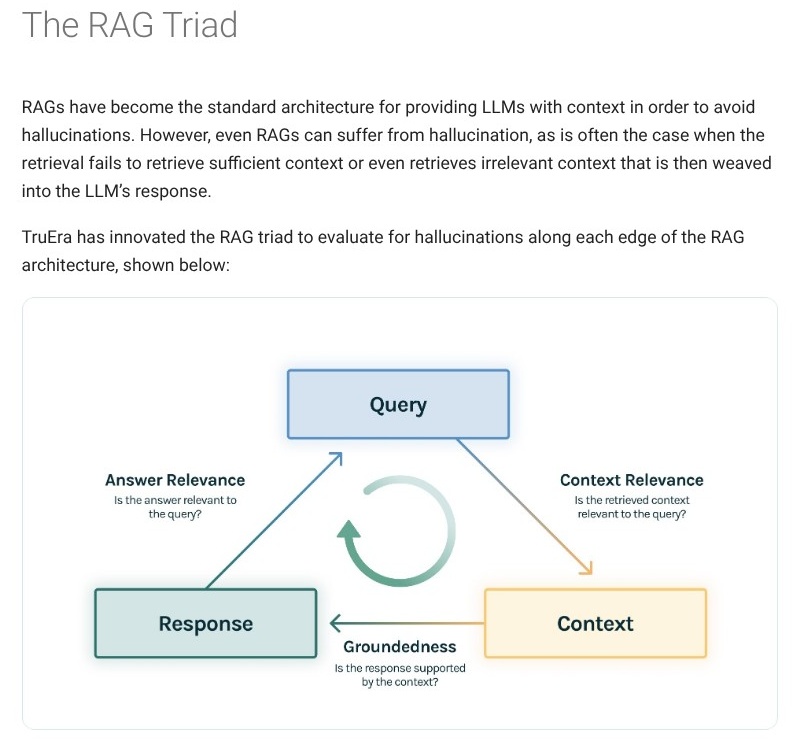
TruLens is useful for separating retrieval problems from answer problems. Its RAG triad measures distinct relationships rather than collapsing everything into one quality judgment:
- Context relevance: Does the retrieved material relate to the question?
- Groundedness: Are the answer’s claims supported by the supplied context?
- Answer relevance: Does the answer address the question?
Imagine a support assistant answering whether an opened product can be returned. Retrieving a shipping policy suggests a retrieval problem. Retrieving the correct returns policy but inventing an exception suggests an unsupported answer. Accurately summarizing that policy without addressing opened products suggests an off-target response.
That separation is more useful to me than a single pass/fail label because it suggests where to investigate. It does not establish the cause automatically.
Groundedness is not universal correctness. An answer can faithfully repeat an outdated policy. The quality of the underlying source material still matters.
I would therefore define the decision the evaluation should support before choosing a threshold. A customer support assistant may need to distinguish between answering from a policy and recognizing that the policy leaves an exception unresolved. Those outcomes should not be treated as interchangeable merely because both mention the right topic.
There is also a difference between finding a regression and authorizing a release. A metric can flag examples that deserve attention without being reliable enough to block deployment automatically. I prefer that narrower role until the judge has demonstrated agreement with domain reviewers on representative cases.
For dataset-first RAG evaluation, Ragas belongs on the shortlist. Its documented workflow centers on datasets, experiments, and metrics. I would lean toward TruLens when the central question is what happened inside the application, and toward Ragas when the evaluation dataset is already the center of the work.
Choosing and Calibrating Your LLM Judge
A configurable judge is valuable only if its judgments fit your requirements. TruLens supports multiple provider routes, including OpenAI, Google, and Bedrock. Local options include Hugging Face classifiers and an Ollama endpoint through LiteLLM.
That flexibility gives you choices about deployment and model spending. It does not establish which judge will be most reliable for your application.
Local logging does not mean local inference. A hosted judge receives the selected evaluation inputs even if traces are stored on your machine. If data must remain within a particular environment, the application model and evaluation model both need an appropriate configuration.
Custom metrics can change the criteria and scoring instructions. They can also use examples, a different score scale, or a different judge model. Some implementations return explanations alongside scores.
I like explanations as an inspection aid. I would not treat them as independent confirmation that the judgment is right.
Before using scores as release gates, my recommendation is to follow a calibration process:
- Create a human-labeled golden set covering the behavior your application needs.
- Separate development and held-out examples so rubric tuning does not consume all independent evidence.
- Establish a fixed baseline with a recorded judge configuration.
- Change one configuration dimension at a time when investigating disagreements.
- Reassess thresholds on held-out cases before relying on pass/fail decisions.
The practical deliverable is not just a metric name. It is a specific judge, rubric, and threshold that people can interpret consistently.
I would also assign someone responsibility for that configuration. If the application changes its purpose, a previously reasonable evaluation may no longer measure the right outcome. Calibration is ongoing ownership, not a setup checkbox, and that work belongs in the adoption decision.
Tracing Agents and Comparing App Versions
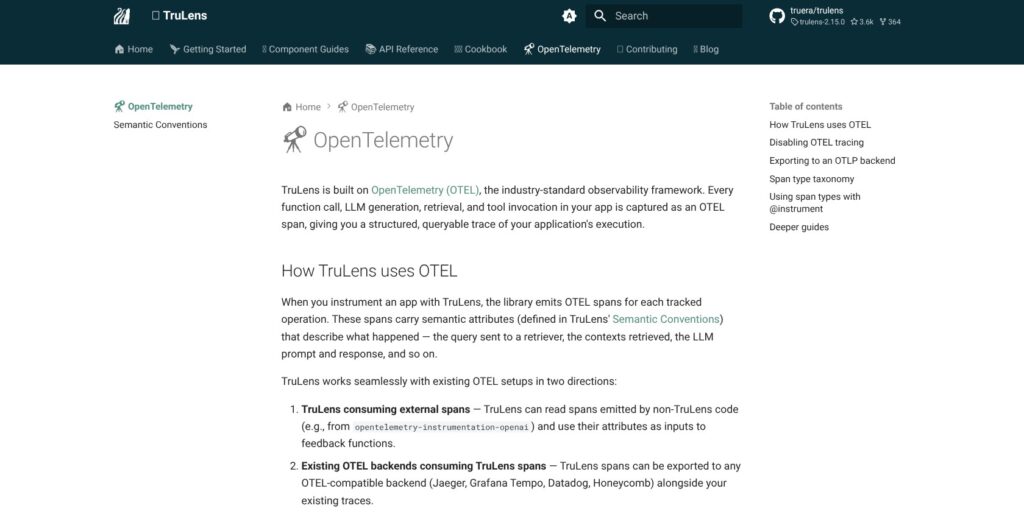
Application traces connect a score to the step worth investigating. TruLens uses OpenTelemetry by default, with instrumentation capturing function-level spans. It can also consume externally created spans, but useful coverage still depends on the data being recorded.
For an agent, I would want a low score to lead back to the relevant step rather than only to the final response. A visible failure may originate in a tool result or an earlier decision. Instrumentation creates the opportunity to investigate; it does not guarantee complete visibility.
The local Streamlit dashboard provides several views:
- Leaderboard: Application-version summaries.
- Records: Individual records and their traces.
- Compare: Side-by-side version analysis.
- Trends: Metrics over time.
My preference is to compare versions using the same questions and evaluation settings. I would inspect changed individual outcomes before accepting an improved average, especially when a small set of high-risk requests matters more than typical performance.
TruLens also supports whole-conversation evaluation, separately from per-turn metrics. The application manages the conversation identifier, and conversation metrics require OpenTelemetry. This matters when an assistant gives individually plausible answers that contradict each other across turns.
Averaging turn scores cannot answer exactly the same question as evaluating the complete ordered conversation. I would use the latter for cross-turn coherence rather than assume strong individual answers imply a coherent exchange.
There is a significant export caveat: OTLP mode replaces database export. The built-in exporter requires the otlp extra and uses gRPC, not HTTP/protobuf. Database-backed dashboard views and evaluations cannot read spans exported only through that route.
For online evaluation, the default WITH_APP_THREAD mode evaluates after a record is produced in the same process. WITH_APP evaluates before return; DEFERRED runs later, while NONE disables evaluation. I would choose deliberately rather than assume evaluation has no effect on the request path.
If the bigger need is a shared place for prompt changes and trace investigation, I would also consider Langfuse. TruLens appeals more to me when code-defined measurement is the primary requirement.
Using TruLens With Snowflake
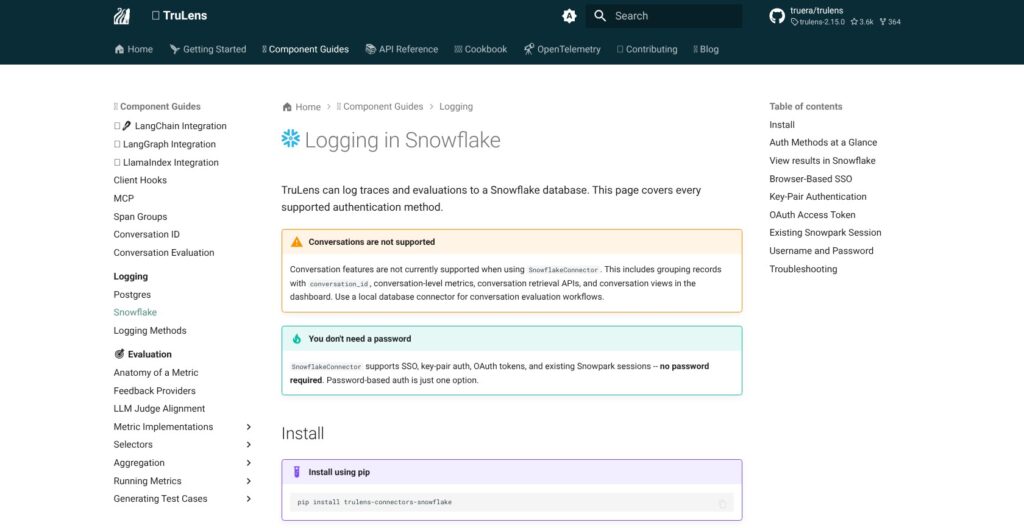
Snowflake is an optional deployment path, not a prerequisite. I would favor it when the organization already wants application evaluation results in that environment, rather than adopt it solely to begin using TruLens.
Custom applications can run on external infrastructure and send traces to Snowflake. Registering the application does not mean its code or every model call moves into Snowflake.
The documented evaluation workflow associates a dataset with an application version, invokes the application, computes metrics, and presents results in Snowsight. That gives existing Snowflake users a place to inspect evaluation runs without treating the local dashboard as the only interface.
However, the interfaces have different features. TruLens SnowflakeConnector currently lacks conversation grouping, conversation-level metrics, conversation retrieval APIs, and conversation dashboard views. Managed Snowsight also lacks the local TruLens dashboard’s Trends time-series views.
My recommendation is to choose the deployment around the evaluation you need. If whole-conversation analysis is central, the connector limitation has more weight than the convenience of keeping results in an existing platform. If versioned dataset evaluation is the priority, Snowflake is a more natural candidate.
How Does TruLens Compare to Alternatives?
Choose by workflow. These TruLens alternatives overlap in capabilities, so I would not reduce the decision to which product “has evals.”
- Ragas: My shortlist choice when datasets and repeatable experiments are the starting point. Its documented primitives include built-in and custom metrics. I would compare it closely with TruLens for offline RAG evaluation.
- DeepEval: My preference when the main requirement is Pytest-compatible assertions and test suites. It also documents agent tracing, so this is a workflow distinction, not a claim that tracing belongs only to TruLens.
- Langfuse: I would favor it for shared prompt versioning, deployment, and observability. Its self-hostable platform connects those activities with evaluation, which may fit a broader AI engineering workflow better.
- LangSmith: I would shortlist it for managed dataset and experiment workflows, especially when human and automated evaluation need to sit together.
| Tool | Documented focus | I would choose it for | Decision point |
|---|---|---|---|
| TruLens | Metrics connected to instrumented applications | Code-owned RAG and agent diagnosis | Will developers own the measurement setup? |
| Ragas | Datasets, experiments, and metrics | Dataset-led evaluation | Is the dataset the center of the workflow? |
| DeepEval | Pytest-compatible tests and assertions | Test-suite-oriented LLM evaluation | Should evals behave like application tests? |
| Langfuse | Prompts, traces, evaluations, and collaboration | Shared prompt and observability operations | Is prompt management equally important? |
| LangSmith | Datasets, experiments, and evaluator workflows | Managed evaluation operations | Does the team need a shared experiment platform? |
I would keep TruLens on the shortlist when the difficult question is why an application produced an answer and developers want control over the measurement. I would choose a rival when the surrounding workflow is the larger problem.
How I Reviewed TruLens
I assessed TruLens against its documented setup, evaluation controls, deployment options, and cost model. I compared alternatives using their documented workflows, with particular attention to developer ownership and the limits that change a buying decision.
I did not execute the product or measure judge accuracy. My recommendations concern workflow fit and documented limits, rather than benchmark results.
Pricing and cost-model information is current as of October 2026.
Should You Use TruLens?
Use TruLens if developers will own evaluation alongside the application. I recommend it for Python RAG and agent projects where scores need to connect to captured behavior, and where configurable metrics matter more than a packaged workflow.
I would not choose it simply because the license is free. The commitment is maintaining instrumentation and deciding whether judge scores represent acceptable behavior. Without that ownership, evaluation can become reporting that nobody trusts enough to act on.
Choose DeepEval for test-suite-first requirements, or Langfuse when shared prompt operations are the stronger need. LangSmith deserves a look for managed dataset and experiment workflows.
For a new TruLens implementation, my recommendation is local storage, representative questions, and a small calibrated metric set. Choose Snowflake when its environment and supported features already match the job. Expand evaluation only when the existing measurements help make concrete product decisions.
TruLens FAQ
Is TruLens free?
The software license is free. TruLens uses the MIT license, which permits use and modification without a license charge. Judge inference and infrastructure can still cost money, and engineering time remains part of operating it. I would budget those separately rather than describe the complete system as free.
Do I need Snowflake?
No. TruLens defaults to local SQLite storage and supports other database configurations. Snowflake is optional. I would choose it for an existing organizational requirement, not because TruLens needs a Snowflake account to work.
Does it stop hallucinations?
No. TruLens can help evaluate and investigate answers, but a score does not prevent an unsupported response. Grounding also depends on the supplied evidence, which may itself be wrong. I would treat evaluation as one quality-control input, not a substitute for trustworthy source material.
Is TruLens suitable for non-developers?
Not as a no-code tool. Its documented setup requires Python instrumentation and metric configuration. Non-developers can contribute domain judgments and help define acceptable answers, but I recommend having a developer responsible for connecting those requirements to the application data and maintaining the evaluation setup.