
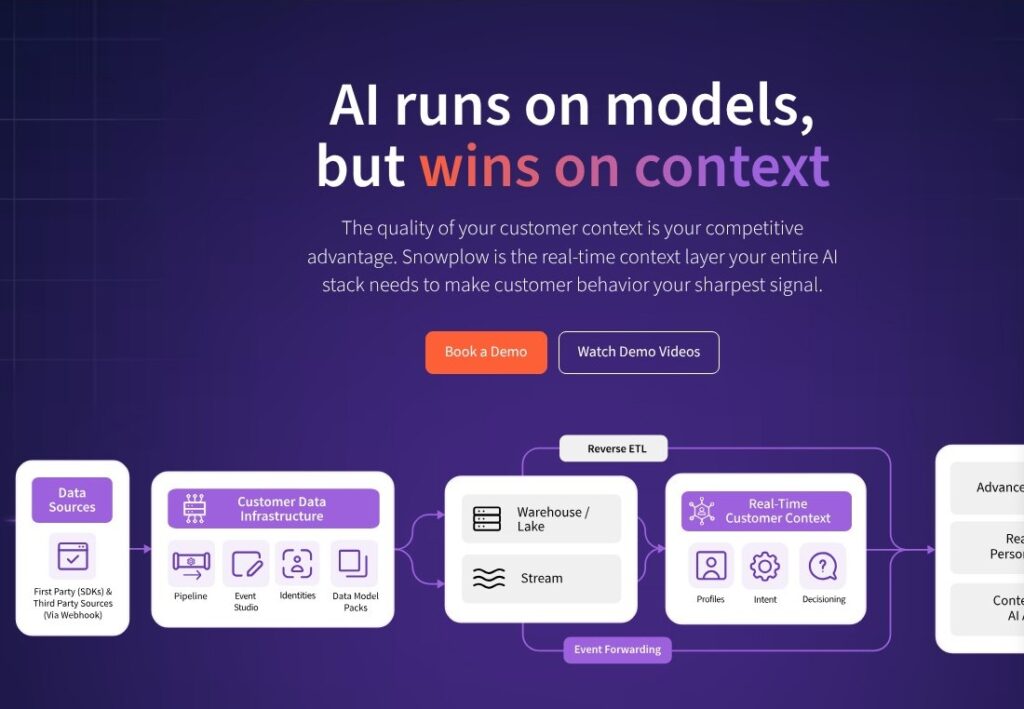
Snowplow is one of the strictest first-party pipelines in event tracking: it checks every behavioral event against a JSON schema, enriches and loads it into Snowflake, BigQuery, Databricks or Redshift, in 10 to 30 seconds for Snowflake and BigQuery by Snowplow’s figures. Its 2026 pitch is “Customer Context Infrastructure” for AI agents.
In this Snowplow review, I’ll take a closer look at Snowplow’s pricing, licensing, features, and how it compares to Twilio Segment, RudderStack and Jitsu, so you can see exactly whether it’s worth a sales call.
Editor’s note: This Snowplow review evaluates the pricing model, license terms, setup path, and documented capabilities of Snowplow CDI (Customer Data Infrastructure) and Signals as of October 2026. It is not a hands-on performance test. I weigh pricing, licensing, data quality, setup, warehouse delivery and AI features.
Quick verdict: I recommend Snowplow for data teams with engineers to spare who want validated, first-party behavioral data in their own warehouse or cloud account. Go in knowing there is no public price, and that since SLULA 1.1 (December 2024) the free Community Edition is non-production only.
Key Takeaways:
- Every event is schema-checked before load; failures never reach atomic.events
- Private Managed Cloud runs the pipeline in your AWS, GCP or Azure account
- No public price beyond a $37,500 AWS Marketplace guide price for 12 months
- Production self-hosting needs a paid license, sold only to existing open-source users
- Signals serves real-time attributes to AI agents, free to 5M events a month
Pros and Cons
Pros
- Every event validated against a JSON schema before it loads
- Private Managed Cloud runs the pipeline in your AWS, GCP or Azure account
- Two dozen-plus trackers and 19 in-stream enrichments, including AI-agent classification
- Snowflake and BigQuery loading in 10 to 30 seconds (Snowplow’s figure)
- Snowtype generates typed tracking code for 10 trackers
- 14-day trial with no card; Signals free up to 5M events a month
Cons
- No public price; the AWS Marketplace guide price is $37,500 a year
- Production self-hosting needs a paid license under SLULA 1.1
- Base CDI allows 5 custom schemas; more needs Event Studio
- Only 5 pre-built forwarders versus 700+ Segment integrations
- Identities, Signals and Data Model Packs are each separate add-ons
How Much Does Snowplow Cost?
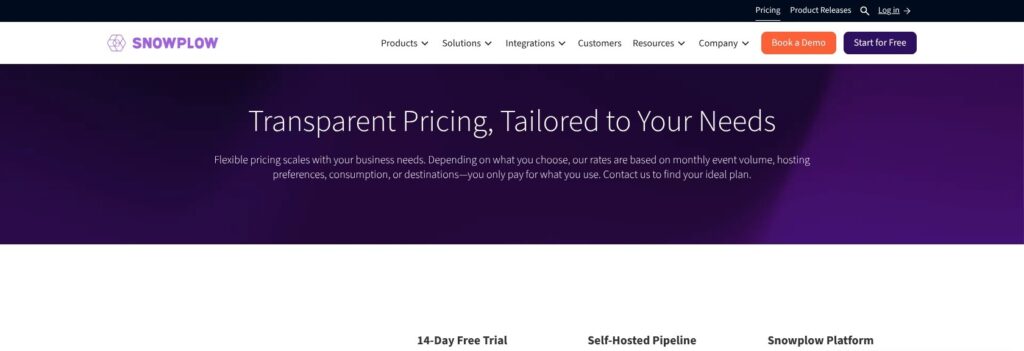
Snowplow pricing is quote-only: none of its offers carries a dollar figure, and rates are “based on monthly event volume, hosting preferences, consumption, or destinations.” The one public number is Snowplow’s own AWS Marketplace listing: a non-cancellable 12-month “BDP Enterprise” contract at a $37,500 guide price, dependent on event volumes, SLAs and support, plus $0.10 per unit of overage. Billing counts each tracked user or agent interaction as one event.
- 14-Day Free Trial ($0): for evaluating the full CDI Cloud product, capped at roughly 20 events per second
- CDI Cloud (quote): for teams that want Snowplow to host the pipeline
- CDI Private Managed Cloud (quote plus your cloud bill): for teams that need data to stay in their own AWS, GCP or Azure account
- Self-Hosted Pipeline (quote): for existing open-source users only, licensing one production pipeline but without Console, Snowtype, Event Forwarding, SSO or SLAs
- Community Edition ($0 license): for non-production evaluation only, at an estimated $200 a month in AWS infrastructure ($240 on GCP) for about 100 events per second
- Signals Free ($0): for testing real-time attributes, with 5M events a month
| Offer | Price | Hosting | Production use | Key limits or extras |
|---|---|---|---|---|
| 14-Day Free Trial | $0, no card | Snowplow’s cloud | 14-day evaluation | About 20 events/second, 1 warehouse, 1 forwarder, 1 Micro, no custom domain |
| CDI Cloud | Quote | Snowplow’s cloud, your warehouse | Yes | Same-day deployment, 24/7 support, unpublished SLAs |
| CDI Private Managed Cloud | Quote plus your cloud bill | Pipeline in your AWS, GCP or Azure account; Console hosted by Snowplow | Yes | Optional High and Advanced security tiers |
| AWS Marketplace contract | $37,500 guide per 12 months | Deployed on AWS | Yes | $0.10 per unit overage, non-cancellable |
| Self-Hosted Pipeline | Quote | Your environment | Yes, one pipeline | Existing open-source users only, no Console |
| Community Edition | $0 license, about $200 to $240/month infrastructure | Your AWS, GCP or Azure account | No | About 100 events/second, test or synthetic data |
| Signals Free | $0, no card | Snowplow shared region | Not published | 5M events a month, 1GB attribute memory |
| Signals paid | Quoted on events and attribute reads | Snowplow-hosted or your cloud | Yes | Dedicated region or your own account |
Event Studio (unlimited custom data structures, custom tracking plans, and JavaScript, SQL and API enrichments), Data Model Packs, Identities, Signals and the High and Advanced security tiers sell separately from base CDI. CDI carries collector uptime and warehouse loading latency SLAs, but Snowplow doesn’t publish the percentages.
Is Snowplow Good Value for Money?
- Good fit: teams that must keep data in their own cloud, and high-reach Segment users: Team ($120/month for 10,000 MTUs, then $10 to $12 per extra 1,000) costs $1,125 a month at 100,000 MTUs and passes $3,125, the monthly equivalent of Snowplow’s AWS guide price, only at about 300,000 MTUs
- Less convincing fit: small sites, since RudderStack Free covers 250K events a month, Jitsu Business is $99/month for 2M, and GA4’s daily BigQuery export is free in the sandbox up to 1M events a day
- Budget priority: on Private Managed Cloud you pay Snowplow plus your own cloud bill, and Snowplow says streaming can reach 60 to 70% of that infrastructure cost at 1B or more events a month
- Hidden cost: every custom event needs a versioned JSON schema and session tables come from dbt models, so budget data engineering time
Reviewer’s Notes: I’d use the 14-day trial to build one tracking plan and confirm events land in my warehouse, then request a quote with three inputs ready: monthly events, hosting model and add-ons such as Event Studio or Signals. I’d open at the $37,500 AWS Marketplace guide price and get the uptime and latency SLA percentages into the Order Form.
Getting Started With Snowplow
Snowplow’s 14-day trial needs no credit card, and a live pipeline arrives in about 20 minutes by Snowplow’s estimate. Here is the path I’d follow to a validated event in my warehouse.
Starting the 14-Day Trial
The sign-up form takes a business email and company domain, plus acceptance of the Trial Agreement and Data Processing Addendum. After email verification, provisioning is automatic, and Console (console.snowplowanalytics.com) has a Getting Started dashboard split into Fundamentals, Analytics and Real-time use cases. I’d treat the trial as a functional test, not a load test, since the collector caps out around 20 events per second.
Building a Tracking Plan and Data Structures
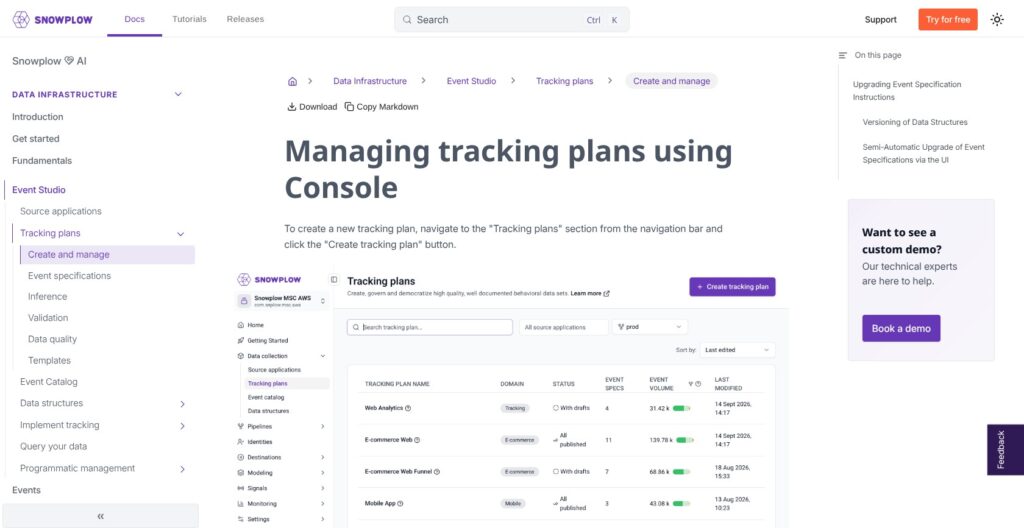
The Create tracking plan dialog offers E-commerce Web (11 events), Base Web (5) and Media Web (24) templates, or a blank plan. Each data structure is a self-describing JSON Schema with an Iglu URI such as iglu:com.acme/checkout_funnel/jsonschema/1-0-0, built from String, Enumerated list, Integer, Decimal and Boolean fields, with a JSON editor for nesting. Drafts validate nothing until they’re deployed to a development environment, and versions follow MODEL-REVISION-ADDITION numbering. Base CDI caps custom data structures at 5; more needs Event Studio.
Sending and Testing My First Events
For a web app, I’d run npm install @snowplow/browser-tracker, call newTracker with a tracker name, the collector URL and an app ID, then add trackPageView() and enableActivityTracking() for page pings. For typed tracking, npm install --save-dev @snowplow/snowtype@latest, npx snowtype init and npx snowtype generate write one file of typed functions for every event specification; Snowtype needs Node.js 18+ and a Console API key with View permission.
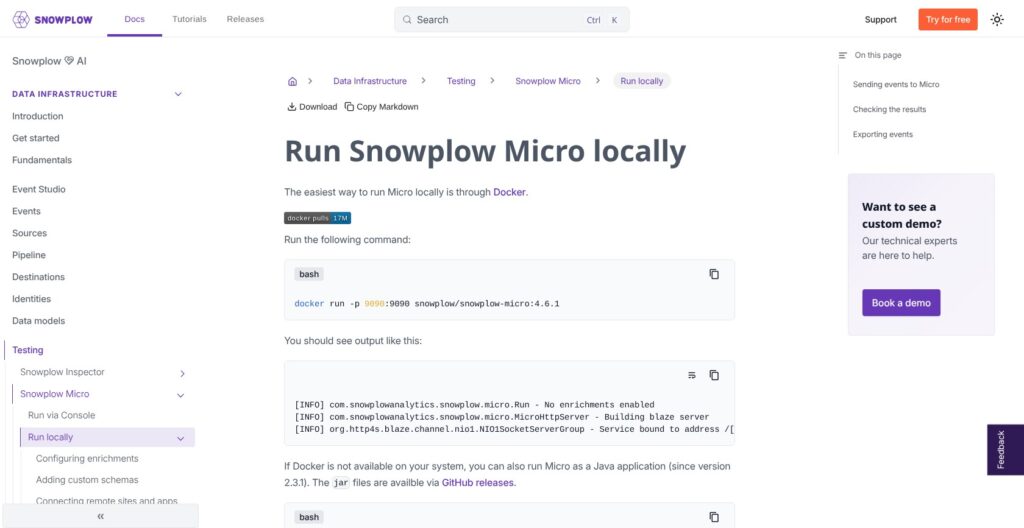
To test locally, I’d start Snowplow Micro with docker run -p 9090:9090 snowplow/snowplow-micro:4.6.1 and open its UI at localhost:9090/micro/ui, with valid and failed events at /micro/good and /micro/bad. Console development environments do the same job in the cloud with a rolling 7 days of events, and the Snowplow Inspector extension adds a Snowplow tab to DevTools in Chromium browsers.
Checking the Warehouse and Failed Events
Valid events land in atomic.events, one wide row per event, with custom events and entities as extra columns; Redshift splits them into separate joined tables. Snowplow has no pass-with-warning or autocorrection mode, so an event that breaks its schema never reaches atomic.events and shows up in Console’s data quality view instead.
Reviewer’s Notes: I’d install Inspector and run Micro before touching production, so schema mismatches surface locally instead of as gaps in atomic.events. I’d also settle who approves a backward-compatible 1-0-1 versus a breaking 2-0-0 before the first deploy, because an event that references a schema version nobody deployed becomes a failed event.
Event Studio, Schemas, and Data Quality
Snowplow validates every event against its schema before load and quarantines failures, so atomic.events only holds events that match a deployed data structure.
🧩 Tracking Plans and Event Specifications
Snowplow renamed Data Product Studio to Event Studio and Data Products to Tracking Plans on February 2, 2025. Each tracking plan holds event specifications with triggers and per-property instructions for developers, plus a 30-day data quality view of valid, inferred, violating and failed events. In 2026, event specifications gained:
- Specification inference (March 3, 2026)
- Specification validation (May 6, 2026), with results attached as an entity and landed in the warehouse, for events implemented with the latest Snowtype version
- Pre-publish testing of specifications in development environments (September 17, 2026)
- Validation counts per tracking plan in Console (September 22, 2026)
For git-based review flows, the Snowplow CLI (brew install snowplow/taps/snowplow-cli) pulls data structures and tracking plans down as YAML or JSON and publishes them back to Console.
🚦 Validation and Failed Events
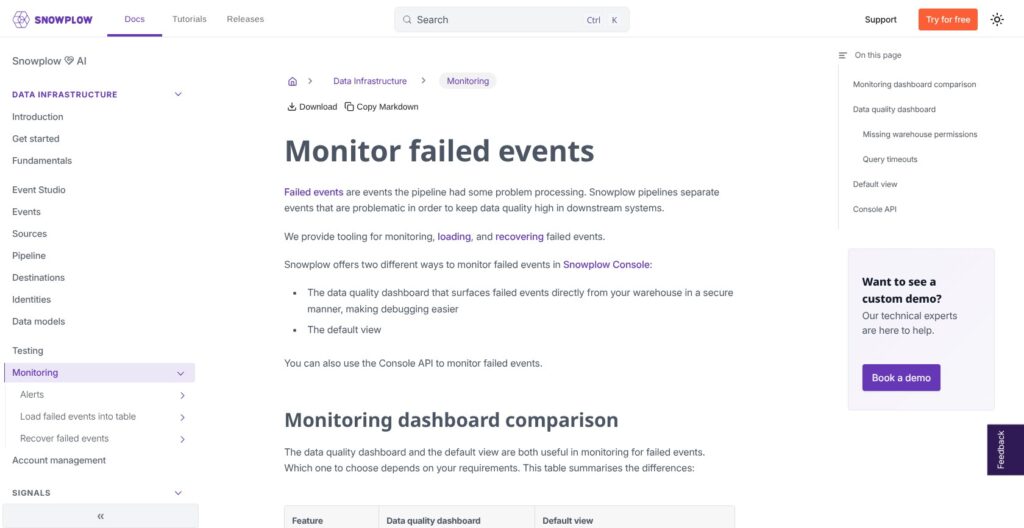
Snowplow’s failed events cover collection, validation, enrichment and, rarely, loading. The Data Quality Dashboard works only on Snowflake and BigQuery with a Failed Events Loader; every other warehouse gets an aggregated view with redacted error messages. Threshold-based failed-event alerts arrived on November 6, 2025. Snowplow calls replay a complicated process mainly reserved for internal failures and outages, and continuous failed-event loading isn’t retroactive, so failures from before it’s switched on never reach the table.
Segment sells its equivalent, Protocols, as an add-on to its Business-tier pipeline, and RudderStack Free allows 1 tracking plan with 5 events. Regulated and analytics-heavy teams get a warehouse that only holds valid rows; teams shipping new events daily without a schema owner will find the same strictness slows them down.
Trackers, Enrichments, and Warehouse Loading
Snowplow’s tracking sources cover 11 client-side options (Web, iOS, Android, React Native, Flutter, Roku and WebView among them), 12 server SDKs including Node.js, Python, Go, Java, .NET, Rust and Lua, and 7 webhooks. Enrich 6.13.1 shipped on August 21, 2026, stream-collector 3.8.0 on September 25, 2026, and the iOS 6.3.1 and Android 6.4.2 trackers on October 12, 2026, so the stack is actively maintained.
🛰️ Trackers and First-Party Collection
The JavaScript tracker sits at 4.10.2 (September 9, 2026) under BSD-3, while some server trackers move slower: the Python tracker’s last release, 1.1.0, shipped in February 2025. Snowplow says its Cookie extension service and a first-party collector domain keep users identifiable for up to 2 years despite ITP, though custom domains aren’t in the trial.
🧪 19 In-Stream Enrichments
Enrich applies up to 19 current enrichments in a fixed order, including:
- IAB spiders and bots detection and YAUAA user-agent parsing
- IP Lookup via MaxMind and Campaign Attribution
- PII Pseudonymization and IP Anonymization
- Agent Classification, which tags AI crawlers by operator and purpose, such as OpenAI with
AI_TRAINING - Bot Detection (April 17, 2026), which merges plugin, ASN, YAUAA and IAB signals into one bot entity
JavaScript, SQL and API enrichments sit in Event Studio and have no UI or API on Self-Hosted. New enrichments such as Bot Detection aren’t switched on automatically, and IP-based bot detection doesn’t work on events with server-side IP anonymization.
🏔️ Warehouse, Lake, and Stream Destinations
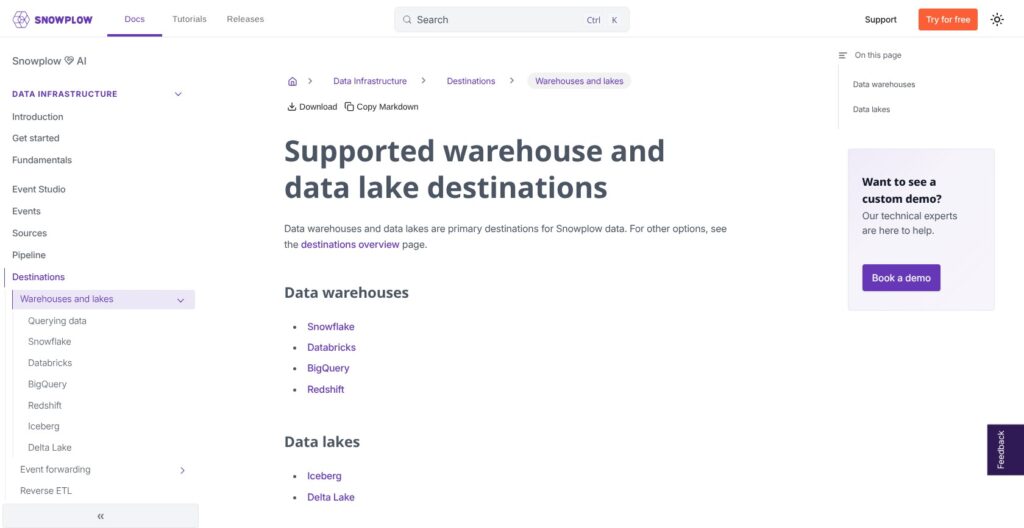
| Destination | Loader | Clouds | Snowplow’s latency claim |
|---|---|---|---|
| Snowflake | Snowpipe Streaming | AWS, Azure, GCP | 10 to 30 seconds |
| BigQuery | Storage Write API | AWS, GCP | 10 to 30 seconds |
| Databricks | Streaming Loader (Preview since October 2, 2025) | AWS, Azure, GCP | Sub-minute |
| Redshift | RDB Loader (COPY INTO) | Not published | Not published |
| Iceberg, Delta Lake | Lake Loader | Iceberg on AWS and GCP; Delta on all three | Not published |
| Kinesis, Pub/Sub, Kafka or Event Hubs | Enriched stream | The pipeline’s cloud | Sub-second |
Snowplow says its Snowflake Streaming Loader cut latency 100x and operating costs 80% compared with batch loading. A lake has to sit in the same cloud as the pipeline, and Delta Lake with Databricks isn’t supported on AWS pipelines. Segment syncs warehouses once a day on Free and twice a day on Team, and RudderStack every 3 hours on Free.
Data Models, Identities, and Event Forwarding
Snowplow ships five core dbt packages (Unified Digital, Media Player, Ecommerce, Attribution and Agent Analytics) plus the Normalize and Utils utilities; most reached v1.0.0 in 2026, v1.x needs dbt Core 1.10.6 or later, and none is officially supported on dbt Fusion.
📊 dbt Data Models
Unified Digital builds snowplow_unified_views, snowplow_unified_sessions, snowplow_unified_users and snowplow_unified_user_mapping on BigQuery, Databricks, Redshift, Snowflake, Postgres or Spark. In CDI, Console configures and schedules these dbt projects, and auto-generated models tailored to a tracking plan reached GA on October 9, 2025. The packages come under a mix of licenses, and commercial use is sold as Data Model Packs.
🪪 Identities
Identities reached GA on April 9, 2026: deterministic identity resolution runs during enrichment, stamps a persistent snowplow_id on every event and emits an identity_merge event on each merge. It’s an optional add-on on Cloud and on AWS or GCP Private Managed Cloud, not Azure. Segment’s identity resolution needs a CDP plan, and RudderStack’s Profiles is Enterprise-only.
📤 Event Forwarding
Event Forwarding went GA on October 15, 2025, running managed Snowbridge apps on AWS or GCP that filter and map events with JavaScript and, per Snowplow, deliver them in seconds. Pre-built forwarders cover Amplitude, Bloomreach, Braze, Meta Conversions API and Mixpanel, with Google Tag Manager Server Side as the route to anything else, against Segment’s 700+ integrations. Reverse ETL (powered by Fivetran) and Audience Hub (powered by Census) are maintained only for customers with active implementations. Skip Snowplow if your marketers need a built-in audience builder.
Signals and AI Features
Snowplow Signals (GA September 30, 2025) computes attributes from the live stream in under a second and serves them at 6 ms p50 and 10 ms p95 in-region on Snowplow’s benchmark, on AWS and GCP only.
⚡ Signals Attributes and Interventions
- Attribute groups are keyed on IDs such as
domain_useridand computed from the live stream or from warehouse tables synced hourly by default - Interventions fire rule-based actions, such as a discount on an abandoned high-value cart, while agentic contexts hand an AI agent recent session activity
- Access comes through the Python SDK (snowplow-signals 0.4.9, Python 3.11+), a Node.js SDK or REST, with tutorials for AWS Bedrock AgentCore, Vercel AI SDK and Google ADK
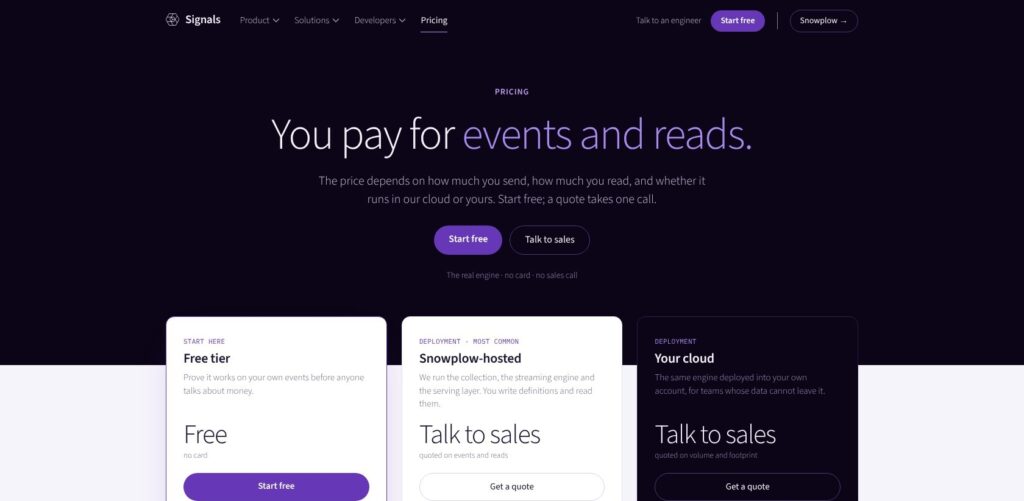
Beyond the free 5M events a month, Signals tiers are quoted on events and attribute reads, and events that fail validation still count; inside CDI, Signals is a paid add-on.
🤖 Snowplow Assistant and MCP Server
A remote MCP server went live on May 28, 2026, the in-Console Snowplow Assistant rolled out the following week, and npx plugins add snowplow/skills adds six skills for Claude Code and Cursor. The Assistant is opt-in for Event Studio customers, acts with the user’s Console permissions, sends message content to a third-party LLM and has weekly token limits.
🕵️ Agent Traffic Analytics
Cloudflare and CloudFront CDN trackers log AI crawlers that never run JavaScript; with Agent Classification and the Agent Analytics dbt package, they compare the pages each AI platform requests with the human sessions it refers back. For existing Snowplow teams, Signals and the agent tooling are worth testing; neither justifies adopting the pipeline alone.
Licensing, Self-Hosting, and Security
On January 8, 2024, Snowplow moved its core pipeline to the source-available Snowplow Limited Use License Agreement (SLULA), which now covers Collector 3.0.0+, Enrich 4.0.0+, Iglu Server 0.12.0+, the loaders and Snowbridge 2.4.0+. SLULA 1.0 barred highly available production use; SLULA 1.1 (rolled out December 2024) allows only non-production use on test or synthetic data, or non-commercial research and teaching, so even a volume test on live website traffic needs a commercial license, and the Self-Hosted Pipeline license is sold only to existing open-source users.
Tracker SDKs and GTM templates stay Apache 2.0, while most dbt models fall under a Personal and Academic License. In April 2025, Snowplow disclosed 5 CVEs in pre-2024 releases, 4 of them critical denial-of-service flaws, with fixes only in SLULA-licensed versions. OpenSnowcat is an Apache 2.0 fork of the pre-change components, maintained by the founder of SnowcatCloud, a Snowplow-compatible hosting vendor. RudderStack’s rudder-server is Elastic License 2.0, Jitsu is MIT, and PostHog is MIT outside its ee/ directory.
- Certifications: SOC 2 Type 2, ISO 27001 and ISO/IEC 42001:2023
- Health data: HIPAA-eligible with a Business Associate Addendum
- Access control: SAML SSO with nine named identity providers, including Okta and Microsoft Entra ID
- In-stream privacy: PII pseudonymization and IP anonymization
- Encryption: customer-managed AWS KMS keys
How Does Snowplow Compare to Competitors?
In any Snowplow vs Segment or Snowplow vs RudderStack decision, Snowplow’s edge is the combination: every event validated against a versioned schema before load, and a pipeline that can run in your own cloud account.
- Twilio Segment: best for routing events to SaaS tools without running infrastructure. Free covers 1,000 MTUs, Team starts at $120/month for 10,000 MTUs, and 700+ integrations ship ready, but Protocols governance is an add-on.
- RudderStack: best as a warehouse-first Segment replacement with published prices. Free covers 250K events a month, Growth is $265/month at 1M, and rudder-server self-hosts under the Elastic License 2.0.
- mParticle: best for large consumer brands that want a managed enterprise CDP with identity and activation. It lists 300+ native integrations, pricing is quote-only, and mParticle announced a merger with Rokt in January 2025.
- Hightouch Events: best for teams already using Hightouch for reverse ETL and audiences. It prices on event count, offers Segment- and RudderStack-compatible SDKs and writes events to your warehouse.
- Jitsu: best for small teams that want a cheap router without a schema registry. It’s MIT-licensed, Business is $99/month for 2M active events, and Jitsu itself concedes Snowplow’s built-in validation is ahead.
- PostHog: best when analytics, replay and flags in one SDK matter more than a standalone pipeline. The first 1M analytics events a month are free, then from $0.00005 per event, with batch exports to BigQuery and Snowflake.
- GA4 BigQuery export: best for GA4 sites that only need raw events in BigQuery. The daily export is free in the BigQuery sandbox, capped at 1M events a day on standard properties, and streaming costs $0.05 per GB.
| Tool | Entry price | Billing unit | Self-host / license | Schema validation | Best for |
|---|---|---|---|---|---|
| Snowplow | Quote ($37,500 AWS guide per 12 months) | Events | SLULA 1.1, production needs a license | Every event, versioned JSON Schema | Validated first-party data in your cloud |
| Twilio Segment | Free; Team $120/month | MTUs | Hosted service | Protocols add-on | Routing to SaaS tools |
| RudderStack | Free to 250K events; Growth $265/month | Events | rudder-server, Elastic License 2.0 | Tracking plans (1 on Free) | Warehouse-first Segment replacement |
| mParticle | Quote only | Not published | Not published | Not published | Enterprise CDP |
| Hightouch Events | Not published | Events | Not published | Data contracts | Existing Hightouch users |
| Jitsu | Free to 200K active events; Business $99/month | Active events | MIT | User-written function | Cheap event routing |
| PostHog | 1M events free monthly | Events | MIT outside ee/ | Not published | All-in-one product analytics |
| GA4 BigQuery export | Free in sandbox, 1M events/day cap | GB (streaming) | Google-hosted | Not published | Raw GA4 data in BigQuery |
Pick Snowplow if validated events in your own warehouse or cloud account matter more than price transparency; pick Segment for SaaS routing, RudderStack or Jitsu for published prices, and the GA4 export if raw GA4 data in BigQuery is all you need.
How I Reviewed Snowplow
I judged Snowplow on five areas: pricing and licensing, data quality and governance, setup effort, warehouse delivery and modeling, and real-time and AI features.
For pricing and licensing, I went through the trial terms, the four deployment options, the add-ons, the AWS Marketplace contract and the SLULA 1.1 terms, and compared the costs with published rates from Segment, RudderStack, Jitsu, PostHog and GA4. For setup and governance, I mapped the path through Console, data structures, the browser tracker, Snowtype, Micro and Inspector. I also weighed warehouse loading, the dbt packages, Event Forwarding, Identities, Signals, the AI tooling and release activity across the pipeline, treating every latency figure as Snowplow’s own.
This is not a hands-on performance test, so I make no claims about throughput or latency on my own workloads.
Prices current as of October 2026.
Should You Choose Snowplow for Event Tracking?
Yes, if you run a data team with engineering capacity and want validated first-party behavioral data in Snowflake, BigQuery, Databricks or Redshift. Regulated teams that need the pipeline inside their own AWS, GCP or Azure account get it through Private Managed Cloud, and high-reach sites trade Segment’s per-user MTU billing for event-based pricing.
Skip it if you need published prices, since RudderStack at $265/month for 1M events or Jitsu at $99/month for 2M are far easier to budget. Marketers who need hundreds of SaaS destinations and audiences will get further with Segment’s 700+ integrations, and anyone who wants a free production self-hosted pipeline should look at Jitsu’s MIT edition, because SLULA 1.1 no longer allows one on Snowplow.
My next step would be to start the 14-day trial, build a Base Web tracking plan, send events through Micro and then the trial pipeline into my warehouse, and request a quote with event volume and hosting model in hand, anchored on the $37,500 AWS Marketplace guide price.
FAQs
Is Snowplow free?
Not for production. Snowplow offers a 14-day CDI Cloud trial with no credit card, Signals is free up to 5M events a month with 1GB of attribute memory, and Community Edition is free to download but licensed for non-production use only. Production pipelines, hosted by Snowplow or in your own cloud, are quoted on event volume, hosting, consumption and destinations.
Is Snowplow open source?
Partly. The tracker SDKs are Apache 2.0 (the JavaScript tracker is BSD-3), but the Collector, Enrich, Iglu Server, loaders and Snowbridge sit under the source-available SLULA, introduced on January 8, 2024, and version 1.1 allows only non-production or non-commercial use. OpenSnowcat is an Apache 2.0 fork of the pre-change pipeline components.
How much does Snowplow cost?
Snowplow publishes no price. The only public figure is its AWS Marketplace listing: a 12-month contract at a $37,500 guide price, or $3,125 a month, plus $0.10 per unit of overage. Quotes depend on monthly event volume, hosting model (Cloud or Private Managed Cloud) and add-ons such as Event Studio, Identities and Signals.
What is the difference between Snowplow and Segment?
Snowplow is a schema-validated pipeline that loads behavioral data into your own warehouse and can run in your own cloud account. Twilio Segment is a hosted router with 700+ integrations, priced on monthly tracked users, and its Team plan starts at $120/month for 10,000 MTUs. I’d choose Snowplow for data quality and ownership, Segment for routing to SaaS tools.
What is Snowplow Signals?
Snowplow Signals computes real-time customer attributes from the event stream and serves them to apps and AI agents, with interventions for rule-triggered actions. It reached general availability on September 30, 2025, runs on AWS and GCP, and serves attributes at 6 ms p50 on Snowplow’s benchmark. The free tier covers 5M events a month; paid tiers are quoted.