
Treasure Data is an enterprise customer data platform (CDP) with 170+ connectors, key-based identity unification, and a Hybrid CDP that runs on managed storage or on Snowflake, Databricks and BigQuery. On April 20, 2026, the company renamed itself Treasure AI and now sells an “Agentic Experience Platform”; treasuredata.com redirects to treasure.ai, but the legal entity is still Treasure Data, Inc., so I use Treasure Data for the CDP and Treasure AI for the company.
In this Treasure Data review, I’ll take a closer look at Treasure Data’s pricing, features, and how it compares to Segment, mParticle, Tealium, RudderStack and Hightouch, so you can see exactly whether it belongs on your shortlist.
Editor’s note: This Treasure Data review covers pricing, setup and capabilities as of October 2026, weighing pricing transparency, identity resolution, warehouse fit, activation, real-time performance, platform limits and security.
Quick verdict: I recommend Treasure Data for large enterprises with multi-brand customer data and a Snowflake, Databricks or BigQuery estate that want a managed identity graph without metered compute. Go in knowing that pricing is quote-only, the docs now span two domains, and queries stop at a hard 6-hour cap.
Key Takeaways:
- No Compute pricing bills mainly on unified profiles and events, not queries or activations
- Complete and Composable modes run on Treasure’s managed storage or on Snowflake, Databricks and BigQuery
- Real-Time 2.0 targets a 100 ms p95 for the Personalization API, with 2,000 events per second default ingestion
- No list prices or self-serve tier: evaluation starts with a two-week proof of concept
- AI costs stack on top: each AI Suite is a separate annual license, and AI Credits have no published rate
Pros and Cons
Pros
- SOC 2 Type 2, ISO 27001 and 27701, plus HIPAA with a BAA on request
- Five hosting regions, including Frankfurt, Tokyo and Seoul
- Composable mode runs on Snowflake, Databricks or BigQuery
- Iceberg tables give Snowflake, Databricks and BigQuery zero-copy reads
- Personalization API targets a p95 of 100 ms or less
- No Compute pricing leaves queries and activations unmetered
Cons
- Quote-only pricing, with no list prices or self-serve tier
- Treasure AI rename split the docs across two domains
- Queries stop at a hard 6-hour runtime cap
- ID Unification forces a full refresh every 3 days
- Real-time profile key cannot change after enablement
How Much Does Treasure Data Cost?
Treasure Data publishes no price list, tier amounts or AI Credit rate, so every contract is a quote. Its “No Compute” model, announced August 13, 2025, charges mainly on the number of unified customer profiles and the volume of behavioral events tied to them, such as website visits, app usage and email activity. Queries, segmentations and activations are unlimited, and compute isn’t metered whether it runs in Treasure’s engine or in your own warehouse.
- Intelligent CDP subscription (Quote only): for every customer, an annual fee sized on unified profiles and behavioral events
- AI Suites (Quote only): for teams adding agentic marketing, a fixed annual license per suite on top of the CDP, with no need to buy all five
- AI Credits (Quote only): for AI-driven actions, metered by use; Treasure AI Studio is free to access, and one credit covers 600 Studio conversations
- Treasure Code CLI ($0): for data engineers who manage CDP configuration as code, usable without any AI features
- Two-week proof of concept (cost not published): for buyers testing on their own data, covering profile unification, data cleaning, segmentation and predictive scoring
The CDP Trade-Up program lets qualified companies leaving another CDP start paying only when the old contract ends, with a Migrator Toolkit that targets a cutover in as little as one month. ESP or CEP replacements get the Engagement AI Suite free for 12 months on a 3-year commitment, 18 months on a 4-year and 24 months on a 5-year.
| Component | How it is charged | Published figure |
|---|---|---|
| Intelligent CDP subscription | Annual, based on unified profiles and behavioral events | Quote only |
| Compute (queries, segments, activations) | Not metered, in Treasure’s engine or your warehouse | Unlimited |
| AI Suites | Fixed annual license per suite | Quote only |
| AI Credits | Usage-based, for AI-driven actions | 600 Studio conversations per credit; dollar rate Quote only |
| Treasure AI Studio | Free access, usage billed in AI Credits | $0 access |
| Treasure Code CLI | Free; the Claude-powered mode bills AI Credits | $0 |
| Two-week proof of concept | Requested on treasure.ai | Not published |
| AI Suites after an AI Workshop | Offer for customers and qualified companies | Free for 60 days |
| Engagement AI Suite (ESP/CEP replacement) | 3-, 4- or 5-year commitment | 12, 18 or 24 months free |
| CDP Trade-Up | Billing starts when your current CDP contract ends | Qualification not published |
Is Treasure Data Good Value for Money?
- Strong for query-heavy teams: compute isn’t metered, so large segment rebuilds don’t raise the Treasure bill, although Composable mode still runs those queries on your Snowflake, Databricks or BigQuery account
- Hard to budget against published rivals: RudderStack lists Free at 250K events a month and Growth at $265 a month, and Segment offers a free trial with no credit card
- No worse than mParticle or Tealium: both are quote-only too, so the real comparison is quote against quote at the same data volume
- AI is a second budget line: each AI Suite is its own annual license and AI Credits are metered, so a CDP-only quote understates the cost of the agentic features Treasure AI now leads with
- Savings claims are vendor-reported: Treasure says Six Flags saved over $1 million through tech consolidation and a retailer leaving Amperity projects over $3 million across multiple years, with no published method
Reviewer’s Notes: I’d book the two-week proof of concept on my own data and ask for the profile and event cost analysis in writing, with the CDP and each AI Suite as separate lines. If I already ran Snowflake, Databricks or BigQuery, I’d get Complete and Composable modes priced side by side, since Composable moves query cost onto the warehouse bill. For an ESP replacement, I’d take the 3-year Engagement AI Suite term with 12 free months before committing five years for 24.
Getting Started With Treasure Data
Treasure Data has no self-serve sign-up or free tier, so my starting point would be the two-week proof of concept; Segment and RudderStack, by contrast, let a team begin on a free trial or free plan.
[Screenshot needed: treasure.ai request-poc page describing the two-week CDP proof of concept] Treasure AI’s evaluation path starts with a proof of concept request rather than a sign-up form. Source: Treasure AI.
Starting an Evaluation
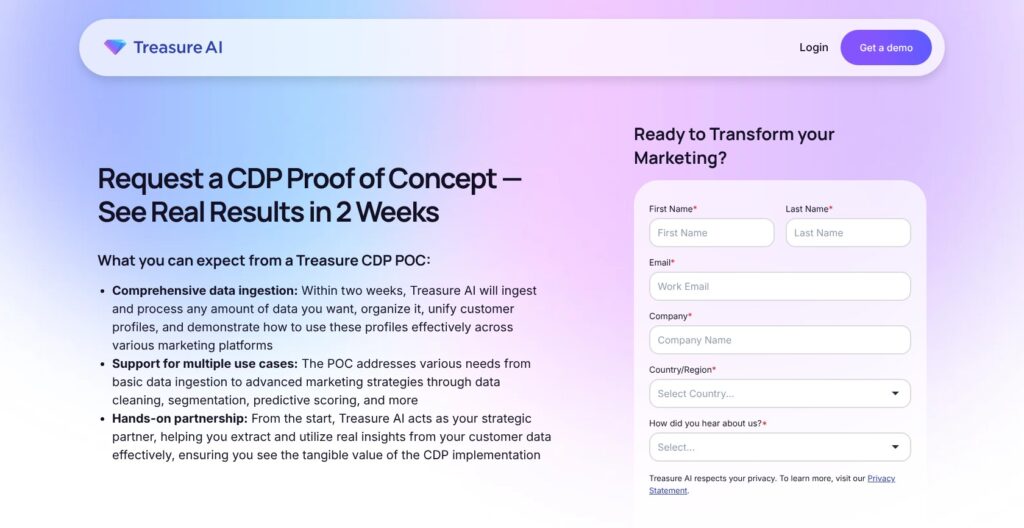
The proof of concept turns your data, at any volume, into unified profiles and covers data cleaning, segmentation and predictive scoring, with Treasure’s team supporting the setup. Customers and qualified companies can instead take an expert-led AI Workshop, which unlocks the AI Suites free for 60 days with the goal of launching one agent on AI Agent Foundry in that window. Docs now sit on both docs.treasuredata.com and docs.treasure.ai with slightly different versions of the same pages, so I’d work from the treasure.ai set.
Connecting Data
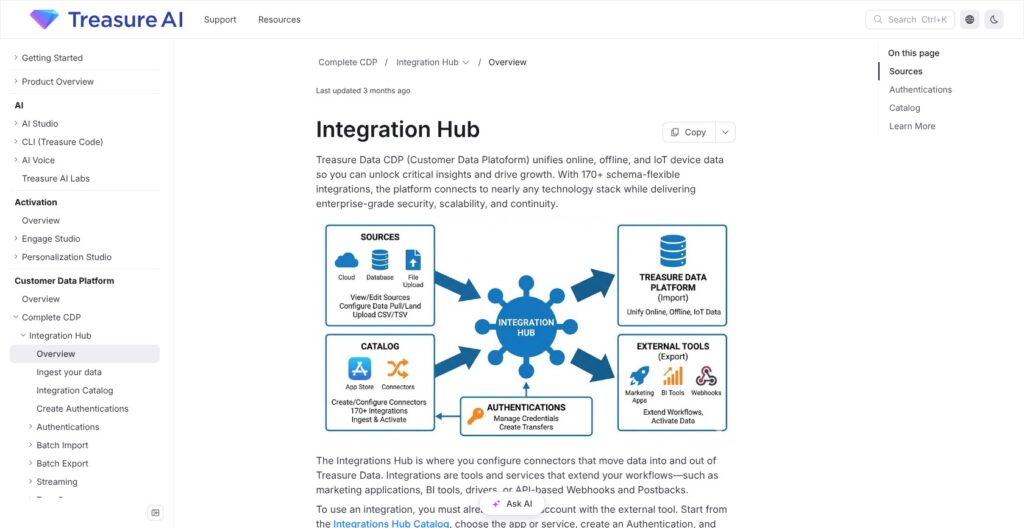
Integration Hub lists 170+ schema-flexible integrations across marketing applications, BI tools, drivers, and API-based webhooks and postbacks. Each source starts with an Authentication and then a recurring transfer, many connectors can also be defined in YAML, and integrations without a UI go through Bulk Import, drivers or webhooks. Real-time events must arrive through the JavaScript SDK v4+, Mobile SDK v1+ or the Ingestion API, at a default ceiling of 2,000 events per second and up to 500 events per request.
[Screenshot needed: docs.treasure.ai Integration Hub page showing the connector types and the 170+ integrations figure] Integration Hub groups connectors into marketing apps, BI tools, drivers and webhooks. Source: Treasure AI.
Unifying Identities
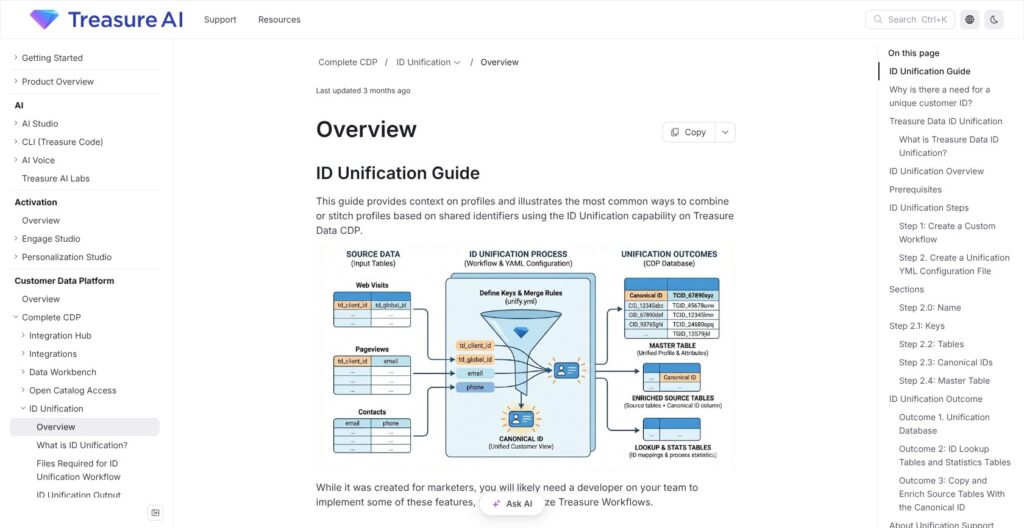
ID Unification runs as a YAML-configured job at the end of a custom Treasure Workflow. I’d list keys such as td_client_id, td_global_id and email in merge_by_keys priority order, and use do_not_merge_key for shared identifiers that shouldn’t merge profiles, though activity on that key is copied to every linked profile. First name, IP address, VIN and home address make poor keys, since a good key identifies exactly one entity.
The caps are 32 key columns, 255 source tables and 32-character key names. A full refresh runs every 3 days regardless of settings, and removed records linger in incremental runs until it does.
[Screenshot needed: docs.treasure.ai ID Unification page showing a YAML configuration with merge_by_keys] ID Unification is configured as YAML inside a Treasure Workflow. Source: Treasure AI.
Building a Parent Segment and Segments
Every segment hangs off a parent segment (formerly a master segment), which must exist first. From there, I’d pick the parent segment, right-click it, choose Create New Batch Segment, add demographic or behavioral rules and preview the audience size. The Audience API covers parent segments, segments, activations, predictive segments and journeys, but creating audiences, segments, folders and syndications still runs through the Legacy Audience API.
Activating
Activation is a right-click on the target segment: Create Activation, an output mapping (all columns, selected columns, or values such as segment ID), a schedule, then Create. Activation templates cover Google Ads, Facebook and Salesforce, and Journey Orchestration adds batch and real-time journeys built from wait, condition and action nodes.
Reviewer’s Notes: I’d settle the profile key before switching on real-time, because it can’t be changed once real-time is enabled. During the proof of concept, I’d also run ID Unification as a full refresh and query canonical_id_lookup for IDs mapped to more than one canonical ID, which can mean more merge iterations are needed.
Complete vs Composable: Where the Data Lives
Since August 2025, Treasure Data’s Hybrid CDP has run in two modes: Complete, where Treasure’s own engine is the source of truth, and Composable, where Snowflake, Databricks or BigQuery holds the data and Treasure acts as a real-time cache for activation and AI.
| Complete mode | Composable mode | |
|---|---|---|
| Source of truth | Treasure’s managed storage | Your Snowflake, Databricks or BigQuery |
| Existing warehouse needed | No | Yes |
| Query path | Trino and Hive on Treasure’s columnar storage | Federated query; only results return |
| Schema and tuning | Managed by Treasure | Your team designs, maintains and tunes |
| Cost profile | Predictable flat fee | Variable with warehouse usage |
🗄️ Complete Mode
Complete mode needs no existing warehouse and bundles managed storage, Integration Hub, Data Workbench, ID Unification, Audience Studio, Journey Orchestration, Treasure Insights, Machine Learning and AI Agent Foundry. Queries run on Trino, with Hive for large, long-running pipeline jobs, scheduled through Digdag-based Treasure Workflow files. Open Catalog Access publishes Apache Iceberg tables that Snowflake, Databricks and BigQuery can read with zero copy, read-only. Twilio Segment also bundles Unify and Engage into its CDP plan, but prices it on monthly tracked users rather than profiles and events.
❄️ Composable Mode
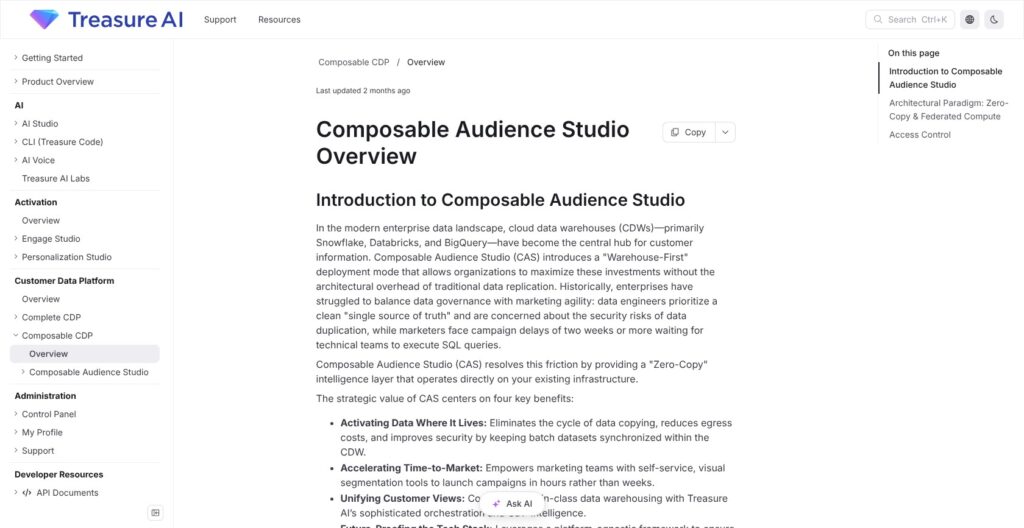
Composable Audience Studio sends a federated query to the warehouse at query time and gets back only the results, so customer data stays in your environment until activation. Snowflake setup takes six steps, including key-pair authentication, zero-copy configuration in Data Workbench and a parent segment config file uploaded through the CAS API. Treasure doesn’t meter that query compute, but the warehouse still bills for it, which is why Composable cost varies while Complete runs on a predictable flat fee. Hightouch requires a warehouse as its data foundation; Treasure runs Composable the same way but also sells Complete for teams without one.
[Screenshot needed: docs.treasure.ai Composable CDP page comparing Complete and Composable modes on cost and schema ownership] The Composable CDP docs set Complete’s flat fee against Composable’s variable warehouse cost. Source: Treasure AI.
⏱️ Limits That Matter
- Query runtime: 6 hours by default, a hard cap that account policies and query hints can shorten but not raise; custom limits go through Support
- Workflow concurrency: 30 concurrent Treasure Workflow tasks per account, with extras queued
- Result downloads: 50 MB in the browser and 500 MB through the REST API
- Drivers: JDBC through the Trino driver, with no transaction support; ODBC has been deprecated since June 2025 and runs on Windows 64-bit only
- Unlimited: databases, tables and users carry no cap
Real-Time, AI Agents, and Treasure Code
Real-Time 2.0 comes with a published SLA table: a p95 of 100 ms or less for the Personalization API, measured from request to response, including the real-time attribute lookup and the batch profile merge.
⚡ Real-Time 2.0
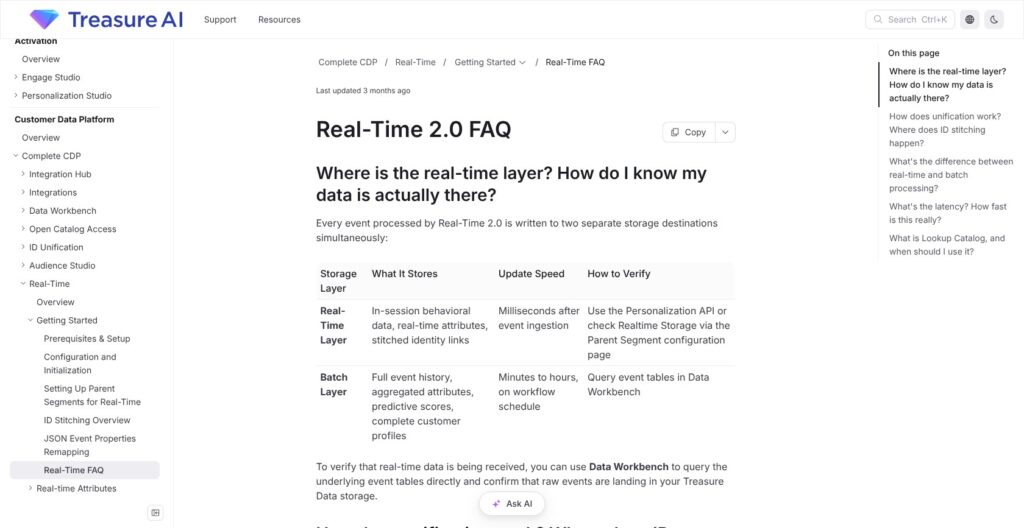
- Triggered activations: up to 3 minutes from event ingestion to delivery
- Event ingestion: 2,000 events per second by default, with 100,000+ available globally through the account team
- Decisioning and triggered activations: 8,000 events per second each
- Profile API: up to 5 attributes within 10 KB, 5 tokens per call and 15 real-time segments per token
Version 2.0 runs server to server against a regional host, where 1.0 used client-side calls with no guaranteed SLA. The real-time layer updates milliseconds after ingestion, while batch data lands in minutes, depending on the workflow schedule.
[Screenshot needed: docs.treasure.ai Real-Time FAQ page showing the SLA and throughput table with the 100 ms p95 target] The Real-Time FAQ lists the Personalization API, triggered activation and ingestion targets. Source: Treasure AI.
🤖 Treasure AI Studio, Agent Hub and Agent Foundry
Treasure AI Studio launched with the rename on April 20, 2026, as a conversational workspace on web, mobile, desktop and the command line, with 50+ pre-built skills covering SQL, segments, journeys, workflows and dashboards. Every AI decision produces reviewable output that a user approves before activation. AI Agent Hub is a catalog of ready-made agents and blueprints, while AI Agent Foundry builds custom agents on data already in Treasure’s Plazma database, running SQL through Trino. Only form-type agents can be scheduled, and Foundry agents surface in Audience Studio, Generic Chat, webhook API endpoints and Slack.
The AI Marketing Cloud reached general availability on October 28, 2025, and Treasure AI now lists five AI Suites: Engagement, Personalization, Creative, Paid Media and Service. The Engagement suite includes Engage Studio for email and mobile push campaigns. Treasure AI and its LLM providers are contractually barred from training on customer data.
💻 Treasure Code
Treasure Code is the free tdx CLI, which keeps CDP configuration as version-controlled code and works with Claude Code, OpenAI Codex, VS Code with GitHub Copilot and Cursor. Running tdx claude launches Claude Code with td-skills and a td-docs MCP server, billed in AI Credits through a local proxy, or on your own Claude account with --no-proxy. Treasure still labels that Claude integration experimental.
Security, Compliance, and Deployment
Treasure Data holds SOC 2 Type 2 and four ISO/IEC certifications, and lets you pin data to one of five regions: US East (N. Virginia), US West (Oregon), Europe (Frankfurt), Tokyo and Seoul.
- Certifications: SOC 2 Type 2 and SOC 3, ISO/IEC 27001:2022, 27701, 27017 and 27018, CSA STAR Level 1, STAR for AI Level 1, Japan’s PrivacyMark, and TRUSTe Responsible AI certification covering AI Agent Foundry and Treasure AI Studio
- Healthcare: an annual HIPAA assessment, with a BAA on request
- Encryption: AES-256 at rest, TLS 1.2+ in transit, customer-managed keys, and separate KMS keys per region
- Residency: region choice is contractually binding, and AI inference stays inside the contracted region
- AI data: masked PII never reaches Amazon Bedrock or OpenAI, and agents run in a server-side sandbox under the requesting user’s permissions
- Privacy operations: 72-hour breach notification, plus one-month GDPR and 45-day CCPA deletion timelines
The FISC document is a control-alignment guide, not a certification, and the compliance reports, including annual external penetration tests, sit behind an NDA. Against Segment’s EU or US region option, Treasure’s Tokyo and Seoul regions, PrivacyMark and FISC guide make it the stronger fit for Japan and Korea deployments.
How Does Treasure Data Compare to Competitors?
Among CDPs and reverse ETL tools, Treasure Data’s edge is a managed identity graph that can also run warehouse-first, plus Tokyo and Seoul hosting; its weakness is buying friction, since Segment, RudderStack and Hightouch all have a free or trial entry point and Treasure has none.
- Twilio Segment: best for developer-led teams that want to start self-serve. Connections sends data to 550+ destinations against Treasure Data’s 170+ integrations, the CDP plan is priced on monthly tracked users with Unify and Engage bundled in, and the free trial needs no credit card. Protocols costs extra outside the CDP plan.
- mParticle: best for mobile-first apps. IDSync controls known and anonymous identities across apps and platforms, and mParticle now belongs to Rokt, whose ads business some buyers will weigh. Pricing is usage-based and quote-only, like Treasure Data’s.
- Tealium: best for teams that start from tag management. EventStream feeds AudienceStream for identity, enrichment, segmentation and real-time connectors, and Tealium cites 1,300+ integration partners, but AudienceStream requires an EventStream account and there is no public price list.
- RudderStack: best for warehouse-native teams that want published prices. Free covers 250K events a month with cloud destinations and reverse ETL included, but stops processing after two consecutive overages; Growth costs $265 a month with a 30-day trial, and Profiles sits mainly on Enterprise.
- Hightouch: best for composable activation on an existing warehouse. Basic Reverse ETL is free for 2 active syncs, the Composable CDP is sold a la carte across Reverse ETL, Events, Customer Studio, Identity Resolution and Real-time Personalization, and AI Decisioning doesn’t require the CDP. Paid plans need a demo.
- Salesforce Data Cloud: best for organizations whose customer data already lives in Salesforce. It bills on consumption credits rather than profiles, supports zero-copy with Snowflake, and bills storage separately.
| Tool | Entry point | Pricing model | Published paid price | Strongest fit |
|---|---|---|---|---|
| Treasure Data | Two-week proof of concept | Unified profiles plus events, compute not metered | Quote only | Enterprise managed or hybrid CDP |
| Twilio Segment | Free trial, no credit card | Monthly tracked users | Quote only (CDP plan) | Developer-led event pipelines |
| mParticle | Quote request | Usage-based | Quote only | Mobile-first identity |
| Tealium | Quote request | Not published | Quote only | Tag management plus CDP |
| RudderStack | Free, 250K events a month | Event-based tiers | Growth $265/month | Warehouse-native pipelines |
| Hightouch | Free Basic Reverse ETL, 2 syncs | A la carte modules | Quote only | Composable activation |
Pick Treasure Data if you want one vendor to hold the identity graph with a warehouse option; pick RudderStack or Hightouch if the warehouse is already your source of truth and you want to start without a contract; pick Segment if developers own the pipeline and want a free trial first.
How I Reviewed Treasure Data
I judged Treasure Data on seven criteria: pricing transparency, identity resolution, data model and warehouse fit, activation, real-time performance, platform limits, and security.
For pricing, I set the profile-and-event model and its AI Suite and AI Credit layers against RudderStack’s published tiers and the entry points of Segment, Hightouch, mParticle and Tealium. For identity and data model, I weighed the ID Unification caps and the forced 3-day full refresh, and compared Complete and Composable modes on cost, schema ownership and setup steps. For activation and real-time, I mapped the path from parent segment to activation against the Real-Time 2.0 SLA and throughput defaults. Limits and security came down to the 6-hour query cap, the 30-task workflow ceiling, the certifications and the five regions.
Every latency, throughput and customer savings figure in this review is Treasure AI’s own published number, not a measurement on my data.
Prices current as of October 2026.
Should You Choose Treasure Data for Your CDP?
Yes, if you’re a large enterprise with customer data spread across brands or markets and you want one vendor to run identity, segmentation and activation. Complete and Composable modes cover both a managed store and a Snowflake, Databricks or BigQuery estate, compute isn’t metered, and the Tokyo and Seoul regions plus PrivacyMark make Treasure Data a strong fit for Japan and Korea deployments.
Skip it if you want to price a CDP before talking to sales: RudderStack’s Growth plan costs $265 a month and Segment has a free trial with no credit card. If your warehouse is already the source of truth and you only need activation, Hightouch’s a la carte Composable CDP, with Basic Reverse ETL free for 2 active syncs, is the leaner buy.
Budget for the AI layer separately, since each AI Suite is its own annual license and AI Credits have no published rate.
Request the two-week proof of concept on your own data, and get unified-profile and event pricing in writing, with each AI Suite and the AI Credit rate quoted as separate lines.
FAQs
Is Treasure Data now Treasure AI?
Yes. Treasure Data renamed itself Treasure AI on April 20, 2026, moved to treasure.ai and redirected treasuredata.com there. Treasure AI is the business name of Treasure Data, Inc., which holds both trademarks, and the vendor says existing APIs, SDKs and workflows keep working. The product category changed from customer data platform to “Agentic Experience Platform.”
How much does Treasure Data cost?
Treasure Data does not publish prices. The CDP is an annual subscription priced mainly on unified customer profiles and behavioral events, with queries, segmentations and activations unmetered. Each AI Suite adds a fixed annual license, and AI-driven actions consume AI Credits, one of which covers 600 Treasure AI Studio conversations. See How Much Does Treasure Data Cost? above for the full breakdown.
Does Treasure Data have a free trial?
No. Treasure Data offers no self-serve free trial or free tier. Evaluation runs through a two-week proof of concept on your own data, and the AI Suites are free for 60 days after an expert-led AI Workshop. For a no-contract start, RudderStack’s Free plan covers 250K events a month.
Does Treasure Data work with Snowflake?
Yes, in both directions. In Composable mode, Snowflake stays the source of truth and Treasure runs federated queries against it, returning only results; setup takes six steps, including key-pair authentication and a config file uploaded through the CAS API. In Complete mode, Treasure publishes Apache Iceberg tables that Snowflake reads with zero copy. Databricks and BigQuery are supported in both modes too.
Who owns Treasure Data?
Treasure Data is an independent company backed by SoftBank. Arm Holdings bought it in 2018 for an estimated $600 million and separated it in June 2021 into SoftBank Vision Fund 2’s portfolio, followed by a $234 million round led by SoftBank Corp. Two board members are SoftBank-affiliated, and the current ownership split is not published.