
Editor’s note: This Tealium review is based on my hands-on evaluation of Tealium’s Customer Data Hub (iQ Tag Management, EventStream, AudienceStream CDP, DataAccess, Functions and the new Context API) in October 2026. I weigh six areas: pricing and contract model, setup and governance, data collection, profiles and audiences, warehouse and AI activation, and fit against rivals.
Quick verdict: I recommend Tealium for enterprises in regulated industries, or running multi-vendor martech stacks, that want tag management, server-side event routing and a real-time CDP from one independent vendor. Go in knowing that pricing is quote-only, with $50,000 a year for 25M events as the one public reference, and that core server-side pieces only switch on through Tealium Support or an account manager.
Tealium pairs a client-side tag manager (iQ) with a real-time CDP (AudienceStream), a combination Twilio Segment, mParticle, RudderStack and Hightouch don’t offer. It claims 1,300+ integrations (900+ of them vendor tags) and 850+ enterprise customers.
In this Tealium review, I’ll take a closer look at Tealium’s pricing, features, and setup, so you can see exactly whether its all-in-one stack justifies an enterprise contract.
Key Takeaways:
- Tag management and a real-time CDP from one vendor: iQ, EventStream and AudienceStream under one contract
- Pricing is quote-only: the AWS Marketplace bundle is the only public price, and renewal and overage terms are unpublished
- Server-side changes publish straight to production: EventStream and AudienceStream have no QA environment
- Context API replaced Moments API in June 2026: live profile context in about 60 ms, plus a managed MCP server for AI agents
- Hard profile limits apply: 500 attributes and 400 KB per profile, and 10,000 events in one visit bans a visitor permanently
Pros and Cons
Pros
- iQ ships Dev, QA and Prod environments with revertible versions
- 1,300+ integrations claimed, 900+ of them vendor tags
- Consent enforced at collection: OneTrust, Cookiebot, Didomi, TrustArc, Usercentrics, GPC
- Context API serves live profile context in about 60 ms, with a managed MCP server
- HIPAA/HITECH, ISO 27001/27701/27018 and SOC 2 Type II coverage
Cons
- No public price list; the AWS listing is $50,000 a year for 25M events
- Server-side changes publish straight to production, no QA environment
- Server-side profiles, Context API and DataAccess need Tealium to enable
- A visitor hitting 10,000 events in one visit is banned permanently
How Much Does Tealium Cost?
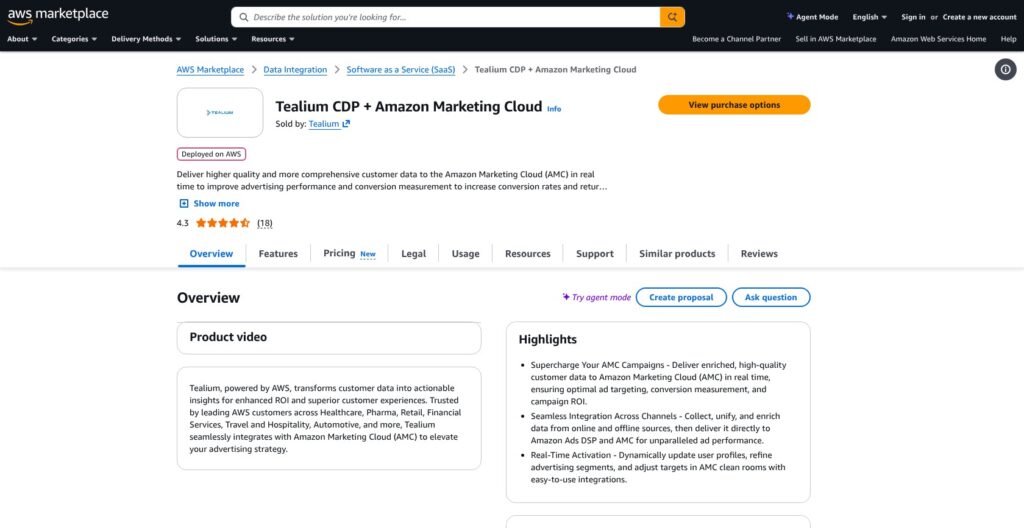
Tealium publishes no price list: Data Collection, the CDP and Cloud Activation are all quote-only. The one public price is Tealium’s own AWS Marketplace listing, where pricing scales with inbound events rather than users or connected destinations:
- Data Collection (iQ + EventStream): for teams that need client-side tag management plus server-side routing to conversions APIs, quote-only
- Customer Data Platform (AudienceStream): for teams building real-time profiles, badges and audiences on collected events, quote-only
- Cloud Activation (CloudStream, Context API, Functions): for teams activating Snowflake, Databricks, BigQuery or Redshift tables without copying data into Tealium, quote-only
- AWS Marketplace bundle (CDP + Amazon Marketing Cloud): $50,000 per 12 months for the Client/Server Event+Audience Data Hub, covering up to 25M events per year, with 12, 24 and 36-month terms offered (only the 12-month price is listed)
| Package | What’s included | Public price | Billing unit |
|---|---|---|---|
| Data Collection | iQ Tag Management, 900+ vendor tags, 50+ extensions, EventStream server-side routing | Quote only | Not published |
| Customer Data Platform | AudienceStream profiles, attributes, badges, audiences, Predict ML | Quote only | Not published |
| Cloud Activation | CloudStream segments on warehouse tables, Context API, Functions | Quote only | Not published |
| DataAccess add-ons | EventStore, AudienceStore (S3), EventDB, AudienceDB (Redshift) | Quote only | Not published |
| AWS Marketplace bundle | Client/Server Event+Audience Data Hub plus Amazon Marketing Cloud | $50,000 per 12 months | Inbound events, up to 25M per year |
One unit on the AWS listing supports up to 25 million events a year, which makes your event forecast the number that decides the bill. I’d pull 12 months of page views, app events and server-side calls before the first sales call. The listing also bundles Amazon Marketing Cloud, so I treat $50,000 as a reference point for an event-based CDP contract, not a rate card for iQ alone.
Is Tealium Good Value for Money?
- Event billing favors large audiences with shallow sessions: Twilio Segment meters monthly tracked users (Free covers 1,000 MTUs, Team starts at $120/month for 10,000 visitors), while Tealium’s AWS listing meters events, so a big audience firing few events each costs less than its visitor count suggests
- The entry price is steep against public rivals: by my arithmetic, $50,000 for 25M events on the AWS listing comes to $2 per 1,000 events, while RudderStack Growth starts at $265/month on tiers from 1M events and Salesforce Data Cloud lists Profiles at $240 per 1,000 profiles per year
- The quote is the real price: DataAccess storage, Context API and CloudStream are each enabled by Support or an account manager, so check which of them your quote actually covers
- Renewal and overage terms are not published: get event overage rates and renewal caps in writing before you sign a 24 or 36-month term
Reviewer’s Notes: If my immediate need were server-side conversions (Meta CAPI, Google Enhanced Conversions), I’d start with iQ plus EventStream and add AudienceStream only once I had at least two activation use cases waiting on real-time profiles. I’d also size the event tier with 20-30% headroom, because bot traffic and runaway tracking inflate event counts, and a visitor who reaches 10,000 events in one visit gets banned rather than simply billed.
My Experience With Tealium
Tealium has no self-serve signup or free trial, so the path below is the one I’d follow from a sales-led account to a first live audience.
Getting an Account and a Profile
The front door is a demo request or Tealium’s self-guided demo. Once an account exists, it splits into profiles, each covering a website, a set of sites or a mobile app. I can create client-side profiles myself in the iQ interface, but a server-side profile for EventStream or AudienceStream only comes through Tealium Support, so I’d ask for it during contracting rather than after kickoff.
Installing utag.js and Building the Data Layer
Each profile gets a hosted utag.js per environment at /utag/ACCOUNT/PROFILE/ENV/utag.js, with the snippet copied from Manage Environments. What stood out to me in the setup: utag.js automatically captures query string parameters, first-party cookies, JavaScript variables and meta elements into one data object, so the utag_data layer on each page only has to carry the values those sources miss. Load rules then decide, in the browser, when each tag fires.
Publishing to Dev, QA and Prod
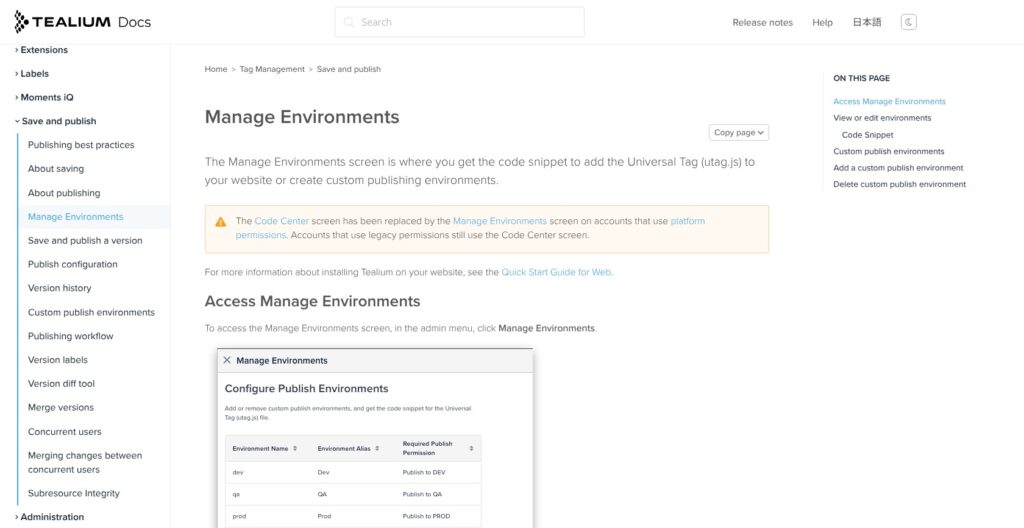
iQ ships three default environments, Dev, QA and Prod, and I can add custom ones, though publishing to a custom environment needs a permission only profile admins can change. Save As creates a named version I can revert to; overwriting the current version cannot be undone. utag.js propagates through the CDN immediately, while utag.sync.js and first-party-domain files take up to five minutes. The Tealium Tools extension for Chrome and Edge adds the Universal Tag Debugger and an Environment Switcher for checking QA builds on the live site.
Turning On EventStream and AudienceStream
On the server side, data arrives through data sources: the Tealium Collect tag, iOS and Android SDKs, the HTTP API, incoming webhooks (HubSpot, Braze Currents, Iterable), file import, or Snowflake and BigQuery. Each data source generates a key for the install code, and events show up in Live Events. Event specifications validate up to 100 attributes per event, but they flag bad events rather than filter them, so invalid data still flows downstream.
Tealium’s own tutorial is the path I’d copy for a first project:
- Build a Lifetime Order Value attribute
- Assign a VIP badge when that value is greater than 500
- Create a VIP audience (badge assigned AND email assigned)
- Attach a connector action, such as Google Sheets, then Trace it and publish
The server side has one publish environment, production, and the tutorial’s workaround is to create “test” attributes. Trace caps a session at 250 events, 12 hours and 15 function calls per minute, enough for spot checks but not for monitoring.
Reviewer’s Notes: On the server side, I would Save As before every publish. Plain Save creates revisions you cannot revert to, and with production as the only environment, a named version is the only rollback point you get.
Data Collection: iQ Tag Management and EventStream
Tealium’s 1,300+ integrations figure combines client-side tags, server-side connectors, warehouses, conversions APIs and AI platforms. Its docs carry roughly 330 client-side tag pages and 275 server-side connector pages, so don’t read the headline as 1,300 server-side connectors.
🏷️ iQ Tag Management
iQ carries 900+ vendor tag integrations and 50+ extensions. Consent is enforced at collection, with native integrations for:
- CMPs: OneTrust, Cookiebot, Didomi, Digital Control Room, TrustArc and Usercentrics
- Opt-outs: an Opt-out Cookie + GPC integration and Global Privacy Control
- Custom and Google setups: a custom CMP template and Google consent mode
Tags that need consent don’t fire without it. Google Tag Manager is free software and reuses the same container model server side, but its server containers run on your own Cloud Run or App Engine bill and build no profiles.
⚡ EventStream Server-Side Routing
EventStream keeps data in memory only until it reaches the next destination, flowing through data sources, Live Events, event specifications, event feeds and connectors. Tealium quotes delivery in under 100 ms, and moving vendors server side cuts client-side network requests and app size, and lets me add a vendor without a code release. The conversions API coverage is the strongest reason to buy it:
- Meta CAPI and Google Enhanced Conversions
- TikTok Events API, LinkedIn and Pinterest
- ChatGPT Ads: a Measurement Pixel (iQ tag) and a Conversions API connector, announced October 6, 2026
For iPaaS-style imports, the Workato-based Data Connect caps the Tealium Events app at 500 events per second.
📱 Mobile SDKs
Native SDKs cover iOS (Swift and Objective-C), Android (Kotlin and Java), Flutter, Cordova, NativeScript and Xamarin. Prism, a new native SDK for Swift and Kotlin with on-device transformations and a rules engine, sits in early access, so I’d build new apps on the current SDKs until Tealium moves Prism to general availability.
AudienceStream CDP, Functions and DataAccess
AudienceStream’s limits are the first thing I’d design around: 500 attributes per profile, 400 KB per compressed profile, and a permanent ban for any visitor who reaches 10,000 events in one visit.
👤 Profiles, Attributes and Badges
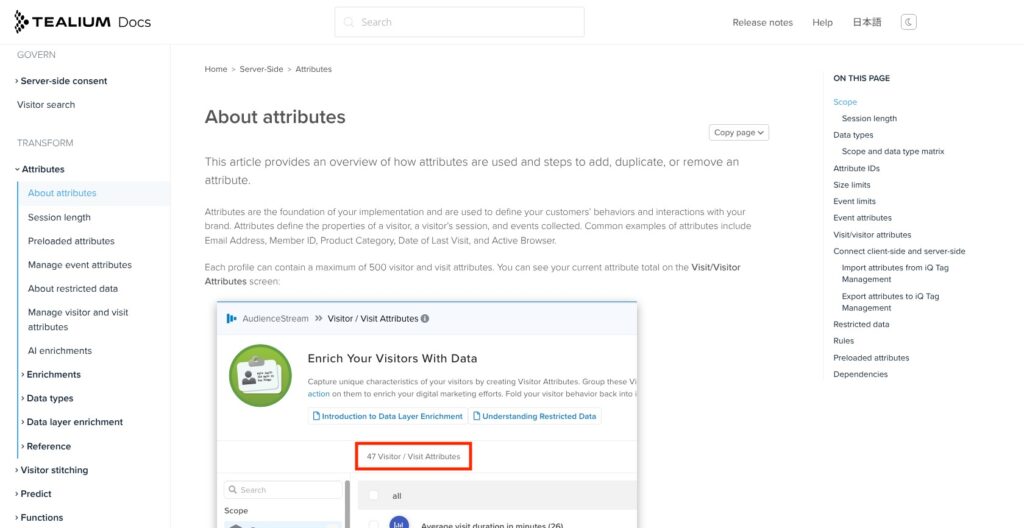
Attributes come in Visitor, Visit and Omnichannel scopes, typed as Number, String, Boolean, Tally, Set of Strings, Date, Funnel or Badge. The ceilings:
- Strings: 1,000 characters, and longer values are not saved
- Timelines: 100 entries
- Tallies, arrays and sets: 30,000 entries
- Visits: 24 hours maximum, 10,000 events each
The ban deletes the profile and ignores all future events for that ID and any stitched IDs, in both AudienceStream and EventStream, until Tealium Operations removes it. Visitor stitching is on by default, but anonymous HTTP API events sent without a tealium_visitor_id each create a new profile, so server-side sources need an ID strategy from day one.
🎯 Audiences and Predict ML
Audiences are dynamic: visitors join and leave as events arrive. Fill Audience backfills an audience once, but it needs at least one connector action and fires only the Joined Audience trigger. Insight graphs refresh daily at 12 AM UTC. Profile retention is set per account, read-only to customers, and changed only through Support. Predict ML trains propensity models on a boolean or badge target, and each retrain creates a new version.
🧩 Functions
Functions run on GraalVM JavaScript (ECMAScript 2020) with 32 MB of memory and a 64 KB size cap, about 1,500 lines. Transformation functions get 150 ms per invocation; event and visitor functions get 10 seconds. V2 event and visitor functions are deprecated in favor of Action V3, so older code needs migrating.
🗄️ DataAccess
EventStore and AudienceStore write JSON (AudienceStore also CSV) to a Tealium-provided S3 bucket, one file per 100 MB or per hour, whichever comes first; EventDB and AudienceDB load into Tealium-provided Redshift. Default retention is 390 days for EventStore and 90 days for EventDB, and Support enables all four. RudderStack takes the opposite route, with warehouse destinations included even on its free tier, so events land in a warehouse you already own.
Warehouse Activation, Context API and AI Features
Tealium’s 2026 releases aim the stack at warehouses and AI agents: Audience Discovery for Snowflake on May 14, Context API on June 9 and Configuration MCP on August 31.
❄️ CloudStream and Audience Discovery for Snowflake
CloudStream builds segments on warehouse tables and activates them without copying data into Tealium. Tealium’s product page names Snowflake, Databricks, BigQuery and Redshift, but the CloudStream docs name only Snowflake and Databricks as sources, and it runs on a dedicated CloudStream profile that Support creates. Audience Discovery is a Snowflake Native App running inside your own Snowflake account, with Cortex natural-language, point-and-click and AI-assisted SQL audience building. Hightouch covers the same composable ground with a free entry (2 active syncs), so Tealium only wins here if you also want its real-time profiles.
🔌 Context API and MCP
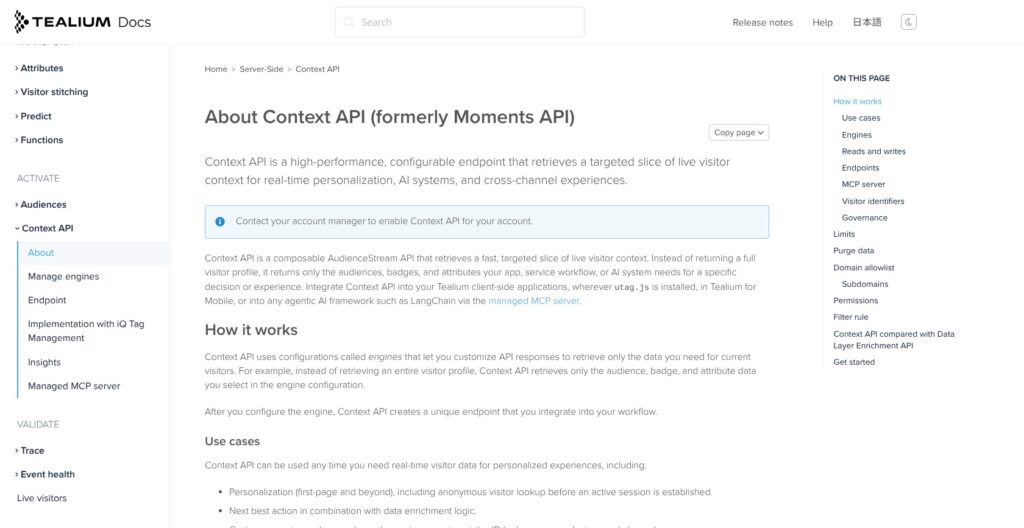
Context API, the successor to Moments API, returns audiences, badges and attributes from configurable engines. The defaults:
- Engines: up to 10 per profile
- Reads: 200 per second per profile, across engines
- Storage: 1 kB per visitor per engine
- Latency: about 60 ms average for payloads of 1 kB or less
A managed MCP server lets AI agents such as Claude pull that context directly. Every read counts toward quota whether or not data is found, and an account manager must enable it.
🤖 AI Features
- May 7 releases: AI at the Edge, AI Decisioning with Invoke Your Own Model, a Configuration Agent and AI Recommended Audiences
- Configuration MCP (August 31, select customers): Claude, ChatGPT or Gemini draft changes to a server-side profile as draft revisions, and a human reviews them in the UI before publish; not available for private cloud accounts
- Tealium Studio and a Developer Portal (August 31): a natural-language interface, plus Platform APIs
- AI enrichments (select customers): LLM processing on event or visitor data that writes its output as a new event, never directly to the profile
Configuration MCP, AI enrichments and AI Recommended Audiences are select-customer only, so I’d confirm in the contract which of these my account gets.
How Does Tealium Compare to Competitors?
Tealium is the only vendor here that bundles a client-side tag manager with a real-time CDP; every rival below covers one side or the other.
- Twilio Segment: best for self-serve product teams. Free covers 1,000 MTUs and Team starts at $120/month with a 14-day trial, but billing scales with monthly tracked users, the full CDP bundle (Connections, Unify, Engage) is custom-priced, and there is no client-side tag manager.
- mParticle: best for mobile-first brands, thanks to its mobile SDK strength. Pricing is quote-only like Tealium’s, it is now part of Rokt, and it has no tag manager of its own, so web tags stay a separate purchase.
- RudderStack: best for data teams that want the warehouse first. Free covers 250K events a month, Growth starts at $265/month, and Reverse ETL comes on every plan, though Profiles, HIPAA and VPC deployment are Enterprise-only.
- Hightouch: best when the warehouse is already the source of truth. Reverse ETL is free with 2 active syncs, paid plans are usage-based with no MTU caps, and the Composable CDP bundles Customer Studio and Identity Resolution.
- Adobe Real-Time CDP: best inside Adobe Experience Cloud. It is sold by sales order with per-profile entitlements, such as 75 KB average profile richness on B2C, up to 5 sandboxes, and 500 KB (Prime) or 700 KB (Ultimate) of data export per profile per year.
- Salesforce Data Cloud: best for Salesforce shops. Profiles list at $240 per 1,000 a year, Enterprise Profiles at $420, and Flex Credits at $500 per 100,000, with ingestion free, so credit metering is what needs modeling.
- Google Tag Manager (server-side): best for tag routing on a budget. The software is free, you host it on Cloud Run or App Engine, and it builds no profiles.
| Tool | Tag management | Server-side | Warehouse-native | Public starting price |
|---|---|---|---|---|
| Tealium | Yes (iQ) | Yes (EventStream) | CloudStream, Audience Discovery | $50,000/year for 25M events (AWS bundle) |
| Twilio Segment | No | Yes | Reverse ETL | Free (1,000 MTUs), Team $120/month |
| mParticle | No | Yes | Ask vendor | Quote only |
| RudderStack | No | Yes | Yes, warehouse-first | Free (250K events), Growth $265/month |
| Hightouch | No | Hightouch Events | Yes, composable | Free (2 active syncs) |
| Google Tag Manager (server-side) | Yes | Yes, self-hosted | No | Free software, you pay hosting |
Pick Tealium if you want tags, server-side CAPI and real-time profiles under one contract; pick Segment or RudderStack if you need public pricing and self-serve setup; pick Hightouch if your warehouse already holds the truth.
How I Reviewed Tealium
I judged Tealium on six areas: the contract and pricing model, the setup path and its governance, collection breadth and consent, profile limits and audience tooling, warehouse and AI activation, and fit against named rivals.
For pricing, I set the AWS Marketplace bundle against published rates from Twilio Segment, RudderStack, Hightouch and Salesforce Data Cloud, and noted which pieces need Support or an account manager to enable. For setup, I mapped the path from a new profile through utag.js, the Dev, QA and Prod environments, versions, EventStream data sources and Trace. For the CDP, I worked through attribute types, profile ceilings, the visit ban, audiences, Functions and DataAccess retention. For activation, I weighed CloudStream, Audience Discovery, Context API and which AI features are limited to select customers.
I weighed setup risk and pricing transparency most heavily, because the single production environment and the quote-only contract are where Tealium differs most from Segment and RudderStack.
Prices current as of October 2026.
Should You Choose Tealium as Your CDP?
Yes, if you’re a regulated enterprise or a multi-brand business running a multi-vendor martech stack and you want tag management, server-side CAPI and real-time profiles from one independent vendor. Existing iQ customers adding AudienceStream are the most natural fit, since they already run Tealium’s data layer and consent integrations.
Skip it if you’re a startup or product team that needs self-serve setup and public pricing: Twilio Segment (Team from $120/month) or RudderStack (Growth from $265/month) will get you live faster. Warehouse-first data teams will get more from Hightouch, and shops standardized on Salesforce or Adobe should look at Data Cloud or Real-Time CDP first.
Whichever way you go, the Tealium trade-off is the same: no public price, a single production environment on the server side, and Support or account-manager gating on server-side profiles, DataAccess, CloudStream and Context API.
My next step would be to request a quote that itemizes event volume, DataAccess, Context API and renewal caps, and to ask for a sandbox server-side profile before signing.
FAQs
How much does Tealium cost?
Tealium pricing is quote-based, with no public price list. The one public reference is Tealium’s AWS Marketplace listing for the CDP plus Amazon Marketing Cloud: $50,000 per 12 months for up to 25M events per year, with 12, 24 and 36-month terms. On that listing, pricing scales with inbound events, not users. See How Much Does Tealium Cost? above for the package breakdown.
Does Tealium have a free trial?
No. Tealium offers no self-serve signup or free trial; the options are a sales demo or a self-guided demo. Even after you sign, server-side profiles for EventStream and AudienceStream are created by Tealium Support. If you need a free hands-on start, Twilio Segment’s Free plan (1,000 MTUs) or RudderStack’s free tier (250K events a month) are the closest alternatives.
Is Tealium a CDP or a tag manager?
Both. Tealium iQ is a client-side tag manager with 900+ vendor tags, EventStream routes events server side to destinations and conversions APIs, and AudienceStream is the real-time CDP that builds profiles, badges and audiences. Together they make up Tealium’s Customer Data Hub, which is why it competes with Google Tag Manager and Twilio Segment at once.
What happened to Tealium Moments API?
Moments API became Context API, launched June 9, 2026 as an expansion of the original product. Context API returns audiences, badges and attributes from configurable engines in about 60 ms on average, supports up to 200 reads per second per profile, and adds a managed MCP server so AI agents can pull live customer context.
Is Tealium HIPAA compliant?
Yes. Tealium supports HIPAA and HITECH through a dedicated HIPAA multi-tenant or private cloud deployment, so healthcare data needs that specific setup rather than the standard environment. It also lists ISO/IEC 27001, 27701 and 27018 certifications and SOC 2 Type I and Type II reports.