Editor’s note: This review evaluates Collibra’s documented capabilities and buying requirements, without a hands-on implementation.
Quick verdict: I recommend Collibra for enterprises that need clear data ownership, consistent business definitions, and formal approval processes across departments. Its biggest appeal is bringing those responsibilities together, but it’s a harder sell if your main problem is simply finding tables. You’ll need people to run the governance program as well as a budget for the software.
Key Takeaways
- Collibra is a strong shortlist choice when data governance involves several departments and accountable owners.
- Its catalog connects technical assets with business definitions, giving you more context for choosing data.
- Custom pricing makes an itemized proposal essential; a marketplace price alone won’t establish your total cost.
- Configurable workflows bring maintenance work, and lineage coverage varies by integration.
- AI Command Center brings AI assets and assessments together, but some newer agent controls remain in preview.
In this Collibra review, I’ll take a closer look at pricing, getting started, governance, lineage, and AI. I’ll also explain when I’d choose Atlan, Alation, or Microsoft Purview instead.
Pros and Cons
Pros
- Business terms, ownership and technical metadata sit within a shared governance framework.
- Built-in workflows cover owner assignment, escalation and access requests.
- Lineage supports impact analysis across supported data and reporting systems.
- Custom lineage definitions provide a route for unsupported systems.
- AI Command Center links AI inventories with assessments and governance decisions.
Cons
- Public marketplace pricing does not establish your complete contract scope.
- Dependent workflows need careful configuration and maintenance.
- Supported connectors still have gaps in the transformations they capture.
- New agent controls include preview features.
How Much Does Collibra Cost?
Request an itemized quote for Collibra. The product lineup alone doesn’t establish your contract entitlements, so I wouldn’t compare its value with a rival until the scope is clear.
Its public AWS Marketplace listing provides one reference point, with a 12-month contract and a private-offer option. That listing is not a universal starting price or a complete account of what your organization would receive.
You have two purchasing routes to discuss:
- Custom proposal (quote required): My preferred starting point for matching the agreement to your governance requirements and rollout.
- AWS Marketplace contract ($170,000 for 12 months on the public listing): A procurement option for organizations buying through AWS. Confirm the included scope or arrange a private offer.
| Purchase route | Public price | What I’d clarify before signing |
|---|---|---|
| Custom proposal | Quote required | Products, user entitlements, environments, implementation and support |
| AWS Marketplace listing | $170,000 per 12-month contract | Exact included scope, private-offer terms and any additional services |
These are purchasing routes, not two equivalent feature tiers. Don’t assume the public marketplace subscription includes everything shown in a sales demo.
Is Collibra Good Value for Money?
I see the strongest value when unclear ownership is already delaying important work. If a reporting team repeatedly needs finance, engineering, and compliance to agree on a dataset, a shared approval process has a practical purpose.
For a small analytics team that mainly needs searchable documentation, I find the case much harder to justify. Buying a broad governance platform doesn’t automatically make a small catalog problem more valuable to solve.
My recommendation is to price a focused catalog and governance rollout first. Make the following items explicit:
- Product scope: Which catalog, lineage, quality, and AI capabilities are included?
- Delivery responsibilities: Who configures integrations and workflows, and who pays for that work?
- Expansion terms: What changes commercially when you add users, environments, or capabilities?
Choose the smallest agreed scope that solves one important governance problem, then expand once teams use it consistently.
Getting Started With Collibra
Getting started is as much an ownership decision as a technical setup. Collibra organizes assets into domains, which sit within communities. A community might represent your finance department, with a domain containing its business terms. You need to decide how those structures map to your business.
I’d begin with a narrow problem, such as agreeing which revenue dataset should feed management reporting. That gives the rollout a useful finish line: people can locate the approved asset, understand its definition, and identify the person responsible for it.
My recommended sequence is:
- Choose the first business area. Pick a dataset or reporting process whose ownership problems are already visible.
- Name its owners and stewards. Decide who approves definitions and who maintains the supporting metadata.
- Connect the relevant sources. Scope metadata ingestion and lineage around the systems involved in that process.
- Add business context. Link definitions and responsibilities to the assets people actually need.
- Exercise an approval workflow. Confirm that a request reaches the right people and produces a useful outcome.
I like that Collibra provides workflows for assigning owners after ingestion. That gives you a way to turn newly imported assets into someone’s responsibility rather than leaving them as an ever-growing inventory.
Still, automation needs a person at the other end. If nobody has time to answer access requests or resolve disputed definitions, sending tasks to them won’t fix the underlying problem.
This is also where I’d compare Atlan. If your immediate priority is understanding dependencies across a modern analytics stack, its catalog and lineage capabilities deserve a place in the evaluation. Collibra makes more sense on my shortlist when the central question is who can approve, change, and take responsibility for shared data.
Reviewer’s Notes: Give the first rollout a business owner and a specific outcome. My preference is a small, maintained catalog with definitions people trust.
Finding Data You Can Actually Trust
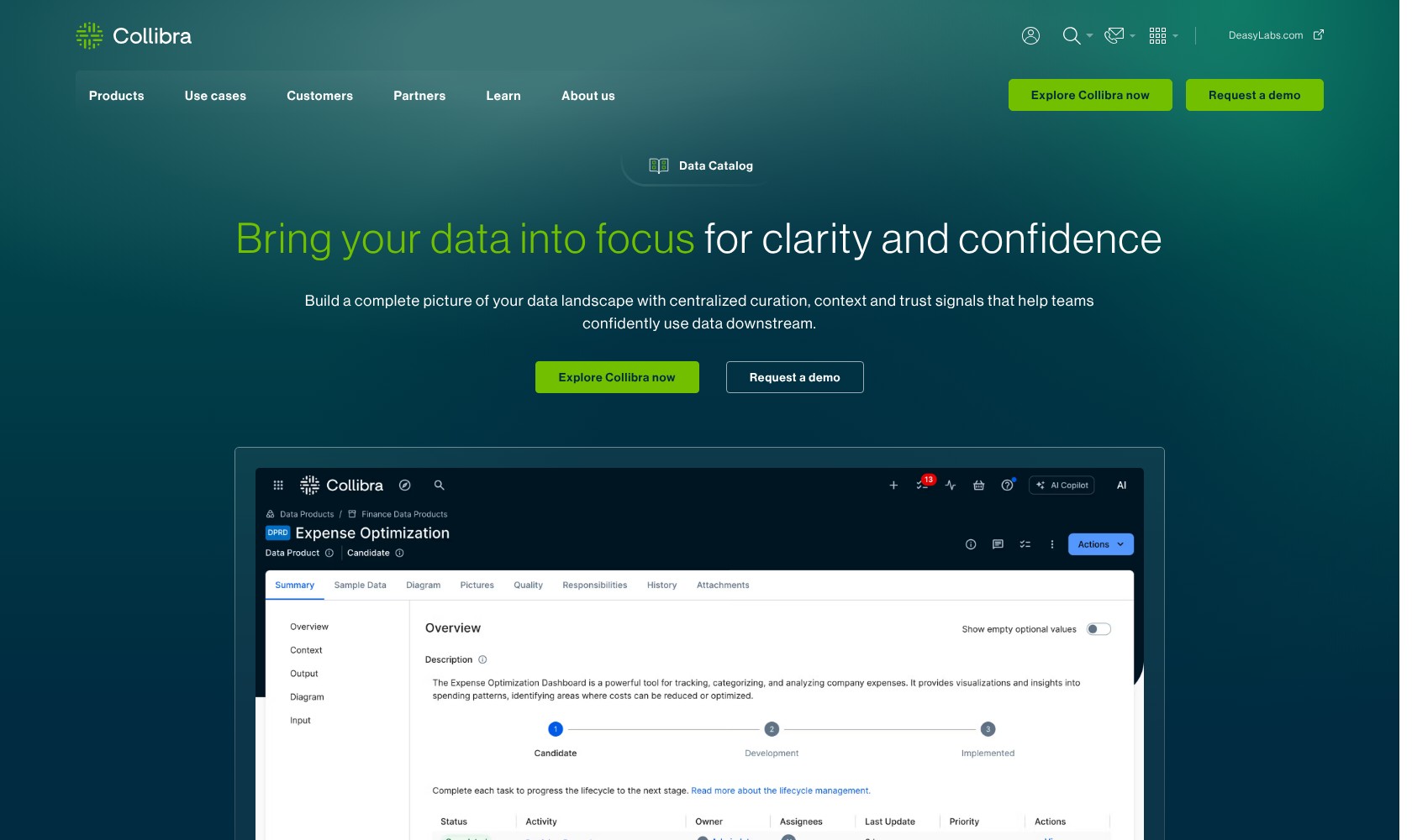
The connection between technical data and business meaning is what I like most about Collibra’s catalog. A table name can tell an engineer where to look, but it rarely tells a finance analyst whether a number includes refunds or excludes canceled orders.
Collibra brings asset metadata together with definitions, classifications, and ownership. That helps you judge whether a dataset fits your task before asking someone to explain it again.
The useful pieces include:
- Business context: Connect technical assets with glossary terms and policies.
- Profiling and classification: Inspect supported data characteristics and identify sensitive categories.
- Data products: Package reusable assets with context and expectations for consumers.
- Marketplace access: Make curated data products available for discovery and consumption.
I particularly like the distinction between maintaining the catalog and presenting curated data to consumers. The person defining a data product has different needs from the analyst trying to find one.
My reservation is the upkeep. An automatically generated description can help populate an asset, but its owner should still approve a business definition that influences reporting. A plausible explanation of a column isn’t the same as an agreed meaning.
Alation is worth comparing if analyst discovery is your first priority. Its popularity signals and reusable SQL queries give that evaluation a concrete focus. I wouldn’t choose between the two on the number of search features alone; I’d ask which one helps your users make the right decision about a real dataset.
Managing Ownership and Approvals
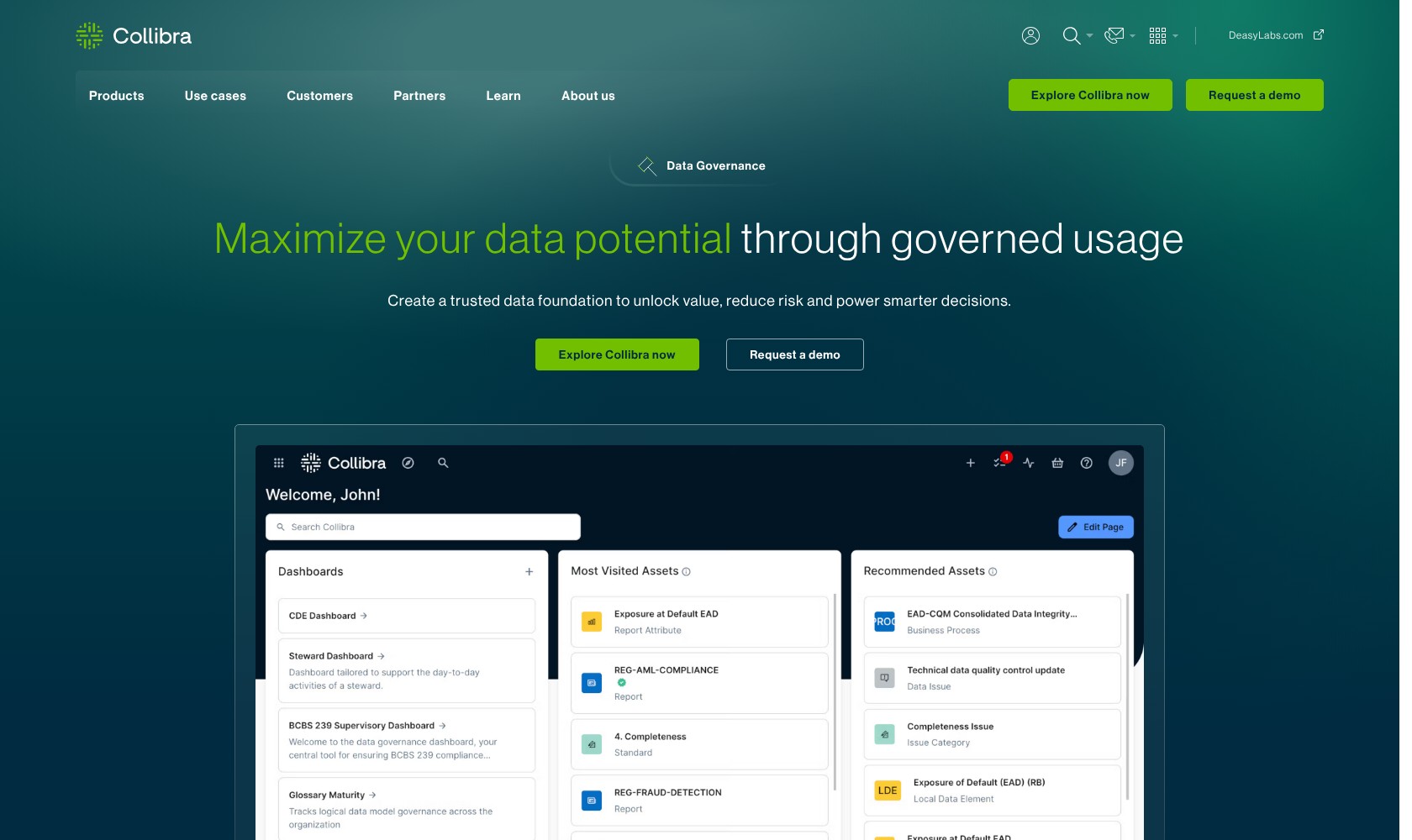
Collibra’s approval workflows are a stronger reason to buy it than a long connector list. They give teams a repeatable way to deal with responsibilities that otherwise disappear into email threads.
Its catalog workflows cover owner assignment, escalation, and access requests. Tasks can ask an individual or group to review an asset, verify ownership, or make a decision.
For a business where several teams depend on the same data, that structure is useful. You can establish who must respond instead of relying on an analyst knowing the right person to message.
However, I don’t consider more approvals an automatic improvement. The default Request Assets Access workflow requires approval from all data owners. That’s sensible when joint approval is necessary, but it could become an unnecessary delay if responsibilities are assigned too broadly.
Configuration is part of the ongoing work. Collibra’s catalog workflows depend on one another, and extending the default access-request asset types can require changes to workflow logic. A named administrator should take responsibility for those relationships before the rollout expands.
This makes Collibra a better fit for an established stewardship program than for a team hoping the software will design one for them. Agree who makes decisions first, then use the platform to make that process consistent.
Following Data Lineage and Quality Issues
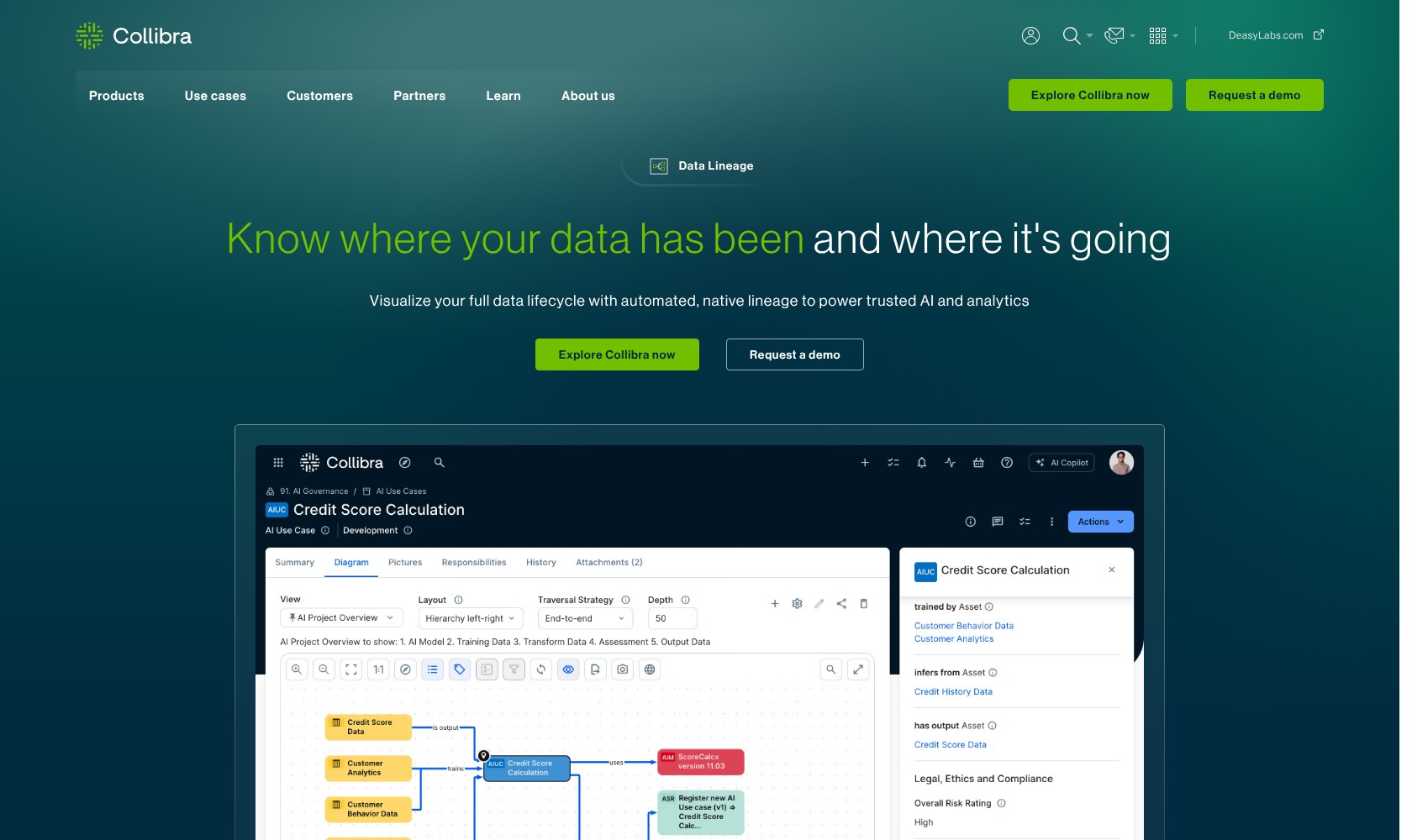
Lineage is most valuable when it answers a specific change question. Before renaming a column or altering a calculation, you want to know which downstream reports depend on it.
Collibra maps supported flows and transformations so teams can investigate those dependencies. Its value increases when you can connect the technical path with the people responsible for affected data.
My caution is with the phrase “supported integration.” It doesn’t mean every transformation inside that tool will appear in the lineage graph.
Tableau provides a useful example:
- Unions created in Tableau’s interface don’t appear in Collibra’s catalog and lineage, while custom-SQL unions are supported.
- Stored procedures can show lineage to worksheets without stitching back to the underlying database.
- Custom SQL can produce incomplete lineage where Tableau’s API doesn’t support the SQL involved.
Those limitations matter more to me than an impressive connector total. If a critical report uses one of those patterns, a polished demo using a simpler query won’t answer your buying question.
Collibra supports custom technical-lineage definitions for unsupported systems. I like having that option, but I’d budget engineering time to create and maintain those definitions. “Possible to integrate” and “ready to use” are different commitments.
Data Quality & Observability associates quality information with catalog assets and can route issue tasks to owners. For example, a dataset may have an agreed definition but still contain missing records. Seeing its quality information alongside that definition gives the consumer a better basis for deciding whether to use it. Confirm that capability in your proposed scope, and give somebody responsibility for responding to quality issues; a score alone doesn’t resolve them.
My recommendation is to make one important report’s full dependency chain part of the proof of concept, including its awkward transformations.
Governing AI With Collibra
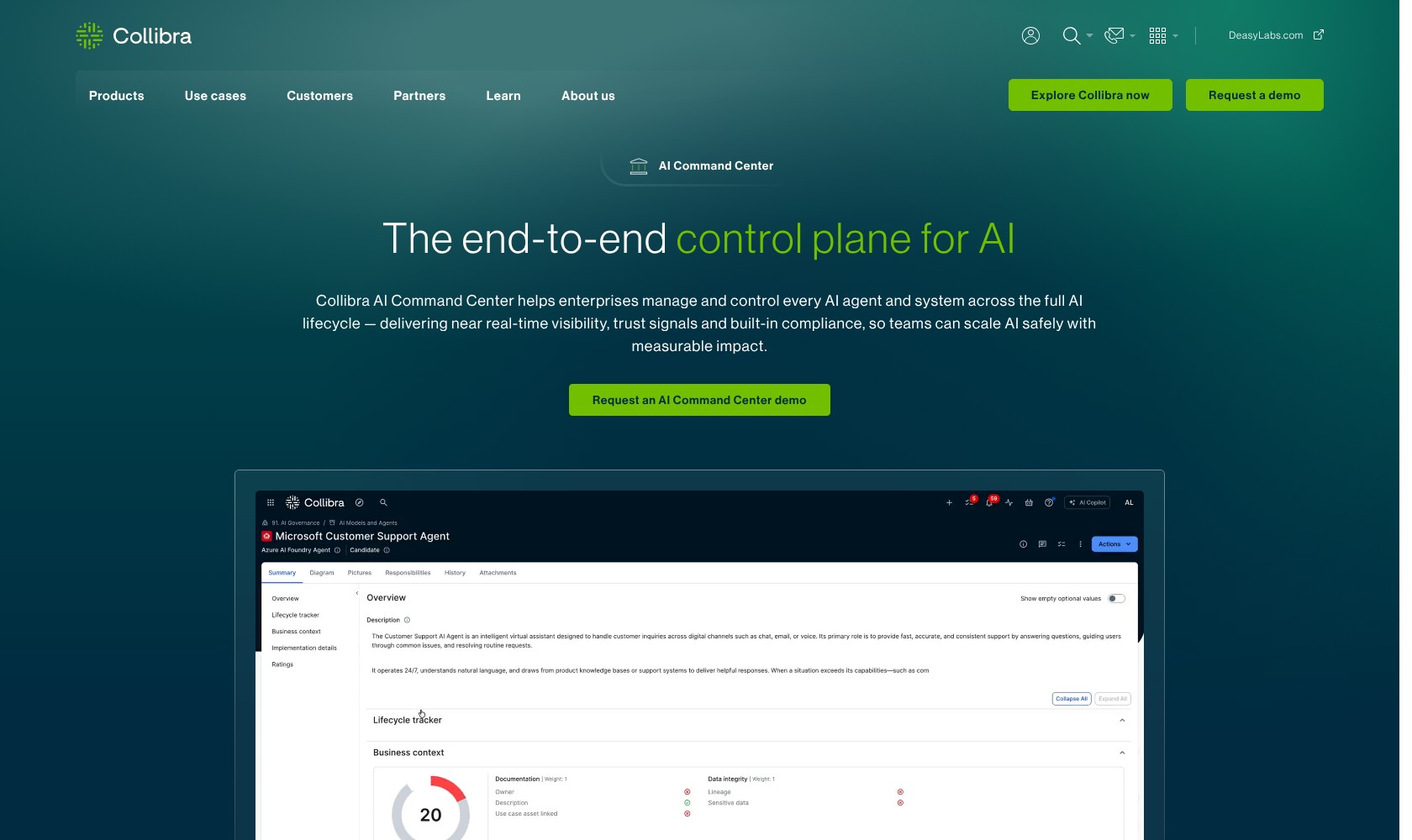
AI Command Center appeals to me most as a shared inventory and decision process for AI. It evolves Collibra’s AI Governance product into a consolidated registry and dashboard while retaining its core roles and assessments.
Setup still requires assigning the right roles and a Business Steward for assessment reviews. I see that as a worthwhile discipline, but someone has to own it.
That is useful if AI projects are spread across departments and platforms. You need to know what exists, who owns it, and which decisions have been recorded before you can oversee it consistently.
Assessments remain central to documenting value and risk. I like that practical focus more than treating an inventory dashboard as proof that an AI system is safe.
However, the newer agent controls need a closer look before purchase. Collibra’s platform page labels Guardian Agents and Agent Contracts as October 2026 previews. I’d confirm availability and supported behavior for your environment before making either feature essential to the contract.
There is also a specific scale caveat: the AI Command Center documentation warns that performance is significantly impaired above 1,000 AI Use Case assets. That is a limit concerning use-case assets, not a statement that the whole Collibra catalog can hold only 1,000 items.
For a large AI inventory, representative scale testing belongs in the evaluation. The platform’s governance approach is promising, but neither assessments nor preview controls should substitute for validating how your actual systems behave.
How Does Collibra Compare to Competitors?
The problem you need to solve first should determine your shortlist:
- Atlan: My comparison pick for teams prioritizing discovery and lineage across warehouses, transformation tools, and BI. Evaluate it against Collibra using the same dependency questions and real assets.
- Alation: Worth a close look when helping analysts discover trusted data and reuse SQL is the immediate goal. Its collaboration and discovery features make that a useful comparison.
- Microsoft Purview: A natural candidate for a Microsoft-heavy organization, with Data Map, Unified Catalog, and connections to Fabric workflows. It supports multicloud sources too. Model its consumption charges against your expected workload before assuming it will cost less.
Collibra gets my vote when formal stewardship and shared accountability are the deciding requirements. That doesn’t mean its rivals lack governance; it means those are the capabilities I’d put at the center of a Collibra evaluation.
How I Reviewed Collibra
I evaluated Collibra’s documented catalog, workflow, lineage, and AI capabilities against enterprise buying needs, alongside its public purchasing options and integration limitations. My recommendations weigh business fit, administrative responsibility, and the scope you need to establish before purchase.
This assessment does not include a hands-on deployment or measured performance results. Pricing information was checked in October 2026.
Should You Choose Collibra?
I recommend Collibra when your organization needs to make data ownership and approvals work across departments. Its catalog supplies context, while workflows give teams a way to act on responsibilities. That combination is more compelling to me than any isolated AI feature.
I’d be less enthusiastic if you’re a small team looking for a quick way to document tables. The purchasing process and governance administration need to earn their place in your budget.
Before committing, ask Collibra to demonstrate one complete process using your data: finding the right asset, identifying its owner, requesting access, and tracing a meaningful dependency. Get the relevant capabilities and delivery responsibilities written into the proposal. If that process works for the people who will maintain it, you’ll have a much stronger reason to buy than a broad feature checklist.
Frequently Asked Questions
What is Collibra used for?
Collibra helps organizations catalog data and manage its definitions, ownership, policies, and related governance processes. Its wider product lineup also covers lineage, data quality, and AI governance. I see its strongest fit in enterprises where several teams share responsibility for data.
How much does Collibra cost?
Ask for an itemized proposal covering your required products and users. The public AWS Marketplace contract is one procurement reference, not a universal starting price. The pricing table above gives its listed annual cost.
Is Collibra suitable for a small team?
It can be difficult to justify if your needs stop at finding and documenting datasets. I’d consider it when governance responsibilities are complex enough to warrant a dedicated platform and you have people available to maintain it.
Does Collibra replace a data warehouse?
No. Its catalog organizes information about data and its governance; the warehouse still stores and processes your analytical data. Evaluate how Collibra connects with your existing systems.
Is Collibra AI Governance now AI Command Center?
AI Command Center is the evolution of Collibra AI Governance, with a consolidated registry and dashboard. Core roles and assessments remain. Some newer agent-control capabilities are previews, so confirm what your proposed deployment includes.