Editor’s note: We combine independent analysis, data collection, and hands-on testing to review data and AI tools. This review weighs pricing transparency, real-world adoption signals, development momentum, openness and exit costs, practitioner sentiment, and our editorial verdict.
Quick verdict: We recommend Haystack for production teams that want typed, inspectable, Git-versionable RAG pipelines with enterprise connectors. The trade-off: a smaller community than LangChain or LlamaIndex, and more ceremony for a minimal prototype.
Most Haystack comparisons still print stale adoption figures. This Haystack review works from September 2026 numbers: among the document parsing and RAG frameworks in our directory, Haystack is the audit-minded pick.
Key Takeaways 🔍
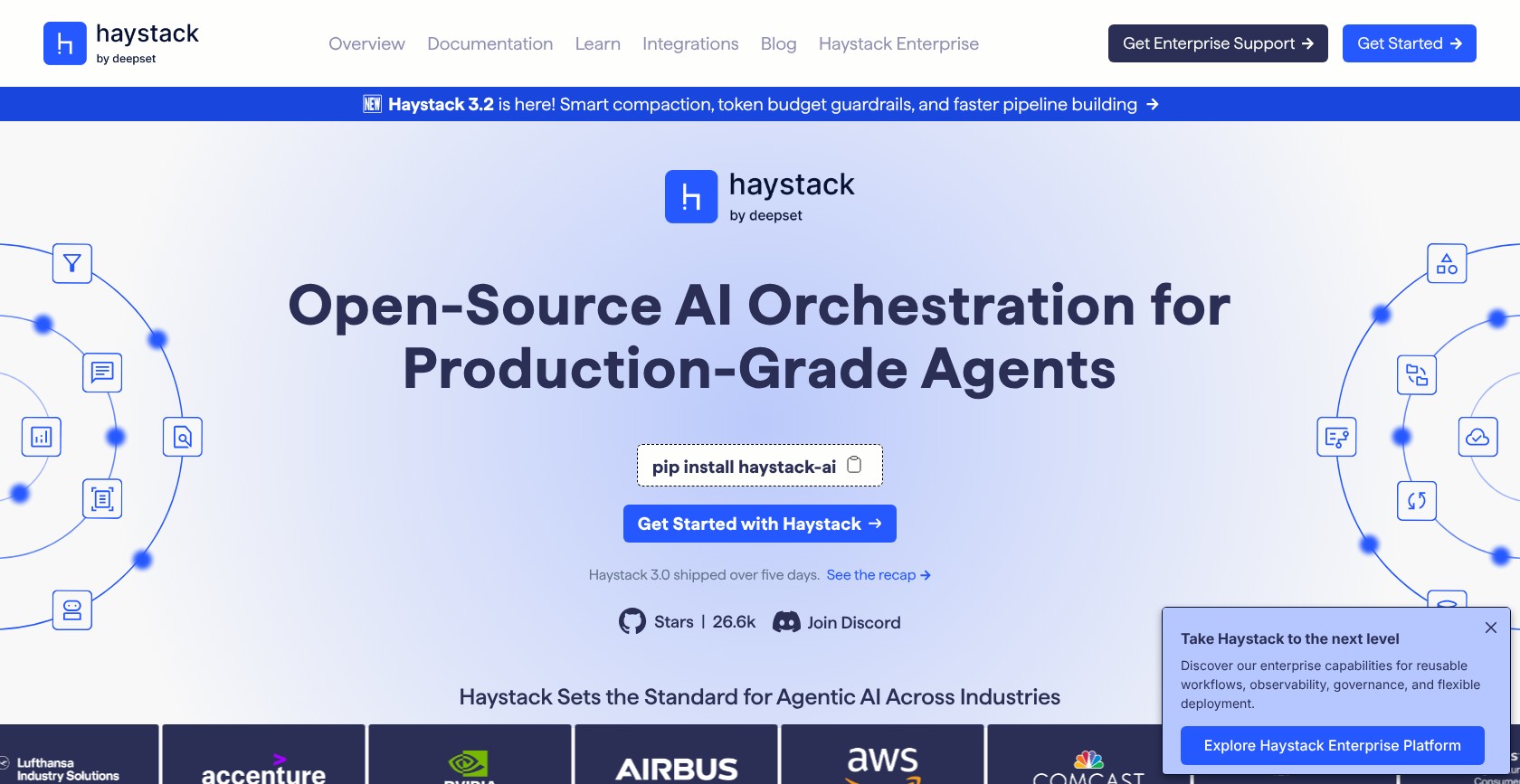
- Apache-2.0, 26.6k GitHub stars, roughly 540,000 monthly PyPI downloads as of September 2026; older comparisons cite 15k to 22.7k stars
- An independent five-framework benchmark measured Haystack’s overhead (about 5.9ms per query) and token usage as the lowest of all five
- deepset’s platform has a real free Studio tier: 1 user, 100 pipeline hours, 50 files, per deepset’s pricing page in September 2026
- Con: the 1.x-to-2.0 rewrite still surfaces migration pain in the project’s support threads
- Con: downloads run about a tenth of LlamaIndex’s cited figure; a smaller community means harder edge-case debugging
Pros and Cons
Haystack’s strengths are architectural; its weaknesses are community size, verbosity, and a rewrite that still echoes in support threads. Figures are dated September 2026.
Pros
- Typed component pipelines build as inspectable DAGs you can test and diff
- pipeline.dumps() serializes any pipeline to YAML for Git-versioned deployments
- Lowest overhead (5.9ms) and token usage (1.57k per query) in an independent five-framework benchmark
- Connectors for Elasticsearch, OpenSearch, Chroma, Qdrant, Weaviate, Pinecone, and Neo4j
- Apache-2.0 license with OpenSSF Best Practices certification
Cons
- 26.6k GitHub stars against LangChain’s 147.2k, and downloads a tenth of LlamaIndex’s
- A minimal RAG app takes visibly more code than rivals
- 2.0 migration breakage still shows up in support threads
- deepset Enterprise pricing is contact-sales only
- Observability (OpenTelemetry, Langfuse, MLflow) only landed properly in the 2026 releases
How Much Does Haystack Cost?
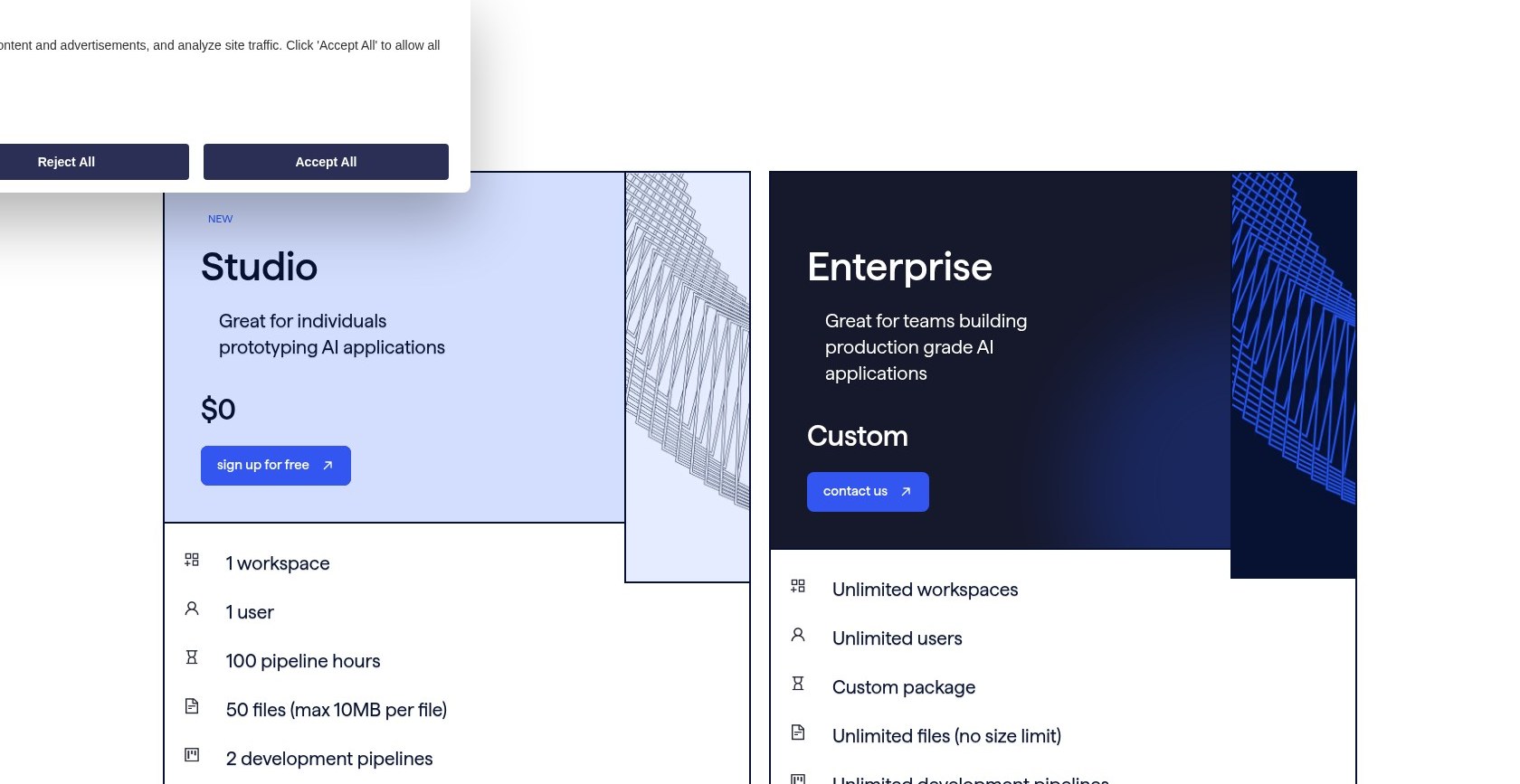
The framework itself costs nothing. haystack-ai ships under Apache-2.0, self-hosted, with no feature gates: every connector, every component, the full pipeline engine. The real Haystack pricing question is deepset’s commercial platform, and its pricing page settles what older comparisons only speculated about (prices as of September 2026):
- haystack-ai ($0): the whole framework, self-hosted, nothing held back
- deepset Studio ($0): 1 workspace, 1 user, 100 pipeline hours, 50 files at 10MB each, 2 development pipelines, cloud deployment, basic pipeline templates, API access, 14-day search history and logs, community support on Discord
- deepset Enterprise (custom): unlimited workspaces, users, and pipelines, custom or on-prem deployment, SSO, RBAC, unlimited search history, and a dedicated account team
| Tier | Price | Users | Pipelines | Key limits |
|---|---|---|---|---|
| haystack-ai (open source) | $0 | Unlimited, self-hosted | Unlimited | You run and pay for the infrastructure |
| deepset Studio | $0 | 1 | 2 development pipelines | 100 pipeline hours, 50 files at 10MB, 14-day history |
| deepset Enterprise | Custom, contact sales | Unlimited | Unlimited | On-prem option, SSO, RBAC, dedicated account team |
There is no public Enterprise price anchor. deepset runs a deliberate contact-sales model, so budget for that tier through a sales conversation, not a rate card.
Is Haystack Good Value for Money?
- The cost is engineering time, not license fees. A minimal RAG app takes more code than in LlamaIndex or LangChain, and those hours are the real invoice
- The runtime math runs the other way. In the independent five-framework benchmark, Haystack averaged about 1.57k tokens per query, the lowest of the five; at production volume that is a genuine LLM cost advantage
- LlamaIndex’s hosted platform bills by credits: free at 10k credits, then Starter at $50 per month and Pro at $500 per month
- LangChain’s framework is also free, with its LangSmith commercial layer at $39 per seat per month
- Studio’s free tier covers a real evaluation: 100 pipeline hours and 2 development pipelines get a proof of concept done without a card
Author’s Testing Notes 📝
Self-host the framework; it is the product, and $0 buys all of it. Use Studio’s free tier when you want to prototype pipelines visually before committing them to code. The Enterprise conversation is only worth scheduling if you need on-prem deployment, SSO, and RBAC for a regulated environment; nobody else needs to talk to sales.
— Panoply reviewer
My Experience With Haystack
Installing and First Pipeline
Setup is one line: pip install haystack-ai, on Python 3.10 or newer, plus an API key for your model provider. OpenAI, Anthropic, Cohere, Mistral, Hugging Face, and Google Vertex AI are all supported, so I could pick a provider without consulting a compatibility matrix.
From there the workflow breaks with what LangChain or LlamaIndex trains you to expect. There is no one-line abstraction hiding the machinery. I followed the quick-start path in the official tutorials (there is also a free DeepLearning.AI short course): declare each component, then connect its typed outputs to the next component’s typed inputs until the graph is complete.
A minimal RAG app is therefore two explicit pipelines, one that indexes documents into a store and one that queries them. That is more code than rivals ask for the same result, a deliberate trade of convenience for transparency. The compensation is that every component declares its input and output types, so a mismatched connection fails when you assemble the graph instead of surfacing later as a wrong answer.
Serializing to YAML
pipeline.dumps() exports the entire pipeline definition to YAML, and the file loads back into a running pipeline. That one call is the operational differentiator: the architecture goes into Git, changes to it arrive as reviewable diffs in pull requests, and Kubernetes deployments redeploy from the same file. ZenML’s comparison frames this model as infrastructure-as-code for RAG, and the label fits: the pipeline is a versioned artifact, not a script.
LlamaIndex offers nothing equivalent; its workflows are code-defined, with no pipeline-level serialization to export.
Observability and Agents
The 2026 releases closed the framework’s biggest historical gap. By May 2026, version 2.29.0 had added first-class observability integrations for OpenTelemetry, Langfuse, and MLflow, plus state injection, which lets components read and modify live agent state mid-run. Langfuse is a tool we review separately in this directory. Haystack’s documentation treats Agents, Tools, and Document Stores as core concepts alongside components and pipelines, so agent work stays inside the same typed architecture as retrieval. The release cadence has held since: v3.2.0 shipped September 24, 2026.
Author’s Testing Notes 📝
If a tutorial you found predates 2024, check its package name before copying anything. farm-haystack is the legacy 1.x line and haystack-ai is the current framework; installing both side by side is a documented source of confusion in the project’s own support threads, and 1.x code will not run on 2.x.
— Panoply reviewer
Typed Pipelines and YAML: The Auditability Case
Why would anyone choose the framework that takes more code? Because in Haystack the pipeline itself is an inspectable object. Every component declares typed inputs and outputs, pipelines assemble as directed acyclic graphs, and you can inspect, unit-test, and diff the result like any other artifact in the repository.
Haystack’s design rests on four principles: technology agnosticism, explicit code, flexibility, and extensibility. Explicit code is exactly what the prototyping crowd calls verbosity, and exactly what a platform team calls a system it can reason about. The agnosticism claim is not aspirational either: InfoWorld counts 34 first-party integrations plus 28 community-contributed ones.
With the YAML export, a retriever swap arrives as a few changed lines a reviewer can approve in a pull request, and the pipeline running in production is demonstrably the one that passed review.
The standing objection is that ceremony costs performance. An independent benchmark from AIMultiple says otherwise: across five frameworks (LangChain, LangGraph, LlamaIndex, Haystack, DSPy) on a 100-query set, all five hit 100% accuracy, and Haystack posted both the lowest framework overhead at roughly 5.9ms per query and the lowest average token usage at about 1.57k tokens. The most explicit framework in the set is also the leanest one to run.
LlamaIndex workflows are code-defined with no pipeline serialization, so there is no exported artifact for a reviewer to read. LangChain’s chains are less explicit and less inspectable than Haystack’s typed DAGs.
The audit trail earns its extra lines in one specific situation: when a compliance officer or a platform team must sign off on exactly what the pipeline does before it ships. If nobody will ever ask you that question, the ceremony buys you less.
Who Actually Runs Haystack
deepset’s reference list reads like a European procurement register, not a startup logo wall. Every entry below is a vendor-published case study, so read them as deepset’s own telling rather than independently verified deployments:
- European Commission: AI@EC, a self-hosted sovereign AI platform built on the Haystack Enterprise Platform
- Bosch: the DRIVE Companion assistant, deployed across 600+ employees in SAP migration teams
- Airbus: a combined table-and-text QA system answering in under a second; Airbus Defence and Space’s KITCH project analyzes military regulations and runs combat simulations
- Lufthansa Industry Solutions: a compliant, enterprise-grade AI knowledge assistant
- Rohde & Schwarz: a trustworthy RAG system built with deepset and appliedAI
- Germany’s Federal Ministry for Research, Technology and Space (BMFTR): a chatbot that makes project funding regulations easier to navigate
- Mozilla: a partnership story on building a unified, sovereign AI stack with Thunderbird and Haystack
That is eight case studies from seven organizations, two of them public bodies (the European Commission and BMFTR), and the pattern does the verdict work: the roster skews European, regulated, and sovereignty-minded, which is precisely the buyer an auditable, self-hostable, Apache-2.0 architecture serves. The live signals back the vendor story: 26.6k GitHub stars, roughly 540,000 monthly PyPI downloads, v3.2.0 released September 24, 2026, and a Production/Stable PyPI classification with OpenSSF Best Practices certification, all checked September 2026.
Where Haystack Falls Short
The community is small for the category. haystack-ai pulls roughly 540,000 PyPI downloads a month against LlamaIndex’s cited 5 million, per ZenML’s figures: about a tenth of the installed base. Practitioner comparisons in 2026 name the consequence bluntly: a smaller community means harder debugging when you hit edge cases. Some of them quote star counts as low as 15k, well under today’s 26.6k, but the point stands. Fewer users means fewer existing answers when your bug is exotic.
The explicitness reads as verbosity. The minimal RAG example needs two separately constructed pipelines where rivals offer a one-line abstraction, a deliberate trade of convenience for transparency. If your goal this week is a demo, you will feel every extra line: a rival’s one-line abstraction has you querying documents before Haystack’s indexing pipeline is fully wired.
The 2.0 rewrite left scar tissue. Search the project’s GitHub Discussions for migration help and three threads set the expectation: a DocumentClassifier compatibility issue from the 1.x-to-2.x transition (August 2024) that is still unanswered, confusion over installing farm-haystack and haystack-ai side by side (March 2024), and ElasticsearchDocumentStore initializer parameters that changed underneath existing code (March 2024). That is what a stuck migrator finds today: real breakage, partial answers, and at least one question nobody closed.
None of the three disqualifies Haystack for its production niche. All three matter if you are a solo builder picking a first framework, the case where community depth and quick wins count most.
How Does Haystack Compare to Competitors?
The big-three decision comes down to what your pipelines must survive: an audit, an agent architecture, or a deadline. The strongest Haystack alternatives split cleanly by niche:
- LangChain is the ecosystem giant at 147.2k GitHub stars (live, September 2026), centered on agents built with LangGraph, and it runs the largest plugin marketplace of the three. For search-centric, RAG-specific tasks it needs more setup than Haystack’s turnkey pipelines, and its chains are less inspectable than typed DAGs. Its commercial layer is LangSmith at $39 per seat per month, a tool we review separately in this directory.
- LlamaIndex is the RAG-first pick, MIT-licensed, with roughly 300 integrations via community-driven LlamaHub and the biggest download base of the three (about 5 million monthly per ZenML’s cited figures). It offers no pipeline-level serialization, so nothing like Haystack’s YAML audit artifact exists, and its hosted platform bills by credits: free at 10k credits, then $50 per month for Starter and $500 per month for Pro.
- DSPy is the outlier from the same five-framework benchmark (it also hit 100% accuracy on that test set): it optimizes prompts programmatically instead of wiring pipelines, a different paradigm rather than a drop-in substitute.
- Unstructured and LlamaParse are not rivals at all; they are the document parsing layer a Haystack pipeline consumes, so pair one with Haystack rather than choosing between them. Both carry their own reviews in this category.
The decision rule: pick LlamaIndex or LangChain when you want the fastest prototype and the deepest ecosystem to lean on. Pick Haystack when a platform team must audit, version, and run the pipeline cheaply at scale; the YAML export and the benchmark’s token numbers are the two facts that close that argument.
How We Test RAG Frameworks
We combine independent analysis, data collection, and hands-on testing to review data and AI tools. For a framework like Haystack, that means collecting public signals (GitHub, PyPI, Docker Hub, Stack Overflow, G2, and Gartner peer reviews), hand-checking vendor pricing pages ourselves, and setting the tool up to run a real task end to end before comparing it against its closest rivals.
Sustained user sentiment feeds the assessment too, deliberately small-weighted so one vocal thread cannot swing a verdict. Where an area cannot be measured, we mark it N/A rather than scoring it zero. Signals are refreshed monthly, editorial verdicts reviewed quarterly, and sponsors and affiliates cannot change a score.
Haystack Review: Should You Build Your RAG Pipelines on Haystack?
So is Haystack worth it? We recommend it for teams whose pipelines have to answer to someone: platform groups that need auditable, serializable architecture, enterprises with compliance sign-off in the deployment path, and anyone running RAG at a scale where 1.57k average tokens per query, the benchmark’s lowest, turns into a real line item. The sovereignty-heavy reference roster (European Commission, Bosch, Airbus, all vendor-published) shows the audit-minded buyer is already here.
Skip it in three cases. Solo builders optimizing time to first demo will move faster on LlamaIndex. Agent-first architectures already living in the LangGraph ecosystem should stay with LangChain. And if you expect to lean on community answers for edge cases, Haystack’s community runs a fraction of either rival’s.
The next action costs nothing: pip install haystack-ai, build one typed pipeline against your own documents, serialize it with pipeline.dumps(), and open a PR with the YAML file. That artifact is the pitch; if your team sees the point of a reviewable pipeline, Haystack is your framework.
FAQ
Is Haystack free?
Yes. The core framework, haystack-ai, is Apache-2.0 licensed and free to self-host with no feature gates. deepset’s commercial platform adds a free Studio tier (1 user, 100 pipeline hours, 50 files) for prototyping, plus a custom-priced Enterprise tier with SSO, RBAC, and on-prem deployment that requires a sales conversation.
Which should I use: Haystack, LangChain, or LlamaIndex?
Haystack builds explicit, typed pipelines as inspectable graphs, best for production teams that need auditable architecture. LangChain centers on agent orchestration through LangGraph and has the largest ecosystem of the three. LlamaIndex is RAG-first, with roughly 300 LlamaHub integrations and the fastest path to a working prototype. See How Does Haystack Compare to Competitors? above for the full breakdown.
What changed in Haystack 2.0?
Haystack 2.0 was a complete architectural rewrite: the 1.x node system became explicit typed components and pipelines, and the PyPI package was renamed from farm-haystack to haystack-ai. The rewrite caused real migration friction, still documented in the project’s GitHub Discussions: component compatibility breaks, package-naming confusion, and changed document-store initializer parameters.
Is Haystack production-ready?
Yes, by the available public measures. PyPI classifies haystack-ai as Production/Stable with OpenSSF Best Practices certification, an independent five-framework benchmark measured the lowest overhead of the set at about 5.9ms per query, and deepset’s vendor-published case studies name the European Commission, Bosch, Airbus, and Lufthansa Industry Solutions as production users.
What is deepset’s relationship to Haystack?
deepset created and maintains the open-source Haystack framework and sells the deepset AI Platform (formerly deepset Cloud) as the commercial layer on top of it. The platform includes deepset Studio, a visual pipeline designer with a free tier (1 workspace, 1 user, 100 pipeline hours, 50 files) listed on deepset’s pricing page as of September 2026.