Editor’s note: We combine independent analysis, data collection, and hands-on testing to review data and AI tools. This Helicone review weighs pricing transparency, real-world adoption signals, development momentum, openness and exit costs, practitioner sentiment, and our editorial verdict.
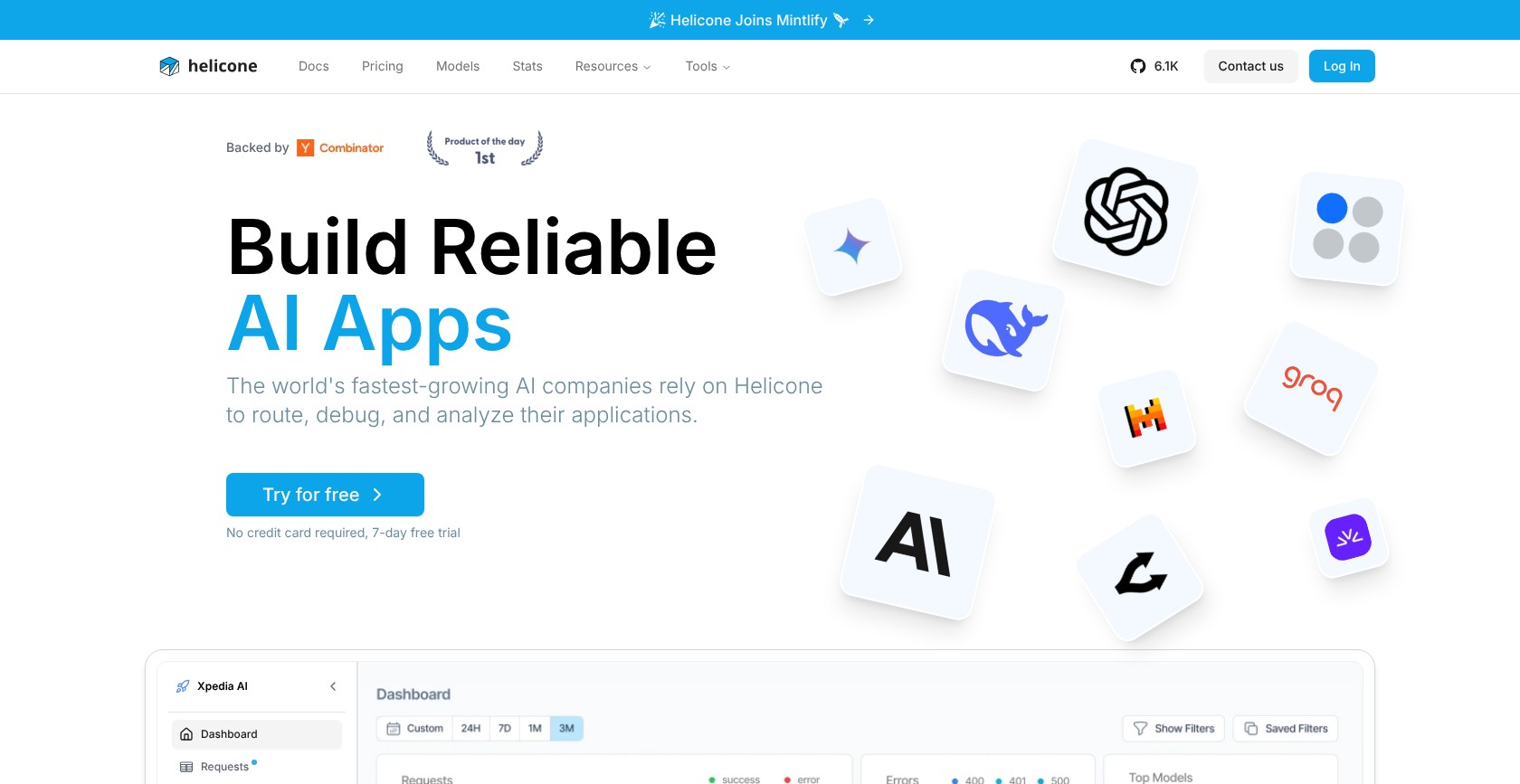
Quick verdict: We recommend Helicone only for teams willing to self-host its Apache-2.0 open-source version, and for existing hosted customers with no urgent reason to leave. We do not recommend starting a new hosted deployment, because you cannot: new signups are disabled. Among the LLM observability tools in our directory, Helicone’s proxy architecture remains one of the cleanest; the roadmap behind it is frozen.
Key Takeaways 🔍
- Mintlify acquired Helicone on March 3, 2026, and the hosted product is now in maintenance mode: security fixes and new-model support continue, feature development has stopped
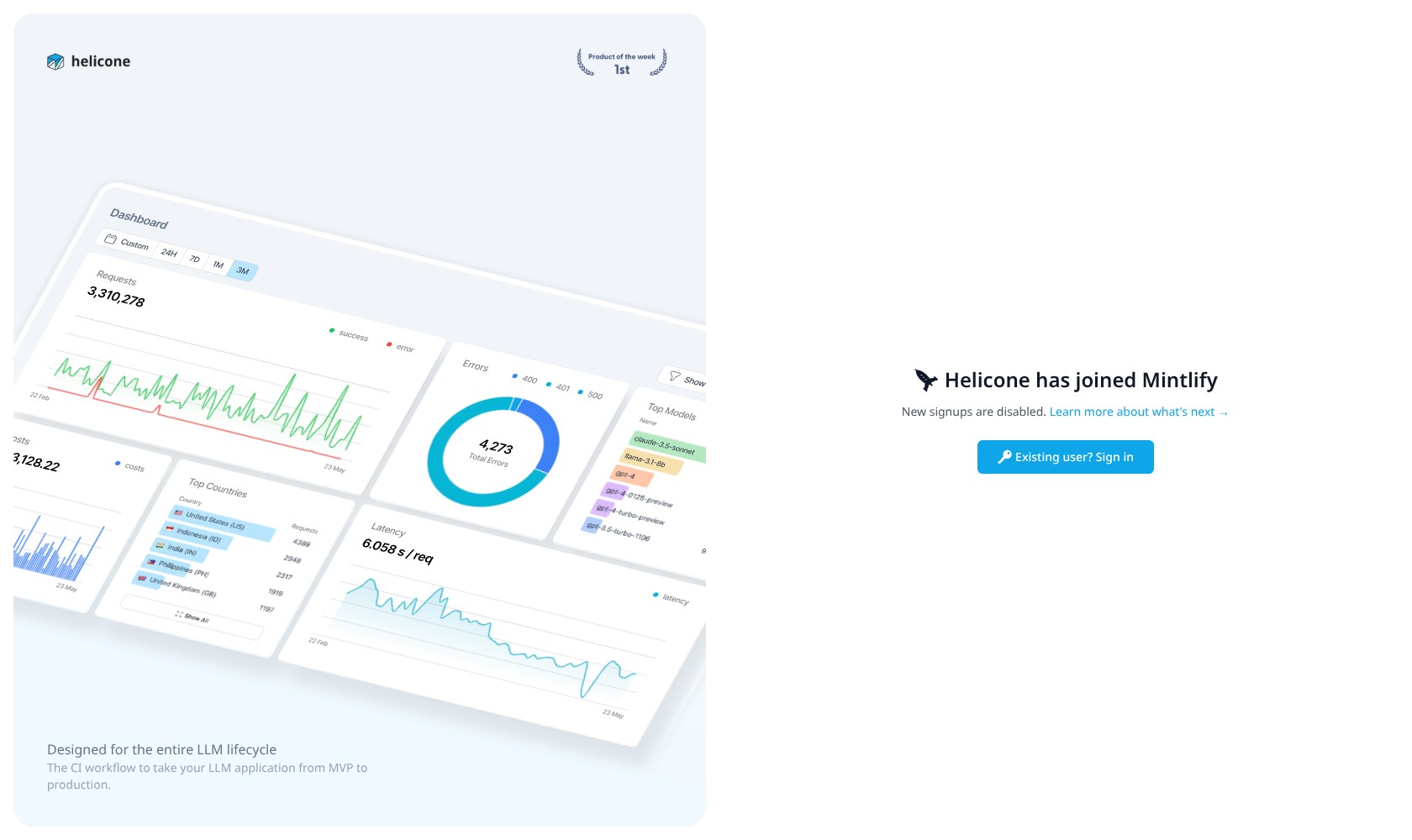
- The live sign-in page reads “New signups are disabled” (checked September 2026)
- Verified current pricing: Hobby free with 10,000 requests per month, Pro $79/month, Team $799/month; several widely read review sites still print older, wrong figures
- The Apache-2.0 self-hosted version stays open to everyone, with no request cap
- Tracing is request-level rather than span-based, and prompt A/B testing was removed in September 2025
Pros and Cons
The 30-second scan, current as of September 2026:
Pros
- Base-URL swap integration works with any HTTP client, first logged request in minutes
- Edge caching with TTLs up to 365 days, rate limiting, and failover in one gateway
- Zero markup on provider costs, unlike gateways that add 10-20%
- Apache-2.0 self-hosting with no request cap
- Near-parity latency in the vendor’s 500-request benchmark, 2.21s mean both through the proxy and direct
Cons
- Hosted product in maintenance mode since March 2026, new signups disabled
- Roadmap frozen, feature development stopped after the acquisition
- Request-level tracing misses the nested agent structure span-based rivals capture
- Prompt experimentation and A/B testing removed September 1, 2025
- Free tier keeps only 7 days of data on 10,000 requests a month
The Mintlify Acquisition: What Changed and For Whom
Mintlify announced its acquisition of Helicone on March 3, 2026, and the Helicone team relocated to Mintlify’s San Francisco office. The hosted product moved into maintenance mode at the same time: security updates, bug fixes, and support for newly released models continue to ship, while feature development has stopped and the roadmap is frozen. New cloud signups are disabled. I checked the sign-in page in September 2026, and it reads “New signups are disabled” directly below the notice that Helicone has joined Mintlify.
No shutdown has been announced. The practical answer depends on which of three groups you are in.
Existing hosted customers: you can stay. Patches, bug fixes, and new-model support keep arriving, and nothing on the vendor’s side forces a move. Plan the exit on your schedule, not theirs. One complication comes from migration-guide coverage written by vendors selling Helicone alternatives, so read the urgency accordingly: those guides report that maintenance-mode dependencies surface as findings during SOC 2 and ISO 27001 review cycles, which pushes some teams to migrate for audit reasons rather than product complaints.
New adopters: the hosted door is closed. You cannot create an account, so the only path in is self-hosting the Apache-2.0 open-source version, which I cover under pricing below.
Migrators: Helicone bundles three jobs into one proxy: request tracing, response caching, and per-user rate limiting. The same vendor-written migration guides recommend splitting them on the way out: tracing to an SDK-based platform such as Langfuse, caching to provider-side prompt caching or a thin Redis layer, and enforcement to a dedicated metering layer. They also flag the silent one, and the warning holds regardless of who sells what: per-user rate limits configured in Helicone stop existing the day the base URL changes back, and missing limits announce themselves as a provider bill.
At the acquisition, Helicone stated it had processed 14.2 trillion tokens for roughly 16,000 organizations, tracking over 33 million end users. Those are vendor-stated figures, not independently audited, but they are dated to the announcement, and that scale is why a product in maintenance mode still gets a full review here.
How Much Does Helicone Cost?
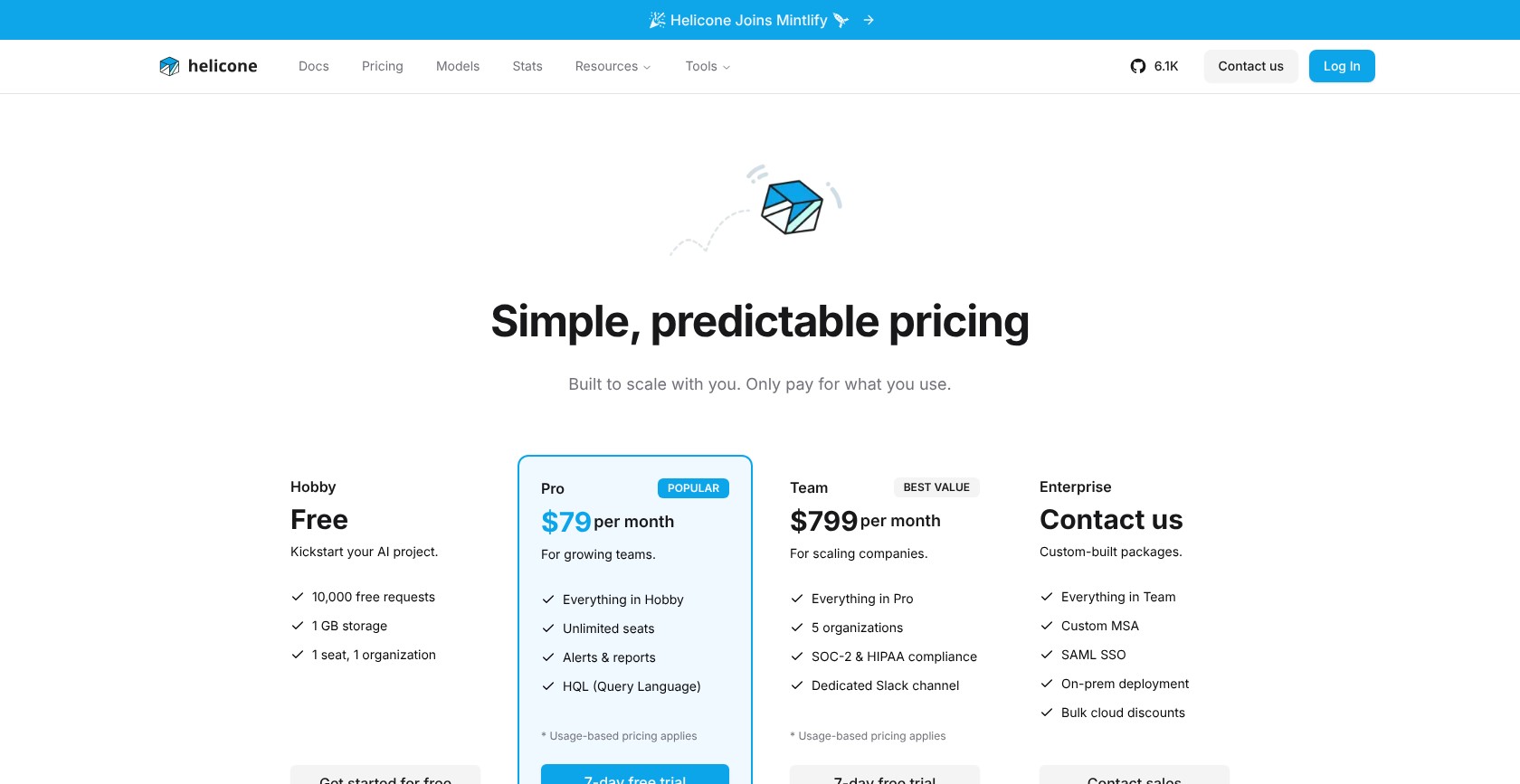
If you looked up Helicone pricing on a third-party review site, the odds are the numbers you found were wrong. Several widely read pages list a $20 per seat Pro plan, a $200 per month Team plan, or a free tier of 50,000 to 100,000 requests. The live pricing page, checked September 2026, says none of that. These are the current tiers, now relevant to existing customers only:
- Hobby ($0): 10,000 requests per month, 1 GB storage, 1 seat, 7-day data retention, 10 logs per minute ingestion
- Pro ($79/month): unlimited seats, 10,000 free requests plus usage-based overage, 1-month retention, 1,000 logs per minute
- Team ($799/month): 5 organizations, SOC-2 and HIPAA compliance, 3-month retention, 15,000 logs per minute
- Enterprise (custom): SAML SSO, on-prem deployment, forever retention
| Plan | Price | Requests | Retention | Ingestion | Key adds |
|---|---|---|---|---|---|
| Hobby | $0 | 10,000/month | 7 days | 10 logs/min | 1 seat, 1 GB storage |
| Pro | $79/month | 10K free + usage-based overage | 1 month | 1,000 logs/min | Unlimited seats |
| Team | $799/month | Not listed | 3 months | 15,000 logs/min | 5 orgs, SOC-2, HIPAA |
| Enterprise | Custom | Custom | Forever | Custom | SAML SSO, on-prem |
Self-hosting is the $0 column that still accepts new users. The platform is Apache-2.0 licensed with no request cap on self-hosted deployments, so the paid cloud tiers buy hosted convenience, compliance, retention, and team features rather than the underlying capability. Per the vendor’s docs, running it means deploying the proxy gateway plus a Supabase backend for storage and auth and ClickHouse for analytics, with optional Redis for caching, via docker-compose. Confirm that component list against the live self-host guide before you plan infrastructure around it.
Is Helicone Good Value for Money?
- For existing customers, the tiers still price fairly against what the gateway bundles: caching, rate limiting, failover, and cost analytics with zero markup
- For new adopters, hosted value is moot; the only real price is the ops time to run the gateway, Supabase, and ClickHouse yourself
- The Hobby tier’s 7-day retention is a real limitation, and the $0-to-$79 step to Pro is steep for an early-stage team that only needs longer history
Author’s Testing Notes 📝
Existing customers on Pro at $79/month should hold and revisit quarterly; the plan still does what it did. New adopters should either self-host or pick an actively developed rival like Langfuse or Portkey. And nobody, in any group, should sign a multi-year dependency on a product whose roadmap is frozen.
— Panoply reviewer
My Experience With Helicone
Helicone’s integration is one URL and one header, and it still works exactly as designed for any team with an existing account or a self-hosted instance.
The Base URL Swap
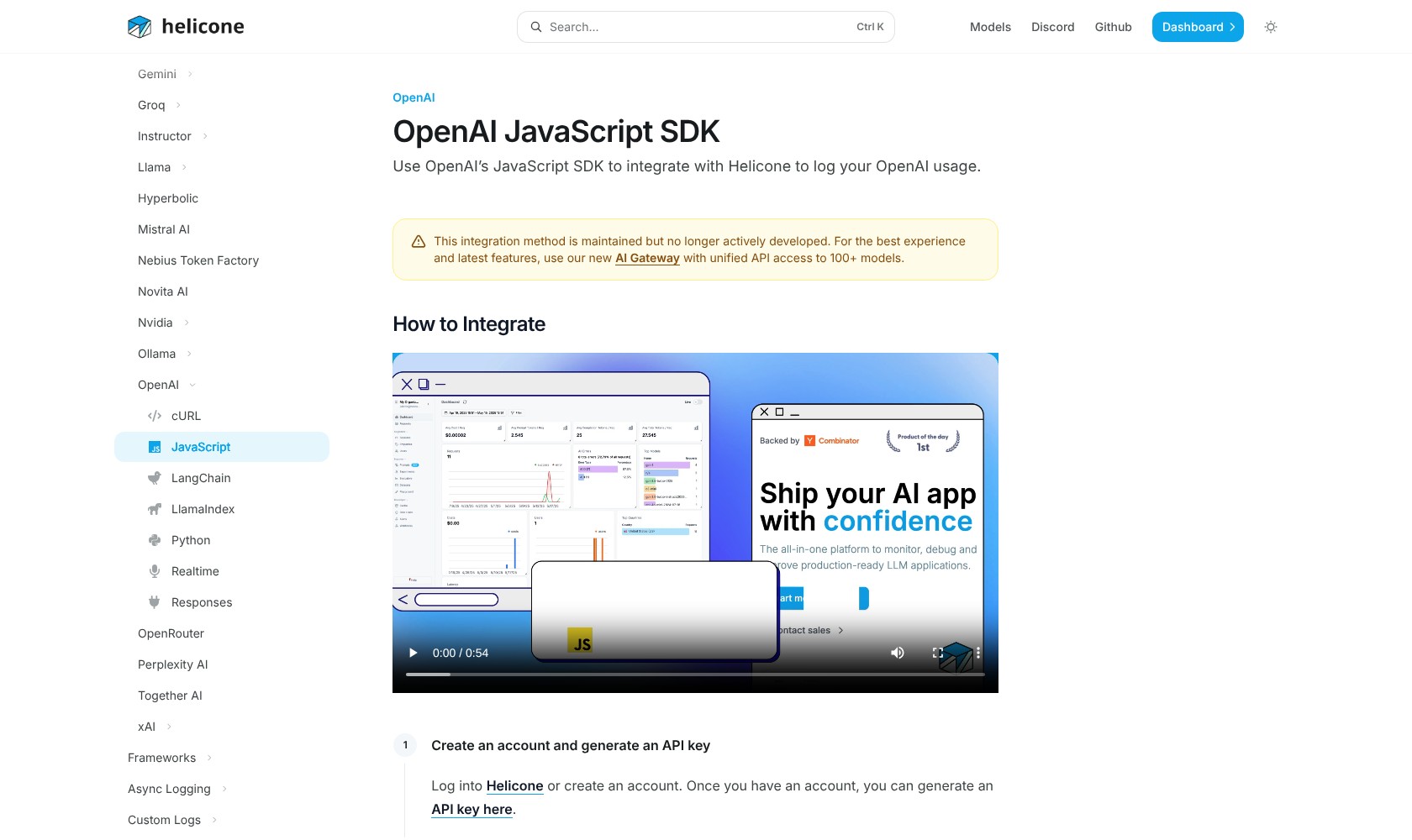
The documented flow is short: point your OpenAI or Anthropic client at Helicone’s proxy endpoint (the oai.helicone.ai/v1 style URL), add a Helicone-Auth bearer header with your Helicone API key, and leave everything else in the request untouched. That is the whole integration. It works with any HTTP client, not just the official SDKs, because the proxy speaks the provider’s own API shape. Per the documented flow, your first logged request reaches the dashboard in under two minutes, with no SDK to install, no wrapper to import, and no instrumentation code to write.
Compare that with Langfuse, where the same visibility costs hours of SDK instrumentation across your codebase. The trade is real: the proxy gives you breadth instantly, and the SDK route gives you depth you configure yourself.
What the Dashboard Answers
Helicone attributes spend per request, per user, and per model, and budget alerts fire when a user or key crosses a threshold you set. For a team whose main question is “where is the LLM bill going,” this is one of the strongest cost-attribution surfaces in the proxy category.
What it does not answer matters just as much. A competing vendor’s migration guide describes the gap as the production operator’s set of questions: cost per customer, cost per feature, whether a scheduled run was actually fresh, whether output quality drifted. Request-level logging watches the request; those questions live above it, in your product’s own vocabulary, and answering them takes custom properties and work on your side.
Retrofitting an Existing App
The honest niche where the proxy beats SDK instrumentation: codebases that were never built with tracing hooks. If you inherit an app with LLM calls scattered across services, one base URL change per service gets you logging, caching, and rate limits without touching application code. No SDK-based rival can match that entry cost.
Author’s Testing Notes 📝
Before you commit to self-hosting, open the repo’s docker-compose file next to the self-host guide. The component list under pricing (gateway, Supabase, ClickHouse, optional Redis) is what Helicone’s documentation describes; confirm it before you size servers or write Terraform, because a maintenance-mode project’s docs can lag its code.
— Panoply reviewer
The Gateway Features: Caching, Limits, and the Latency Question
Why route production traffic through someone else’s proxy at all? Because Helicone’s gateway bundles three features that otherwise take three tools. Caching runs at the Cloudflare edge with a TTL configurable up to 365 days, so repeated prompts return cached responses without hitting the provider, and a cached hit costs you nothing on the provider bill. Per-user rate limiting enforces caps at the proxy, before a runaway user reaches your OpenAI bill.
Automatic failover reroutes when a provider errors. And Helicone adds zero markup on provider costs, a stated differentiator against gateways that add 10-20% overhead. Langfuse, the most common tracing replacement, has no proxy-layer caching, so leaving Helicone means rebuilding this layer somewhere else.
The standing objection to any proxy is latency. Helicone’s own 500-request benchmark shows a mean latency of 2.21 seconds both through the proxy and direct OpenAI calls, with a maximum of 3.76 seconds through the proxy against 3.56 seconds direct. The vendor credits Cloudflare Workers’ edge architecture, which avoids cold starts. That is vendor-published data, so treat it as the vendor’s best case. The documentation does not commit to a fixed per-request millisecond overhead at all. You will also see a 50-80ms overhead figure repeated across the web; it traces to no primary source, so we do not cite it. The vendor benchmark is the only measured data available, and it shows near-parity.
As the acquisition section covered, the proxy bundles three jobs: tracing, caching, and enforcement. That bundling is the convenience going in and the migration surface coming out. The framing comes from a competing vendor’s migration guide, and it holds up on architecture alone. The single-point-of-failure risk is real, and it is the right reason to hesitate. The measured latency cost is not.
Where the Tracing Model Runs Out
Helicone captures request/response pairs. Langfuse, LangSmith, and Arize Phoenix capture trees: nested spans that show a parent agent calling a sub-agent calling a tool. If your pipeline is one prompt in, one completion out, the flat model loses nothing. The moment you build multi-step agent pipelines with tool calls and sub-agents, the proxy misses the internal structure, and representing that nesting in Helicone takes manual instrumentation that span-based rivals handle natively. Agent-specific failure modes sit in the same blind spot: a missed scheduled run looks like nothing at the request level, because no request ever happened.
One vendor’s migration writeup names the failure class the flat model misses entirely: “a 200 OK with hallucinated output is a failure that no traditional observability stack catches.” Request-level logging confirms the call succeeded; it cannot tell you the answer was wrong. Catching output-quality drift takes evaluation tooling, and that is Helicone’s second gap: its prompt experimentation and A/B testing feature was deprecated and removed on September 1, 2025, months before the acquisition, so this is a product decision rather than acquisition fallout. Langfuse ships custom scoring functions, human annotation, and prompt versioning; Braintrust is built around evals. Helicone no longer offers prompt experiments at all.
Helicone was always a gateway with logs, not an eval platform. The difference in 2026 is that the gap can no longer close, because the roadmap that might have closed it is frozen.
How Does Helicone Compare to Competitors?
Which rival you need depends on which of Helicone’s three jobs you are replacing. The Helicone alternatives split into two camps, observability platforms and fellow gateways, and both sit alongside Helicone in our LLM observability and evaluation category:
- Langfuse: the natural migration target for the tracing job. Native tree/span model, custom scoring and human annotation for evals, prompt versioning, free self-hosting on Postgres and Redis, and a generous cloud free tier of 50,000 observations a month against Helicone’s 10,000 requests. The cost is hours of SDK instrumentation where Helicone took a URL swap, and there is no proxy-layer caching
- LangSmith: automatic tracing if you build inside LangChain, plus a prompt-testing playground. Outside LangChain, expect 1-3 hours of manual instrumentation and a narrower framework fit than the provider-agnostic tools on this list
- Arize Phoenix: span-based tracing and evaluation, and a consistent name on LLM observability shortlists; our separate Arize review in this directory covers it in depth
- Braintrust: eval-first for teams whose gap was never logging. It competes directly on the experimentation surface Helicone removed in 2025
- Portkey: the gateway-shaped successor. Fully Apache-2.0 since March 2026, 250+ models, built-in guardrails including PII redaction, jailbreak detection, and prompt-injection filters, plus semantic caching and versioned prompt management
- LiteLLM: the MIT-licensed self-host gateway. 100+ providers behind one OpenAI-compatible endpoint, zero markup, and virtual keys for team-level budget control. The trade: your team owns all of the operational work, from uptime to compliance documentation
The decision rule: replacing Helicone’s logging means Langfuse; replacing its gateway means Portkey or LiteLLM. Most migrating teams need one of each, not one of everything, because as covered above, Helicone was three tools wearing one base URL.
How We Test LLM Observability Tools
We combine independent analysis, data collection, and hands-on testing. For each tool we collect public adoption signals (GitHub activity, PyPI and Docker Hub downloads, Stack Overflow volume, G2 and Gartner peer reviews), hand-check the vendor’s pricing page, and set the tool up ourselves to run a real task end to end against its closest rivals. Sustained user sentiment is weighed, deliberately small, as a supporting signal rather than a driver. Where an area cannot be measured for a tool, we score it N/A rather than zero. Signals are refreshed monthly and editorial verdicts quarterly, which is how this review reflects the March 2026 maintenance-mode change that most published Helicone reviews still omit. Sponsors and affiliates cannot change a score. Prices current as of September 2026.
Helicone Review: Should You Run Your LLM Traffic Through Helicone?
Is Helicone worth it in 2026? We recommend it in exactly two situations. Existing hosted customers can hold: patches and new-model support continue, no shutdown has been announced, and the product still does what it did at its peak. Plan an unhurried exit anyway. Self-hosters get a genuinely good Apache-2.0 gateway with no request cap, and inherit its community-maintained future with eyes open.
For anything new, build on infrastructure that is actively developed. For a multi-year production dependency, a frozen roadmap outweighs everything the product does well.
None of that is a knock on the engineering. Helicone, a YC W23 company, reached 6.2k GitHub stars and, by its own count, 14.2 trillion tokens processed for roughly 16,000 organizations. The architecture did not fail; the roadmap froze.
Existing customers: inventory which of the three bundled jobs (tracing, caching, rate limits) you actually use before choosing replacements, because each job migrates to a different tool. New adopters: start at Langfuse if the job is tracing, Portkey if it is the gateway.
FAQ
Is Helicone still worth adopting in 2026?
Not as a hosted customer, because you cannot become one: new signups are disabled as of September 2026. The only path in is self-hosting the Apache-2.0 open-source version, which remains fully functional with no request cap but is now community-maintained rather than vendor-developed.
What happens to existing Helicone customers?
Existing customers continue to receive security patches, bug fixes, and support for newly released models, with no shutdown date announced. No new features will ship, and the roadmap is frozen. See The Mintlify Acquisition section above for the triage by reader class.
Does the Helicone proxy add latency?
Helicone’s own 500-request benchmark shows near-parity: 2.21 seconds mean latency both through the proxy and direct OpenAI calls, with a 0.2-second gap at the maximum. That is vendor-published data. A widely repeated 50-80ms overhead figure traces to no primary source, so we do not cite it.
Is Helicone free to self-host?
Yes. The platform is Apache-2.0 licensed with no request cap on self-hosted deployments. You run the stack yourself: the proxy gateway plus Supabase and ClickHouse, with optional Redis, per the vendor’s docs. Confirm the component list against the live self-host guide before you deploy.
Is the Helicone pricing listed on third-party sites accurate?
Mostly no. Common stale figures include a $20 per seat Pro plan, a $200 per month Team plan, and free tiers of 50,000 to 100,000 requests. The vendor’s live page, checked September 2026, lists Hobby free with 10,000 requests per month, Pro at $79/month, Team at $799/month, and custom Enterprise. See How Much Does Helicone Cost above for the full tier breakdown.