
Microsoft Power BI is our top pick among business intelligence tools for 2026. Desktop authoring is free, Pro costs $14 per user per month (billed annually), and semantic models keep report metrics consistent. Tableau is better for visual exploration, while Looker suits teams that define metrics in code.
In this guide, we’ll compare 18 BI tools on price, modeling, AI features, and where each works best, so you can choose the right platform for your team.
Top 3 Side by Side
Top Pick

Power BI
See pricing Visit Power BI →Free Desktop app
Pro from $14/user/month (billed annually)
- Free Desktop app for building reports
- Governed semantic models with DAX
- Copilot on any paid Fabric capacity
Semantic Layer

Looker
See pricing Visit Looker →Quote-based, annual contract
Platform fee around $60K/year
- LookML semantic layer kept in Git
- Gemini answers grounded in LookML
- Live queries on your warehouse
Visual Analysis

Tableau
See pricing Visit Tableau →From $15/user/month (Viewer, billed annually)
Creator from $75/user/month
- Drag-and-drop visual analysis
- Desktop app for Windows and Mac
- Pulse metric digests included
Key Takeaways 🔍
- Power BI is our top-rated pick, with governed DAX semantic models, free Desktop authoring and Copilot on any paid Fabric capacity from F2, from $14 per user per month (Pro, billed annually)
- Prices span free to enterprise: Metabase’s open source edition and Apache Superset cost nothing, Preset’s Starter plan is free for 5 users, and Looker contracts typically land around $150K a year
- Below Fabric F64, every Power BI viewer needs a paid license: F64 runs about $8,410 a month pay-as-you-go, so at $14 per Pro seat the break-even sits around 600 viewers
- Choose Lightdash for dbt-centric teams with many viewers: Cloud Pro is a flat $3,000 a month for unlimited users, with metrics defined in your dbt YAML
- Five big names changed since 2024: Mode folded into ThoughtSpot Analyst Studio, MicroStrategy became Strategy, QuickSight became Amazon Quick, Looker Studio is Data Studio again, and Power BI Premium capacity gave way to Fabric F SKUs
What Changed in BI Since 2024
Mode now lives inside ThoughtSpot as Analyst Studio, MicroStrategy is now Strategy, QuickSight became Amazon Quick, Looker Studio went back to being Data Studio, and Databricks One became Genie One.
AI querying is now common across the category: Power BI has Copilot, Looker has Gemini, ThoughtSpot has Spotter, and Databricks has Genie. The quality of those answers depends heavily on the semantic layer beneath them. Prices changed too: Microsoft raised Power BI Pro from $10 to $14 on April 1, 2025, Qlik stopped selling per-user subscriptions to new customers the same day, and Tableau now sells four editions (Standard, Enterprise, Cloud+ and Tableau+).
BI tools range from free open source (Metabase, Apache Superset) to six-figure contracts: expect around $150K a year for a typical Looker deal and around $90K for ThoughtSpot, despite its $25 list price. Most tools share connectors or live SQL access, dashboards, scheduled reports, and row-level permissions on paid tiers. Prices rise with viewer counts, capacity, AI usage, and embedding rights.
How We Chose These Tools
We went hands-on with all 18 platforms for this guide: we connected each to the same warehouse dataset, rebuilt the same revenue dashboard, defined the same core metrics in each modeling layer, asked each AI assistant the same questions, and priced each for a few builders and many viewers. Prices are what each vendor charged when we tested in October 2026, and every price shows its billing basis, because BI vendors bill per user, per editor, per capacity, per GB or by credits, and annual and monthly rates can differ by 20% or more.
These are the BI tools we would shortlist for a modern data stack, from the big three to the warehouse-native and open source tools most lists skip.
Business Intelligence Tools Comparison Table
Take a look at our top picks side by side to see which one fits your workflow:
| Microsoft Power BI | Looker | Tableau | Omni | Metabase | |
|---|---|---|---|---|---|
| Best for | Best overall | Semantic layer | Visual exploration | Warehouse-native BI | Open source |
| Starting price | $14/user/month (billed annually) | Quote-based, about $60K/year | $15/user/month (Viewer, billed annually) | Quote-based (annual contract) | Free; Cloud from $90/month |
| Free plan or trial | Free Desktop app | None (trial via sales) | Free trial; Tableau Public | Trial via sales | Free open source; 14-day Cloud trial |
| Semantic layer | DAX semantic models | LookML (code, Git) | Tableau Semantics (Tableau+) | Omni model, imports dbt | Light models and metrics |
| AI querying | Copilot (Fabric F2+) | Gemini on LookML | Pulse; Tableau Agent on Cloud+ | Blobby (AI credits) | Metabot (metered tokens) |
| Recommended for | Microsoft shops | Google Cloud teams | Visual analysts | dbt teams leaving Looker | Startups and self-hosters |
Our Top 18 Business Intelligence Tools
- Microsoft Power BI
- Looker
- Tableau
- Omni
- Metabase
- Sigma Computing
- ThoughtSpot
- Qlik Cloud Analytics (Qlik Sense)
- Hex
- Apache Superset and Preset
- Lightdash
- Databricks AI/BI and Genie
- Amazon Quick (Formerly QuickSight)
- Looker Studio (Now Data Studio)
- Holistics
- Zoho Analytics
- Domo
- Luzmo
1. Microsoft Power BI
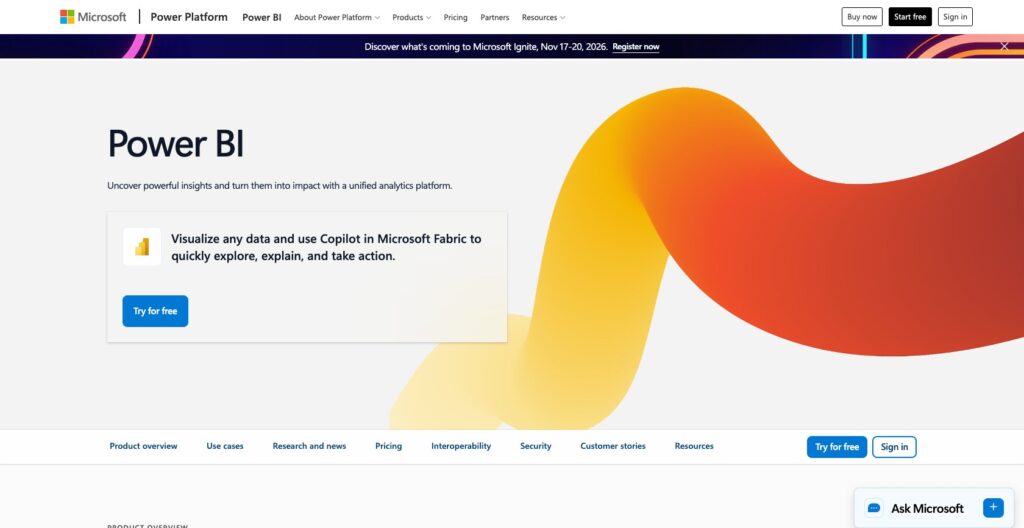
Best Overall: Governed Semantic Models at the Lowest Seat Price
Most teams overpay for BI because of viewers, not builders, and Power BI is the only major platform where authoring is free (Desktop) and a full Pro seat costs $14. DAX semantic models give you governed, reusable metrics, and Copilot runs on any paid Fabric capacity from F2 (since April 2025) and writes DAX queries (since October 2025).
Below F64, every viewer still needs a Pro, PPU or trial license; F64 costs about $8,409.60 a month pay-as-you-go (about 40.5% less reserved), so break-even against $14 Pro seats is around 600 viewers. Desktop is Windows-only, and Copilot burns capacity units: users report an F2 running dry after roughly 20 questions a day. Premium P SKUs retire in favor of Fabric F SKUs: each P SKU subscription ends with its current agreement term, and Microsoft no longer sells or renews them.
What users say: The missing Mac Desktop is the most repeated complaint.
Summary: The default pick for most teams, and the cheapest way to put governed metrics in front of many people. Plans (October 2026, per user per month, billed annually; pricing page):
- Free: $0 (Desktop authoring; viewing shared content needs a paid license or F64)
- Pro: $14 (up from $10 on April 1, 2025; 8 refreshes a day)
- Premium Per User: $24 (48 refreshes a day, larger models; $14 add-on for existing Pro users)
- Fabric F2: about $262.80/month pay-as-you-go (Copilot enabled; viewers still need Pro)
- Fabric F64: about $8,409.60/month pay-as-you-go (free viewers)
60-day Fabric trial (F64 equivalent).
2. Looker
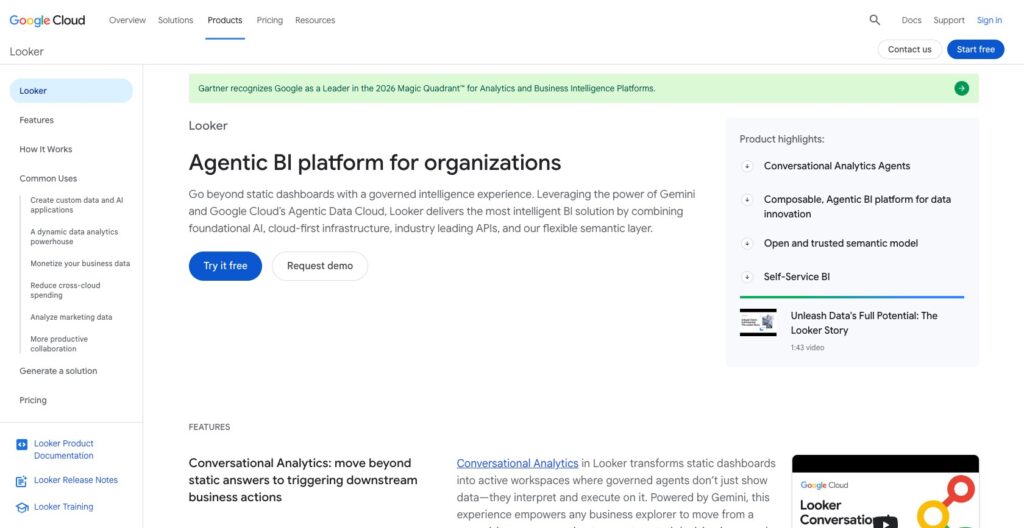
Code-First Semantic Layer for Governed, AI-Ready Metrics
Why sign a six-figure contract for BI when Power BI costs $14 a seat? Because LookML defines every metric once, in code, in Git, and every dashboard and AI answer reads from that one definition. Looker queries BigQuery, Snowflake and other warehouses live, and Gemini in Looker, Conversational Analytics and Dashboard Agents are grounded in LookML; Google says the semantic layer cuts natural-language query errors by up to two thirds.
The three editions are Standard, Enterprise and Embed, each with a monthly Gemini token allotment: Standard 60M input and 1.2M output, Enterprise 300M and 6M, Embed 1.2B and 24M. Overage beyond the allotment is $3 per million input tokens and $20 per million output once Google’s promotional fair-use period ends.
Developer time is the cost missing from every quote: expect a 2 to 4 week ramp before a new LookML developer ships models. Looker is not Looker Studio, now Data Studio (item 14).
Summary: Best for Google Cloud and BigQuery teams that have, or will hire, LookML developers. Skip it if nobody on your team will write code. Plans (October 2026, annual commitment, all quote-based):
- Standard: platform fee around $60K a year; 10 Standard Users and 2 Developer Users included
- Enterprise: larger Gemini allotment
- Embed: for customer-facing analytics
- Extra seats: roughly $400 a year per Viewer, $800 per Standard User and $125 a month per Developer
No free plan; trials go through sales. Expect contracts around $150K a year with seats added.
3. Tableau
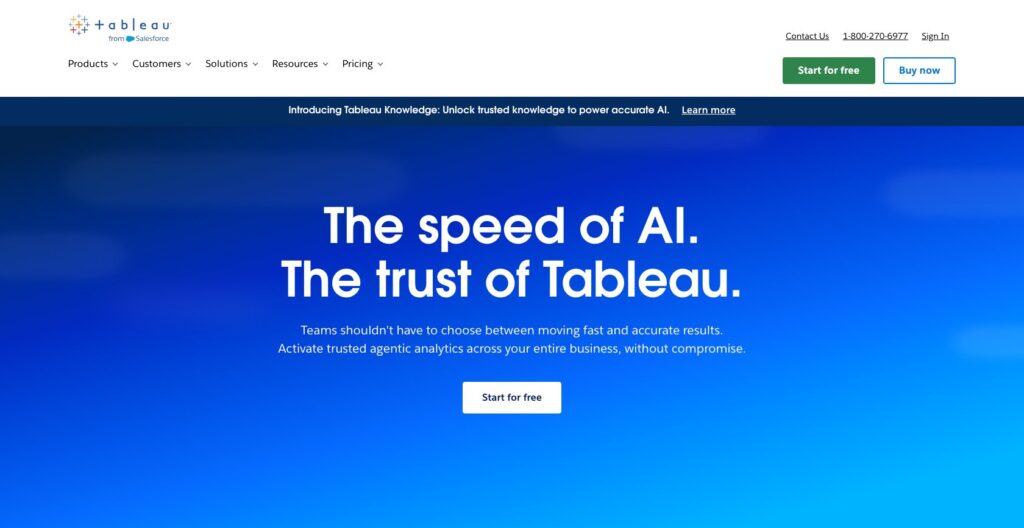
The Visual Exploration Benchmark, Now in Four Editions
If all you want is Tableau Pulse metric digests, skip the expensive tiers: Pulse ships in Standard and Enterprise. Tableau is still the best drag-and-drop visual exploration tool we tested, with Desktop on Windows and Mac, unlike Power BI, and a huge community.
Salesforce restructured the editions in May 2026: Standard, Enterprise, Cloud+ (Tableau Agent, up to 50 sites) and Tableau+ (Cloud+ plus Tableau Next and a set allotment of Data Cloud credits). Tableau Next and Tableau Semantics, the semantic layer for agents, are generally available on Tableau+; Tableau Next is also sold standalone on role-based licenses.
Tableau Agent is gated to Cloud+ and Tableau+, both contact-sales, and Tableau Next can still draw on Data Services or Flex Credits on top of its role-based licenses. Every deployment needs at least one Creator, and Tableau Cloud gets new AI features before Tableau Server.
Summary: 10 Creators and 100 Viewers on Standard cost 10 x $75 + 100 x $15 = $2,250 a month, versus 110 x $14 = $1,540 on Power BI Pro. Pay the gap if your analysts live in visual exploration or on Macs. Plans (October 2026, per user per month, billed annually):
- Standard: Viewer $15, Explorer $42, Creator $75
- Enterprise: Viewer $35, Explorer $70, Creator $115
- Cloud+: contact sales (adds Tableau Agent)
- Tableau+: contact sales (adds Tableau Next, Tableau Semantics and a set allotment of Data Cloud credits)
Free trial; Tableau Public is free for public data.
4. Omni
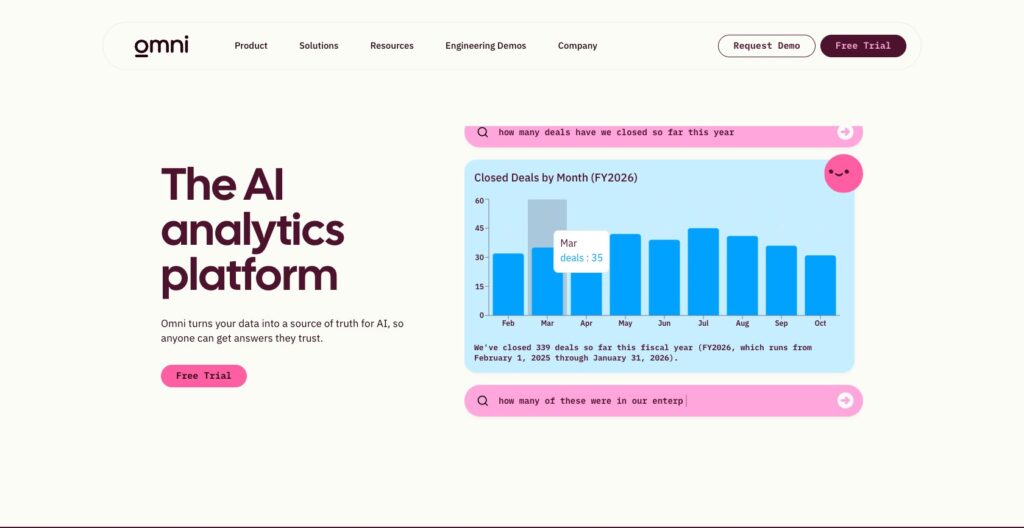
Looker-Grade Governance With a Friendlier Workbook
What happens when the people who built Looker start over for the dbt era? Omni was founded in 2022 by ex-Looker leaders Colin Zima (CEO) and Jamie Davidson, with Chris Merrick (ex-Stitch) as CTO. One shared semantic model (YAML-style, Git workflow) feeds both analysts and the Blobby AI assistant; it reads dbt metadata and the dbt Semantic Layer into that model and can push logic back upstream.
The workbook is what Looker never had: SQL, spreadsheet-style and point-and-click analysis in one place, plus MCP support, a CLI to add AI context, and embedding. Omni raised a $120M Series C at about $1.5B valuation led by ICONIQ in April 2026, with ARR up nearly 4x in a year and customers including BambooHR, Guitar Center, Checkr, Mercury and Pendo.
It is a young product, so documentation lags features and editor polish trails older tools. The first-year bill also includes AI credits, warehouse compute and migration work if you are leaving Looker.
What users say: Support responds fast and releases ship often, but the docs trail the product.
Summary: If you’re a dbt team leaving Looker, or picking your first governed BI layer, put Omni on the shortlist next to Looker. Plans (October 2026):
- Annual contract: quote-based (seats plus AI credits); no public list price
- Warehouse compute: billed separately by your warehouse
- Trial: through sales
5. Metabase
The Easiest Open Source BI Tool to Self-Host
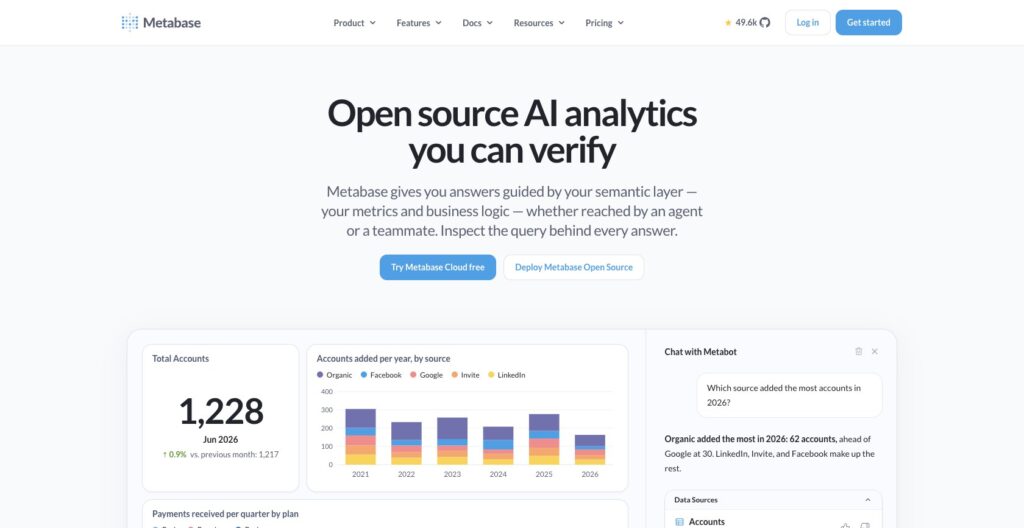
A single JAR file or Docker container gets Metabase running, and its query builder is the one business users pick up without SQL. The open source edition is free under the AGPL with unlimited users (about 49,600 GitHub stars); Enterprise adds air-gapped deployment. Metabot answers natural-language questions and writes SQL; hosted AI usage is metered at $3.75 per million tokens after the first million, or bring your own LLM key.
Modeling is light compared with Looker, Omni or Power BI: models and metrics live inside Metabase, with no dbt-native metrics. SSO beyond basic LDAP, row and column permissions, white-label and activity logging need Pro or Enterprise, and embedding on the free edition means keeping the “Powered by Metabase” badge or complying with the AGPL.
What users say: The line between models and questions gets confusing, and swapping a data source can mean duplicating content.
Summary: Best for startups and lean data teams who want self-serve dashboards now. Skip it if you need a governed semantic layer across many teams. Plans (October 2026, billed annually; pricing page):
- Open Source: free, self-hosted, unlimited users
- Starter (Cloud): $90/month with 5 users, then $6 per extra user per month
- Pro: $517.50/month with 10 users, then $12 per extra user per month (multi-tenant embedding, white-label, SSO)
- Enterprise: from about $20,000 a year
14-day free trial on Starter and Pro.
6. Sigma Computing
Spreadsheet Interface on Live Warehouse Data, With Writeback
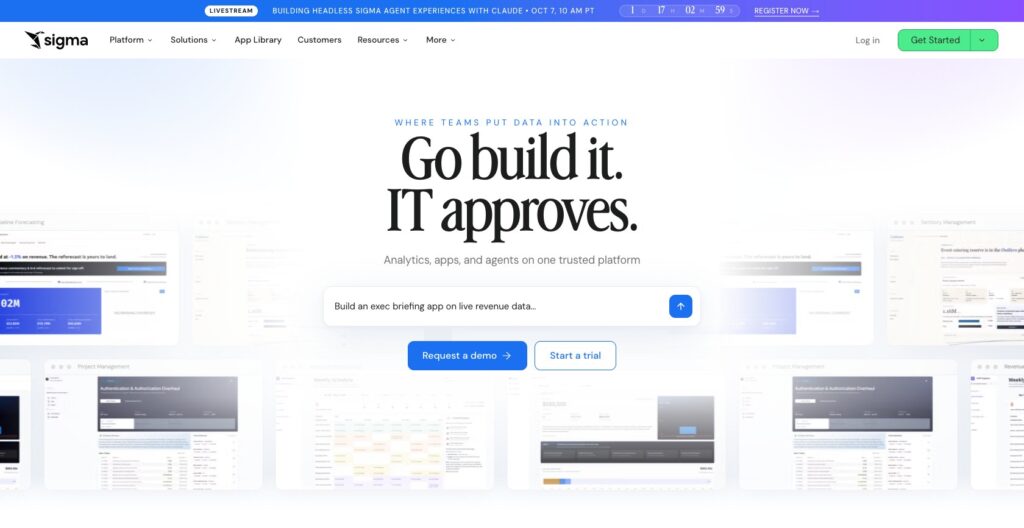
Every BI rollout ends with someone exporting to Excel. Sigma gives that person the spreadsheet on top of live warehouse data instead: a spreadsheet-style interface over Snowflake, Databricks, BigQuery, Redshift and Postgres with no extracts, and Input Tables that write planning numbers, forecasts and annotations straight back to the warehouse. Data models and metrics are defined in-app, with partial import of dbt and Snowflake semantics.
Licensing moved to four role tiers (View, Act, Analyze, Build) in March 2025, and in May 2026 the company repositioned around AI Apps, agentic analytics and Ask Sigma. It raised an $80M Series E at a $3B valuation the same month, and ARR passed $200M.
There are no public prices. Buyers report renewals rising roughly 25% to 30% a year, and warehouse compute is billed separately because every click runs a query.
Summary: The best pick when the people asking for BI live in spreadsheets and need to write numbers back, as long as you negotiate renewal caps up front. Plans (October 2026, annual contract):
- View, Act, Analyze, Build: quote-based role tiers
- Typical contract: tens of thousands of dollars a year including a platform fee
- Warehouse compute: billed by your warehouse
Free trial through Sigma’s sales team; no free plan.
7. ThoughtSpot
Search and AI Agents, Plus Mode’s Old Workbench
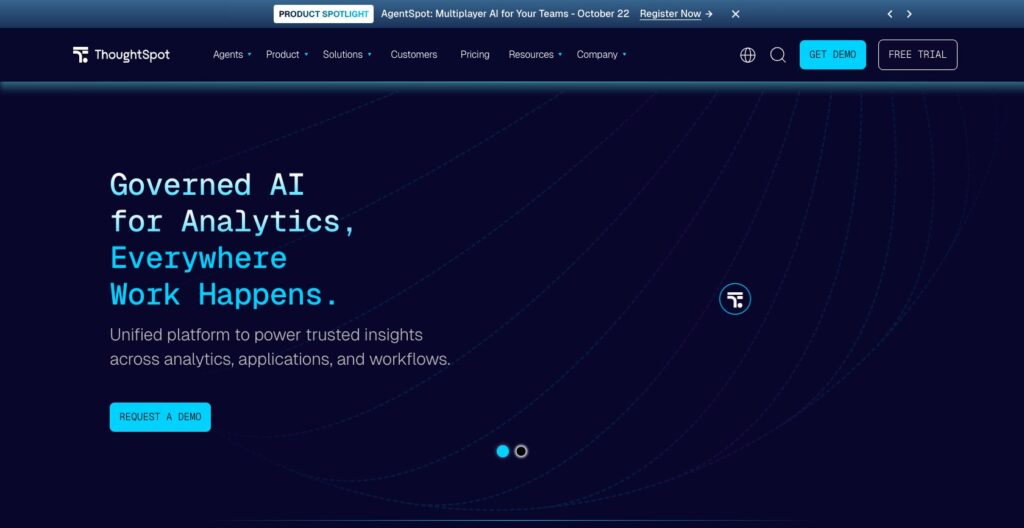
ThoughtSpot is one of the few enterprise BI vendors with list prices ($25 and $50 per user), yet real contracts land around $90K a year. Spotter agents for conversation, modeling and visualization ship on paid plans. ThoughtSpot advertises unlimited LLM tokens, but Pro also lists a cap of 25 Spotter queries per user per month, so get the limit in writing. Models and worksheets carry business-language synonyms.
Mode went here too: ThoughtSpot bought it for $200M in 2023 and rebuilt its SQL, Python and R notebooks as Analyst Studio (launched January 2025), adding SpotCache, a data-prep agent and a spreadsheet interface in February 2026. ThoughtSpot has not published a sunset date for mode.com, but Analyst Studio is the product it develops, hence no separate Mode entry.
Search only works after heavy up-front modeling of worksheets and synonyms, and implementation typically adds 15% to 40% of the first-year subscription.
Summary: Best for enterprises that will invest in modeling so business users can self-serve by search. Skip it if you have no one to curate the model. Plans (October 2026, per user per month, billed annually; pricing page):
- Essentials: $25 (5 to 50 users, 25M rows)
- Pro: $50 (up to 1,000 users, 250M rows)
- Enterprise: custom; expect contracts around $90K a year
- Embedded: free 1-year Developer tier (10 users, 25M rows), then usage at $0.10 per credit
Free trial on all plans.
8. Qlik Cloud Analytics (Qlik Sense)
Associative Engine With Unlimited-User Capacity Pricing
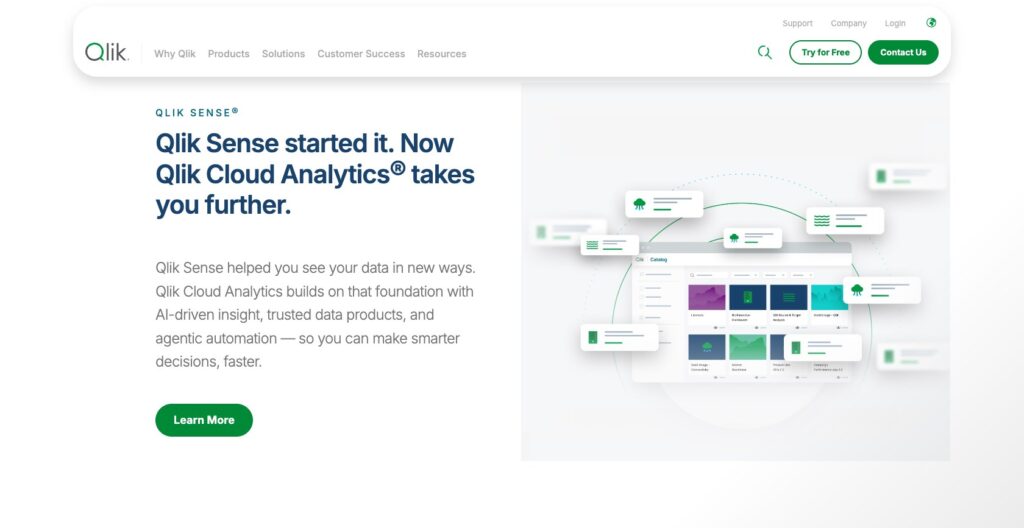
Per-seat bills punish success: the more people open your dashboards, the more you pay. Qlik’s Standard and Premium tiers include unlimited users, and its associative engine lets those users click across any selection without predefined drill paths. Qlik Answers (an agentic assistant) and Insight Advisor handle natural-language questions, and Qlik Predict with AutoML sits on Premium and up.
Qlik stopped selling user-based subscriptions to new customers on April 1, 2025; existing contracts move to capacity at renewal. The meter is “Data for Analysis”, the monthly high-water mark of data loaded into apps, with overage tolerance of up to 10x built in. Client-managed Qlik Sense on Windows continues, and the May 2026 release is supported to May 2028.
That meter is also the downside: data growth, not headcount, drives the bill. Advanced modeling needs Qlik’s load scripting, and Standard leaves out full AutoML, data quality and Talend integration tools.
Summary: If hundreds of people need to view dashboards and your data volume is stable, price Qlik’s Standard tier against per-seat tools first. Plans (October 2026, billed annually; see Qlik’s pricing page):
- Starter: $300/month (10 users, 10 GB)
- Standard: $825/month (unlimited users, 25 GB)
- Premium: $2,750/month (unlimited users, 50 GB, AutoML)
- Enterprise: custom (unlimited users, 250 GB minimum)
Free trial on Starter; no permanent free plan.
9. Hex
SQL, Python and Data Apps in One Notebook
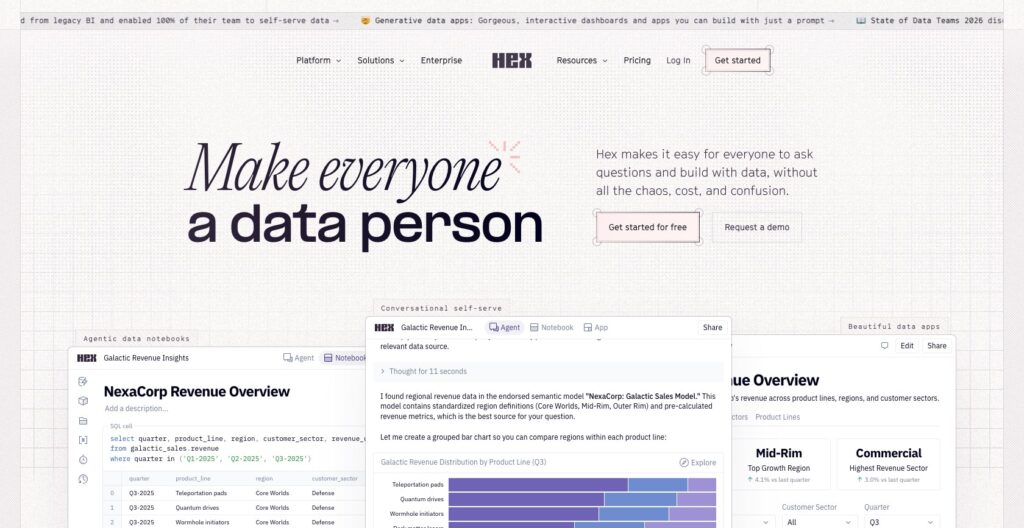
One notebook for SQL, Python and a shareable app, and the free Community plan is enough to try it on a real project. Hex’s AI stack runs from Magic (inline assist) through the Notebook Agent, Threads (conversational analytics for non-technical users) and a Modeling Agent that builds semantic models synced from dbt, Cube or Snowflake, with Context Studio and Evals added in 2026. It is the natural landing spot for former Mode teams that do not want ThoughtSpot, and the company raised a $70M Series C in May 2025, about $172M in total.
Pricing is per editor and climbs to $75 on Team; Professional caps you at 5 published apps, and monthly AI credit grants do not roll over. Hex is also less dashboard-centric than classic BI, so for wide audiences it complements a dashboard tool rather than replacing it.
Summary: If you were a Mode team and don’t want an enterprise ThoughtSpot contract, Hex is the closer fit. Plans (October 2026, per editor per month; see Hex’s pricing page):
- Community: free
- Professional: $36 (up to 5 published apps)
- Team: $75 (unlimited apps, scheduled runs and alerts)
- Enterprise: custom (unlimited users)
14-day Team trial, no card required.
10. Apache Superset and Preset
Free Open Source Dashboards, or Managed for $20 a Seat
“Free” BI still needs someone on call: a production Superset runs about five processes (web server, Celery worker, scheduler, Redis and Postgres). In return you get an Apache 2.0 project with about 75,000 GitHub stars, 60+ supported databases, SQL Lab and wide chart variety; 6.0 brought a redesigned UI with dark mode, and 6.1 (mid-2026) added an opt-in MCP service for AI agents. Datasets are saved SQL with light metadata, not a true semantic layer (proposal SIP-182 is still open), so business users struggle to self-serve on existing star schemas.
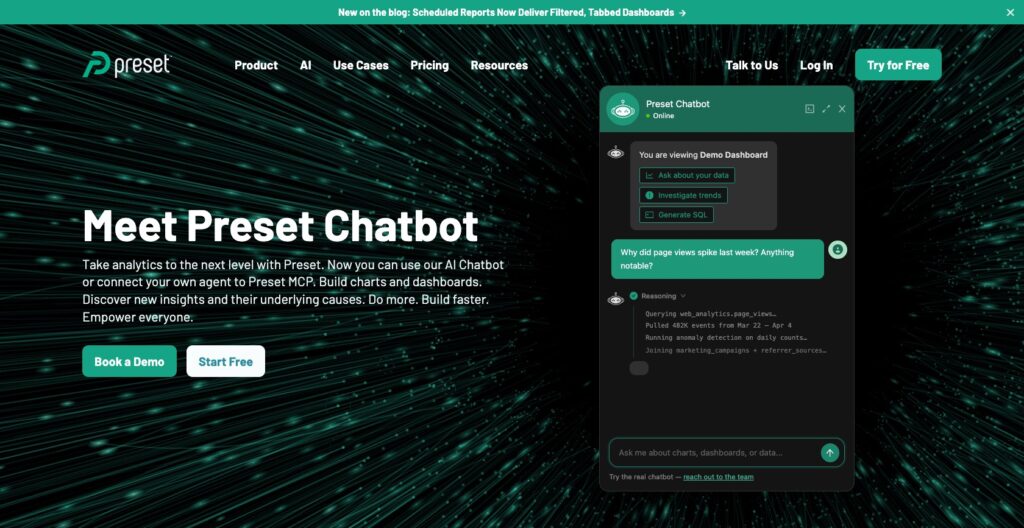
Preset is the same engine without the Celery ops, with an embedded dashboards add-on at $500 a month per 50 viewers. dbt integration, SSO with SCIM and full AI (chatbot, MCP server) are Enterprise-only; Pro gets a 14-day AI chatbot trial.
What users say: Simple tasks that take minutes in other BI tools can take much longer in Superset, and dependency upgrades can break connectors.
Summary: Best for engineer-built dashboards at zero license cost. Skip self-hosting if nobody owns the infrastructure; Preset is the shortcut. Plans (October 2026; pricing page):
- Apache Superset: free, self-hosted (hosting costs only)
- Preset Starter: free (up to 5 users, 1 workspace)
- Preset Professional: $20 per user per month billed annually ($25 monthly)
- Preset Enterprise: custom (dbt integration, Managed Private Cloud, SSO, full AI)
11. Lightdash
dbt-Native BI With One Flat Price for Unlimited Users
If your metrics already live in dbt, defining them again in LookML or DAX is duplicate work. Lightdash reads dimensions and metrics straight from your dbt YAML, so the explore your business users click through is the model your engineers already maintain. The open source edition is free to self-host; Cloud Pro is a flat $3,000 a month with unlimited users and AI agents that use your existing dbt semantics, and Enterprise adds SSO, SAML, SCIM and HIPAA with a BAA. Funding is modest: an $11M Series A led by Accel in 2024, about $19.4M raised in total.
It only works if you run dbt, AI agents are Cloud-only, and the $36K-a-year floor is steep for a 5-person team, though cheap once 100+ people view dashboards.
What users say: Teams that evaluated it against Superset and Metabase for business users on existing star schemas say its Looker-style explore won.
Summary: If dbt is your source of truth and viewers outnumber builders, start here. Plans (October 2026; see Lightdash’s pricing page):
- Open Source: free, self-hosted
- Cloud Pro: $3,000/month flat, unlimited users, AI agents included
- Enterprise: custom (SSO, SCIM, HIPAA)
21-day Cloud trial, no card required.
12. Databricks AI/BI and Genie
BI and Natural-Language Querying Built Into the Lakehouse, No Seats
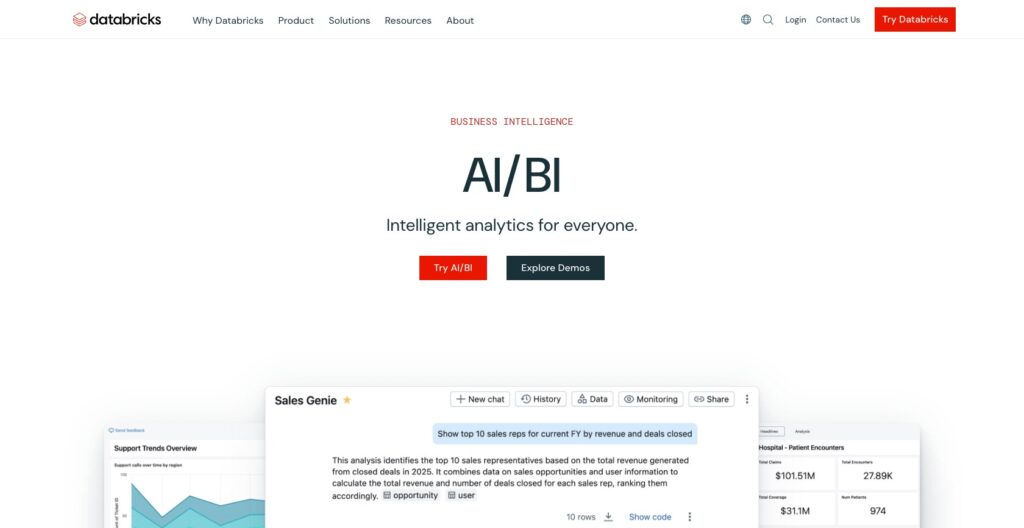
If you already pay for Databricks SQL, you already have AI/BI Dashboards and Genie, with no separate BI license. The cost is SQL warehouse compute (about $0.55 per DBU on Pro and about $0.70 on Serverless) plus AI usage, and Genie One gives every user $10 of free usage a month with no seats. Databricks One became Genie on April 27, 2026 and Genie One on June 9, 2026 (GA June 16).
The 2026 releases added Agent Mode for multi-step reports (July), Genie Code for dashboard authoring (July), local metric views and an import of Power BI and Tableau reports as AI/BI dashboards (August). Unity Catalog metric views are the semantic layer, so dashboards, notebooks and agents share one definition.
It only makes sense if your data already lives in Databricks, and costs land as DBUs on the warehouse bill, so idle or oversized SQL warehouses inflate BI spend.
Summary: For Databricks shops, try this before you buy another BI license; for everyone else, it’s not an option. Pricing (October 2026, usage-based):
- AI/BI Dashboards and Genie: included with Databricks SQL, no per-seat fee
- SQL warehouse compute: about $0.55/DBU (Pro) or $0.70/DBU (Serverless)
- Genie One: $10 free usage per user per month, then usage-based
13. Amazon Quick (Formerly QuickSight)
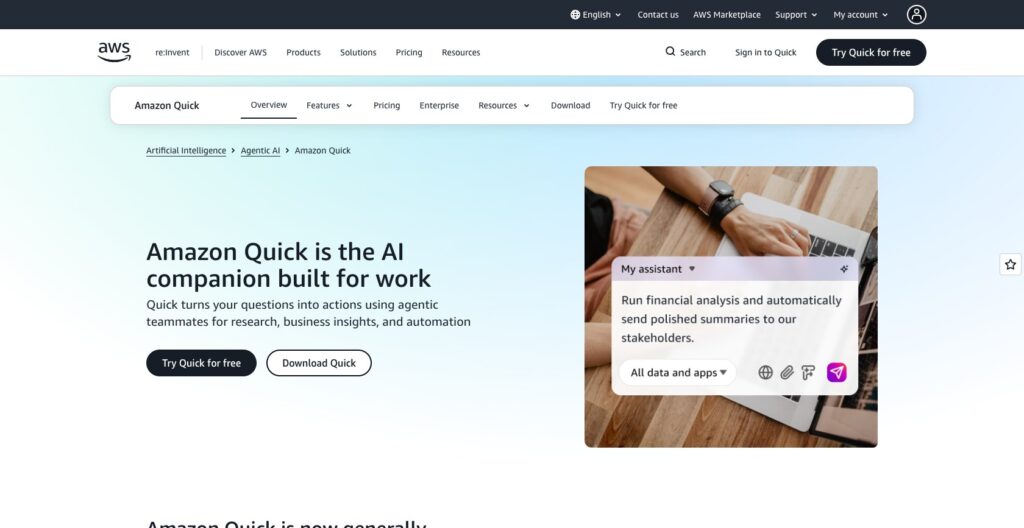
AWS-Native Dashboards Inside an AI Workspace
Was QuickSight discontinued? No. AWS turned it into Amazon Quick Suite on October 9, 2025, and has since branded it Amazon Quick; existing dashboards, datasets and analyses carried over unchanged. BI now sits beside the Quick Chat, Research, Flows and Automate agents, the SPICE in-memory engine costs $0.38 per GB per month, and Pixel-Perfect reports run $1 per report unit (500 minimum). Author Pro was cut from $50 to $40 a month in October 2025, and the semantic layer is topics and datasets, lighter than LookML.
Professional and Enterprise accounts pay a $250 a month infrastructure fee on top of seats, which hurts small teams, and three names in about six months make old docs and procurement records hard to match.
Summary: Best for AWS-centric teams that want dashboards next to their data with per-user pricing. Skip it if you’re multi-cloud. Plans (October 2026; see AWS’s Quick pricing page):
- Free: $0
- Plus: $20/month billed annually ($25 monthly); Max: $100/month billed annually ($125 monthly)
- Professional: $20 per user per month, plus $250/month per account
- Enterprise: $40 per user per month, plus $250/month per account
30-day trial for up to 25 users.
14. Looker Studio (Now Data Studio)
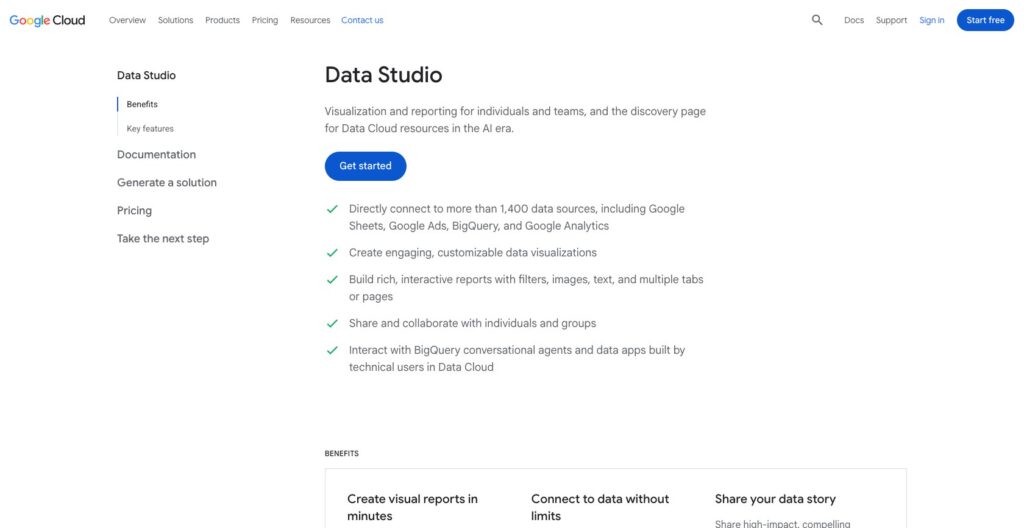
Free Google Dashboards, Renamed Data Studio Again
Google renamed Looker Studio back to Data Studio in April 2026, the name it dropped in 2022, and existing reports, links and embeds carried over. Data Studio stays free, with hundreds of connectors and strong reporting on Google Ads, GA4 and BigQuery; BigQuery conversational agents arrived with the April 2026 relaunch. Data Studio Pro adds team workspaces, 200 scheduled deliveries per report, Gemini and an SLA, and became purchasable in the Google Workspace Admin Console on February 5, 2026. Google now positions Data Studio for personal exploration and Looker for governed BI.
There is no semantic layer: metrics are defined report by report as calculated fields, so the same KPI drifts across reports. Pro also bills per user per Google Cloud project, which gets awkward at scale.
Summary: If your data is mostly Google marketing data and the budget is zero, start here and move to Looker when metrics need governance. Plans (October 2026):
- Data Studio: free
- Data Studio Pro: $9 per user per project per month
30-day Pro trial.
15. Holistics
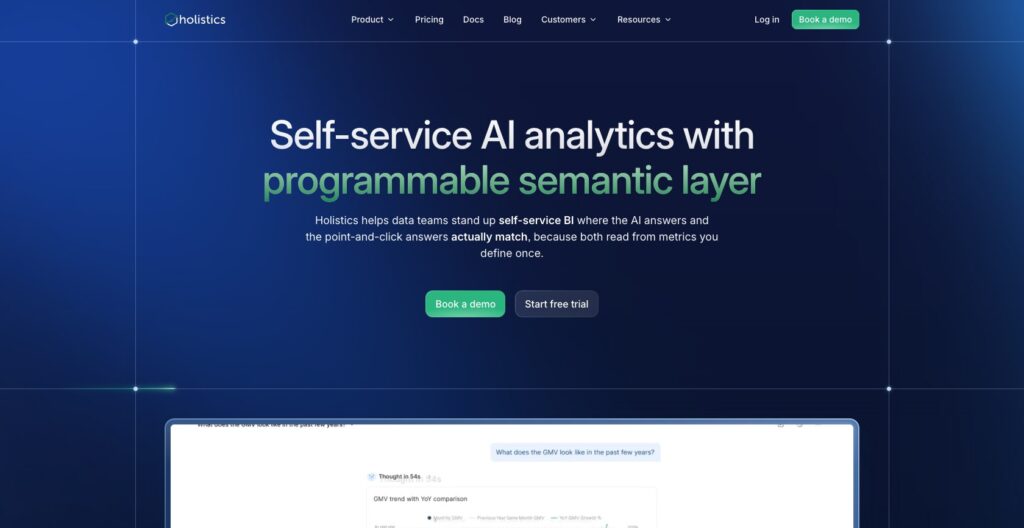
Code-Based Semantic Layer for Under $1,000 a Month
Holistics is the cheapest published route to a code-based semantic layer: $800 a month, billed annually, with 10 users included. AML (Analytics Modeling Language) defines models and relationships, AQL (Analytics Query Language) composes metrics on top, and both live in Git with dbt integration. An AI assistant works on the AQL layer, and the service runs in US, EU and APAC regions (EU and APAC are priced separately).
Entry caps you at 100 reports (an extra 100 cost $120 a month), SSO and security features sit in the $2,000 a month Security Compliance Suite, and the ecosystem and community are a fraction of Looker’s.
Summary: Holistics gives you most of what LookML does for a fraction of a typical Looker contract, with fewer integrations. Plans (October 2026, US region, per month billed annually; monthly billing in brackets; see Holistics’ pricing page):
- Entry: $800 ($960), 10 users, 100 reports
- Standard: $1,000 ($1,200)
- Security Compliance Suite: $2,000 ($2,400)
- Extra users: $12.50 ($15), or $15 ($18) on the Suite
Free trial on all plans.
16. Zoho Analytics
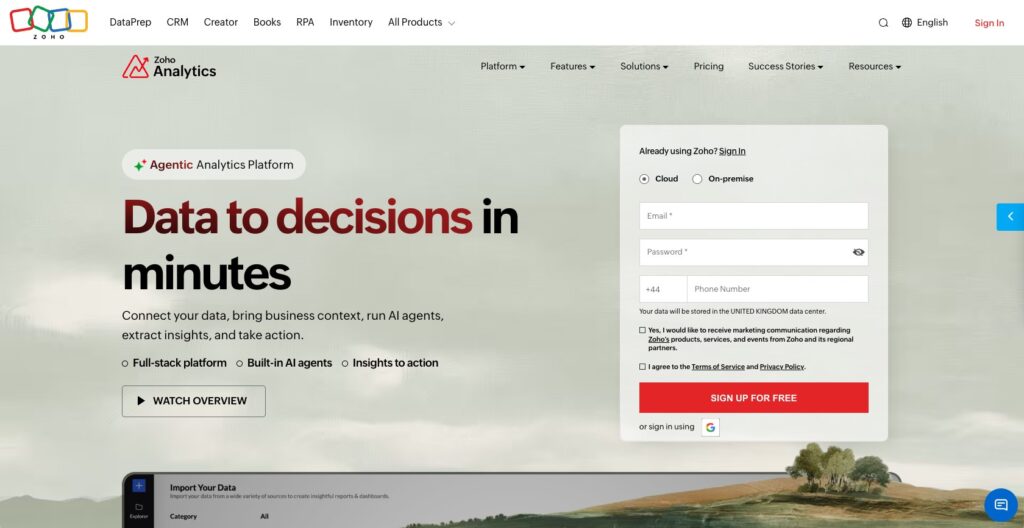
Low-Cost Self-Service BI With a Real Free Plan
Zoho Analytics has a free plan for 2 users and 10,000 rows, and 15-day trials with no card. Premium and Enterprise get the Ask Zia conversational agent, automated insights and what-if analysis; Basic and Standard get auto analysis plus trend and anomaly detection. The Zoho data model carries business-logic metrics (lighter than LookML), it runs in the cloud or on-premise (about $30 per user per month on-premise), and extra viewers cost $4 a month with a 25-viewer minimum.
Row limits are the trade-off: 0.5M rows on Basic, full AI gated to Premium and up, and less depth than Power BI or Tableau for large models.
Summary: Best for small businesses and Zoho users who want BI under $100 a month. Skip it if you have tens of millions of rows. Plans (October 2026, per account per month, billed annually, about 20% more monthly; entry prices vary by region, so confirm on Zoho’s pricing page):
- Free: $0 (2 users, 10K rows)
- Basic: about $24 (2 users, 0.5M rows)
- Standard: about $48 (5 users, 1M rows)
- Premium: about $115 (15 users, 5M rows, Ask Zia)
- Enterprise: about $455 (50 users, 50M rows)
17. Domo
All-in-One BI and ETL on a Credit Meter
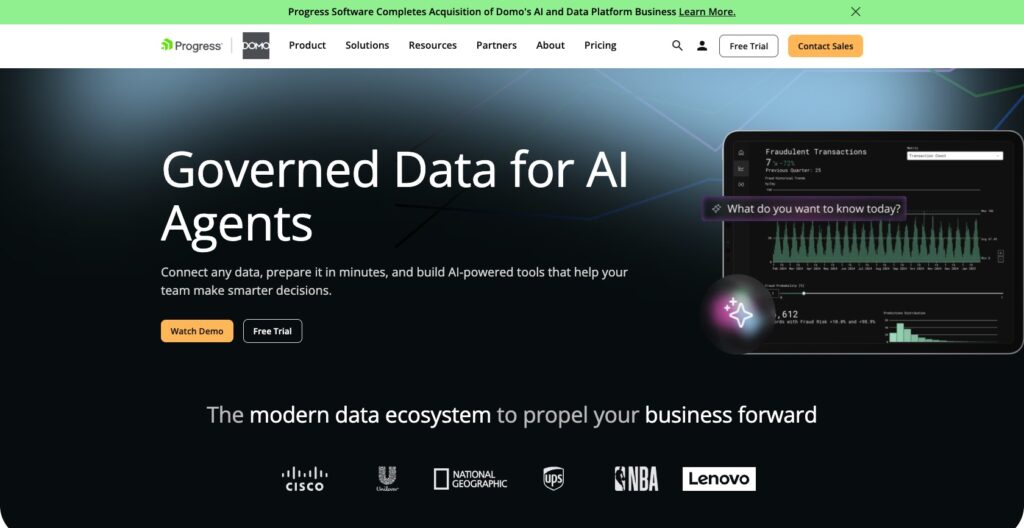
Domo is the one tool here that replaces the stack under BI too: connectors, Magic ETL, dashboards and apps in one platform, which is also why its bill is hard to predict. Pricing has been a hybrid of per-user fees plus consumption credits since 2023, and ingestion, Magic ETL (charged on both input and output rows), refreshes, queries and AI all draw credits. DomoGPT and Agent Catalyst, launched at Domopalooza 2025, let you build AI agents on the same data.
Users report renewal shocks and true-up bills for credit overages. Expect around $30K to $75K a year for 10 to 25 users and $200K to $500K+ for 200+ users.
Summary: If you want one vendor for pipelines and dashboards, model credits for every connector and ETL flow, and get overage and renewal caps in writing before you sign. Pricing (October 2026, annual contract):
- Platform: quote-based (per-user fees plus credits)
- Typical spend: around $30K to $75K a year for 10 to 25 users
- Large deployments: $200K to $500K+ a year for 200+ users
30-day free trial with unlimited users, no card; no permanent free plan.
18. Luzmo
Embedded Analytics for SaaS Products, One Plan
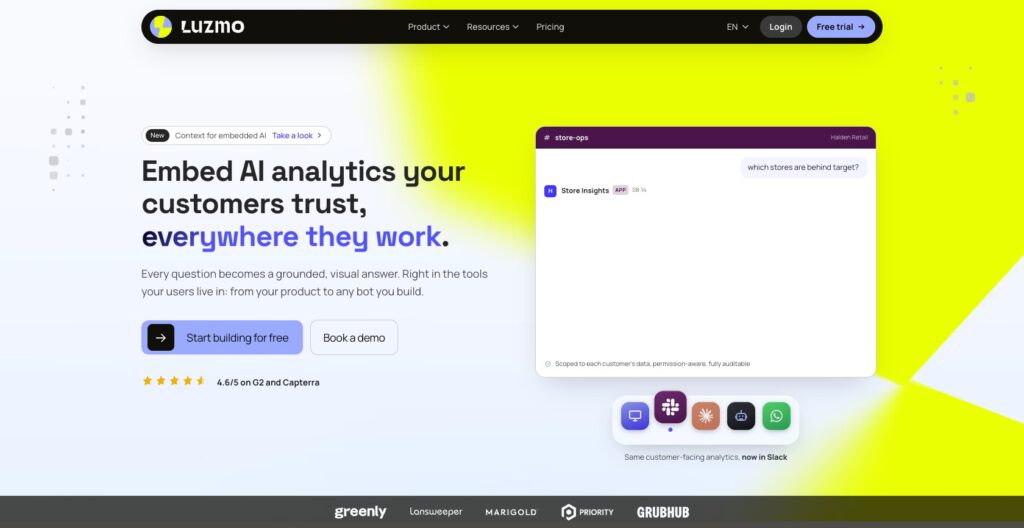
Customer-facing analytics is where BI pricing gets most opaque, and Luzmo (formerly Cumul.io) answers with one published plan: from EUR 1,995 a month billed annually, with 100M synced rows, 500 AI conversations a month, white-label, MCP and agents included, plus optional MAU-based billing. The old Basic, Pro and Elite tiers are retired.
Sisense withdrew its self-serve plans and is quote-only (expect a year-one bill in the tens of thousands of dollars for its Compose SDK, before services); GoodData sells per workspace with unlimited users on a quote; Metabase Pro and Preset’s $500-per-50-viewers add-on cover lighter embedding; and Power BI Embedded serves “app owns data” on any F SKU with unlicensed end users.
Luzmo is annual-only with a roughly EUR 24K-a-year floor, it is embedded-only rather than an internal BI tool, and AI conversation overage depends on your contract.
Summary: For a SaaS team shipping analytics to customers this quarter, Luzmo is the fastest published-price route. Pricing (October 2026, billed annually; see Luzmo’s pricing page):
- Luzmo plan: from EUR 1,995/month (100M synced rows, 500 AI conversations a month)
- Extra rows: EUR 0.25 per million
Free trial with the full product.
How to Choose a Business Intelligence Tool: Pricing Models and Semantic Layers
The license price on the quote is rarely the number that hurts. The pricing model and where your metrics live decide the bill, and the AI accuracy, two years in.
Count builders versus viewers first. If viewers outnumber builders 10 to 1, per-seat tools get expensive fast and capacity or flat-fee models win; if a handful of analysts do all the work, per-editor tools stay cheap. Then add the costs quotes leave out: AI credits or tokens, warehouse compute for live-query tools (Sigma, Omni, Hex and Lightdash all run every query against your warehouse), embedding rights, and year-2 increases (buyers report Sigma renewals rising roughly 25% to 30%).
| Pricing model | Tools | Watch out for |
|---|---|---|
| Per user | Power BI Pro/PPU, Tableau, ThoughtSpot, Amazon Quick, Preset | Viewer seats multiply; Power BI viewers need Pro below F64; Tableau needs at least one Creator |
| Capacity | Fabric F SKUs, Qlik Cloud Analytics | Data growth and Copilot usage drive cost, not headcount |
| Platform fee + seats | Looker, Sigma, Omni | Annual contract with no public list; budget for renewal increases |
| Flat fee | Lightdash ($3,000/month), Evidence ($2,500/month), Holistics (10 users included) | Unlimited users, but a $30K to $36K a year floor for small teams |
| Per editor | Hex, Count (viewers free on Count) | Editor counts creep; AI credits don’t roll over |
| Usage or credits | Domo, Databricks AI/BI, Metabase AI tokens | Hard-to-forecast bills; cap overages in writing |
| Open source | Metabase, Superset, Lightdash | Engineer time; SSO and row-level security often paywalled |
Next, choose where the semantic layer lives. There are three options: in dbt, read by the BI tool (Lightdash, Hex, Omni’s dbt import); in the BI tool (LookML, the Omni model, Holistics AML, Power BI semantic models); or in the data platform (Databricks Unity Catalog metric views, Snowflake semantic views). Pick one home per metric, because two definitions of revenue will drift apart within a quarter.
If AI querying matters, route board and KPI questions through the semantic layer and keep raw text-to-SQL for ad hoc exploration. Ungrounded text-to-SQL returns plausible wrong numbers, while a semantic layer refuses questions it can’t map; dbt Labs, which sells a semantic layer, published a 2026 benchmark in which semantic-layer answers reached 98% to 100% accuracy versus 84% to 90% for text-to-SQL on the same models.
Shortlist two tools with different pricing models, price both for your real builder and viewer counts, and test each AI assistant on five questions you already know the answers to.
Final Thoughts
Every major tool now ships an AI assistant, so the semantic layer separates right answers from confident wrong ones. The defense is portability: keep metric definitions in code you can move (dbt, LookML, YAML models), favor open source cores (Metabase, Superset, Lightdash), and avoid multi-year contracts without renewal caps.
Since 2024, Mode became Analyst Studio inside ThoughtSpot (January 2025); MicroStrategy rebranded to Strategy in February 2025 (Strategy One plus the Mosaic semantic layer); QuickSight became Amazon Quick Suite on October 9, 2025, then Amazon Quick; Looker Studio went back to Data Studio in April 2026; Databricks One became Genie One in June 2026; Power BI Premium capacity gave way to Fabric F SKUs; Sisense withdrew its self-serve plans; and Redash has run on volunteers since Databricks shut its hosted version in 2021. SAP Analytics Cloud and Oracle Analytics Cloud fit their own estates, and Strategy, Sisense, GoodData, Evidence and Grafana still exist; none made this shortlist.
Start with Metabase or Power BI Pro; add a governed semantic layer (Looker, Omni, or Lightdash on dbt) when two dashboards disagree on revenue; reach for ThoughtSpot, Sigma or Qlik when hundreds of business users need search, spreadsheets or unlimited viewers.
Pick the business intelligence tools whose metric definitions you could export tomorrow, and price the shortlist for the viewers you’ll have in two years.
Frequently Asked Questions
What is the cheapest business intelligence tool for a small team?
Free options cover most small teams: Metabase open source, Apache Superset, Preset Starter (free for 5 users), Hex Community, Count’s free plan (3 editors), Zoho Analytics free (2 users, 10,000 rows) and Data Studio. The cheapest paid managed plans are Metabase Starter at $90 a month with 5 users, Preset Professional at $20 per user and Power BI Pro at $14 per user, all billed annually.
Is Mode Analytics still available?
Mode’s SQL, Python and R workbench now lives inside ThoughtSpot as Analyst Studio. ThoughtSpot bought Mode for $200M in 2023 and launched Analyst Studio in January 2025. ThoughtSpot has not published a sunset date for mode.com, but Analyst Studio is the product it develops; Hex is the closest standalone alternative.
Does Power BI work on a Mac?
Not natively. Power BI Desktop is Windows-only in 2026, so Mac users run it in a Windows virtual machine (Windows 11 on ARM works on Apple silicon), on a cloud PC, or use the browser-based Power BI service, which has fewer modeling features. Tableau Desktop runs natively on Mac.
Do you need Fabric F64 for Power BI Copilot?
No. Since April 2025, Copilot works on any paid Fabric capacity from F2 (or Premium P1), though every question draws down capacity units. F64 still matters for viewers: below F64, every viewer needs a Pro, PPU or trial license; from F64 up, free-license users can view.
Can you trust AI and natural-language answers in BI tools?
Only when they are grounded in a semantic layer. Ungrounded text-to-SQL tends to return plausible but wrong numbers on real warehouse schemas, while semantic-layer-backed assistants (Looker on LookML, Omni, Lightdash on dbt) refuse questions they can’t map. Test any assistant on questions you already know the answers to.
Do I still need a BI semantic layer if I use dbt?
It depends where you want metrics to live. Lightdash and Hex read dbt definitions directly, Omni imports the dbt Semantic Layer into its own model, and Looker or Power BI keep a separate model. One home per metric is the rule; duplicating definitions in both places causes drift.
Comments 0 Responses