
Top 5 Side by Side
Managed warehouse sync

Fivetran
See pricing Visit Fivetran →Free up to 500,000 monthly active rows
Paid usage varies; warehouse costs extra
- Managed initial copy and change-stream sync
- Deleted records retained with a flag
- Nested JSON requires analytical modeling
Deployment control

Airbyte
See pricing Visit Airbyte →Standard from $20/month with 5 credits
Self-hosted Core also available
- Managed or self-hosted deployment
- Schema enforcement or schemaless JSON
- Destination-specific delete configuration
Pre-load transformation
Hevo
See pricing Visit Hevo →Starter $299/month for 5 million events
$265/month with annual billing
- Python and visual transformations
- Destination-dependent JSON handling
- Array-element deletions need care
Continuous capture

Estuary
See pricing Visit Estuary →Free: 10GB/month, 2 connector instances
Cloud: $100/connector/month + $0.50/GB
- Continuous MongoDB change capture
- Pipelines to multiple destinations
- Configurable Snowflake delete handling
Workflow orchestration

Boomi Data Integration
See pricing Visit Boomi Data Integration →Custom quote; consumption credits
Trial: 14 days or 1,000 credits
- MongoDB ingestion and orchestration
- SQL and Python workflow steps
- Complex document fields kept as JSON
Fivetran is our starting recommendation for teams that want managed MongoDB-to-warehouse replication, while Airbyte gives engineers more control over deployment and Estuary suits continuous change capture.
The choices have changed since our original roundup. Rivery is now Boomi Data Integration, Matillion has introduced a newer MongoDB Load component, and the archived Transporter project no longer belongs on a current shortlist.
The best MongoDB ETL tools handle more than the first export. Your pipeline needs to preserve useful document structure, keep updates and deletions consistent, and deliver data in a form your analysts can query. This guide covers 11 options, from managed warehouse pipelines to developer tools and visual data preparation software.
Prices range from free local software to usage-based services and custom contracts. Compare what each bill includes: a monthly active row, an event, a gigabyte, and an hour of replication compute are different units. Warehouse costs and the time needed to operate the pipeline can matter as much as the connector charge.
We have retained eight tools from the original list and added Estuary, Debezium, and AWS Database Migration Service. The updated selection gives you three routes: managed replication, engineering-owned pipelines, and specialist visual workflows. Choose the route first, then compare the tools within it.
Key Takeaways 🔍
- Start with Fivetran for managed warehouse sync. Its free plan covers up to 500,000 monthly active rows; higher usage changes the cost calculation.
- Free software still needs an operating budget. Debezium and Meltano require infrastructure and maintenance, while KNIME offers free local workflow execution.
- Capturing a delete does not necessarily remove a warehouse row. Some tools retain flagged records that your reports must exclude.
- Match the tool to the work. Consider Airbyte for deployment control, Estuary for continuous capture, and FME for spatial transformations.
- The old lineup needs more than new prices. Transporter is archived, Rivery has a new identity, and several specialist products deserve narrower recommendations.
How We Chose These Tools
Our recommendations weigh MongoDB connector behavior, initial loading, ongoing changes, nested data, recovery, and operating cost. We distinguish a connector that emits change events from a complete service that applies those changes to a warehouse. Recommendations reflect each tool’s fit for those requirements; they are not performance benchmarks.
Prices are current as of October 2026, in US dollars where stated. Annual commitments, included allowances, destination charges, and infrastructure costs are identified where relevant. The first six picks cover managed ingestion or warehouse transformation; the remaining options suit engineering and specialist workflows.
MongoDB ETL Tools Comparison Table
These five options cover the main managed-pipeline choices. “CDC” means change data capture: reading database changes instead of repeatedly copying everything.
| Fivetran | Airbyte | Hevo | Estuary | Boomi Data Integration | |
|---|---|---|---|---|---|
| Best for | Managed warehouse sync | Deployment control | Ingestion with transformations | Continuous capture | Ingestion and orchestration |
| Starting price | Free within allowance; paid usage varies | Standard $20/month, 5 credits | Starter $299/month, or $265/month annually | Cloud $100/connector/month + $0.50/GB | Custom quote; consumption credits |
| Free plan or trial | 500,000 MAR; 14-day connection trial | Self-hosted Core; 14-day cloud trial | 14-day trial | Free: 10GB/month, 2 connector instances | 14 days or 1,000 credits |
| MongoDB capture | Scheduled change-stream sync | Scheduled CDC or full refresh | OpLog or change streams | Continuous change streams; batch alternatives | Change streams or standard extraction |
| Nested documents | JSON or one-level unpacking | Schema enforcement or JSON | Destination-dependent parsing | JSON with field projections | Complex fields remain JSON |
| Recommended for | Teams minimizing pipeline operations | Engineers wanting configuration choices | Teams shaping data before loading | Teams serving multiple downstream systems | Teams coordinating data workflows |
The entry prices are not quotes for equivalent workloads. Hevo’s Starter allowance is 5 million events; its limited-connector free plan should not be assumed to include MongoDB. Estuary counts source and destination connector instances separately.
Our Top 11 MongoDB ETL Tools
- Fivetran
- Airbyte
- Hevo
- Estuary
- Boomi Data Integration
- Matillion
- Debezium
- AWS Database Migration Service
- Meltano
- FME
- KNIME
1. Fivetran
Managed warehouse replication with fewer infrastructure responsibilities
Fivetran is a sensible first choice when your goal is to keep a warehouse populated without operating the extraction service yourself. It handles the initial collection copy, then uses MongoDB change streams to collect subsequent changes.
The detail to understand is deletion. A removed source document leaves a destination row with _fivetran_deleted set to true. Build that flag into your reporting model, or deleted records can continue contributing to your totals.
Document shape also affects the work left for your analytics team. Packed mode keeps the document as JSON; unpacked mode expands one level while deeper objects and arrays remain JSON. You still need to decide how those structures become useful analytical tables.
Fivetran’s MongoDB connector supports replica sets and sharded clusters, with specific storage-engine and version requirements. If the saved change-stream position expires, it triggers a re-sync. That helps recovery, but it is not a reason to ignore the amount of change history MongoDB retains.
Destination choice is broad, including Snowflake, BigQuery, Redshift, Databricks, and PostgreSQL. Their compute charges remain separate from your Fivetran bill, so frequent loading and subsequent transformations need their own budget.
Airbyte is the stronger alternative if self-hosting matters. Fivetran’s appeal is the managed operating model, with a clear understanding that your team still owns the warehouse model.
Summary: A strong default for managed replication, provided you account for retained deleted rows and downstream JSON transformation.
- Free: Up to 500,000 connection monthly active rows, or MAR.
- Paid: Usage-based pricing; estimate your MongoDB workload through Fivetran’s pricing.
- Trial: 14 days for each new connection. Warehouse costs remain additional.
2. Airbyte
More control over deployment, schema, and destination behavior
Airbyte suits engineers who want to choose between managed service and self-hosted Core. The flexibility is useful, but you also take on more decisions about schemas, connector versions, and how records land in the destination.
Its MongoDB source supports CDC and full refresh. With schema enforcement, it samples documents to discover fields; schemaless mode preserves an _id and JSON data object. The latter can be useful when documents differ significantly, although analysts still need a model they can query consistently.
Check the installed connector version before planning a sharded deployment. MongoDB V2 version 2.1.0 added sharded-cluster support, so an existing installation should not be assumed to have the same capabilities as a newer release.
Airbyte also makes an important destination distinction. Its Snowflake connector supports hard-delete and soft-delete CDC modes, defaulting to hard deletion. That is a Snowflake configuration, not a promise that every Airbyte destination treats deletes identically.
CDC jobs run on a schedule. If you need a continuously running capture service, compare Estuary; if you choose Airbyte, evaluate the complete interval from a MongoDB change to an updated destination table.
The price advantage of self-hosting depends on your team. Running infrastructure, monitoring failed syncs, and managing upgrades are real work even when the software bill is small.
Summary: Choose Airbyte when deployment flexibility and schema choices justify a more involved setup.
- Core: Self-hosted; budget infrastructure and operational work separately.
- Standard: From $20/month with 5 credits; additional credits cost $5 each.
- Plus: From $189/month with 40 credits. Standard and Plus offer a 14-day trial; see Airbyte’s plans.
3. Hevo
Managed ingestion with transformations before loading
Hevo is worth considering when you want a managed pipeline and some control over data before it reaches the warehouse. Python and drag-and-drop transformations let you filter, clean, or reshape events without building the entire extraction service.
With Load Historical Data enabled, Hevo copies existing MongoDB records before continuing with OpLog or change-stream ingestion. Sharded clusters require change streams. Check support for your exact deployment, rather than assuming a MongoDB-compatible service or replica-less standalone server will work.
Nested data requires destination-specific planning. Snowflake and PostgreSQL can receive JSON columns, while other destinations offer different parsing and array-handling choices. A promise to “flatten MongoDB” is too broad to tell you what your resulting tables will look like.
Hevo marks deleted destination records with __hevo__marked_deleted. There is also a narrower caveat: it cannot track removed MongoDB array elements as individual deletions in the same way. If you split arrays into child records, evaluate how to reconcile those records. This does not mean all updates to a stored JSON array are lost.
A flat customer collection and an order collection containing changing line items can require different handling within the same product.
Summary: A useful managed option for pre-load transformations, with array-element deletion and destination mapping worth checking closely.
- Starter: $299/month, or $265/month billed annually, for 5 million events.
- Usage: Inserts, updates, and deletes count toward destination event usage; excess usage adds cost.
- Trial: 14 days. Use Hevo Pipeline pricing to assess the paid database workload rather than assuming free-plan eligibility.
4. Estuary
Continuous capture for warehouse and operational destinations
Estuary fits workloads where MongoDB changes need to keep moving continuously, potentially into more than one downstream system. Its MongoDB capture runs change-stream reads alongside the initial backfill, then continues collecting changes.
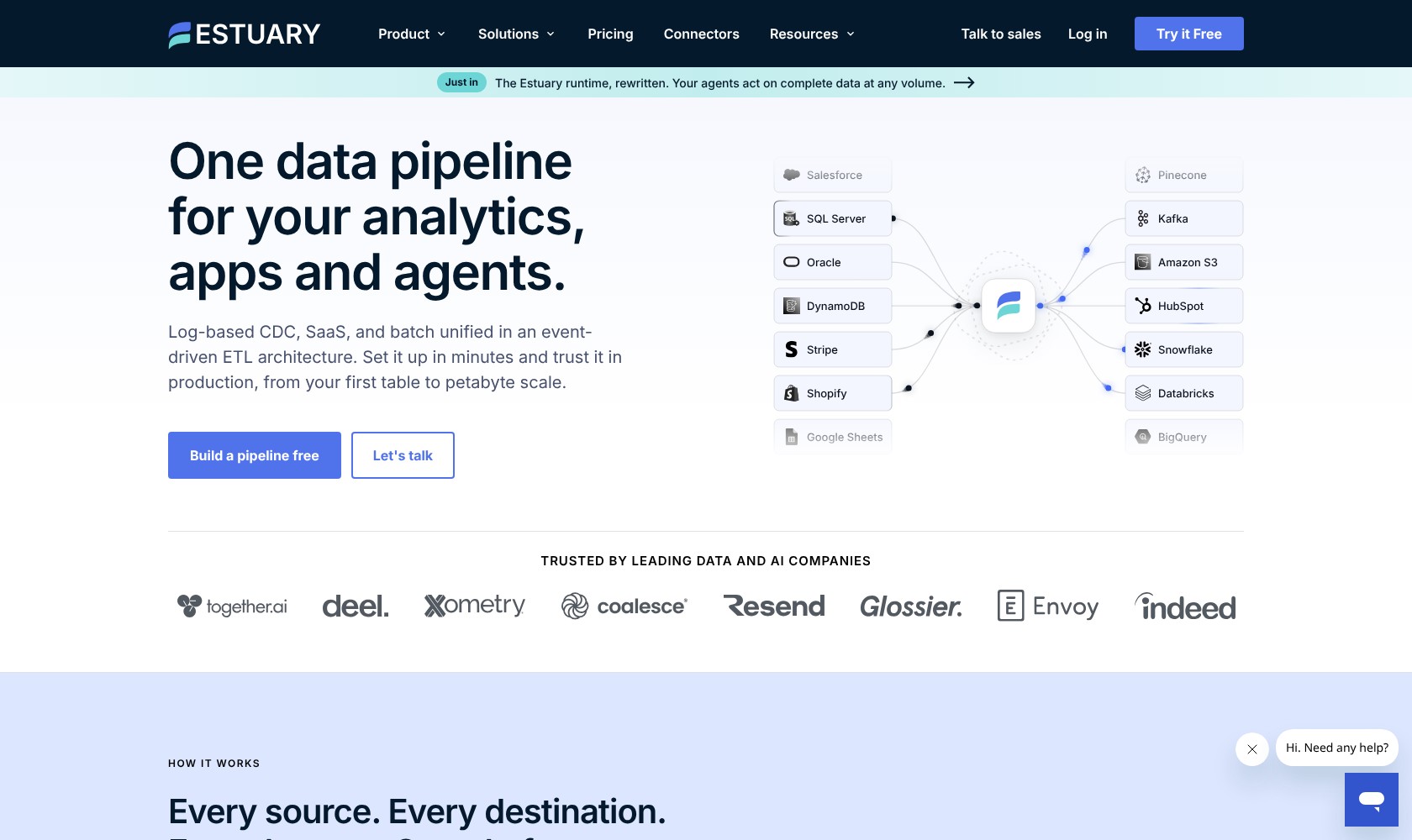
It also supports scheduled snapshots and cursor-based incremental collection reads. These modes are not interchangeable: only the change-stream mode captures deletion events. A periodically refreshed collection is not automatically a complete record of what disappeared.
Estuary calls delivery into a destination a materialization. Snowflake materializations use soft deletion by default, with an optional hardDelete setting to remove rows. Check the equivalent behavior for your chosen destination, particularly if downstream applications expect only current records.
You can expose nested document fields as output columns using JSON-pointer projections. This gives you control over the output schema, but it does not decide the business meaning of an array or build every analytical relationship for you.
The pricing model needs attention when comparing it with Fivetran or Hevo. Source and destination connections both count as connector instances, and measured volume can include data sourced, transformed, and delivered. The database’s stored size alone will not tell you the bill.
Summary: A strong shortlist choice for continuous CDC, with explicit destination behavior and a cost model that rewards careful workload estimates.
- Developer: Free up to 10GB/month and 2 concurrent connector instances.
- Cloud: $100 per connector instance monthly, plus $0.50/GB.
- Trial: 30 days. Check Estuary’s pricing against the full source-to-destination design.
5. Boomi Data Integration (formerly Rivery)
Managed ingestion with coordinated SQL and Python workflows
Boomi Data Integration is Rivery’s current name. Choose it when ingestion, transformations, and orchestration need to work together across dependent data jobs.
Keep the product boundary clear: this is the former Rivery warehouse-integration service, not simply any MongoDB connector in the wider Boomi platform.
MongoDB change-stream extraction starts with a snapshot and then applies subsequent changes. Capture first lands in intermediate FileZone storage; the data-flow schedule controls delivery into the warehouse. Continuous capture therefore does not guarantee an immediately updated report.
The mapping also leaves work for your model. Complex objects and arrays remain JSON instead of automatically becoming separate child tables. Initial mapping samples documents, so check sparse optional fields. CDC retains soft-deleted rows; account for them in reporting. MongoDB time-series collections are unsupported for change-stream extraction.
Compared with a narrower ingestion service, the reason to choose Boomi is the surrounding workflow: dependencies, SQL/Python transformations, and the coordination of downstream steps. If those features are unnecessary, compare a simpler managed connector first.
Summary: Retain Rivery on your shortlist under its new name when orchestration is part of the requirement.
- Paid: Custom quote, with consumption measured in Boomi Data Units.
- Database usage: Standard transfer consumes 1 BDU per 100MB; log-based CDC consumes 2 BDUs per 100MB.
- Trial: 14 days or 1,000 credits, whichever comes first. Request pricing for Boomi Data Integration specifically.
6. Matillion
Visual warehouse transformation with query-based MongoDB loading
Matillion belongs here when building and maintaining transformations is a larger part of your work than continuously replicating database changes. Its Data Productivity Cloud provides the foundation for Maia, with a visual canvas alongside SQL and Python.
Use the current MongoDB Load component when assessing a new Maia pipeline. Older Matillion ETL MongoDB Query configurations have different behavior.
MongoDB Load supports full loading or incremental loading through a datetime high-water mark. In plain terms, it remembers the highest timestamp and asks for records above it next time. Selecting a primary key allows merging; otherwise, the component appends records.
That design depends on a timestamp that changes whenever the records you care about change. It should not be treated as MongoDB change-stream CDC, or assumed to notice a source record that has been deleted.
Driver options can flatten objects and configured array elements, but that still needs deliberate setup. Confirm availability in your project: MongoDB Load is expanding beyond its initial Snowflake and BigQuery destinations.
Summary: Choose Matillion for visual transformation workflows and scheduled loads. Prefer a verified MongoDB CDC connector when complete change capture is essential.
- Paid: Consumption credits, with commercial pricing available by quote.
- Trial: A time-limited Maia trial is available, subject to fair-use terms.
- Planning: Include your transformation workload when requesting Matillion pricing.
7. Debezium
Change-data-capture infrastructure for engineering teams
Debezium gives your engineers control over MongoDB change events and what happens next. It makes sense when you are building a data platform with consumers and destinations you intend to manage yourself.
The MongoDB connector can take an initial snapshot and then read change streams from replica sets or sharded clusters. A common deployment uses Kafka Connect and publishes changes into Kafka topics. That is one architecture, rather than a requirement to treat every Debezium deployment identically.
The distinction from Fivetran is ownership. Debezium emits events; your downstream consumer or sink must translate them into the warehouse state you want.
A delete produces a deletion event and, by default, a tombstone: a same-key record with a null value that supports Kafka log compaction. Neither substitutes for configuring a sink that actually removes or flags the corresponding warehouse record.
You also own recovery planning. A saved position is useful only while the relevant history remains available, so monitor lag and MongoDB’s oplog retention. Decide how snapshots, retries, and replay interact with downstream processing before a production interruption.
The official MongoDB Kafka Connector is another source-to-Kafka option worth considering within an existing Kafka architecture. It still leaves you responsible for delivery into the final analytical destination.
Summary: A capable choice for teams that want control of the event pipeline and have engineers to operate it. It is excessive for a team simply seeking a managed daily warehouse sync.
- Software: The Debezium project uses the Apache 2.0 license.
- Operating cost: Budget runtime, messaging infrastructure, sinks, monitoring, and engineering. A free software license does not cover those responsibilities.
8. AWS Database Migration Service
MongoDB migration and replication within an AWS architecture
AWS Database Migration Service, or AWS DMS, is a practical option when MongoDB replication is part of an AWS migration or existing cloud deployment. It can reduce the need to introduce a separate integration platform, but your team still configures endpoints, networking, and replication tasks.
The choice between document mode and table mode matters. Document mode preserves a JSON representation; table mode maps fields into target columns and expects consistent types for the same field across documents. A field that sometimes contains a number and sometimes text deserves attention before you build around that mode.
Schema changes also require planning. In table mode, new fields missing from the target are not automatically replicated, and collections added during CDC do not automatically create target tables. Collection renames during CDC are unsupported.
Check both versions, not just MongoDB’s. DMS 3.5.4 and later support MongoDB 7.0 and 8.0; CDC also requires replica-set and oplog configuration.
DMS is a replication and migration tool rather than a substitute for a full transformation environment. Matillion or FME may be a better fit when extensive visual data shaping is the main requirement.
Summary: Shortlist DMS for AWS-oriented replication, with explicit schema-change and destination checks.
- Pricing: Replication usage, storage, transfer, and destination services can contribute to the bill.
- Estimate: Use the regional configuration relevant to your workload in AWS DMS pricing. There is no meaningful universal monthly starting price for every MongoDB deployment.
9. Meltano
Composable Singer pipelines for developers who want control
Meltano is useful when your team wants pipelines configured and maintained as code. The MongoDB extractor is a component you choose, not one uniform connector with identical behavior across every implementation.
For this use case, distinguish the MeltanoLabs MongoDB tap from the z3z1ma variant that Meltano Hub lists by default. The MeltanoLabs v0.3.0 release includes LOG_BASED change-stream extraction; pin and evaluate the exact variant you intend to deploy.
Its default incremental mode uses document _id. That is not equivalent to tracking every update and deletion. Change-stream mode must be selected deliberately and requires a replica set or sharded cluster.
The more consequential detail is what comes out. Change-stream records represent events, with their own event keys. A Singer target receiving those records does not automatically maintain one current warehouse row for each source document. Your pipeline must interpret updates and deletes correctly.
The CDC branch needs a separate initial backfill. Plan how the initial copy joins subsequent events without gaps and how state persists between runs. CDC runs exit after 10 seconds of inactivity, so recurring execution needs orchestration.
Those responsibilities make Meltano attractive to a developer who wants composition and control, but a poor substitute for managed replication when there is no engineering owner.
Summary: Keep Meltano as the code-managed option, with a specific tap and an explicit snapshot, state, and event-application design.
- Software: The selected MeltanoLabs tap is Apache 2.0 licensed.
- Operating cost: Compute, orchestration, destination execution, and ongoing maintenance remain your responsibility.
10. FME
Visual ETL for spatial data and complex document transformations
FME is the specialist choice when your MongoDB workflow includes spatial information or substantial visual data transformation. Safe Software’s FME Form builds workflows, while FME Flow and Flow Hosted provide execution options.
Its MongoDB reader/writer maps collections to feature types, documents to features, and document fields to attributes. Nested fields use dotted names, which gives you a concrete way to manipulate document content within a visual workspace.
There is a practical schema caveat: the reader infers structure from a configurable first batch. A sparse optional field absent from that batch may need explicit handling. Define the collections you need and verify the inferred attributes before relying on a workflow.
FME’s spatial handling is a reason to choose it over a general warehouse connector. Treat this reader/writer as a visual ETL workflow: plan recurring execution and deletion reconciliation rather than assuming automatic change-stream replication.
Summary: Choose FME for spatial integration and deliberate transformations. Fivetran or Estuary offers a more direct route when the requirement is managed ongoing replication.
- Pricing: Commercial, with a tailored quote for your subscription and deployment.
- Planning: Include both authoring and execution requirements when requesting FME pricing.
11. KNIME
Free local preparation with paid automation options
KNIME fits an analyst or data scientist who needs to read MongoDB data, prepare it visually, and continue into analysis. Its free Analytics Platform lets you build and run workflows locally.
The appeal is the work after extraction: transformations, analysis, modeling, and visualization can remain in the same workflow. That is a different purchase from a managed connector whose main job is keeping a warehouse synchronized.
Separate local execution from automation. Paid options add sharing and scheduled execution, and deployment constraints matter. KNIME Pro requires cloud-accessible resources; a private-network MongoDB source needs a suitable alternative deployment, such as an appropriately configured Business Hub environment.
Do not assume that a MongoDB connector includes change-stream CDC or automatic destination deletion. Evaluate the exact workflow and server compatibility you need.
Summary: A useful starting point for visual preparation and analysis, especially when local execution is enough.
- Analytics Platform: Free local workflow building and execution.
- Pro: From $19/month with 120 workflow runtime credits; additional runtime costs $0.025 per vCore-minute.
- Team / Business Hub: Team starts at $99/month; Business Hub requires a quote. Compare KNIME’s plans against your automation needs.
How to Choose a MongoDB ETL Tool
Start with one representative collection and your actual destination. A generic connector demonstration cannot tell you whether a changing array, a missing field, or a deleted order will remain correct in your reporting model.
- Confirm the supported deployment. Check the MongoDB version, replica-set or sharded topology, network access, and exact connector release. A compatible protocol does not guarantee support for every MongoDB-like database.
- Define the required state. Do you need current records, a history of changes, or both? Check inserts, updates, replacements, and deletes at the destination, including any flags your reports must filter.
- Choose where shaping happens. ETL transforms data before loading; ELT loads it before transformation. Keeping JSON can preserve flexibility, while relational tables make some reporting easier. Neither removes the need to define relationships.
- Plan outages and freshness. A resume token identifies a position in the change stream. MongoDB must retain enough oplog history to resume from it. Also distinguish how quickly changes are captured from how often the destination updates.
- Price the same workload. Ask each vendor to estimate an equivalent initial load, recurring changes, and destination schedule. Add warehouse compute and the people who will operate the pipeline.
For example, imagine an order containing a $100 total and two line items. You might preserve one JSON record, or create an orders table and a separate line-items table. Flattening everything into two rows and summing the repeated order total would incorrectly produce $200.
Now remove one line item. Updating the order document and removing a previously created child row are different downstream operations. That is why a connector’s “CDC supported” label cannot replace checking the resulting tables.
Before committing, run a small acceptance exercise: load existing records, change a value and its type, omit an optional field, remove an array element, delete a document, then pause and resume the pipeline. Check the resulting records and the recovery behavior, not just a green job-status indicator.
If you also need to choose the destination, our data warehouse guide covers the broader architecture decision.
Final Thoughts
Start with Fivetran for managed warehouse replication, Airbyte for deployment control, or Hevo for ingestion with transformations. Add Estuary to the shortlist when continuous capture matters.
Choose Debezium or Meltano when engineers will own the pipeline, AWS DMS for an AWS replication project, and FME or KNIME for specialist visual work. Compare related options in the Panoply tools directory, then validate your preferred tool with representative MongoDB documents and the destination you will actually use.
MongoDB ETL Tools: FAQs
Can I build a free MongoDB ETL pipeline?
Yes, using software such as Debezium or a Meltano tap and target, but hosting, maintenance, and destination costs remain. KNIME is free for local workflows. Managed free tiers have usage limits and should be evaluated against your complete workload.
Does MongoDB already have ETL tools?
MongoDB provides import/export utilities, aggregation pipelines, and Kafka and Spark connectors. These can form parts of a pipeline, but exporting or transforming documents alone does not provide an automated, monitored delivery service into every external warehouse.
Comments 0 Responses