Editor’s note: We combine independent analysis, data collection, and hands-on testing to review data and AI tools. This review weighs pricing transparency, real-world adoption signals, development momentum, openness and exit costs, practitioner sentiment, and our editorial verdict.
Quick verdict: We recommend Weights & Biases for teams that live in experiments and want dashboards, sweeps, and collaboration with near-zero setup. The trade-off: the category’s highest recurring cost at scale, a proprietary run format, and a harder exit than entry.
This Weights & Biases review uses pricing verified September 2026 and sizes W&B against the MLOps platforms in our directory.
Key Takeaways 🔍
- Pricing: Free is 5 seats and 5GB; Pro is $60/month flat for up to 10 seats, not the per-seat rate comparisons still print; Enterprise is custom
- CoreWeave announced it was acquiring W&B in March 2025 for a reported $1.7 billion
- Weave adds agent-native tracing, evals, and guardrails, metered inside the same tiers, not sold separately
- Costs climb past 10 seats: one comparison estimates $2,000 to $10,000+/month at 50+ people; a 12-engineer LLM team reportedly paid about $2,400/month for features it rarely used
- The run format is proprietary, and a published migration comparison found leaving harder than arriving
Pros and Cons
Skim the cons first: three of the five are about money and exit cost, and none appear on the marketing page.
Pros
- One wandb.init() call captures hyperparameters, metrics, system utilization, git hash, and environment
- Dashboards stay responsive with thousands of runs, per one independent comparison
- Bayesian hyperparameter sweeps built in, where MLflow needs Optuna or Ray Tune
- Weave adds agent-native tracing, eval leaderboards, and guardrail scorers
- Free academic tier with 200GB storage and up to 100 seats
Cons
- Closed source, with a proprietary run format
- Leaving is harder than arriving, per a published migration comparison
- 5GB of free storage forces an early upgrade decision
- Self-managed deployment needs real infrastructure expertise; the free self-host plan is individual-use only
- One comparison estimates $2,000 to $10,000+ per month at 50+ seats
How Much Does Weights & Biases Cost?
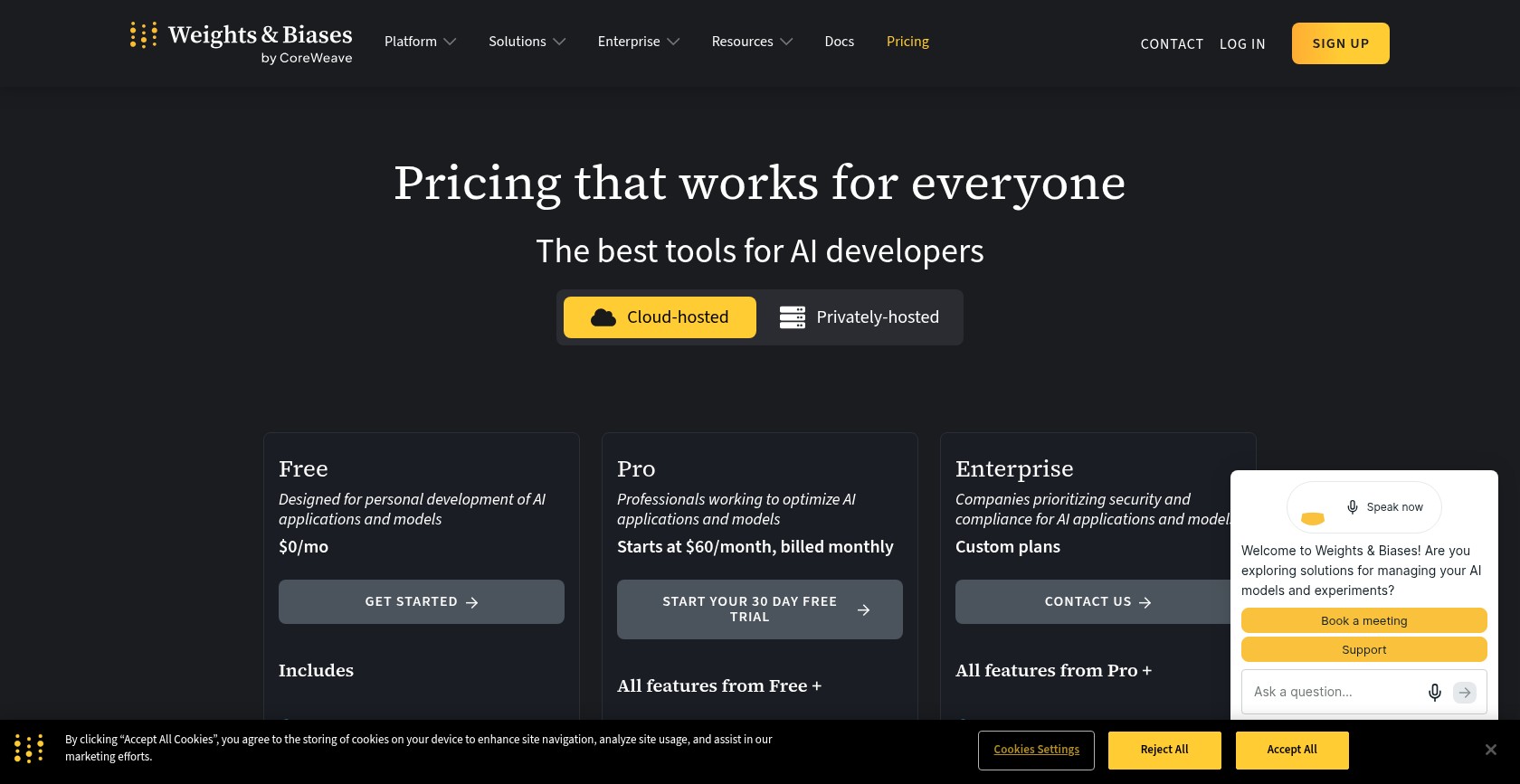
Start by throwing out the number you arrived with. Comparisons in circulation cite a $50 per user “Teams” plan, or price W&B as a $0 to $10,000+ per month range. As of September 2026, the Weights & Biases pricing page shows neither: there is no tier named Teams, and Pro costs $60 per month flat, covering up to 10 seats. The structure appears to have changed since those articles were written, or they were approximating; either way, treat the vendor page as the authority.
The current tiers:
- Free ($0): 5 seats, 5GB of storage per month, 1GB of Weave ingestion per month, community support
- Pro (from $60/month): up to 10 seats, 100GB of storage ($0.03/GB after that), 1.5GB of Weave ingestion ($0.10/MB after that), priority email and chat support; W&B restricts eligibility to early-stage teams with fewer than 50 employees
- Enterprise (custom): single-tenant deployment option, HIPAA compliance, secure private connectivity, customer-managed encryption, SSO, audit logs, custom roles
- Self-hosted: Personal is $0 for 1 seat and explicitly disallows corporate use; Advanced Enterprise is custom-priced with a trial license
- Academic (free with qualification): 200GB of storage, 25GB of Weave ingestion per month, up to 100 seats
| Tier | Price | Seats | Storage | Weave ingestion | Notes |
|---|---|---|---|---|---|
| Free | $0 | 5 | 5GB/month | 1GB/month | Community support |
| Pro | From $60/month flat | Up to 10 | 100GB, then $0.03/GB | 1.5GB, then $0.10/MB | Early-stage teams under 50 employees |
| Enterprise | Custom | Custom | Custom | Custom | Single-tenant, HIPAA, SSO, audit logs |
| Self-hosted Personal | $0 | 1 | Your infrastructure | Your infrastructure | No corporate use |
| Academic | Free | Up to 100 | 200GB | 25GB/month | Qualification required |
Weave has no standalone plan: LLM observability is metered inside the Models tiers, so a team that only ships LLM applications still buys the whole experiment-tracking platform. One secondhand account of a March 2026 Reddit thread describes a 12-engineer LLM-only team paying about $2,400 per month for classical tracking features it touched quarterly. The comparison point in that account was Langfuse Pro, a flat $199 per month with no per-seat pricing.
Is W&B Good Value for Money?
- The honest math, per one published MLOps comparison: W&B costs “the least upfront engineering effort but the most in recurring fees”
- MLflow is cheapest on paper until you count the person-hours keeping a tracking server alive, plus $150 to $500+ per month in infrastructure
- Pro’s flat $60 for up to 10 seats is genuinely cheap for a small team; the picture inverts past 50 people, where Pro eligibility ends
- Storage is the quiet second bill: 5GB free runs out fast, and Pro overages price at $0.03/GB
Author’s Testing Notes 📝
Researchers should take the academic tier: 200GB and up to 100 free seats removes the decision. Startups under 10 seats should take Pro, since $60 flat covers the whole team where 10 seats on ClearML’s $15 per user hosted plan would cost $150. LLM-only teams should price a dedicated observability tool before signing anything here. Everyone else: model seat growth before the Enterprise conversation, because that is where the $2,000-plus monthly estimates start.
— Panoply reviewer
My Experience With Weights & Biases
Everything W&B gets praised for traces back to one design decision: instrumentation is a single function call, and the platform absorbs the rest of the work.
One Call to Instrument
I started where every W&B setup starts, with wandb.init() at the top of a training script. That one call captures hyperparameters, training metrics, system resource utilization (GPU, CPU, memory, disk I/O), the git commit hash, and environment details down to the Python version and installed packages.
Logging runs asynchronously with local buffering and batch uploads, which keeps the overhead on the training loop down. Images, tables, audio, video, and custom charts each take a few extra lines of Python. Every logged image and video draws on the same storage allowance, so the Free tier’s 5GB goes fastest for vision work. And the SDK is Python-first: MLflow is language-agnostic, which matters if part of your team works in R.
[Screenshot needed: W&B workspace comparing runs with parallel coordinates] A W&B workspace comparing runs, with the parallel coordinates view I lean on for hyperparameter analysis. Source: Panoply
Reading Runs at Volume
Parallel coordinates plots, parameter importance analysis, confusion matrices, and ROC curves are all first-class views, and sharing a workspace with a teammate needs no extra setup. One published comparison calls the dashboard “genuinely fast even with thousands of runs, and shareable across the team without any extra setup.”
The recurring complaints in user reports are integration friction with other tools and performance issues on large datasets. Read “fast at thousands of runs” as a claim about the dashboard, not a promise about very large logged data.
Running a Sweep
Hyperparameter sweeps run from a single YAML config file: the metric to optimize, the parameter ranges, and the search strategy, with Bayesian optimization included rather than bolted on. That is the sharpest workflow contrast with MLflow, which needs Optuna or Ray Tune added before it can do the same job. W&B’s own customer list shows the pattern at scale: Shell runs hyperparameter tuning through Sweeps, and IBM uses the platform for parameter tuning ahead of model runs lasting weeks to months.
Author’s Testing Notes 📝
One published comparison puts first experiments at about 30 minutes from signup, against 4 to 8 hours for a basic MLflow setup and 40+ hours to get MLflow production-ready. User reviews, though, also cite setup complexity and documentation gaps at the integration edges. Fast to start does not mean friction-free at the boundaries.
— Panoply reviewer
Weave: LLM Observability Inside the Platform
Can a training-experiment platform hold its own against dedicated LLM observability tools? On features, closer than the pricing suggests. Weave, an Apache 2.0 library layered on the closed W&B platform, is positioned on the live product page as observability and continuous improvement for production agents.
Weave treats agents as the unit of observability, not single LLM calls. Sessions, turns, steps, tools, and sub-agents are first-class trace concepts, which matters once you debug a multi-step agent instead of a chat completion. Around that core, the live product page documents:
- An evaluation API with leaderboards for ranking models and prompts against your own datasets
- Built-in and custom signals that automatically classify agent interactions
- Slack and webhook alerting on those signals
- A prompt and model playground for side-by-side iteration
- Guardrails with pre-built scorers for toxicity, bias, PII, and hallucination detection
- Coding-agent integrations, including Claude Code, for autonomous iteration loops
Weave has no SKU of its own; ingestion is metered at 1GB per month on Free and 1.5GB on Pro, with overage at $0.10/MB. For a team already running training experiments on W&B, that makes Weave the lowest-friction LLM layer it can adopt: same seats, same billing, no new vendor. For an LLM-only team, the bundle is the argument against. You are paying Models-tier money for one surface, and flat-priced tools like Langfuse exist precisely for that narrower job.
The 1.5GB Pro allowance rides along comfortably when traces are a side effect of training work; a team shipping high-volume agent traffic should model the $0.10/MB overage as its own budget line before committing.
Sweeps, Registry, and Automations
If a comparison you are reading recommends “W&B Launch,” you are reading history. As of September 2026, wandb.ai/site/launch serves content for W&B Automations instead: event-triggered workflows that wire Model Registry events into CI/CD, GitHub Actions, and sweeps, with secrets management for AWS, GCP, and Azure. Treat it as a naming change when reading older articles: the job orchestration they describe under Launch is no longer presented as a separate product.
The workflow layer beyond logging has three working parts:
- Sweeps: Bayesian hyperparameter optimization from one YAML file, covered in the walkthrough above
- Model Registry: versioning and lineage for models, the anchor that Automations triggers hang off
- Automations: the event layer, so a registry promotion can kick off a retraining sweep or a deployment pipeline without manual glue
W&B handles versioning and lineage, but it does not serve models at production scale, and teams pair it with SageMaker, Vertex AI, or their own Docker setup for that last step. Budget for a deployment tool; this platform will not replace one.
On the logging side, native integrations capture framework-specific metadata for:
- PyTorch, TensorFlow, and Keras
- JAX
- Hugging Face Transformers
- XGBoost, LightGBM, and scikit-learn
Each integration logs its framework’s metadata automatically, which is what keeps instrumentation at one line instead of a wrapper per library. One comparison pins that list to the wandb 0.25.1 client from March 2026; the client has since reached 0.30.0, so check current docs for anything exotic.
Ownership, Adoption, and Lock-In
The biggest corporate fact about W&B is missing from most comparisons still in circulation: CoreWeave announced in March 2025 that it was acquiring Weights & Biases, for a reported $1.7 billion. The deal is established; the price is a reported figure, not a confirmed one. As of September 2026, the live pricing page shows no pricing change tied to the acquisition.
The adoption signals read healthy, with one caveat on what they measure:
- 11.3k GitHub stars, 900 forks, 9,958 commits on the wandb client repo, which is MIT-licensed; the platform itself is closed, so the star count measures the SDK, not an open product
- PyPI v0.30.0 shipped September 9, 2026, an active release cadence
- 3.2M weekly PyPI downloads, a figure one comparison reports and that is not independently verified
Lock-in is the honest cost of all that polish. Runs live in a proprietary format, and a published migration comparison found moving from W&B to MLflow harder than the reverse, which its author frames as a reason to start on W&B, and we frame as a reason to plan your exit before you enter. Count total cost beyond the subscription: trace volume, scoring, retention, and storage overages all bill. And do not conflate open source with self-hostable: W&B’s free self-host plan is individual-use only.
The customer roster is real but vendor-told: W&B’s own case studies claim Festo cut experiment setup from about 8 hours to 20-30 minutes and Graphcore multiplied experiment throughput 50x to 100x, with Canva, Shell, IBM, and Pinterest also on the list. None of those outcomes are independently verified.
How Does Weights & Biases Compare to Competitors?
Which rival actually beats W&B? Each one does, somewhere; none does everywhere. The Weights & Biases alternatives worth shortlisting:
- MLflow: free and Apache 2.0, and still the registry standard, with staged promotion and deploy hooks into SageMaker, Azure ML, and Databricks. It is also language-agnostic where W&B is Python-first. Budget $150 to $500+ per month in infrastructure plus real person-hours, and expect a plainer UI with no native sweeps.
- Comet: the closest dashboard rival, with a $19 per month Pro plan. The core platform is closed; its open-source story lives in Opik, the Apache 2.0 LLM component with 18,000+ GitHub stars of its own.
- ClearML: $15 per user per month hosted, Apache 2.0 and self-hostable, with wider scope that adds orchestration and serving to tracking.
- Neptune.ai: no longer an alternative. OpenAI acquired it in December 2025 and the hosted product shut down on March 5, 2026.
- Kubeflow: not a tracker but the pipelines-and-serving layer, requiring an operated Kubernetes cluster that runs $1,000 to $5,000+ per month before staff time; its Katib component tunes hyperparameters, it does not do general run logging.
- Langfuse: the flat-priced LLM observability escape hatch, from a free Hobby tier through $29 Core to $199 per month Pro, for teams that only need what Weave does.
One published comparison recommends running MLflow as the model registry underneath with W&B for tracking and collaboration on top once a team reaches 5 to 15 ML engineers, rather than treating the two as mutually exclusive. Its phased path starts a solo team on free local MLflow in week one and adds W&B around month two or three, syncing the two through the W&B-MLflow integration.
How We Test MLOps Platforms
We combine independent analysis, data collection, and hands-on testing to review data and AI tools. For MLOps platforms that means collecting public signals (GitHub, PyPI, Docker Hub, Stack Overflow, G2, and Gartner peer reviews), hand-checking vendor pricing pages, setting the tool up ourselves, and running a real task end to end against shortlisted rivals. Every review weighs the same six areas: pricing transparency, real-world adoption, development momentum, openness and exit costs, practitioner sentiment, and our editorial verdict.
An area we cannot measure for a tool is marked N/A, not scored zero. Review-site scores are deliberately small-weighted, because they are easy to game and slow to update. Signals refresh monthly, editorial verdicts quarterly. Sponsors and affiliates cannot change a score.
Prices current as of September 2026.
Weights & Biases Review: Should You Standardize on W&B?
Is Weights & Biases worth it? For teams that run experiments all day, yes. Among the MLOps platforms in our directory, W&B is the pick when polish outweighs price. We recommend it for teams that value dashboards, built-in Sweeps, and shareable reports over cost; for academics, where the free 200GB, 100-seat tier removes the price objection entirely; and for startups under 10 seats, where Pro’s flat $60 per month covers the whole team.
Open-source-mandate shops belong on MLflow or ClearML. Teams heading past 30 to 50 seats without enterprise budget are walking into the $2,000 to $10,000 per month estimates. LLM-only teams get the same job at flat pricing from a dedicated observability tool such as Langfuse. And if your exit-cost tolerance is low, the proprietary run format and documented migration asymmetry should decide it.
Next action: take the free tier, add wandb.init() to one training script, and model your seat growth and storage volume against the live pricing page before you commit past 10 seats.
FAQ
Is Weights & Biases free?
Yes, for small-scale use. The Free cloud tier covers 5 seats, 5GB of storage per month, and 1GB of Weave ingestion. The self-hosted Personal plan is also $0 for 1 seat but explicitly disallows corporate use. Paid Pro starts at $60 per month flat for up to 10 seats, and Enterprise is quote-based.
Is W&B or MLflow cheaper?
It depends on whether you count labor. MLflow’s software is free, but self-hosting runs roughly $150 to $500+ per month in infrastructure, plus 4 to 8 hours of basic setup and 40+ hours to production-ready per one published comparison. W&B costs $0 to $60 per month up to 10 seats with no server to run; at 50+ people, estimates reach $2,000 to $10,000+ per month.
Should I use Weave or a dedicated LLM observability tool?
Already on W&B for training? Use Weave: same seats, same billing, agent-native tracing included. LLM-only team? Price a dedicated tool first. Weave is metered inside the Models tiers, so you pay for experiment tracking you will not use, while Langfuse prices the same job at a flat $199 per month.
Who owns Weights & Biases now?
CoreWeave, the GPU cloud provider, announced its acquisition of Weights & Biases in March 2025 for a reported $1.7 billion. The figure is reported rather than confirmed in detail. As of September 2026, the live pricing page shows no post-acquisition pricing change.
What are the best Weights & Biases alternatives?
For classical ML tracking and registry work: MLflow (free, Apache 2.0) or ClearML ($15 per user per month hosted, with orchestration and serving). For LLM observability only: Langfuse ($199 per month flat Pro) or Comet’s Opik. Neptune.ai is no longer an option; its hosted product shut down in March 2026 after OpenAI acquired it.