
Editor’s note: This Dremio review evaluates the pricing model, the documented product behavior and the edition ladder as Dremio sells it in October 2026, including the 30-day Dremio Cloud trial and the free Community Edition. It is not a hands-on performance test. I weigh five areas: pricing transparency, openness and exit costs, setup and operating effort, governance, and development momentum.
Quick verdict: I recommend Dremio for data teams that keep their tables in Apache Iceberg on S3 and want BI-speed SQL without copying data into a warehouse, paying $0.20 per DCU only while engines run. Go in knowing that the managed service runs in five AWS regions only (Azure is still coming soon), that support tiers and self-managed Enterprise pricing are quote-only, and that SAP, which closed its acquisition on July 6, 2026, has not said what changes for non-SAP customers.
Among lake query engines, Dremio’s edge is Autonomous Reflections, accelerations it builds and drops from the last 7 days of queries, plus a Polaris-based Open Catalog in every Cloud project.
In this review, I’ll take a closer look at Dremio’s pricing, Reflections, Iceberg catalog and AI agent, and how it stacks up against Trino, Starburst and Amazon Athena, so you can see exactly whether it belongs in your lakehouse.
Key Takeaways
- $0.20 per DCU, billed per second; an XSmall engine costs $6.40 an hour, a Medium $25.60
- Autonomous Reflections are always on in Cloud, up to 100, at most 10 new per day
- Full Iceberg DML plus automatic compaction and clustering on the Open Catalog
- Cloud runs in 5 AWS regions only, and the 99.99% uptime on the pricing page is not a published SLA
- Community Edition is free but has no time travel, row policies or Autonomous Reflections, and its public repo stalled in September 2025
Dremio Pros and Cons
Pros
- Pay-as-you-go at $0.20 per DCU, billed per second, with a 30-day trial and $400 in credits
- Autonomous Reflections build and retire up to 100 accelerations from 7 days of query history
- Built-in Open Catalog on Apache Polaris that other engines read over the Iceberg REST API
- Full Iceberg DML plus automatic compaction, Z-order clustering and manifest rewrites
- Arrow Flight SQL, JDBC, ODBC, a dbt adapter and a hosted MCP server for Claude and ChatGPT
Cons
- Dremio Cloud runs in 5 AWS regions only, with Azure still marked coming soon
- Community Edition has no time travel, row policies or Autonomous Reflections
- Enterprise pricing, support tiers and any uptime SLA are behind a sales call
- Reflections refresh at most hourly in Cloud, and a busy refresh engine pauses them
- SAP closed the acquisition in July 2026 and has said nothing about Cloud pricing or Community
How Much Does Dremio Cost?
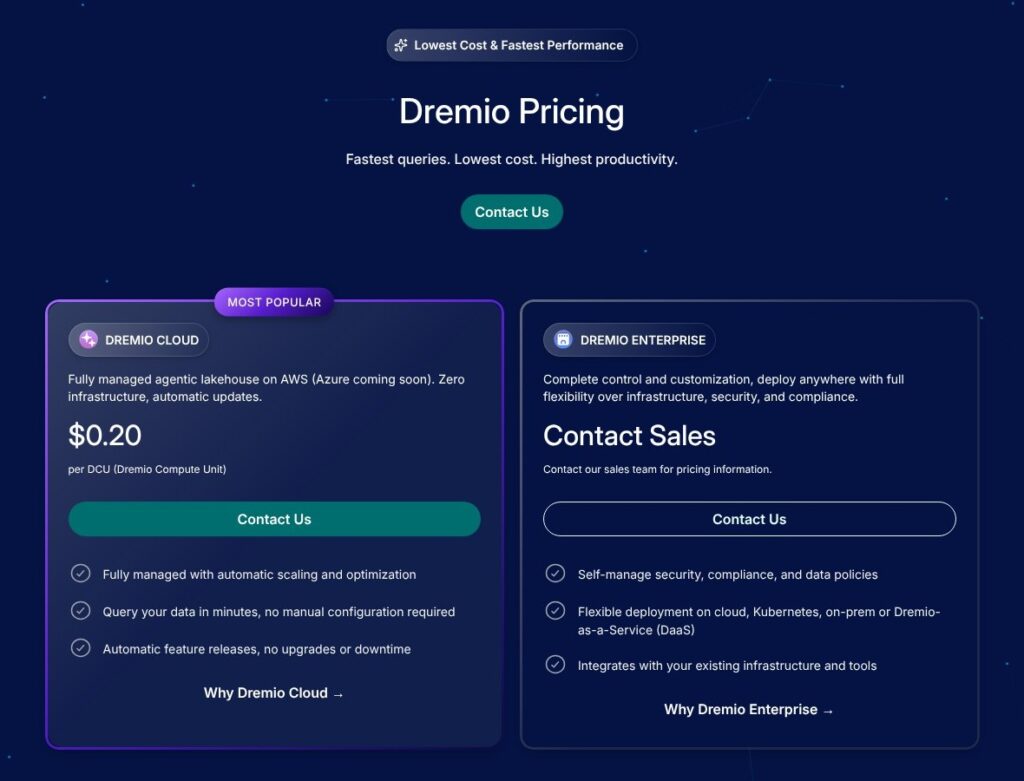
Dremio Cloud is the only paid edition with a public price: $0.20 per Dremio Compute Unit (DCU), pay-as-you-go, with the underlying AWS infrastructure included.
- Community (free): for evaluation, self-managed on Docker or Kubernetes; Dremio pitches its single-container Docker install for testing, not production.
- Dremio Cloud ($0.20 per DCU): for teams on AWS that want a managed lakehouse engine; the 30-day trial comes with $400 in credits and needs no card, annual contracts with committed pricing are available, and billing runs per second with a 60-second minimum.
- Dremio Enterprise (quote only): for self-managed deployments on Kubernetes, on-premises or on AWS, Azure and GCP; it is consumption-based with annual commits and AWS and Azure marketplace purchase, and since version 26.0 a Kubernetes deployment will not start without a license key.
Bronze, Silver and Gold support tiers sit outside the DCU price on both paid editions, with no published rates.
| Engine size | DCUs per hour | List price per hour | Concurrent queries per replica (default / max) |
|---|---|---|---|
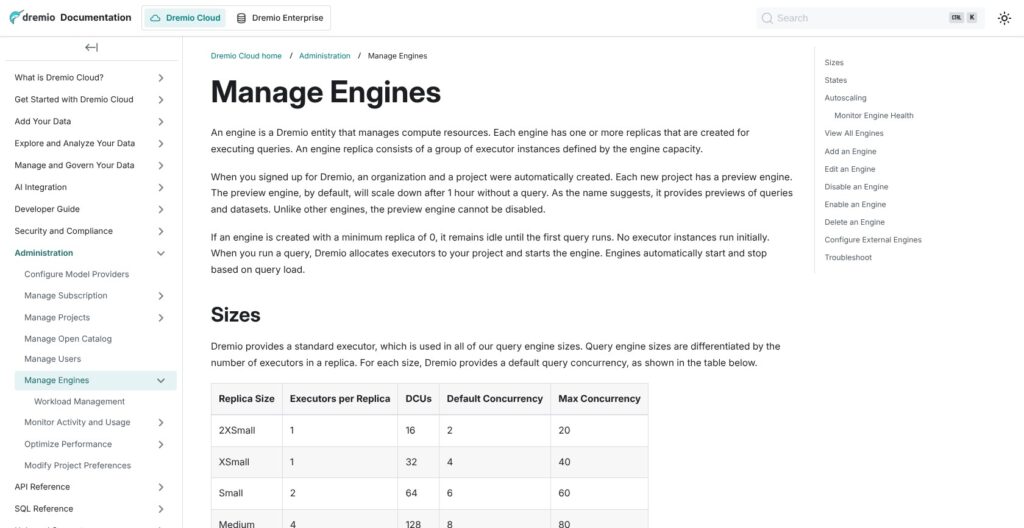
| 2XSmall | 16 | $3.20 | 2 / 20 |
| XSmall | 32 | $6.40 | 4 / 40 |
| Small | 64 | $12.80 | 6 / 60 |
| Medium | 128 | $25.60 | 8 / 80 |
| Large | 256 | $51.20 | 10 / 100 |
| XLarge | 512 | $102.40 | 12 / 120 |
| 2XLarge | 1,024 | $204.80 | 16 / 160 |
| 3XLarge | 2,048 | $409.60 | 20 / 200 |
Prices are per replica: a second replica running alongside the first doubles the hourly rate.
- Storage: Dremio-hosted project storage bills per TB-month ($23 in Dremio’s example region); bring your own S3 bucket and Dremio charges nothing for storage.
- LLM tokens: only when the AI agent runs on the Dremio-provided model, at $1.25 per million input and $10 per million output tokens in Dremio’s billing example.
- Your own model provider: Gemini, OpenAI, Anthropic, Azure OpenAI or AWS Bedrock keys carry no Dremio token charge.
Is Dremio Good Value for Money?
A Medium engine running 8 hours a day for 22 working days bills 176 hours, or 22,528 DCUs, which is $4,505.60 a month at list price. An XSmall on the same schedule comes to $1,126.40. Neither figure includes support or hosted storage.
Engines stop once the last replica sits idle for the auto-stop window (2 hours by default), and a minimum of zero replicas keeps nothing running until the first query. With the default left in place, every working day on a Medium can end with $51.20 of idle time, so the auto-stop timer is the first setting I would change.
Amazon Athena charges $5 per TB scanned with no engine to size, so a team scanning 3 TB a month pays $15 there, far below even the XSmall schedule above.
- Good value when one engine serves many dashboards through Reflections, since concurrent queries share the hourly rate (a Medium runs 8 at once by default, up to 80 per replica).
- Poor value for sporadic queries on small data, where Athena’s per-scan billing wins.
- A second meter: Reflection refreshes run on their own engine, and Dremio recommends at least two nodes for it.
Reviewer’s Notes: I would start on the trial with an XSmall engine, set the minimum replicas to 0 and the auto-stop well below 2 hours, then watch DCU usage for two weeks. Ask sales for an annual committed-pricing contract only once a steady Medium-or-larger baseline shows up.
Getting Started With Dremio Cloud on the Free Trial
The Dremio Cloud trial needs no card and gives you 30 days and $400 in credits, enough for about 62 hours on an XSmall engine or about 15 on a Medium.
Signing Up and Picking a Region
Signup creates an organization and a first project automatically, along with a preview engine that scales down after 1 hour without a query and cannot be disabled. You pick the project’s region when you create it:
- US: us-east-1 (N. Virginia), us-east-2 (Ohio) or us-west-2 (Oregon)
- EU: eu-central-1 (Frankfurt) or eu-west-1 (Ireland)
US and EU projects sit behind separate control planes, so the region is a data-residency decision you make on day one. I would settle residency with whoever owns compliance before creating the project, not after the first tables land.
Connecting Data
The built-in Open Catalog already exists in a new project, so you can create Iceberg tables before connecting anything else. You can also add:
- Object storage: Amazon S3 or Azure Storage
- External catalogs: AWS Glue, Unity Catalog, Snowflake Open Catalog, Google Cloud Lakehouse Catalog or any Iceberg REST catalog
- Databases: 13 connectors covering PostgreSQL, SQL Server, MySQL, Oracle, Db2, SAP HANA, Redshift, BigQuery, Snowflake, Azure Synapse, Vertica, Druid and MongoDB
To load files, use COPY INTO, an autoingest pipe for event-driven micro-batches from object storage, or a local upload of up to 500 MB. Self-managed Enterprise adds Teradata, Hive, HDFS and GCS connectors that Cloud lacks.
Running the First Queries
Next you create an engine (2XSmall to 3XLarge), set its minimum and maximum replicas and the auto-stop, and open the SQL Runner. One query can join an Iceberg table in the lake with a PostgreSQL database, and because Iceberg partitioning is hidden, you filter on the column itself rather than a partition path.
BI tools connect over Arrow Flight SQL, JDBC, ODBC or the native Tableau and Power BI connectors, and those clients return at most 10 GB of data per query. Save a busy query as a view, and that view becomes a candidate for acceleration.
Autonomous Reflections are scored on the last 7 days of query patterns, so give the trial a full week of real queries before you judge speed. A manual aggregate Reflection on your busiest view is the shortcut if you need an answer sooner.
Reflections: How Dremio Makes Lake Queries Fast
A Reflection is a precomputed copy of a dataset, raw or aggregated, that the planner swaps into matching queries without any change to your SQL. The planner compares the cost of the Reflection against the raw data and picks the cheaper plan, and it matches Reflections defined on views to queries written against the underlying tables. Aggregate Reflections store one base aggregate at the finest grain you define and re-aggregate it for coarser GROUP BY queries, rather than building a cube of every combination.
Autonomous Reflections
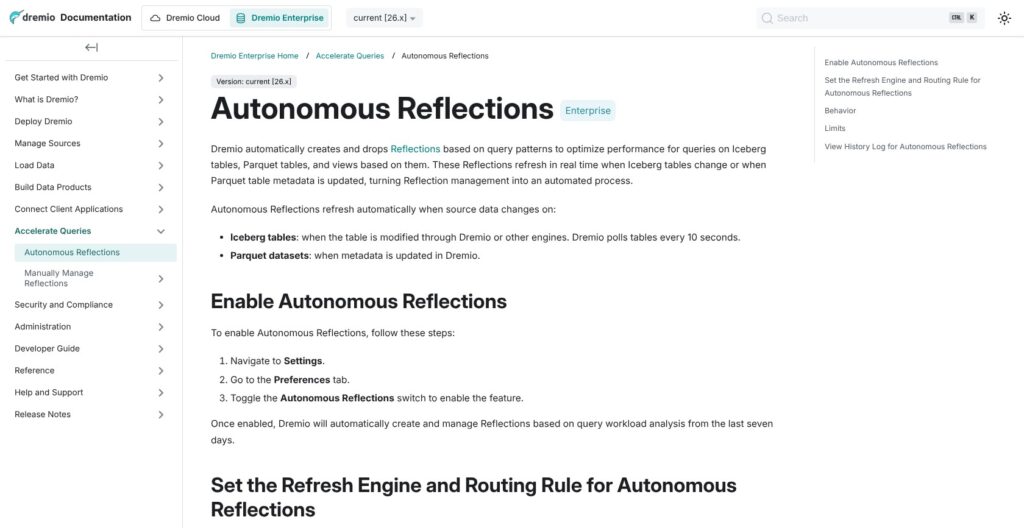
Dremio builds and drops these from the last 7 days of query patterns on Iceberg tables, Parquet datasets and views:
- Up to 100 autonomous Reflections, with no more than 10 created per day
- Low scorers are disabled for 7 days before being dropped
- One you drop manually is not recreated for 90 days
- Always on in Cloud, off by default in Enterprise
Cloud caps an organization at 500 Reflections in total, 100 of them autonomous. Open-source Trino has no built-in equivalent, so acceleration there is tuning work your team owns.
Freshness and the Refresh Bill
For Iceberg tables, Dremio checks freshness from table metadata; for CSV, JSON and database connections, it falls back on an expiration policy you configure, and stale Reflections are skipped at planning time. Cloud refreshes a Reflection at most once an hour. Refreshes run on a dedicated engine that Dremio recommends at two or more nodes, and when that engine hits capacity, Autonomous Reflections pause.
Users on Dremio’s community forum have reported raw Reflections over large CSV sets taking 36 to 54 minutes to refresh, and a select-all Reflection over 16.7 GiB of Parquet running past an hour and a half while using 58.5 GB of storage. Dremio staff steer them toward aggregate Reflections and toward Parquet or Iceberg over CSV.
The September 29, 2026 Cloud changelog still lists fixes for wrong results on Reflection-accelerated views joined more than once and on negated filters over a filtered Reflection. I would spot-check accelerated results against the raw tables on any dashboard that feeds finance or compliance reporting.
Open Catalog, Iceberg Writes and Automatic Optimization
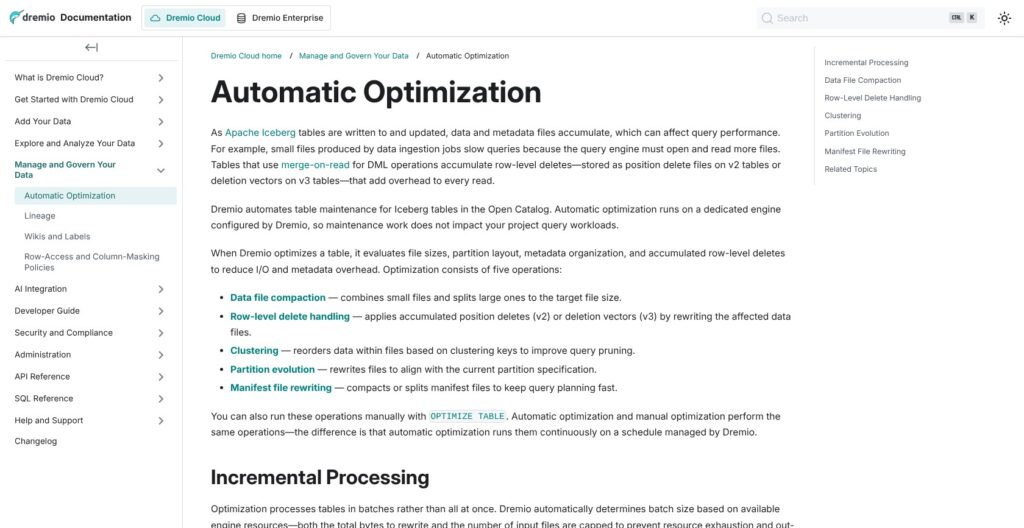
Every Dremio Cloud project ships with an Open Catalog built on Apache Polaris. The Open Catalog speaks the Iceberg REST API, so other engines that support it can read the same tables, which keeps exit costs low if you leave Dremio.
On Iceberg tables, Dremio runs:
- DML: INSERT, UPDATE, DELETE, MERGE, TRUNCATE, OPTIMIZE TABLE and ROLLBACK TABLE
- DDL and utilities: COPY INTO, VACUUM TABLE, CREATE FUNCTION, SET TAG and ANALYZE TABLE
DML works on Iceberg tables only. Delta Lake and UniForm tables are read-only in Dremio, so a Delta-first shop on Databricks gets queries but not writes. MERGE handles CDC-style upserts inside Dremio, with no separate Spark job to run.
Automatic Optimization
Tables in the Open Catalog get five maintenance jobs on a dedicated engine that Dremio configures:
- Data file compaction to a 256 MB target
- Row-level delete handling (v2 position deletes, v3 deletion vectors)
- Z-order clustering
- Partition evolution
- Manifest rewriting
Manual OPTIMIZE TABLE runs the same five operations, but Dremio recommends the automatic jobs instead. Very large tables with millions of small files need several runs, because each run is batch-capped to avoid out-of-memory errors.
Time Travel and Cross-Engine Reads
Time travel queries and ROLLBACK TABLE let you read or restore an earlier snapshot; Community Edition has no time travel. In July 2025 a Dremio maintainer confirmed a bug where Iceberg tables written by Flink’s upsert sink read as empty because of how equality deletes were applied, with the fix slated for 26.1.0.
I would test reads of every table another engine writes before cutting dashboards over. Athena also reads and writes Iceberg tables registered in AWS Glue, while Databricks steers you toward Unity Catalog and Delta.
AI Agent, MCP Server and the Semantic Layer
Dremio Cloud’s built-in AI agent answers questions in natural language and shows the SQL it ran. It accepts:
- @ references to tables and views
- File uploads in CSV, JSON or Parquet, up to 10 files of 500 MB each per message
- Reusable personal skills
Because the SQL is visible, you can rerun it in the SQL Runner and check it against a known number before trusting an answer. Users need the CALL MODEL privilege on a model provider. On the Dremio-provided model, tokens bill at $1.25 per million input and $10 per million output in Dremio’s example; plug in your own Gemini, OpenAI, Anthropic, Azure OpenAI or Bedrock provider and Dremio bills no tokens.
MCP for Claude, ChatGPT and Cursor
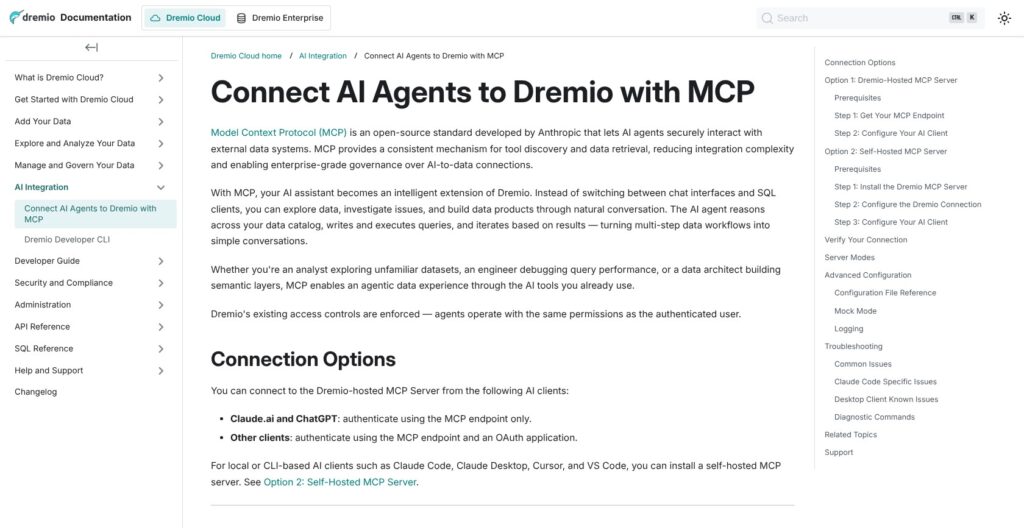
Claude.ai and ChatGPT connect to a hosted MCP endpoint at mcp.dremio.cloud/mcp/{project_id}. Claude Code, Claude Desktop, Cursor and VS Code use a self-hosted, open-source MCP server with a personal access token; the same server is the route for self-managed Enterprise deployments. Agents run with the authenticated user’s privileges, so row and column policies still apply to anything an LLM asks.
The Semantic Layer
Views organized in spaces, plus tags and lineage, make up the semantic layer the agent queries through. Row-access and column-masking policies are written as UDFs on Enterprise and Cloud, and Enterprise can also defer to Apache Ranger or Privacera for Spaces. Community Edition lacks the AI agent, the MCP integration features, lineage and policies. The agent can only be as precise as the views you expose to it, so budget modeling time for each one before you open it to business users.
Editions, Security and the SAP Question
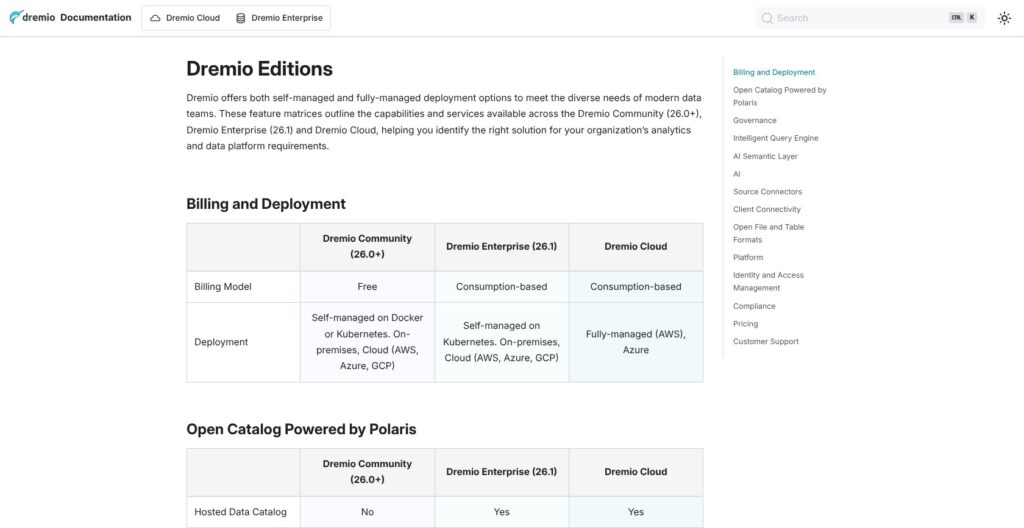
The edition you pick decides whether you get row and column policies, Autonomous Reflections and zero-downtime upgrades:
| Feature | Community | Enterprise | Cloud |
|---|---|---|---|
| Price | Free | Quote only | $0.20 per DCU |
| Deployment | Self-managed on Docker or Kubernetes | Kubernetes, on-premises, AWS, Azure, GCP | Managed on AWS, 5 regions |
| Row and column policies, lineage | No | Yes | Yes |
| Autonomous Reflections | No | Off by default | Always on |
| Automatic Iceberg optimization, time travel | No | Yes | Yes |
| AI agent and MCP | Open-source MCP server only | Agent with a limited tool set, open-source MCP server | Full agent, hosted MCP, Dremio-provided LLM |
| Upgrades | With downtime | With downtime | Automatic, zero downtime |
| Support | Community portal | Bronze, Silver, Gold | Bronze, Silver, Gold |
Cloud alone adds high availability, replica scaling and social identity providers, while Enterprise keeps the wider connector list and external access-policy providers. On Enterprise you own the cluster, the upgrade downtime and, on Kubernetes, the license key.
On the paid editions, security covers:
- Sign-in: SSO via OIDC with Entra ID, Okta, Google or GitHub, plus SCIM provisioning
- Tokens: personal access tokens valid for up to 180 days, or non-expiring
- Network: PrivateLink on Cloud, also available for 7 of the 13 database connectors
- Compliance: SOC 2, ISO 27001:2022, HIPAA, GDPR and CCPA
The pricing page advertises 99.99% uptime, but Dremio publishes no SLA terms behind that number, so get the uptime commitment and service credits written into the order form before you sign.
What the SAP Acquisition Changes
SAP announced the deal on May 4, 2026 and closed it on July 6, 2026, without disclosing terms. SAP says it will make SAP Business Data Cloud an Apache Iceberg-native lakehouse that unifies SAP and non-SAP data, and that it is “fully committed to continuing to invest in and prioritize” Dremio’s work on Iceberg, Polaris and Arrow. SAP shops gain the most, since SAP HANA is already a Dremio Cloud connector.
In October 2026 the pricing page still shows $0.20 per DCU and the 30-day, $400 trial. Neither company’s acquisition release addresses Cloud pricing or Community Edition. The public dremio-oss repo (Apache 2.0) last moved in September 2025 at 26.0.5, while Enterprise has shipped through 26.1.12.
For a multi-year commitment, I would ask for price protection in the contract. The Polaris catalog and your Iceberg files are the exit hatch if the roadmap turns SAP-first.
How Does Dremio Compare to Competitors?
Dremio wins when many BI users hit the same Iceberg tables on AWS and you want acceleration you don’t have to manage.
| Tool | Pricing model | Entry price | Free option | Best for |
|---|---|---|---|---|
| Dremio Cloud | Per DCU of engine uptime | $0.20 per DCU (XSmall $6.40/hour) | 30-day $400 trial; free Community | BI on Iceberg with automatic acceleration |
| Trino | Open source, self-hosted | $0 (Apache 2.0) plus your infrastructure | Yes | Teams with ops capacity that want a free federated engine |
| Starburst Galaxy | Per credit | From $0.50 per credit (Pro) | Free tier up to 3 clusters; 30-day $500 trial | Managed Trino with a free tier |
| Amazon Athena | Per TB scanned | $5 per TB | No | Ad hoc SQL on S3 with no engine to size |
| Databricks | Per DBU | Varies by SKU | 14-day trial | Spark, ML and streaming beside SQL |
| Snowflake | Per credit | Varies by edition and region | Free trial | Managed warehouse plus Iceberg tables |
- Trino: The Apache 2.0 engine costs nothing to license, and it suits teams with the staff to run, tune and upgrade their own cluster. There is no Autonomous Reflections equivalent, so acceleration is your job; Dremio Cloud’s XSmall at $6.40 an hour is roughly what you pay to skip that ops work.
- Starburst Galaxy: Managed Trino with a free tier for up to 3 clusters and Pro credits from $0.50. Governance features such as ABAC, SCIM and PrivateLink start at the $0.75 Enterprise credit tier, while Dremio Cloud publishes no tier gate for SSO or SCIM.
- Amazon Athena: $5 per TB scanned with no cluster at all, and converting to compressed columnar files cuts AWS’s own 3 TB example from $15 to $1.25. It wins for occasional queries, but heavy dashboard traffic is billed by data scanned rather than engine hours, and federated queries bill a 10 MB minimum each.
- Databricks: The pick when Spark jobs, ML and streaming matter as much as SQL, with a 14-day trial. It centers on Delta and Unity Catalog, while Dremio writes only Iceberg. Dremio does read Delta tables, so it can sit beside a Databricks estate as a BI layer without owning the writes.
- Snowflake: A fully managed warehouse with Iceberg table support, billed per credit at rates that vary by edition and region. Choose it for one vendor across storage, compute and data sharing; choose Dremio for per-second engine billing over Iceberg tables you already keep in S3.
- ClickHouse: A real-time analytics database on its own columnar storage format, a better fit for event and log dashboards than lake queries over Iceberg. Dremio is the better pick when the data already lives in Iceberg on S3 and has to stay there.
How I Reviewed Dremio
I evaluated Dremio on the five areas Panoply weighs for every data tool: pricing transparency, openness and exit costs, setup and operating effort, governance, and development momentum. For Dremio, that meant:
- Working the DCU table into monthly bills for real schedules
- Mapping the documented path from a trial signup to an accelerated dashboard query
- Going through the Reflections, Autonomous Reflections and automatic optimization rules line by line
- Comparing Community, Enterprise and Cloud feature by feature
- Following the Cloud changelog through September 2026 and the 26.1 release line
- Weighing what the SAP deal does and does not change
I compared it against Trino, Starburst Galaxy, Amazon Athena, Databricks, Snowflake and ClickHouse. Prices current as of October 2026.
Should You Run Your Lakehouse Queries on Dremio?
Yes, if your tables are (or will be) Iceberg on S3, many BI users hit the same data, you want a portable Polaris catalog, and you can live on AWS. In that setup, Autonomous Reflections and automatic optimization take over most of the tuning that Trino leaves to you, at $6.40 to $25.60 an hour for the engine sizes most teams start on. SAP shops gain the most from where the acquisition points, with SAP HANA already a connector and an Iceberg-native Business Data Cloud on SAP’s roadmap.
Skip it if:
- You are on Azure or GCP and want a managed service now: run self-managed Enterprise or pick Starburst Galaxy
- Your queries are sporadic and small: Athena at $5 per TB scanned costs less
- You need a free, production-grade engine: Trino
- Spark and ML are the main workload: Databricks
Open the 30-day trial at dremio.com, point it at one real Iceberg table set, and run your top 20 dashboard queries for a full week so Autonomous Reflections have history. Then read the DCU usage page before you talk to sales.
FAQ
Is Dremio free?
Dremio Community Edition is free and self-managed on Docker or Kubernetes, but it lacks time travel, row and column policies, Autonomous Reflections and the AI agent, and Dremio pitches its Docker install for testing, not production. Dremio Cloud has a 30-day trial with $400 in credits and no card required.
How much does Dremio cost?
Dremio Cloud costs $0.20 per DCU, billed per second. An XSmall engine is $6.40 an hour and a Medium is $25.60, so a Medium running 8 hours a day for 22 days comes to about $4,506 a month. Enterprise pricing is quote-only, and support tiers cost extra.
Is Dremio open source?
Partly. The core lives in the dremio-oss repo under Apache 2.0, but that repo was last updated in September 2025 at 26.0.5. Enterprise and Cloud features such as Autonomous Reflections, row and column policies and the AI agent are not in Community Edition. The formats Dremio builds on, Iceberg, Polaris and Arrow, are open.
Who owns Dremio?
SAP owns Dremio. It announced the acquisition on May 4, 2026 and completed it on July 6, 2026, without disclosing the price. SAP plans an Iceberg-native SAP Business Data Cloud that unifies SAP and non-SAP data, and it has not announced changes to Dremio Cloud pricing or Community Edition.
Does Dremio work with Apache Iceberg?
Yes. Dremio reads and writes Iceberg tables with full DML, including MERGE, and every Cloud project includes an Open Catalog built on Apache Polaris. Tables in that catalog get automatic compaction, Z-order clustering and manifest rewrites. Delta Lake tables are read-only.
Dremio vs Trino: which should I pick?
Pick Dremio Cloud if you want a managed engine with automatic acceleration on Iceberg and can run on AWS. Pick Trino if you want a free Apache 2.0 engine and have the staff to operate it. See How Does Dremio Compare to Competitors? above for Starburst, Athena and the rest.