
Editor’s note: This Datafold review evaluates Datafold’s pricing, migration workflow, data validation, and operational trade-offs. Recommendations reflect independent analysis, without a hands-on performance rating.
Quick verdict: I recommend Datafold for data teams that need to check a warehouse migration or understand what a SQL change will do before it reaches production. Its strongest selling point is the ability to inspect changed data values, but getting that benefit requires database access, properly prepared comparison datasets, and a sales conversation.
Key Takeaways
- Data Diff is the main reason to consider Datafold: it highlights changed rows and values that simple row counts can overlook.
- Migration work combines code translation with validation: useful when moving SQL workloads between platforms.
- CI integration brings data checks into pull requests: reviewers can investigate output changes before approving code.
- Pricing needs a quote: you cannot choose a publicly priced subscription tier and calculate your bill upfront.
- Setup and coverage need attention: staging data must exist, sampling is not exhaustive, and the Data Knowledge Graph is in private beta.
In this review, I’ll look at the buying process, day-to-day workflow, and alternatives. Among data observability and quality tools, its appeal is strongest when you need to explain what changed and decide whether to accept it.
Datafold Pros and Cons
Pros
- Value-level comparisons reveal changes beyond table row counts.
- Pull-request integration puts data differences alongside code review.
- Migration services combine code conversion with output validation.
- Column-level lineage helps trace downstream dependencies.
- Shared, dedicated, and customer-cloud deployment options.
Cons
- No public subscription price for straightforward budget comparisons.
- CI checks depend on staging builds and database configuration.
- Sampled comparisons can miss differences outside the sample.
- The former open-source data-diff package is no longer actively maintained by Datafold.
How Much Does Datafold Cost?
Datafold requires a quote. I find that frustrating for teams comparing a shortlist: you need to discuss your workload before you can judge whether the price makes sense.
The buying options below describe ongoing access and project work; Datafold does not advertise a corresponding subscription tier table:
- Datafold platform (custom quote): for ongoing data comparisons, deployment checks, and monitoring. Ask which capabilities, deployment options, and support are included.
- Migration service (custom fixed project price): for an agreed migration scope. Pricing considers the number of code objects and project complexity.
| Purchase route | Public starting price | What I would clarify before signing |
|---|---|---|
| Ongoing platform access | Quote required | Included features, usage allowances, deployment, and renewal terms |
| Migration service | Fixed quote for agreed scope | Objects covered, acceptance criteria, exclusions, and scope changes |
I like having a fixed migration price, provided the scope is specific. A contract for converting an agreed set of objects is easier to assess than an open-ended promise to modernize your entire data estate.
However, do not apply that fixed-price promise to every Datafold purchase. The migration service and an ongoing platform agreement are different commitments.
Is Datafold Good Value for Money?
My recommendation depends on the work it would replace:
- For a substantial migration, compare the quote with the engineering effort needed to reconcile source and target results manually.
- For frequent SQL changes, consider whether reviewers regularly spend time writing one-off comparison queries.
- For a small, stable project, start with well-chosen tests before adding another commercial service.
Also allow for the compute used by data comparisons. In-database diffs execute SQL in your database, so the software quote is not the whole resource budget.
Reviewer’s Notes: I would ask for a platform proposal if the need is recurring pull-request validation, and a scoped migration proposal if the need is a one-time move. Have the quote name the actual workload. “Data quality” is too broad a purchasing brief.
Getting Started With Datafold
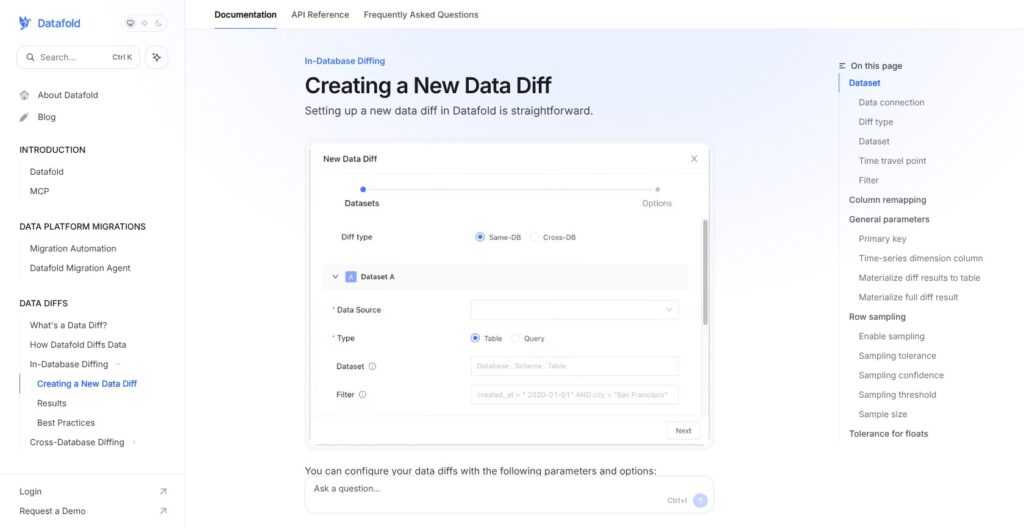
You need comparable data before Datafold can give you a useful comparison. Connecting a warehouse is only the beginning, particularly when you want checks on proposed code changes.
For a first diff, the workflow is:
- Connect the relevant data sources. Choose the tables or query results you want to compare.
- Choose row identifiers. Use one or more columns that identify corresponding records in both datasets.
- Set the comparison scope. Map columns where necessary and decide which filters or tolerances are appropriate.
- Choose full or sampled coverage. Match the decision to the consequences of a missed difference.
- Inspect the results. Separate intended changes from discrepancies that need investigation.
Those identifiers do not have to be database-enforced primary keys. That flexibility is useful, but I would still check their uniqueness: a convenient column is not automatically a reliable way to match records.
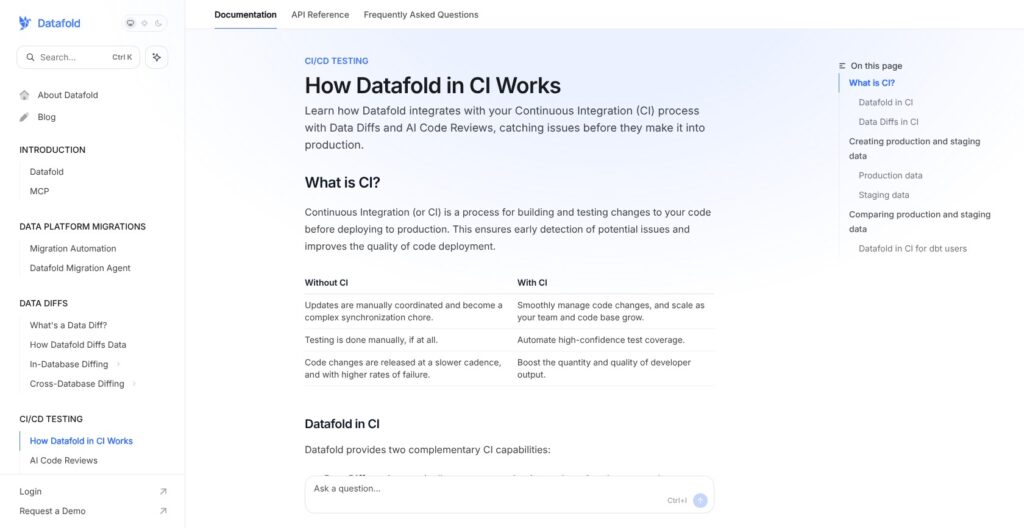
For CI, your pipeline must build staging data from the pull-request branch. Datafold then compares that output with the production counterpart and makes the differences available during review. The dbt integration uses production and pull-request manifests; dbt Core needs upload steps in the CI workflow, while dbt Cloud handles manifest submission automatically.
I like this fit for teams with repeatable builds and established code review. For a team still running transformations manually, I would improve that process first. Otherwise, setting up Datafold also means building the foundations its checks rely on.
Checking Data Changes Before You Merge
A passing test can still leave you with an unintended result. This is where I think Datafold makes its clearest case alongside dbt.
Imagine changing a join in a revenue model. Customer IDs remain unique, and the revenue column still contains no nulls, but some customers now have different revenue values. Basic uniqueness and non-null checks can pass because neither rule says the amounts must match the previous version.
A value-level diff addresses that different question: what changed? This example is why I would keep explicit business-rule tests and add diffing where changes carry enough risk to justify it.
The Results Still Need a Reviewer
Datafold can surface differences, but your team has to decide whether they are acceptable. A corrected calculation should change results. Blocking every changed value would make it harder to fix bad logic.
My preference is to review the affected records alongside the purpose of the code change. If a pull request adjusts tax handling, changes to unrelated customer attributes deserve attention. The value lies in making that conversation specific.
Sampling needs the same judgment. Comparing a subset can reduce the work involved, but an error outside that subset can go unnoticed. I would use a sample for early investigation and agree on fuller coverage for consequential sign-off decisions.
AI Code Review Is an Extra Layer
Datafold also offers AI Code Reviews as an optional add-on. These examine code changes and provide suggestions or annotations; Data Diff examines the data produced by the staging build.
I like having both perspectives available. A code review can question the logic, while a diff shows its consequences. Neither makes human approval unnecessary, and I would not pay for AI review without first establishing how much useful feedback the core comparisons deliver for your team.
Using Datafold for a Database Migration
Migration validation is the use case where I would put Datafold highest on my shortlist. Moving SQL between platforms involves more than producing code that runs. You also need confidence that the new system produces the results you meant to preserve.
Datafold’s migration service combines code translation with data validation. Deliveries normally arrive as pull requests for your team to review. That gives you a practical review point instead of treating converted code as a finished result simply because it executes.
I particularly like the feedback loop: discrepancies between source and target output can inform corrections to the translated code. It is a more convincing proposition than evaluating an AI converter solely on whether the generated SQL looks plausible.
What Your Team Still Has to Provide
The service requires customer preparation, including:
- Source data available in the target environment, or ready for ingestion. The migration cannot be validated against data that is not accessible.
- Legacy code exports and database connections. Datafold needs the material being converted and the systems involved.
- Internal review and environment ownership. Education and IT environment configuration are outside the stated service scope.
That last point matters. I would involve the people responsible for access and infrastructure before agreeing to a delivery schedule. A fixed project price does not remove dependencies on your team.
I would also define “matching” carefully. Reproducing the old results can be exactly what you need for a platform move. But if the old revenue calculation was wrong, reproducing it faithfully preserves the mistake. Business-rule checks still belong in the acceptance criteria.
Finally, identical results are only part of a successful migration. I would evaluate query performance and operating cost separately rather than treating a clean diff as approval of the entire new platform.
Lineage, Monitoring, and the New AI Features
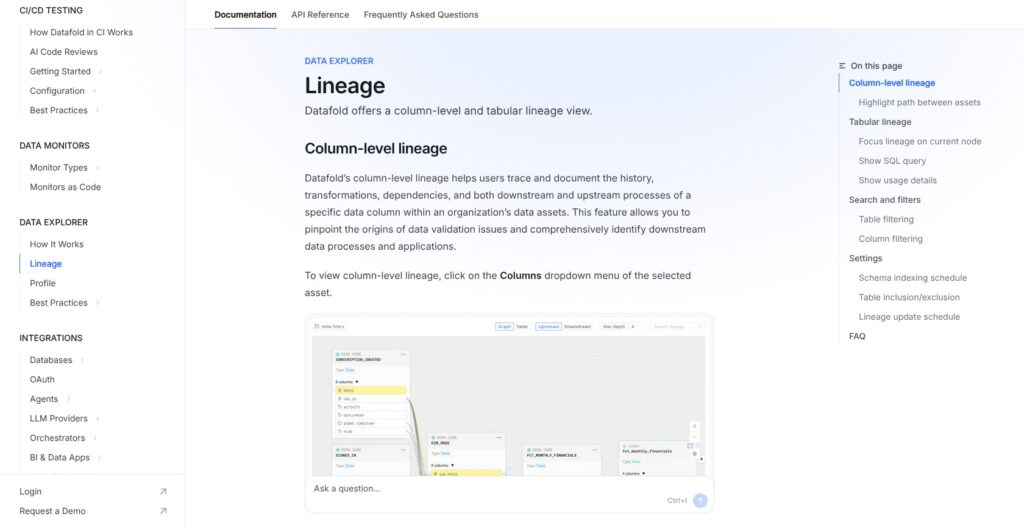
Column-level lineage adds context to a changed value. It lets you follow upstream and downstream dependencies and inspect associated SQL. I see the greatest benefit when a shared model feeds several reports and the person reviewing a change does not own them all.
Monitoring extends the comparison work beyond individual pull requests. Datafold supports diff, metric, custom SQL test, and schema-change monitors, with notifications through channels including Slack and email. That is useful for keeping checks active after deployment.
For a purchase driven primarily by production incidents, I would still compare Monte Carlo. Its observability focus makes it a relevant alternative when the urgent problem is finding and investigating failures across the stack.
Is the AI Context Layer Ready for Your Team?
Datafold exposes tools through MCP, which lets a connected coding assistant work with capabilities such as diffs and monitoring. Its broader Data Knowledge Graph remains in private beta.
I like the idea of giving an assistant business context and dependency information, but I would not base a purchase on beta capabilities before confirming access. Ask for a demonstration of the tasks you need before assigning this feature any purchasing value.
Check Where Comparisons Run
Cross-database diffing co-locates datasets in a central database. If your choice depends on where data travels, clarify that architecture early.
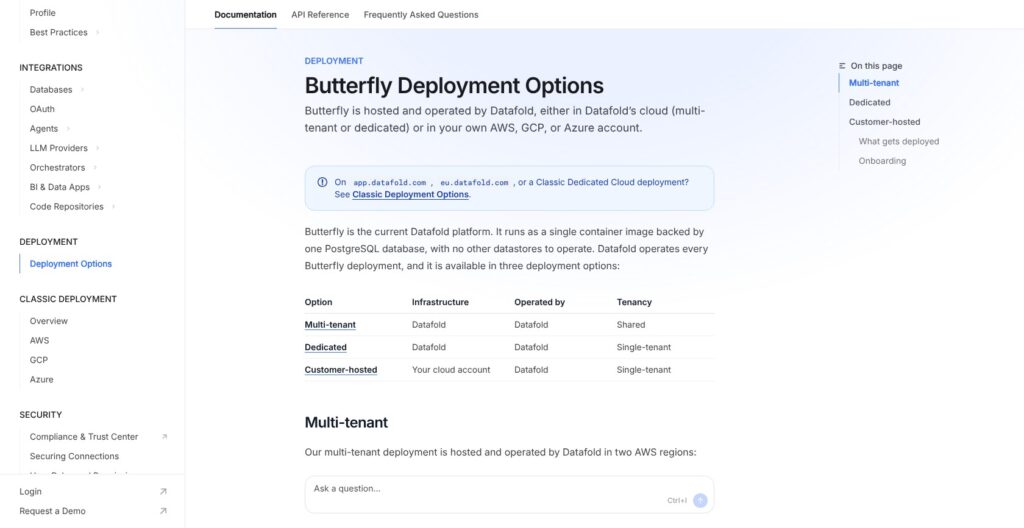
Datafold offers shared cloud, dedicated cloud, and deployment in your own AWS, GCP, or Azure account. Datafold operates all three. I like the deployment choice, but customer-cloud hosting should not be mistaken for running the product independently without vendor access.
How Does Datafold Compare to Competitors?
I would choose an alternative based on the problem you want to solve, rather than trying to find one product that replaces every Datafold capability.
- dbt data tests: my starting point for explicit rules such as unique IDs, required fields, and valid relationships. Keep them even if you add Datafold, because a comparison with yesterday’s data does not define correct business behavior.
- Monte Carlo: worth prioritizing when production monitoring and incident investigation are the main requirements. Compare it with Datafold on those workflows, rather than assuming either product wins every data-quality task.
- Recce: worth a look for teams focused on reviewing dbt changes who want a free starting option. Its free cloud plan has usage limits, and its local open-source option gives you another evaluation route. I would not treat it as an equivalent to Datafold’s scoped migration service.
How I Reviewed Datafold
I assessed Datafold’s comparison workflow, migration responsibilities, deployment choices, and pricing transparency, then weighed where it would add value alongside existing tests and monitoring. The recommendations are an editorial assessment; they do not include measured production performance or a completed warehouse migration.
Pricing basis and feature availability checked in October 2026.
Should You Use Datafold?
I would shortlist Datafold for a significant warehouse migration or a team that needs better evidence during SQL code review. Value-level comparisons give reviewers something more concrete than a successful build and a reassuring row count.
I would be slower to recommend it for a small project with simple validation needs. Start with explicit tests, identify what they miss, and ask Datafold to demonstrate that gap on a representative workload.
For migration buyers, agree on scope and acceptance criteria before discussing broad promises about speed. For ongoing users, make the purchasing decision on the core diffing workflow, with the newer AI features evaluated separately.
Datafold FAQ
Is Datafold Free or Open Source?
The commercial platform requires a quote. Datafold ended active development and support of its separate open-source data-diff package in May 2024. I would not treat that old package as a maintained free edition of the current service.
Do You Need dbt to Use Datafold?
No. Datafold supports other CI approaches and programmatic comparisons. Its dbt integration is useful, but deployment testing still requires staging data to compare with production.
Does Datafold Check Every Row?
It can run full comparisons, but sampled runs check a subset. Filters and column selection also affect coverage. Agree on the scope before treating a clean result as sign-off.
Will Datafold Handle an Entire Migration for Me?
It handles agreed code conversion and validation work, with preparation and review still required from your team. I would put responsibilities and acceptance criteria in the contract before treating it as an outsourced migration.