Editor’s note: In this Amazon Kinesis review, which also covers Amazon MSK, I priced all six capacity modes of both services in us-east-1, mapped the quotas that throttle each one, and traced their integration paths. It is not a hands-on performance test.
Quick verdict: I recommend Kinesis Data Streams for AWS teams that consume through Lambda, Managed Flink or direct S3 delivery and want nothing to operate, and MSK when you need the Kafka API, compacted topics, transactions or a way off AWS later. The trade-off: Kinesis has no free tier and caps provisioned shards at 1 MB/s of writes; MSK starts at three brokers, about $447 a month before storage, plus cross-AZ client traffic.
Among streaming platforms in the directory, these are the two AWS-native options next to Confluent Cloud, Redpanda and self-managed Apache Kafka. In this review, I’ll take a closer look at Kinesis and MSK pricing, the quotas that decide which one fits, the integrations, and how both compare to those rivals plus WarpStream, Aiven, Google Pub/Sub and Azure Event Hubs at list price, so you can see exactly which service your pipeline belongs on. Two published Kinesis-to-MSK migrations show where each service breaks.
Key Takeaways
- Kinesis On-Demand Standard costs $0.04 per stream-hour plus $0.08 per GB in and $0.04 out, with no free tier
- MSK Provisioned starts at about $447 a month for three kafka.m7g.large brokers; Serverless charges $547.50 a month before traffic
- Kinesis is not the Kafka API: at-least-once delivery, no transactions, and every client changes if you leave
- MSK Serverless caps at 200 MBps in, 400 MBps out and 2,400 partitions; Express brokers lift that at 2x the broker-hour
- Atlassian left Kinesis for MSK at about 150 billion events a day, and Kong left for transactions and Go tooling
Pros and Cons
Pros
- Kinesis on-demand scales from 4 MB/s to 10 GB/s of writes in us-east-1
- A provisioned Kinesis shard costs $10.95 a month for 1 MB/s of writes
- On-Demand Advantage cuts ingest to $0.032 per GB with no fan-out fee
- On-demand streams write straight to S3 at $0.0275 per GB
- MSK tiered storage keeps Kafka replay in S3 at $0.06 per GB-month
- Express brokers need no disk sizing and bill $0.01 per GB written
Cons
- Kinesis has no free tier
- Advantage bills a 25 MB/s account minimum, about $3,150 a month
- A hot partition key throttles one 1 MB/s shard while the rest idle
- Kinesis is at-least-once, with no transactions or Kafka clients
- MSK Serverless costs $547.50 a month before any traffic
- MSK bills client traffic that crosses Availability Zones
How Much Do Amazon Kinesis and MSK Cost?
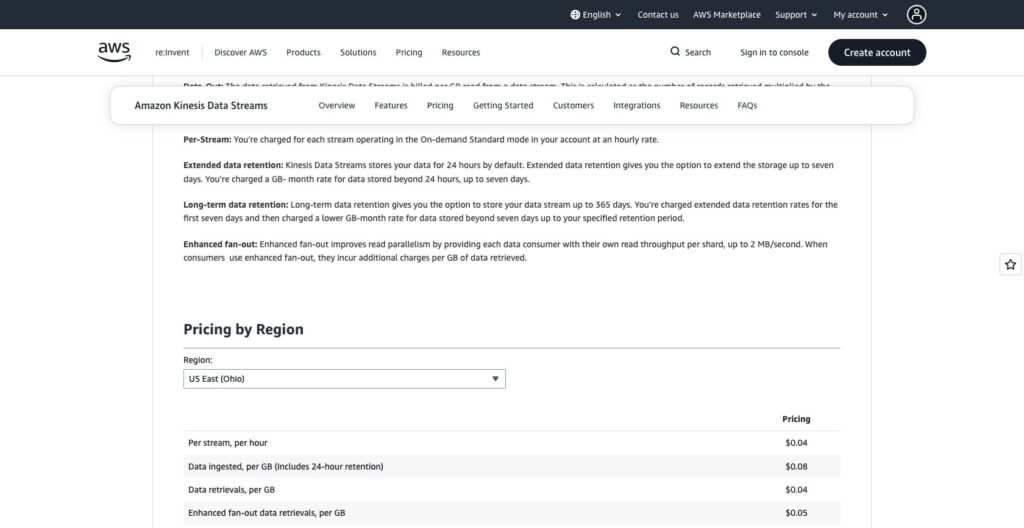
Kinesis has no AWS Free Tier, so every mode bills from the first hour. At 730 hours a month, the fixed floor is $29.20 for one Kinesis On-Demand Standard stream, $10.95 per provisioned shard, about $447 for three kafka.m7g.large MSK brokers, and $547.50 for an MSK Serverless cluster before a byte moves. All prices are us-east-1 list rates.
- Kinesis On-Demand Standard ($0.04 per stream-hour): plus per-GB billing, 24-hour retention included; for spiky or unknown traffic
- Kinesis On-Demand Advantage ($0.032 per GB in): no stream-hour or fan-out fee, but a 25 MB/s account minimum on ingest and retrieval, shortfall billed; for steady high volume without shard management
- Kinesis Provisioned ($0.015 per shard-hour): plus $0.014 per million 25 KB PUT units; for steady traffic you will reshard by hand
- MSK Provisioned (from $0.204 per broker-hour): kafka.m7g.large up to kafka.m7g.16xlarge at $6.528, three brokers in practice; for Kafka with your own sizing
- MSK Express (from $0.408 per broker-hour): up to $13.056 for express.m7g.16xlarge, three-AZ only; for Kafka without disk sizing
- MSK Serverless ($0.75 per cluster-hour): plus $0.0015 per partition-hour; for dev clusters
| Mode | Fixed monthly floor (730 h) | Per GB in | Per GB out | Storage or retention | Best for |
|---|---|---|---|---|---|
| Kinesis On-Demand Standard | $29.20 per stream | $0.08 | $0.04 ($0.05 enhanced fan-out) | 1 to 7 days $0.10 per GB-month, beyond 7 days $0.023 | Spiky event feeds |
| Kinesis On-Demand Advantage | $0 stream fee, 25 MB/s minimum | $0.032 | $0.016 | $0.023 per GB-month | Steady volume above 25 MB/s |
| Kinesis Provisioned | $10.95 per shard | $0.014 per million PUT units | Enhanced fan-out $0.013 plus $0.015 per consumer-shard-hour | $0.020 per shard-hour to 7 days, then $0.023 per GB-month | Predictable traffic |
| MSK Provisioned, 3 x m7g.large | About $447 | Standard AWS transfer | Standard AWS transfer | $0.10 per GB-month, tiered $0.06 plus $0.0015 per GB retrieved | Kafka with your own sizing |
| MSK Express, 3 x m7g.large | About $894 | $0.01 per GB written | Standard AWS transfer | $0.10 per GB-month, unlimited | Kafka without disk sizing |
| MSK Serverless | $547.50 | $0.10 | $0.05 | $0.10 per GB-month | Dev clusters, under 200 MBps |
Producer-to-Kinesis traffic and same-region reads carry no transfer fee. Cross-region reads are free in provisioned mode but billed in on-demand, which matters if a consumer sits in a second region.
Is Amazon Kinesis or MSK Good Value for Money?
- Low or spiky volume belongs on On-Demand Standard: $29.20 fixed against $446.76 for three brokers, but a steady 10 MB/s is 26,280 GB a month, or about $2,100 in ingest alone at $0.08
- Advantage pays off from about 10 MB/s: its 25 MB/s minimum costs about $3,150 a month, roughly what Standard charges for a steady 10 MB/s in and out ($3,183)
- Steady, evenly keyed traffic is cheapest on provisioned shards: one published cost model puts a 10 MB/s stream with seven-day retention at about $270 a month on Kinesis against about $2,274 on MSK, assuming three m5.large brokers and 18 TB of provisioned storage. Treat it as illustrative: the Kinesis side matches ten shards ($109.50) plus seven-day retention ($146), and tiered storage at $0.06 per GB-month shrinks the MSK side
- Many consumers change the math: enhanced fan-out costs $0.05 per GB on Standard and $0.015 per consumer-shard-hour plus $0.013 per GB on Provisioned, while Advantage charges no fan-out fee
- Cross-AZ client traffic is the MSK line to model: broker replication is free, client traffic crossing Availability Zones bills at standard AWS transfer rates
- Rivals: Confluent Cloud Standard from about $385 a month plus per-GB fees, Redpanda Serverless from $0.10 an hour plus $0.045 per GB in, WarpStream at $0.01 per GiB written with $100 to $1,500 cluster tiers, Aiven Developer at $35 a month capped at 1 MB/s
Reviewer’s Notes: A spiky, low-volume feed consumed by Lambda belongs on Kinesis On-Demand Standard at $29.20 a month fixed. A steady feed I can key evenly goes on provisioned shards at $10.95 per MB/s of writes, and an on-demand account steadily past 10 MB/s in and out goes on Advantage. MSK earns its broker bill through the Kafka API, not on price, and Serverless only suits dev clusters, because its $547.50 a month buys three m7g.large brokers with about $100 to spare.
Getting Started With Kinesis and MSK
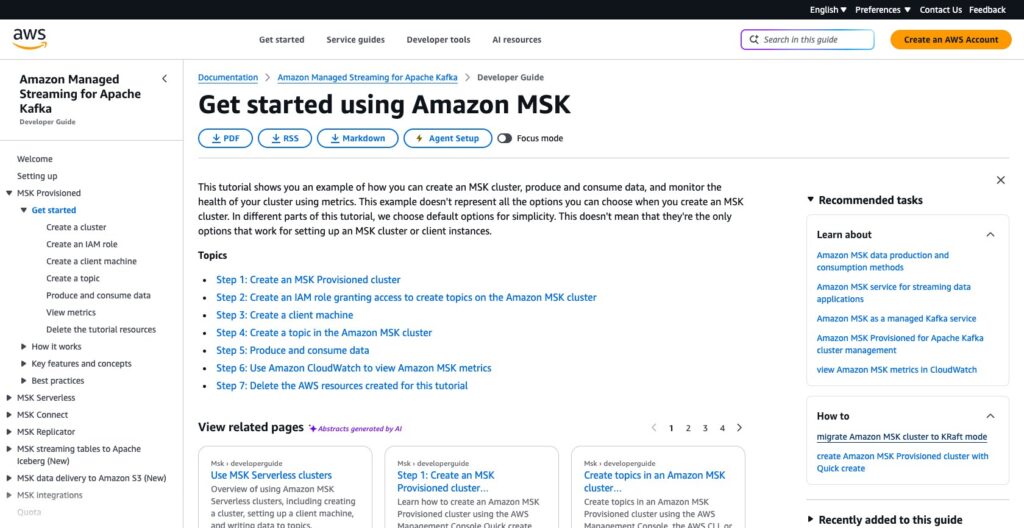
Kinesis asks for one capacity choice and a partition key; MSK asks for a broker type, a size, a network path and an auth scheme.
Creating a Kinesis Data Stream
A new stream needs a capacity mode: on-demand starts at 4 MB/s of writes and 8 MB/s of reads and scales to 10 GB/s in us-east-1; provisioned asks for a shard count and holds you to 1 MB/s of writes per shard. Modes switch at most twice per 24 hours, and an account gets 50 on-demand streams by default.
Pick the partition key before anything else: a skewed key throttles one shard while the rest idle, and on-demand scaling does not fix it. I would use random or UUID keys unless per-key ordering is a hard requirement.
Producers write through the SDK’s PutRecords call or the Kinesis Producer Library. Consumers are Lambda event source mappings, Managed Flink, KCL 3.x applications, or direct delivery to S3 and Iceberg on on-demand streams. KCL 1.x and KPL 0.x reached end of support on January 30, 2026, so start on KCL 3.x. Enhanced fan-out gives each registered consumer its own 2 MB/s per shard, up to 20 consumers per stream (50 on Advantage).
Standing Up an MSK Cluster
MSK Provisioned means picking a broker size from kafka.m7g.large upward, a broker count spread across Availability Zones, EBS storage per broker (up to 16,384 GiB) and a Kafka version. Express skips the storage sizing, runs three-AZ only on Kafka 3.6, 3.8 or 3.9, and costs twice the standard broker-hour. Serverless needs no sizing but caps at 2,400 partitions and 200 MBps in.
IAM access control costs nothing extra; Provisioned also supports SASL/SCRAM and mutual TLS. Clients that sit outside the cluster’s VPC connect through multi-VPC private connectivity at $0.0225 an hour per auth scheme plus $0.006 per GB, which replaces the one-PrivateLink-endpoint-per-broker setup Kong’s team built for cross-account access.
I would start every new cluster on KRaft. A ZooKeeper cluster on Kafka 3.9.x can migrate in place through UpdateClusterKafkaVersion to 3.9.x.kraft, provided standard brokers span three AZs and clients use bootstrap.servers only.
Connecting Producers and Consumers
Kinesis clients are AWS SDK calls. MSK clients are any Kafka client with the IAM auth library, at up to 3,000 IAM connections per broker, plus Kafka Connect through MSK Connect at $0.11 per MCU-hour, which runs connector plugins you package and upload to S3. Kong’s team found IAM auth for Kafka ingestion poorly documented next to Kinesis, so budget networking and auth work before the first MSK producer writes a record.
Kinesis or MSK: Which One Should You Pick?
Pick MSK if anything in your pipeline speaks Kafka; pick Kinesis if your consumers are AWS services and nobody wants to operate brokers.
- Kafka clients, compacted topics, idempotent producers or multi-topic transactions: MSK, because Kinesis offers none of them
- A path off AWS later: MSK, since Kafka clients move to Confluent, Redpanda or self-managed brokers unchanged
- Lambda, Managed Flink or direct S3 delivery as the consumer: Kinesis, with no brokers to size
- Spiky or low volume: Kinesis On-Demand Standard at $29.20 a month fixed
- Steady, evenly keyed volume: Kinesis Provisioned at $10.95 per shard, or Advantage once on-demand traffic passes about 10 MB/s
Kinesis delivers at-least-once with ordering per shard and a 10 MiB record ceiling. Kafka on MSK adds exactly-once through idempotent producers and transactions, compacted topics and Kafka Streams, though Express brokers do not yet fully support the Kafka Streams API. Kinesis also has few maintained Go clients: Kong’s team needed DynamoDB or RDS to store consumer offsets with Kinsumer, while Kafka gave them kafka-go, Kafka-UI and simpler local development.
Atlassian moved StreamHub from Kinesis to MSK at about 150 billion ingested and 225 billion delivered events a day: throttling during spikes left the API barely at 99.99%, billing grew linearly with shards, on-demand autoscaling was too expensive at that scale, and seven-day replay needed paid add-ons. On MSK they got replay through tiered storage, with the last five minutes on EBS and the rest in S3. Kong started on Kinesis in 2021 because it was fast to adopt, then moved to a shared MSK cluster for multi-tenancy, transactions and Go tooling; the double-write migration took about two months.
Atlassian then hit MSK’s own ceilings: broker network limits, local disks filling when the remote tier lagged, a control plane that could not reboot or scale brokers during an AZ failure, rolling upgrades at about 15 minutes per broker, and storage that grows but never shrinks. Atlassian’s takeaway: tiered storage cuts cost but not operational responsibility, so plan capacity around the hottest broker and keep a failover path that does not depend on the control plane.
Every producer and KCL consumer changes in a move to Kafka, so if Kafka is a realistic future requirement, start on MSK and pay that rewrite once.
Scaling, Quotas and the Failure Modes to Plan For
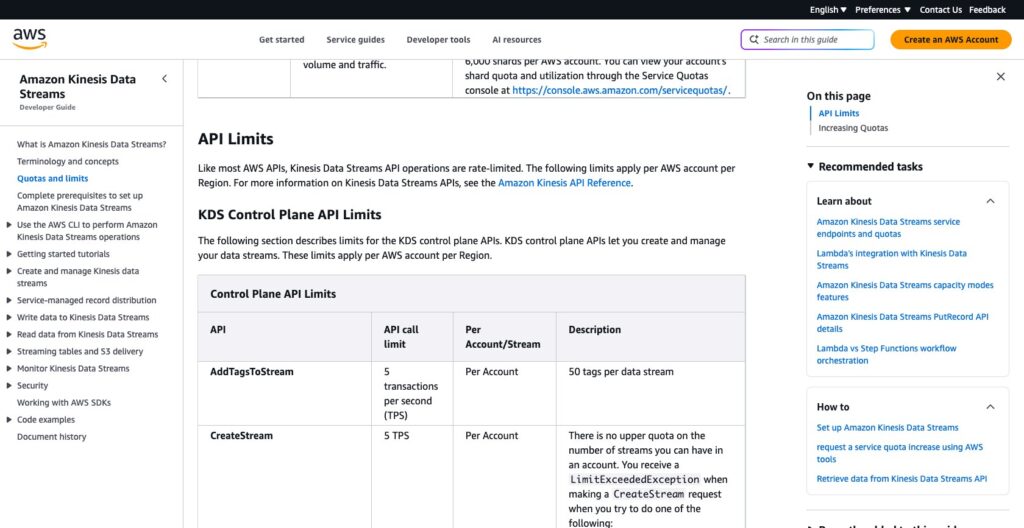
A Kinesis shard takes 1 MB/s or 1,000 records a second in and gives 2 MB/s out, shared across standard consumers, with 5 GetRecords calls a second; an account gets 20,000 provisioned shards by default in us-east-1. A skewed partition key throttles one shard with WriteProvisionedThroughputExceeded while the rest idle, stream-level CloudWatch metrics hide it, and 60-second aggregation averages away one-second bursts. AWS says improper key distribution is outside what on-demand auto-scaling handles.
- Random or UUID partition keys unless per-key ordering is mandatory
- Shard-level enhanced monitoring, since stream-level metrics average the problem away
- Alarms on WriteProvisionedThroughputExceeded and IteratorAgeMilliseconds
- Exponential backoff in every producer
- Split hot shards in provisioned mode
On-demand capacity scales to 10 GB/s of writes in us-east-1, us-west-2 and eu-west-1, and 200 MB/s elsewhere.
MSK Serverless fails on quotas rather than keys, and the quotas are per cluster:
- 200 MBps in and 400 MBps out, with 5 MBps in and 10 MBps out per partition
- 2,400 non-compacted and 120 compacted partitions, and connector offset and config topics count, so “Quota exceeded for maximum number of partitions” arrives early and the workaround is deleting topics
- 500 consumer groups, 3,000 connections, 8 MiB messages, 10 clusters per account
Express brokers lift those ceilings: up to 60 brokers per KRaft cluster, 15 MB/s per partition, 1,500 partitions on an express.m7g.large up to 32,000 on a 16xlarge, and sustained ingress from 15.6 MBps on the large to 500 MBps on the 16xlarge. The 3x throughput, 20x faster scaling and 90% faster recovery figures are AWS’s own “up to” claims. AWS’s one published scale-out run doubled a three-broker m7g.4xlarge cluster at about 300 MBps in roughly 28 minutes, with no standard-broker comparison, so load test with your own workload.
On MSK Provisioned the failure lands on the invoice: replication between brokers is free, but producer and consumer traffic across Availability Zones bills at standard AWS transfer rates. Follower reads from the local Availability Zone (KIP-392) and same-AZ client placement cut it.
Integrations: Lambda, Flink, Firehose, S3 and Iceberg
A Kinesis on-demand stream lands in S3 at $0.0275 per GB (Standard) or $0.011 per GB (Advantage), and in Apache Iceberg or S3 Tables at $0.035 or $0.014 per GB, with no Firehose in between. AWS claims the S3 Tables path cuts ingestion cost by up to 50% and query cost by up to 30%; both are AWS’s numbers.
- Lambda event source mappings
- Managed Service for Apache Flink at $0.11 per KPU-hour plus one orchestration KPU per application, with 50 GB of running storage included per KPU
- Amazon Data Firehose at $0.029 per GB, with JSON-to-Parquet conversion at $0.018 per GB, dynamic partitioning at $0.020 per GB plus $0.005 per 1,000 S3 objects, a Snowflake destination at $0.071 per GB and Iceberg tables at $0.045 per GB
- KCL 3.x applications
MSK integrates through Kafka clients plus four paid add-ons:
- Any Kafka client, plus Debezium as an MSK Connect source connector for change data capture
- MSK Connect at $0.11 per MCU-hour (1 vCPU, 4 GB), running Kafka Connect plugins you upload to S3; Confluent counts 120-plus connectors on its side, 80-plus fully managed
- MSK Replicator at $0.30 an hour plus $0.08 per GB for cross-cluster and cross-region copies, with $0.02 per GB transfer across regions
- Direct delivery channels per topic to S3 at $8 per TB or S3 Tables at $10 per TB, with 5 to 15 minute freshness and up to 10 GB/s per channel
- Tiered storage to S3 at $0.06 per GB-month for long replay, plus AWS Glue Schema Registry and Lambda as listed integrations
How Do Kinesis and MSK Compare to Competitors?
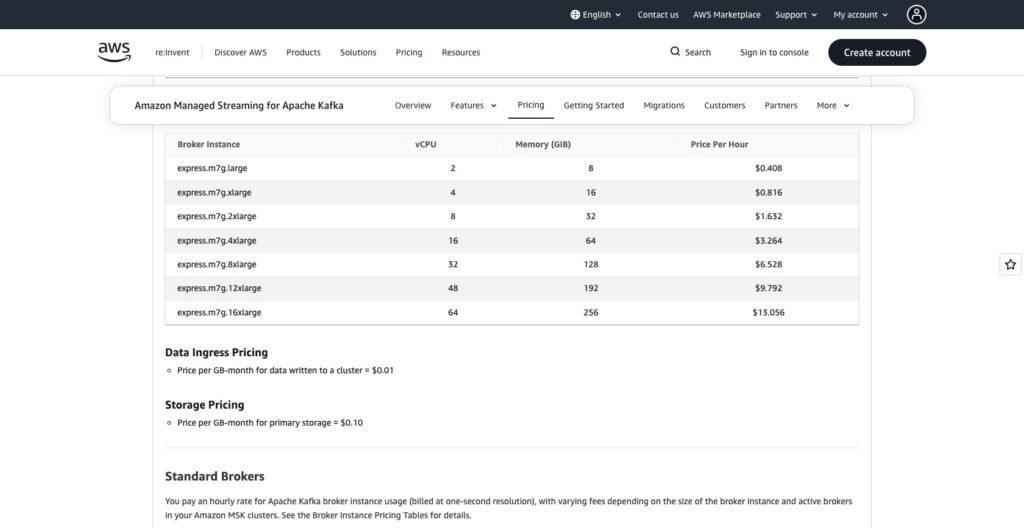
MSK’s cheapest production shape, three kafka.m7g.large brokers at about $447 a month, costs more than Confluent Cloud Standard’s entry of about $385 a month ($0.75 per eCKU-hour plus $0.035 to $0.05 per GB), while Confluent Basic gives the first eCKU free, then $0.14 per eCKU-hour. Kinesis has no equivalent outside AWS except Pub/Sub and Event Hubs.
- Confluent Cloud: Confluent’s pitch is 120-plus connectors, Stream Governance, Tableflow, multi-cloud and a 99.99% SLA against MSK’s 99.9%. Enterprise runs $1.75 to $2.25 per eCKU-hour and Freight from about $2,300 a month; Dedicated pricing is not published. Its 69% savings customer claim is Confluent’s own number, and its no-in-place-upgrade argument is outdated since AWS shipped ZooKeeper-to-KRaft migration in August 2026.
- Redpanda Cloud: a Kafka-compatible C++ broker, with Serverless from $0.10 an hour plus $0.045 per GB in and $0.04 per GB out, capped at 100 MB/s write and 5,000 partitions; BYOC and Dedicated are quote-only. Wins for teams that want Kafka without JVM tuning.
- WarpStream: object-storage Kafka at $0.01 per GiB written and $0.01 per GiB stored, cluster tiers at $100, $500 and $1,500 a month, and no per-partition, per-core or network fees billed by WarpStream. Wins when partition counts and transfer lines dominate an MSK bill.
- Aiven for Apache Kafka: Developer at $35 a month capped at 1 MB/s, Professional from $180 a month with a 99.99% SLA; Aiven’s own estimate reaches about $4,226 a month at 10 MB/s. Wins for multi-cloud teams under 1 MB/s.
- Google Pub/Sub and Azure Event Hubs: Pub/Sub at $40 per TiB after 10 GiB free a month, with BigQuery subscriptions at $50 per TiB and import topics at $50 per TiB from Kinesis or $80 from MSK; Event Hubs Standard throughput units at $0.03 an hour for 1 MB/s of ingress each and the Kafka endpoint at $0.09 an hour. Each is Kinesis for its own cloud.
- Self-managed Apache Kafka: zero license fee and every operational hour yours; Delhivery now runs more than 350 applications on MSK after leaving Kafka on EC2.
Kinesis’s closest price rival is its own Advantage tier.
How I Reviewed Amazon Kinesis and MSK
I priced every mode of both services in us-east-1 at 730 hours a month and built the comparison table from those unit rates: three Kinesis modes, three MSK deployment types, and the add-ons (Firehose, Managed Flink, MSK Connect, MSK Replicator, private connectivity and direct S3 delivery). I checked the service quotas for shard, partition, connection and throughput ceilings, and traced the integration paths from each stream to Lambda, Flink, S3 and Iceberg.
For evidence of where each service breaks, I weighed two published large-scale migrations from Kinesis to MSK, Atlassian’s and Kong’s, and compared the result against Confluent Cloud, Redpanda, WarpStream, Aiven, Pub/Sub and Event Hubs at their list prices.
I did not run a load test, so the Express broker performance figures stay AWS’s “up to” claims. Prices current as of October 2026, us-east-1.
Should You Run Your Streaming on Amazon Kinesis or MSK?
The fixed floors are $29.20 a month for a Kinesis On-Demand Standard stream, $10.95 per provisioned shard, about $447 for three kafka.m7g.large MSK brokers and $547.50 for an MSK Serverless cluster. Kinesis gives you at-least-once delivery and AWS SDK clients; MSK gives you the Kafka API with transactions and compacted topics, a 200 MBps cap on Serverless, and a cross-AZ transfer line on the bill.
I recommend Kinesis On-Demand Standard for spiky or low-volume event feeds consumed by Lambda, Firehose or direct S3 delivery. For steady traffic you can key evenly, provisioned shards are the cheapest option in this review, and an on-demand account steadily past about 10 MB/s belongs on Advantage. For any Kafka-client, compacted-topic or transactional requirement, or any plan to leave AWS, I recommend MSK Provisioned on KRaft with tiered storage, or Express if you would rather pay 2x the broker-hour than size disks. MSK Serverless fits dev clusters. Teams that want managed connectors and governance more than AWS-native billing should price Confluent Cloud Standard first.
The next step: create one on-demand Kinesis stream or one three-broker m7g.large MSK cluster in a sandbox account and run a week of your real producer traffic through it, because your steady throughput decides which pricing line wins. The official site is aws.amazon.com/kinesis.
FAQ
Is Amazon Kinesis cheaper than MSK?
For low or spiky volume, yes: one Kinesis On-Demand Standard stream carries a $29.20 monthly floor against about $447 for three kafka.m7g.large MSK brokers. Steady traffic changes the answer by mode. One published cost model puts a 10 MB/s stream with seven-day retention at about $270 a month on provisioned Kinesis shards versus about $2,274 on MSK, assuming 18 TB of provisioned storage; treat it as illustrative.
What is the difference between Kinesis and MSK?
Kinesis Data Streams is a proprietary shard-based stream with AWS SDK clients, at-least-once delivery, and Lambda, Managed Flink and direct S3 delivery as consumers. Amazon MSK is managed Apache Kafka with the Kafka API, idempotent producers and transactions, compacted topics and Kafka Connect through MSK Connect. See Kinesis or MSK: Which One Should You Pick? above for the decision rule.
What are the Kinesis shard limits?
Each shard accepts 1 MB/s or 1,000 records a second of writes and serves 2 MB/s of reads shared across standard consumers, or 2 MB/s per consumer with enhanced fan-out. GetRecords allows 5 calls a second per shard, a single record can be up to 10 MiB, and retention runs from 24 hours to 365 days. On-demand streams start at 4 MB/s of writes and scale to 10 GB/s in us-east-1.
Does Amazon MSK charge for data transfer between brokers?
No. Replication traffic between brokers, and between metadata nodes and brokers, is free. Data moving in and out of the cluster bills at standard AWS transfer rates, and that includes producer and consumer traffic that crosses Availability Zones. Same-AZ client placement and follower reads from the local zone (KIP-392) reduce it, and MSK Replicator adds $0.02 per GB when it copies across regions.
Can I migrate from Kinesis to MSK without rewriting my code?
No. Every producer and every KCL consumer changes to a Kafka client, because Kinesis does not speak the Kafka protocol. The usual pattern is double-writing to both streams, then cutting consumers over and re-indexing, which took Kong’s team about two months. If you stay on Kinesis, KCL 1.x reached end of support on January 30, 2026, so a move to KCL 3.x is pending anyway.