I recommend Striim for enterprise data teams that need change data capture with in-flight processing, rather than a simple copy of database tables. Its appeal is combining database changes and SQL-like transformations in one pipeline, but consumption billing and source-side administration make it a deliberate engineering purchase.
Among streaming and CDC tools, Striim sits closer to an integration platform than a lightweight connector service. This Striim review focuses on whether that extra capability earns its place in your architecture, especially when you already have a warehouse transformation layer.
Key Takeaways
- Process changes before delivery: Continuous queries support filtering, aggregation, and enrichment before events reach their destination.
- Choose your operating model: Striim offers managed Cloud and self-managed Platform deployments.
- Start with a free allowance: Developer includes up to 25 million events per month.
- Caveat: billing includes both sides: Input and output events contribute to consumption, alongside compute and transfer.
- Caveat: visual does not mean turnkey: Database preparation and connector-specific recovery still require engineering ownership.
In this review, I’ll look at Striim’s pricing, setup, and processing features to help you decide whether it fits your data pipeline.
Striim Pros and Cons
Striim’s strongest feature is also its buying filter: it can do more than replicate rows. I like that flexibility when downstream systems need prepared events, but it is harder to justify when straightforward replication is the entire requirement.
Pros
- SQL-like continuous queries process live events.
- Visual Flow Designer connects pipeline components.
- Automated wizards combine initial loading and CDC.
- Managed and self-managed deployment options.
- Cloud metering includes budget alerts.
Cons
- Production pricing requires a sales quote.
- Database capture requires source-side preparation.
- Schema evolution support varies by connector.
- Recovery can produce duplicates on some targets.
My main reservation is the engineering work around the designer. Database permissions, update handling, and recovery behavior still need careful decisions.
How Much Does Striim Cost?
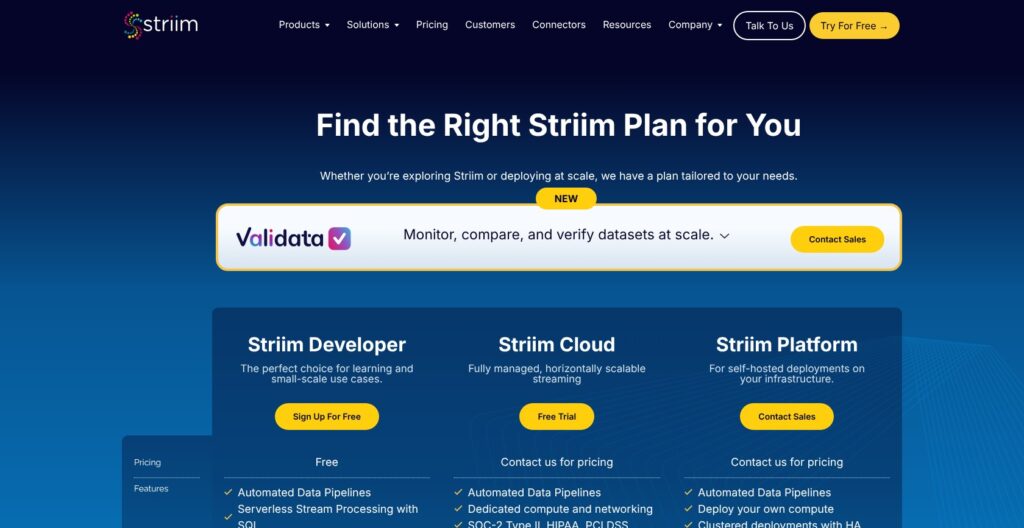
Striim pricing is not a single subscription figure. The free entry point is clear, while production budgeting depends on deployment and workload. I recommend getting a quote for a specific pipeline, including its sources and destinations.
- Developer: free. A serverless option with a 25-million-event monthly allowance and community support, best suited to evaluation.
- Cloud: custom quote. A dedicated managed offering for teams that want Striim to operate the service infrastructure.
- Platform: custom quote. Self-managed software for on-premises infrastructure or cloud VMs, with connector licensing.
| Plan | Published price | Deployment | Main buying consideration |
|---|---|---|---|
| Developer | Free | Serverless | 25 million events monthly; community support |
| Cloud | Sales quote | Dedicated managed cloud | Consumption and contracted service scope |
| Platform | Sales quote | On-premises or cloud VMs | Connector licensing and internal operations |
The current Enterprise monthly consumption schedule charges 100 credits per million standard-adapter events and 200 credits per million premium-adapter events. Both input and output count. PostgreSQLReader and SnowflakeWriter are standard adapters; OracleReader and MSJet are premium.
For example, one million changes passing through one standard source and one standard target produce two million billed adapter events, or 200 credits before compute and transfer. This example is not a dollar quote.
I also dislike treating the initial load as financially interchangeable with steady-state CDC. A large historical dataset and a modest daily change stream are different workload shapes. A useful quote separates the migration period from ongoing operation rather than hiding both behind one average.
Published Enterprise compute starting rates include $0.60 per vCPU-hour on AWS in the US and $0.50 on Google Cloud or Azure in the US. These are components, not an all-in subscription price.
Striim’s metering console includes usage history and budget alerts. Credits alone do not establish cash cost, and a specific dollar total needs the applicable commercial terms.
Is Striim Good Value for Money?
My value judgment depends on what it replaces:
- Good fit: A pipeline that genuinely needs transformations before delivery, with an engineering team ready to own its logic.
- Weaker fit: A straightforward copy into a warehouse where existing SQL models already handle preparation.
- Contract priority: A written scenario covering adapter tiers, destination fan-out, compute, and transfer.
Buying Striim for unused processing features would be expensive architectural insurance. Buying it because a downstream application needs a shaped event stream is a more convincing case.
I recommend Cloud for managed production, Platform when self-hosting is a requirement, and Developer for evaluation. Those are different operating choices, not merely progressively larger plans.
Getting Started With Striim
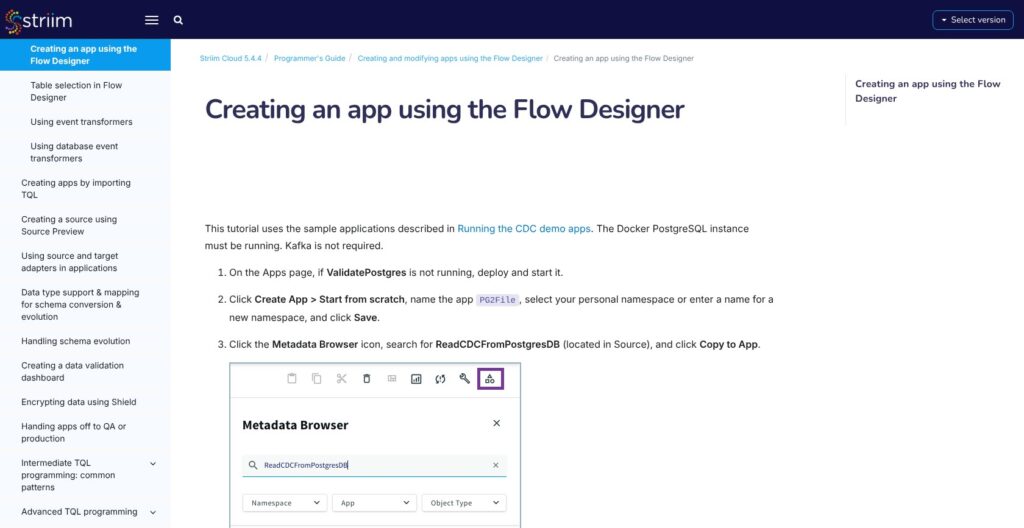
The first dependency is your database, not the designer. Striim can represent a pipeline visually, but it cannot remove the administrative work needed to make database changes available.
A practical rollout has five stages:
- Prepare the source. Establish the required capture configuration, permissions, and network access.
- Define the destination mapping. Decide how source data and change operations should appear downstream.
- Load existing data. Populate the destination before ongoing changes become the main feed.
- Hand off to CDC. Continue from the retained source change history.
- Deploy and operate the application. Run the pipeline with monitoring and a defined editing process.
For self-managed PostgreSQL, preparation includes logical replication, wal2json, and a replication slot. Each reader needs its own slot. That makes the DBA a participant in the project, even if a data engineer owns the Striim application.
I would assign source readiness and pipeline design to explicit owners rather than assuming one engineer has permission to handle both. This is particularly relevant in organizations where database administrators and integration engineers work under different change-management processes. A visual tool does not bridge an organizational approval gap.
The automated pipeline wizards perform an initial load followed by CDC. During that load, source DDL changes must be avoided, and source logs or change streams must remain available from the beginning of loading until CDC starts. The handoff depends on retained history, not simply on completing a table copy.
For a hypothetical PostgreSQL-to-Snowflake order pipeline, the initial load supplies existing orders while CDC carries subsequent changes. A transformation could prepare selected fields for a downstream consumer. The design question is whether the destination represents current order state or an event history, because those are different data products.
That distinction affects mapping. An updated order might replace the current record in one design but become another event in another. I prefer making that decision before adding enrichment, since attractive output fields cannot compensate for unclear update and delete behavior.
Flow Designer connects sources and processing components to targets. Applications are deployed and started to run; deployed or running applications are read-only, and editing requires the Created state. Plan changes as deployments, not casual edits to a live diagram.
The documented PostgreSQL tutorial also illustrates a useful boundary: raw CDC output contains metadata as well as row values, and a continuous query can cast fields while preserving operation type. That is a better mental model than imagining every connector produces a finished analytics table.
My take is that Striim offers structured setup rather than effortless setup. It suits a team prepared to define the data contract and coordinate database access, not a buyer expecting credentials alone to complete the integration.
Change Data Capture and Connector Coverage
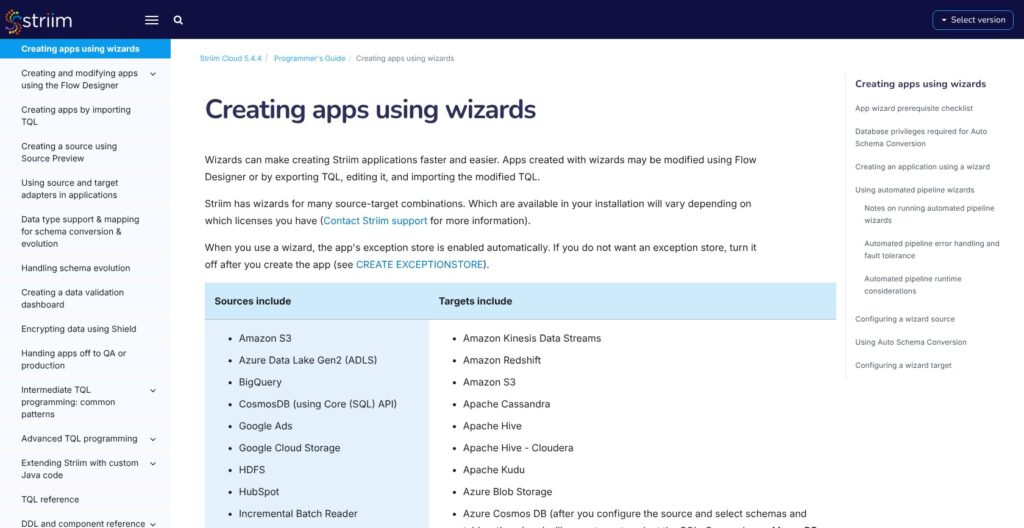
Connector names are only the beginning of compatibility. I care more about the supported capture method and event behavior than a large connector count.
Striim’s catalog includes different adapter roles, and access to preview application connectors should not be confused with production-ready database CDC. A supported destination is also not automatically a supported change-capture source. The direction of movement matters.
Three compatibility details deserve particular weight:
- Capture prerequisites: The source database needs the appropriate logging or replication configuration and permissions.
- Change representation: Events may expose keys and metadata without supplying every previous column value.
- DDL propagation: Supported schema changes depend on the source adapter and destination writer.
PostgreSQL illustrates why this matters. Its CDC events expose operation and log-position metadata, but deletes contain the primary key with nulls for other fields. Updates provide post-change values, while before-value information is restricted to primary-key information.
For an order-status feed, current values may be enough. For a workflow that needs to explain exactly what changed in every column, those before-value limits become material. CDC is not automatically a full audit history, and I would not buy any capture tool on that assumption.
Schema evolution is similarly specific. SQL Server schema evolution uses MSJet rather than MS SQL Reader. Snowflake Writer supports ADD COLUMN and DROP COLUMN, while Databricks Writer supports CREATE TABLE, ADD COLUMN, DROP TABLE, and TRUNCATE.
Those differences make “automatic schema evolution” too broad a purchasing promise. A team that frequently changes database structures needs a release policy aligned with its actual source-to-target route. Supporting a database brand does not mean every migration script can pass through unchanged.
Compared with Debezium, Striim gives buyers a platform-centered way to combine capture and downstream processing. Debezium leaves more architectural choices around deployment and delivery to the adopting team. I prefer the integrated approach when the team wants capture and processing in one application.
For a buyer, the useful unit of comparison is therefore the complete data route: a particular source, its event semantics, and the intended destination. That is much more informative than comparing catalog totals.
SQL Transformations Before Data Lands
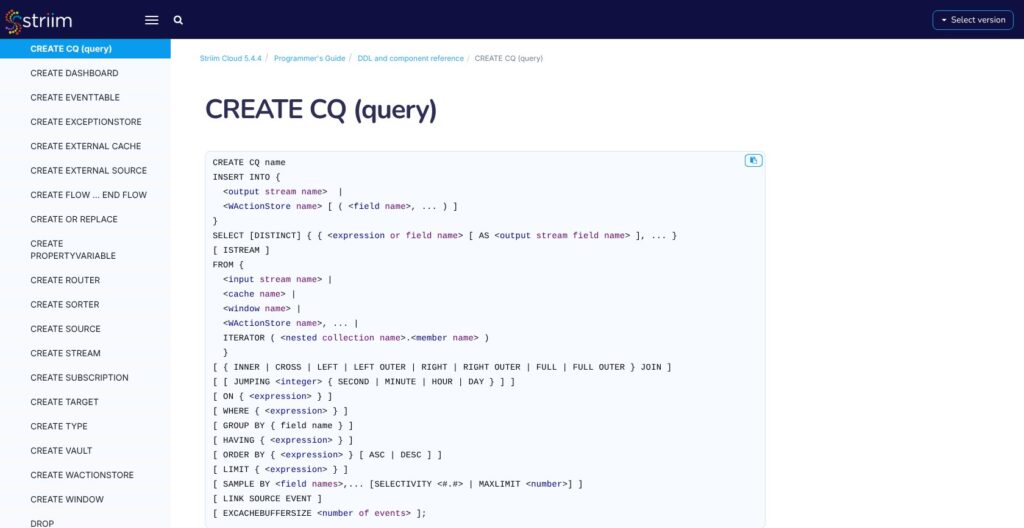
Processing before delivery is Striim’s strongest selling point. Its continuous queries use SQL-like syntax to process events as they flow, rather than waiting for a warehouse job after delivery.
The main processing options include:
- Filtering: Pass through the events or fields relevant to a destination.
- Enrichment: Add reference information through caches or other supported query inputs.
- Windowed aggregation: Calculate results over a defined set of streaming events.
I like this model when the receiving system needs an immediately usable event, such as an order associated with a customer segment. It puts preparation beside movement rather than requiring every consumer to repeat the same logic.
But SQL-like is not ordinary database SQL. Queries over multiple components require at least one cache or window, and INNER JOIN takes exactly two components in FROM. Familiar syntax helps, but streaming state still needs explicit design.
That difference changes staffing expectations. A capable analytics SQL developer has a useful foundation, yet a pipeline also needs decisions about which events remain available for a join and how reference data stays current. The designer does not make those decisions disappear.
Caches load on startup or restart by default, with configurable refresh timing. A CDC-driven main stream therefore does not imply a continuously synchronized lookup. A hypothetical customer-segment enrichment can carry fresh order data alongside older segment information.
My preference is to keep operationally necessary preparation in Striim and leave broadly reusable analytical modeling in the warehouse. That gives the pipeline a clear purpose without turning it into an opaque second modeling layer.
There is also a governance cost to early filtering. Once a field is excluded from the delivered stream, that destination cannot use it for later questions unless another route preserves it. I would favor minimal, intentional shaping over aggressive transformations that merely make the first dashboard easier to build.
Striim earns its complexity when delivery-time semantics matter. It is less compelling when transformations can comfortably wait until after landing.
Monitoring, Recovery, and Deployment
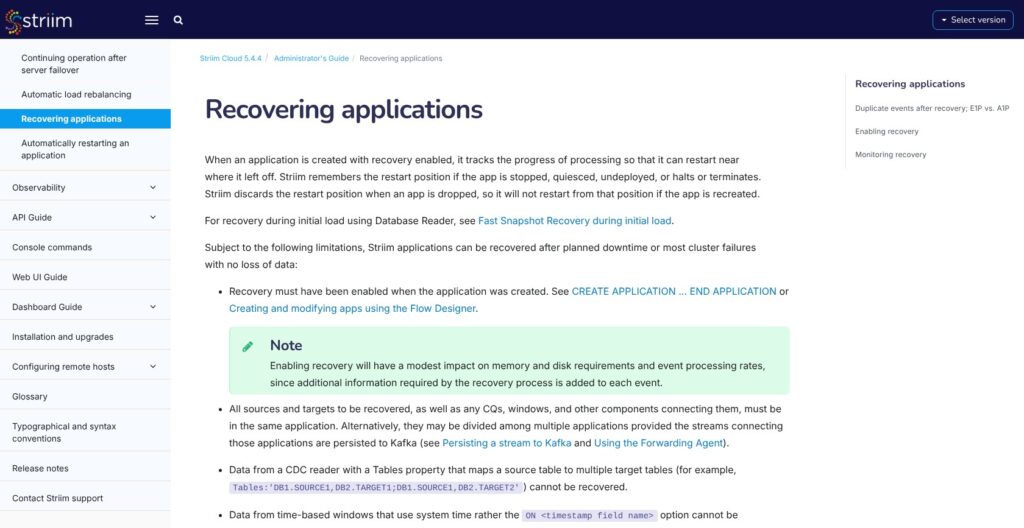
A running pipeline is not the same as a trustworthy dataset. Striim provides operational visibility, but reliability still depends on how the application and its endpoints are configured.
Running applications expose event totals, current rates, and input/output graphs. These help an operator understand activity, although event movement alone does not establish that a destination correctly represents business state.
I separate the operational questions into three groups:
- Flow health: Is data moving through the application?
- Recovery behavior: What happens when processing resumes after interruption?
- Data meaning: Does replay preserve the intended destination state?
Recovery must be enabled when an application is created. It saves processing progress and introduces resource overhead; dropping the application discards its restart position. This makes recovery an architectural setting rather than a reassuring button to discover during an incident.
Support also varies by connector. HTTPReader, TCPReader, UDPReader, and MultiFileReader are not recoverable, and some target configurations can receive duplicates after recovery. There is no universal exactly-once guarantee.
For a current-state table, replayed changes and an append-only event history pose different problems. I want the destination design to account for that distinction. A platform’s ability to resume processing is valuable, but it does not independently settle the business consequences of receiving an event twice.
Managed Cloud is my preference when the team wants to concentrate on application logic. Platform makes sense when infrastructure control is a requirement and the organization can operate the deployment.
Multi-server deployment is documented for Cloud Mission Critical and Platform. Partition keys need to align with cache lookup keys, and cache replication affects memory requirements. I would not assume every Cloud configuration carries the same deployment options.
My overall judgment is favorable but conditional: Striim provides useful operational building blocks for an engineering-owned service. It is not a reason to remove the pipeline from release management or leave incident ownership ambiguous.
The strongest operating model has a named owner for source availability and another for pipeline behavior, with a clear handoff between them.
How Does Striim Compare to Alternatives?
Choose the operating model before comparing feature breadth. The most relevant Striim alternatives solve overlapping problems, but they do not ask your team to own the same pieces.
-
Debezium: for architecture ownership. A common deployment uses Kafka Connect to capture database changes into topics, with separate sink connectors handling onward delivery. Debezium Server and its embedded Engine offer other approaches, so it is inaccurate to say Kafka is always required. I favor Debezium when a platform team wants to assemble the capture architecture; Striim is more attractive when an integrated application model is the goal.
-
AWS Database Migration Service: for migration-oriented replication. AWS DMS provides table-selection and transformation rules. Its transformation model has restrictions, including not replicating two source tables into one target table. I would shortlist it for AWS-centered migration and ongoing replication, while giving Striim closer attention when event enrichment is a central requirement rather than an incidental mapping task.
-
Fivetran HVR: for enterprise database replication. HVR uses Capture and Integrate actions, with documented log-based capture and bidirectional loop prevention. I consider it a relevant comparison when replication topology drives the purchase. HVR’s capabilities should not be treated as interchangeable with every hosted Fivetran connector, and database-specific setup still matters.
A team with an established streaming platform may value Debezium’s composability more than Striim’s integrated design. A migration project may not need continuous-query processing at all.
My reason to shortlist Striim is processing before delivery. If that requirement disappears from the project, I would reopen the comparison rather than assume the broader platform remains the best purchase.
How I Reviewed Striim
I evaluated Striim through its documented specifications and workflows, covering pricing terms, PostgreSQL setup, connector behavior, SQL-like transformations, and recovery limits. I compared those requirements with Debezium, AWS DMS, and Fivetran HVR to judge which buyers each approach suits. The walkthrough explains documented product behavior.
Prices current as of October 2026.
Should You Choose Striim?
Choose Striim when database changes need meaningful processing before delivery, and your team can own source preparation and application behavior. I see a strong fit for enterprise engineers connecting operational databases to consumers that need more than raw replicated rows.
Skip it when the requirement is merely to land tables and your existing warehouse stack already handles the transformations. In that situation, Striim risks adding another place to maintain logic without a clear consumer benefit.
For a managed production deployment, my recommendation is a Cloud proposal for one named data route, with its processing requirements and expected consumption represented in the quote. Platform belongs on the shortlist when self-hosting is a firm requirement, not simply because it offers more control.
Developer is the sensible starting point for understanding the application model. The purchase decision should follow the production architecture, not the appeal of the free allowance.
Striim FAQ
Is Striim free?
Striim Developer is free and includes up to 25 million events per month, with community support. Cloud and Platform use sales-led pricing. I regard Developer as an evaluation entry point, not a substitute for defining production support and deployment requirements.
Does Striim automatically handle every schema change?
No. Schema evolution depends on the source adapter, target writer, and DDL operation. For example, Snowflake Writer supports ADD COLUMN and DROP COLUMN. A supported source-to-target connection does not imply that every database schema migration will propagate automatically.
Can Striim produce duplicates after recovery?
Yes, some destinations can contain duplicate events after recovery, including documented cases involving Cosmos DB and Redshift. Recovery support is connector-dependent, and the application must be configured for it. Resuming from saved progress is not universal deduplication, so destination behavior remains part of the pipeline design.