
Editor’s note: This Prefect review evaluates workflow design, deployment options, recovery controls, and pricing for data engineering teams.
Quick verdict: I recommend Prefect if you already write Python pipelines and want a more manageable way to schedule them, track failures, and control retries. Its biggest appeal is how much of your existing Python logic you can keep. The trade-off is that you’re still responsible for sound pipeline design, even when Prefect hosts the orchestration service.
Key Takeaways
- Prefect is a strong fit for Python teams moving beyond isolated scripts and cron jobs.
- You can choose managed execution or run workflows on your own infrastructure.
- Task-level recovery controls are useful when one unreliable step holds up an otherwise healthy pipeline.
- Caching needs configuration, so don’t assume every interrupted workflow automatically skips completed work.
- Cloud governance features can push a small team toward an enterprise contract.
I’ll look at the cost of running Prefect, how a Python script becomes a scheduled workflow, and where its recovery controls need care.
Prefect Pros and Cons
Pros
- Python functions become workflows with the @flow decorator.
- Task retries support delays and conditional retry rules.
- Hybrid, push, and managed pools offer different infrastructure choices.
- Automations can react when an expected event does not arrive.
- Asset tracking connects workflow runs to their outputs.
Cons
- Python knowledge is necessary to build and maintain workflows.
- Result persistence must be enabled for caching.
- Managed execution requires official Prefect container images.
- SSO and advanced access controls require Enterprise.
How Much Does Prefect Cost?
Prefect offers open-source software and Prefect Cloud. My first question is who will maintain the orchestration infrastructure.
- Open source ($0 license): for teams prepared to host and operate it.
- Hobby (free): for a small Cloud trial or personal project.
- Starter ($100/month): my starting point for a small team needing its own compute.
- Team ($100/user/month): for teams needing service accounts and collaboration controls.
- Enterprise (custom): for stricter governance requirements.
| Cloud plan | Deployments | Included Serverless compute/month | Run retention |
|---|---|---|---|
| Hobby | 5 | 500 minutes | 7 days |
| Starter | 20 | 75 hours | 7 days |
| Team | 100 | 225 hours | 14 days |
| Enterprise | Unlimited | Custom | Custom |
Is Prefect Good Value for Money?
- Budget for access: four Team seats cost $400/month at the listed rate.
- Include infrastructure: your own cloud compute is a separate expense.
- Assign a maintenance owner: self-hosting savings shrink if upkeep repeatedly interrupts delivery.
Reviewer’s Notes: I’d start a small production team on Starter and upgrade for a specific requirement. Check mandatory access controls before committing to a migration.
Getting Started With Prefect
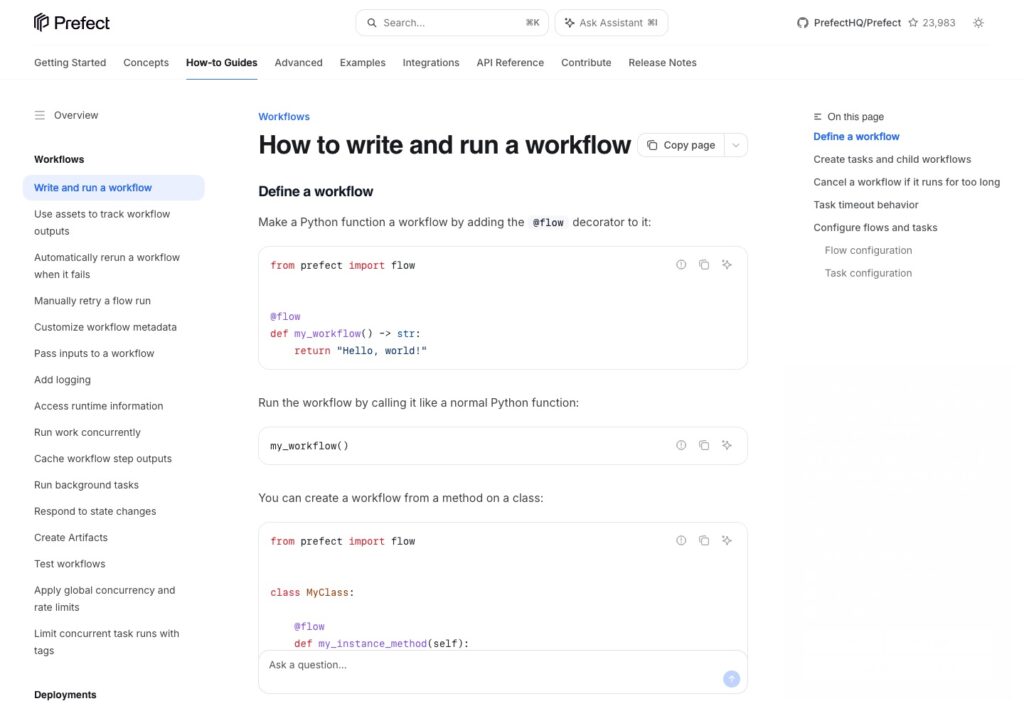
I like Prefect’s starting point: keep the Python function that does useful work, then add orchestration around it. You don’t have to turn every helper function into a special platform object.
A flow is the overall workflow. Tasks give individual steps their own execution controls and visibility. For an order-processing pipeline, I would make the API download and warehouse load separate tasks because they fail for different reasons and need different recovery behavior.
- Choose one existing script. Pick a job with a clear input and output, rather than migrating the entire data platform.
- Add a flow and useful task boundaries. Keep ordinary Python branches and loops where they make the code easier to follow.
- Set failure behavior. Decide which errors deserve another attempt and which should stop the run.
- Create a deployment. This connects the workflow to its run configuration, parameters, and schedule.
- Choose where it executes. Use the environment that already has the dependencies and access the job needs.
A flow defines the work; a deployment tells Prefect how to start it remotely. The same underlying workflow can have separate deployment configurations for different uses.
This is approachable for a Python developer. I wouldn’t recommend it to a business user looking to connect apps through a visual editor. Someone still needs to understand the code when a transformation produces the wrong result.
Prefect is most attractive when you have useful scripts but little orchestration in place. If your Airflow project already works reliably, fewer decorators or shorter configuration files aren’t enough to justify a rewrite.
Retries and Caching: Where I Would Be Careful
Task-level retries are one of Prefect’s most useful features. A temporarily unavailable API shouldn’t force you to build your own retry loop into every pipeline.
You can set retry delays, use exponential backoff, and apply conditions that decide whether a task should retry. I prefer that control to repeatedly rerunning an entire workflow: an expired credential needs attention, while a brief service interruption may clear on the next attempt.
For example, I would retry a read request after a transient connection failure. I would be more careful with a task that creates an invoice or appends rows. Retrying an operation that already succeeded remotely can duplicate its effects unless your application prevents that.
Be Deliberate About Cached Results
Prefect can reuse stored task results, but persistence is disabled by default. Its default cache key also includes the flow run ID, so cross-run reuse needs a deliberate policy.
To avoid repeating an expensive extraction, decide what makes the previous result valid and where it will be stored. A successful cache hit is only helpful when the cached data is still appropriate for the current job.
I would review these choices before relying on recovery:
- Retry scope: which individual operation should run again?
- Result storage: can a replacement execution environment access the saved output?
- Cache validity: what input or code change should invalidate the result?
Where Your Prefect Workflows Run
The execution options are a major reason I’d shortlist Prefect. You can change infrastructure strategy without treating every workflow as a completely separate scheduling system.
| Approach | Where jobs run | Worker required? | My recommendation |
|---|---|---|---|
| Hybrid | Your infrastructure | Yes | When you need close control of the runtime |
| Push | Your supported cloud infrastructure | No | When you want on-demand jobs without maintaining a worker |
| Managed | Prefect’s infrastructure | No | When reducing infrastructure work is the priority |
Hybrid pools are a good fit if your team already operates containers or Kubernetes. I like being able to retain that investment, although someone must keep the worker and execution environment healthy.
Push pools remove the persistent worker. They still need a supported provider account and the permissions to provision or launch work. I would choose this route when the team is comfortable with its cloud setup but wants fewer long-running processes to maintain.
Managed Execution Has Real Boundaries
Managed execution is convenient, but it isn’t an unrestricted replacement for your own runtime. It uses official Prefect images, allows Python dependencies to be installed at runtime, and limits individual runs to 24 hours.
That is enough flexibility for many scheduled Python jobs. I’d choose another execution option for a workload requiring a custom container image or a longer uninterrupted run.
Managed compute usage is measured from startup through teardown, rounded up to the minute. Dependency installation therefore matters to the allowance, not just the time spent processing data. For short, frequent jobs, I would pay particular attention to that overhead.
I wouldn’t introduce Kubernetes just to run a daily script. I’d use it here when the team already operates a cluster or the workload needs that control.
Monitoring, Automations, and Data Assets
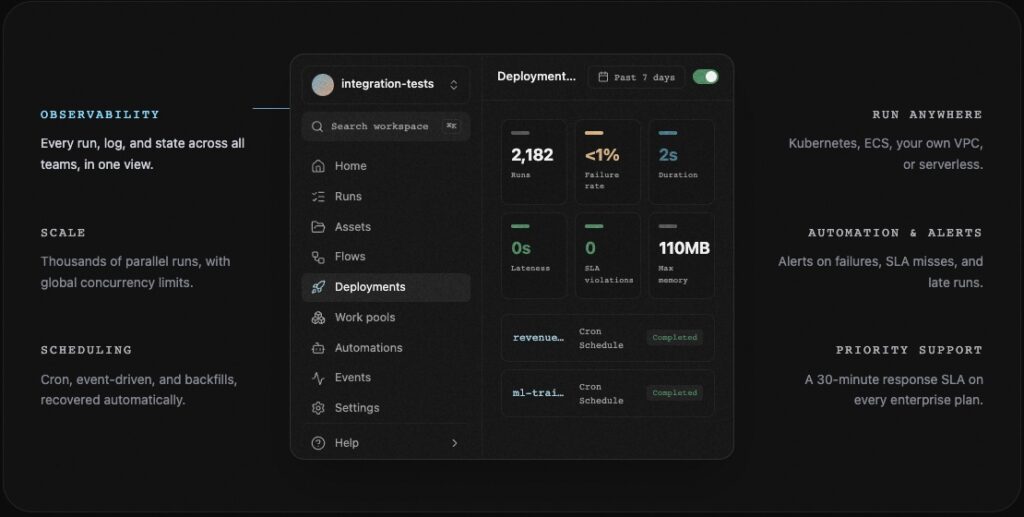
I like Prefect’s ability to catch missing events. A morning pipeline that never starts can deserve just as much attention as one that fails.
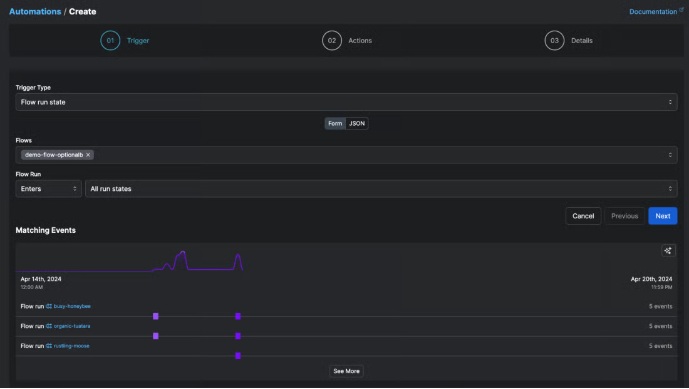
Automations can respond to events or the absence of expected events. They can launch a deployment, pause work, or send a notification. That makes them useful for catching a workflow that never reached the state you expected, as well as one that explicitly failed.
I would start with a small number of actionable alerts. A message that identifies the affected workflow and its owner is more useful than sending every state change to a shared channel. Automating a restart also deserves the same care as configuring retries: repeating a faulty job faster doesn’t fix its logic.
Prefect Also Tracks Assets
Prefect can connect execution to data outputs using assets. The @materialize decorator records materialization attempts, while dependencies help show how outputs relate to one another.
I like this addition because a successful run is only part of the story. When a downstream table matters, it’s useful to see which workflow produced it and what happened during its latest materialization.
However, asset health reflects the latest materialization outcome. It doesn’t establish that every value in the table is correct. I would still add business-specific validation, such as checking whether an order total is plausible or required records are missing.
Dagster remains worth comparing when your team wants to organize the whole platform around data assets. Prefect’s appeal is strongest when executing existing Python workflows is the starting point and asset visibility supports that work.
How Does Prefect Compare to Alternatives?
- Apache Airflow: my preference when you already have reliable DAGs and engineers who know how to operate them. A migration needs a concrete benefit, such as simplifying a troublesome workflow, rather than a general promise of cleaner code. Airflow also supports dynamic task mapping, so flexibility alone is not a reason to dismiss it.
- Dagster: worth prioritizing when tables, models, and other persistent data assets are the organizing principle of your platform. Prefect is easier to justify when the immediate task is giving existing Python execution better controls.
- Astronomer: worth considering when you want managed Airflow while preserving your investment in that ecosystem. I’d compare that route before replacing working Airflow pipelines with Prefect flows.
Prefect announced its acquisition of Dagster Labs in July 2026, with a commitment to continue both Dagster and Dagster+. I would still compare the products on their workflow models. Shared ownership doesn’t make them interchangeable, and it isn’t a reason to assume their subscriptions include each other.
How I Reviewed Prefect
I evaluated Prefect’s workflow model, recovery controls, execution choices, and Cloud plan restrictions, with particular attention to the responsibilities that remain with your engineering team. The recommendations weigh those trade-offs against Airflow and Dagster; they are not performance benchmarks.
Prices current as of October 2026.
Should You Choose Prefect?
I’d choose Prefect for a Python team that has outgrown scripts running in isolation. It offers a practical way to introduce orchestration without making every workflow follow an asset-first design.
I’d skip it if nobody on the team can maintain the Python code, or if your existing orchestrator already handles the workload comfortably. Prefect earns its place when its recovery and execution controls solve a recurring operational problem.
Begin with one representative workflow that depends on an external service. Check that your team can understand a failure, recover safely, and find the affected output. That tells you more about the fit than moving every job at once.
FAQ
Is Prefect free?
The open-source software has no license charge, and Prefect Cloud offers a free Hobby plan. Self-hosting still involves infrastructure and maintenance costs. Choose the free route that matches who will operate the service.
Do I need Python to use Prefect?
Yes, Prefect’s workflow model is built around Python functions. It’s a better fit for developers and data engineers than for someone seeking a visual, no-code automation builder.
Is Prefect better than Airflow?
I’d favor Prefect for an existing Python codebase that needs orchestration with relatively little restructuring. I’d retain Airflow when the team already operates it effectively and there isn’t a specific migration benefit.
Can Prefect run on my own infrastructure?
Yes. Hybrid work pools use workers in your environment, while supported push pools launch jobs in your cloud account without a persistent worker. Self-hosting the orchestration service is a separate option from choosing where jobs execute.
Does Prefect automatically fix failed workflows?
No. It provides retries, caching, and automation controls, but you must configure them to suit the workload. Errors in business logic and unsafe repeated writes still require application-level fixes.