
Editor’s note: This research-based review evaluates Druid’s ingestion, SQL capabilities, deployment requirements, and ownership costs. It does not include a hands-on performance benchmark.
Quick verdict: I recommend Apache Druid for engineering teams building interactive analytics around continuous event streams. Its appeal is a database designed for fresh data and repeated aggregations, but running it well demands infrastructure expertise and deliberate data modeling.
I would shortlist this OLAP engine for product telemetry, advertising analytics, or operational dashboards. This Apache Druid review explains where it fits among real-time analytics databases.
Key Takeaways
- Apache Druid is open-source software; compute, storage, and ongoing operations still cost money.
- Kafka and Kinesis ingestion make continuous event analytics a core use case.
- Optional rollup can reduce the data you store, but aggregated events lose individual detail.
- Primary-key row updates are unsupported, making frequently changing records an awkward fit.
- SQL joins are supported, although query execution and memory constraints matter.
In this review, I’ll look at what you gain from Druid’s architecture, where the operating burden falls, and when ClickHouse, Pinot, or managed Druid deserves your attention.
Apache Druid Pros and Cons
Pros
- Native streaming ingestion from Kafka and Kinesis
- Columnar segments and bitmap indexes for selective analytics
- Optional ingestion-time rollup reduces stored rows
- SQL querying alongside the native JSON query API
- Independent scaling of ingestion and query services
Cons
- No single-record updates by primary key
- Native joins require non-base inputs to fit in memory
- Production deployments require several supporting services
- Security features require explicit configuration
Apache Druid Pricing: Free Software, Paid Operations
Apache Druid has no paid software tiers. The purchasing decision is whether your team should operate the database or pay a commercial provider to manage it.
- Apache Druid ($0 software license): For teams that want infrastructure control and can operate their own deployment. Hosting and staff time are additional costs.
- Imply Polaris (from $100/month): A commercial managed Druid service. Starter begins at $100/month for evaluations; Standard starts at $600/month, and Custom uses quoted pricing. Usage affects the bill.
| Option | Software or service cost | What you still need to budget for | Best fit |
|---|---|---|---|
| Self-managed Apache Druid | $0 software license | Compute, storage, networking, monitoring, and engineering | Teams with platform expertise |
| Managed Druid through Imply Polaris | Starter from $100/month; Standard from $600/month; Custom quoted | Capacity, ingestion/processing volume, and file storage affect billing | Teams prioritizing managed operations |
A free download does not provide a production cluster, an on-call team, or a recovery plan. I would compare a managed quote with a full self-hosting estimate, including the time spent upgrading and troubleshooting the system.
Is Apache Druid Good Value for Money?
I like Druid’s value proposition when fresh analytical data is part of the product you sell. Infrastructure work can be worthwhile when customers repeatedly filter and aggregate event data throughout the day.
- Good value: A platform team has clear workload requirements and can own the cluster.
- Less convincing value: A small team mainly needs periodic reports and has no database operator.
- Worth comparing: Managed Druid when engineering capacity is the limiting resource.
For a platform team, I recommend starting with the free software for a scoped evaluation. Move to self-managed production only after estimating operational effort alongside infrastructure costs.
Getting Started With Apache Druid
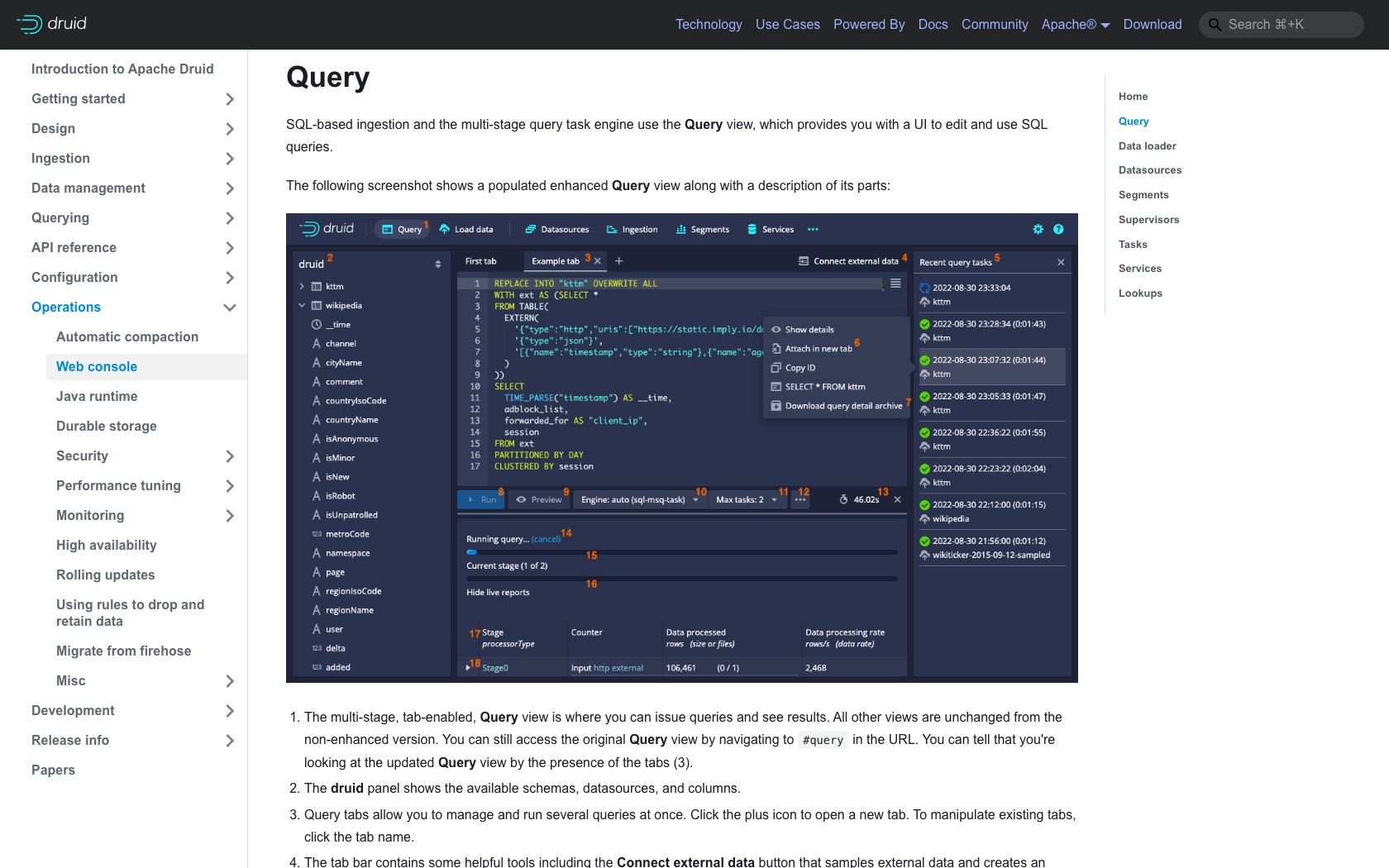
Druid’s local quickstart needs a Unix-like environment with at least 6 GiB of RAM, Java 17, Python 3, and Perl 5. The documented flow is to download the distribution, start its services, and open the console on localhost port 8888.
That is an evaluation setup. I would not use its footprint as a production sizing estimate.
Use the console to evaluate your own data:
- Load representative data. Use the ingestion wizard to configure the source and inspect previews.
- Check the timestamp and dimensions. Choose fields that match the filters and breakdowns your application needs.
- Decide whether to aggregate during ingestion. Preserve detailed records if the application needs event-level investigation.
- Run SQL in the Query view. Check the answers against known totals before judging speed.
- Inspect tasks and datasources. Confirm ingestion completed and the expected data is available.
I like that ingestion and querying share a console, but the interface does not remove the modeling decisions. A successful sample query says little about a dashboard with many simultaneous users or a stream that arrives unevenly.
For an evaluation, I would bring one familiar dataset and three actual application queries. Include a selective filter, a broad aggregation, and the most awkward join. Those expose more useful differences than a demonstration with conveniently small inputs.
Streaming Ingestion and Fresh Data
Druid has ingestion services for Apache Kafka and Amazon Kinesis. Supervisors coordinate ongoing tasks, including recovery and handoff, so continuous ingestion is built into the database’s workflow.
I like this fit for applications that already produce an event stream: Druid provides both ongoing ingestion and analytical querying in one system.
The exactly-once claim needs careful reading. Kafka ingestion tracks partitions and offsets, while Druid coordinates committed offsets with published segment metadata. That protects the ingestion process across failures; it is not a promise to identify every logically duplicated business event in your source stream.
Two purchases mistakenly emitted as separate source records still need an upstream data-quality strategy. I would define the event identity and replay behavior before relying on dashboard totals.
Batch ingestion complements the streaming path. SQL-based ingestion supports INSERT and REPLACE, with transformations and aggregation during loading. That gives you a way to load historical data alongside your ongoing stream.
My main buying question is how much data freshness your users need. If yesterday’s data answers their questions, the extra operational work becomes harder to justify. If they repeatedly investigate events as they arrive, Druid deserves a serious evaluation.
Rollup, Indexing, and SQL Trade-offs
Druid stores data in time-partitioned, columnar segments. Column-oriented access limits the fields a query needs to scan, while bitmap indexes help narrow matching rows. Those choices suit dashboards that repeatedly filter a large event dataset by time and dimensions.
I would model the filters your users actually select before choosing an ingestion schema. A data model designed around country and device type may serve a product dashboard well while leaving a later investigative requirement poorly supported.
Rollup Saves Space by Giving Up Detail
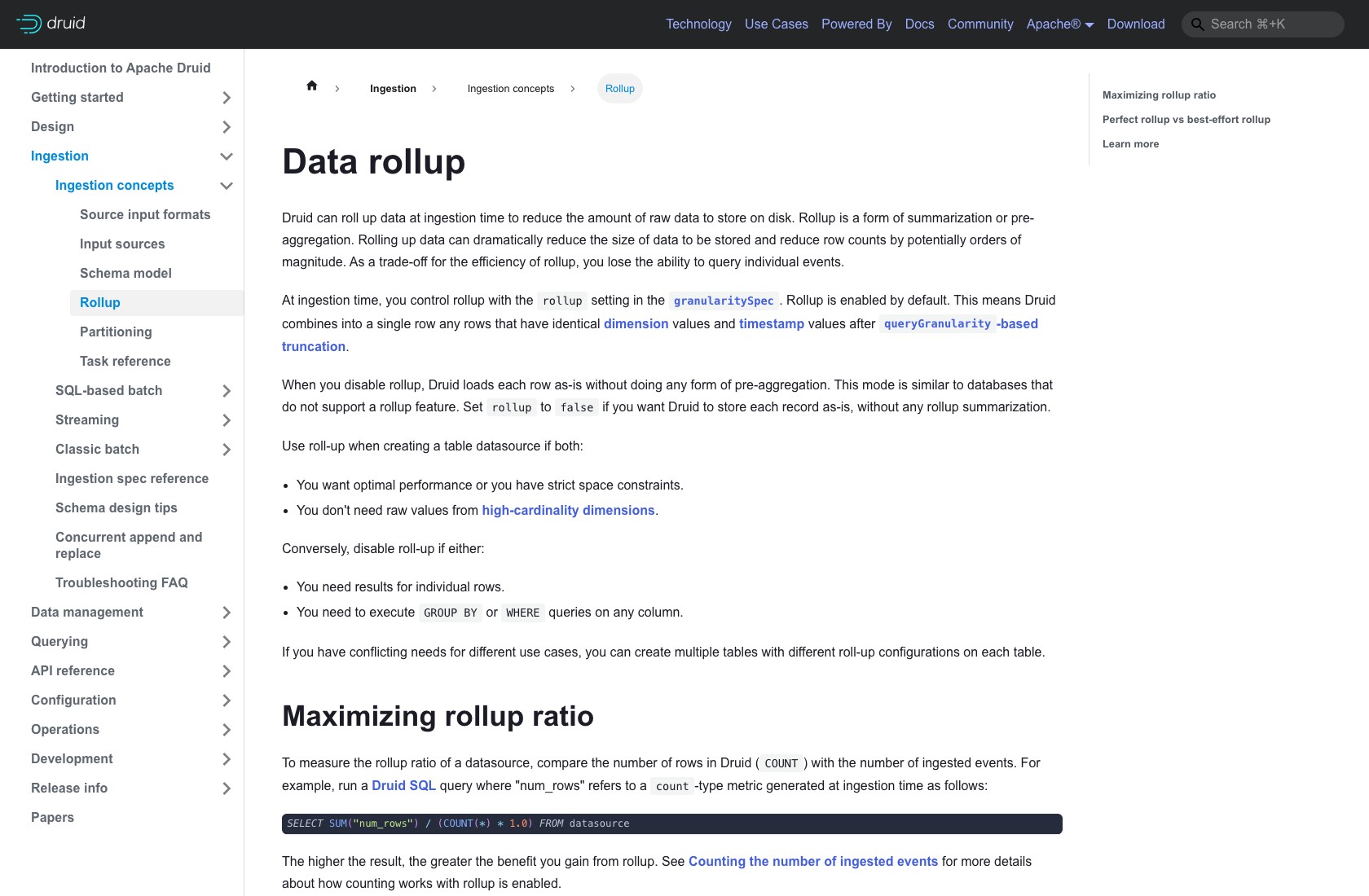
Rollup combines records sharing dimension values and a timestamp at the selected granularity. Fewer stored rows can reduce storage and query work, but the combined records no longer preserve each original event.
I like rollup for predictable aggregate reporting. I would disable it, or keep a separate detailed datasource, when analysts need to inspect individual events. The right choice depends on which questions the product must answer later, not just how small you can make the initial dataset.
Druid Supports Joins, With Different Execution Paths
Druid supports SQL joins, but native query execution uses broadcast hash joins, where inputs other than the leftmost base must fit in memory. That makes small dimension tables a more natural fit than repeatedly joining large fact tables.
The multi-stage query engine, or MSQ, also supports sort-merge joins for larger inputs. Sort-merge does not have an overall input-size limit, but it has different execution costs and a per-key data limit. It is not a reason to assume that every large join will suit an interactive dashboard.
I would compare ClickHouse when flexible analytical joins dominate the requirements. Its join types and algorithm choices make it a relevant shortlist candidate, although they do not establish a performance winner without workload testing.
Check Exact Versus Approximate Answers
Druid’s SQL translation uses approximate distinct counting by default for COUNT(DISTINCT ...). Exact counting can be selected through query configuration.
For exploratory audience analytics, approximation may be acceptable. For a reconciliation report, I would make the accuracy requirement explicit. Fast answers are useful only when the calculation matches the question.
Running Druid in Production
Druid separates ingestion, query routing, and historical data serving into different services. That lets you scale individual responsibilities, but it also gives your team more components to understand.
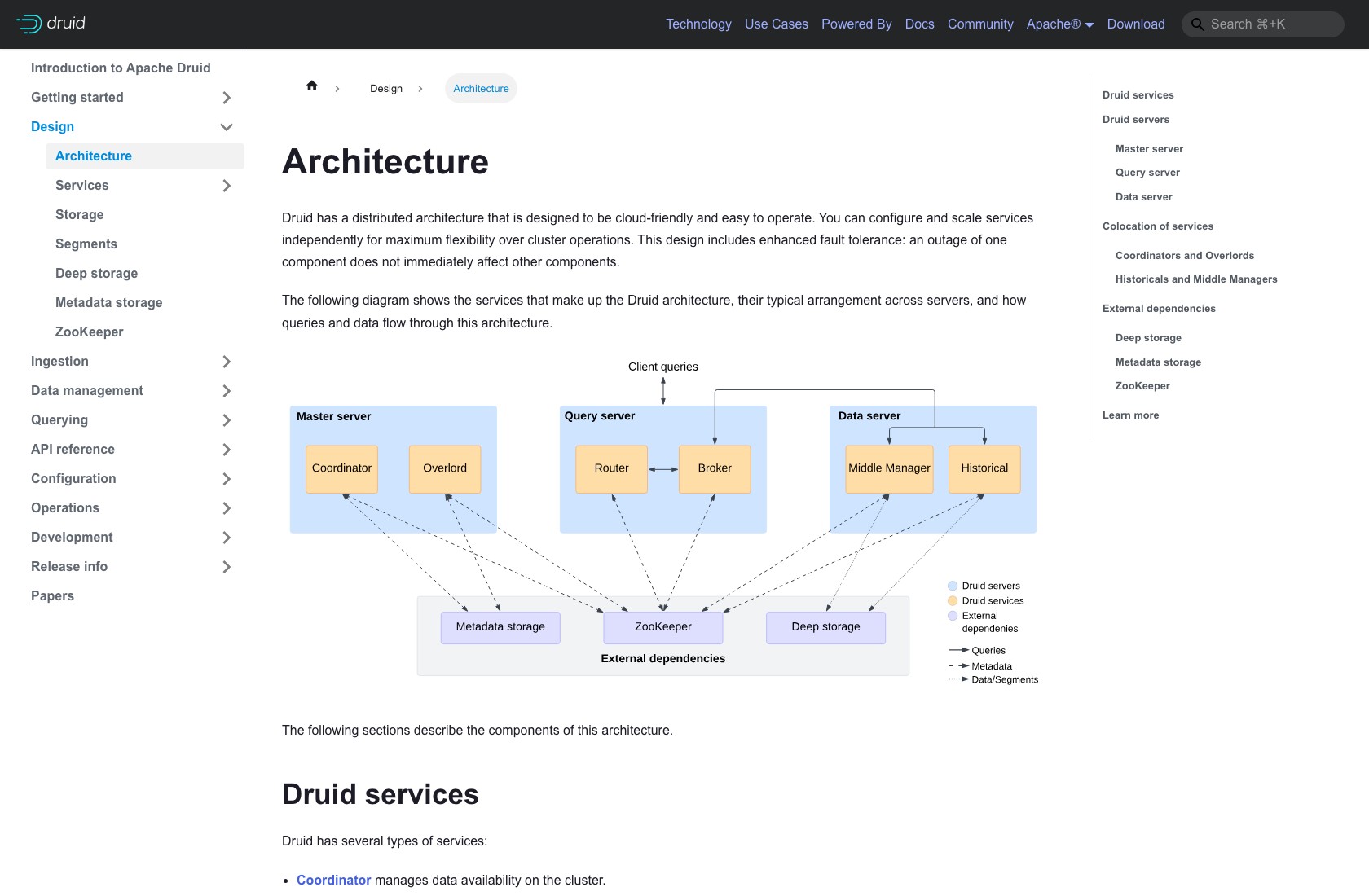
A production design includes supporting infrastructure:
- Deep storage: Durable segment storage independent of the Druid processes.
- Metadata database: Commonly PostgreSQL or MySQL for cluster metadata.
- ZooKeeper: Coordination, discovery, and leader election.
- Druid services: Ingestion and query capacity with appropriate redundancy.
Historical services cache segments for query serving. Deep storage keeps the underlying segment files separately, which supports recovery and separates data durability from an individual query server’s lifetime.
I like that separation for a long-running analytics system. I would still budget for the storage backend’s durability, metadata protection, and recovery procedures. Having segment files available is one part of operating a resilient service.
Security features are disabled by default. A production deployment needs deliberate TLS, authentication, and authorization configuration. This is another reason I would give ownership to a platform team rather than leave a local evaluation running as a shared service.
Data corrections also deserve attention. Druid supports overwriting time ranges and reindexing, but it does not offer single-record primary-key updates. If your source represents an order whose status changes repeatedly, decide how those changes become analytical events or replacement data.
Reviewer’s Notes: I would settle the correction strategy before committing to Druid. A fast aggregate is less valuable if the team has no manageable way to correct the records behind it.
Apache Druid Alternatives
- ClickHouse: My shortlist choice when analytical SQL flexibility and join options matter more than Druid’s specific ingestion model. Compare representative queries; neither engine wins every workload.
- Apache Pinot: Worth evaluating when streaming analytics needs primary-key upserts. Pinot supports full and partial upserts, but requires stream partitioning by primary key and memory for key metadata.
- Imply Polaris: The managed option to investigate when Druid fits the data but operating the cluster does not fit the team. Compare its commercial terms with the cost of providing that operational capacity internally.
| Option | Reason to evaluate it | Main trade-off |
|---|---|---|
| Apache Druid | Continuous event ingestion and selective aggregation | Operational ownership and data-model constraints |
| ClickHouse | Analytical SQL with multiple join algorithms | Resource use and algorithm choices still need evaluation |
| Apache Pinot | Streaming records that require upserts | Partitioning rules and primary-key metadata overhead |
| Imply Polaris | Managed Druid operations | Separate service fees and usage billing |
I would keep the shortlist small. Choose the alternative that addresses your hardest requirement, then compare it with Druid using the same data and concurrency expectations.
How I Reviewed Apache Druid
I evaluated Druid’s documented ingestion, data modeling, SQL execution, console workflow, deployment architecture, and security requirements. I also compared the relevant join, upsert, and managed-service options from ClickHouse, Pinot, and Imply.
This is a research-based assessment, not a measured comparison of query speed or production costs. My recommendations concern workload fit and operational trade-offs; they do not establish a latency advantage on your data.
Pricing basis checked October 2026. Infrastructure costs depend on your deployment.
Should You Choose Apache Druid?
Choose Druid when continuous event analytics is a core requirement and your team can support the system behind it. I particularly like its fit for applications built around repeated filtering, grouping, and time-based investigation.
I would be more cautious when the central requirement is mutable records, complex relational exploration, or occasional reporting. Those needs weaken the case for accepting Druid’s operational and modeling obligations.
The free license makes evaluation accessible. The production decision should turn on whether its strengths match your real queries and whether your team can own ingestion, corrections, capacity, and recovery. If the engine fits but staffing does not, compare a managed Druid service before committing to self-hosting.
Apache Druid FAQ
Is Apache Druid free?
Yes, the open-source software has no license fee. Self-managed deployments still incur infrastructure and operating costs. Commercial managed Druid services charge separately.
Is Apache Druid a replacement for PostgreSQL?
I would use it for analytical workloads rather than as a replacement for transactional application storage. Its lack of primary-key row updates is an important distinction.
Does Apache Druid support SQL joins?
Yes. With native joins, inputs other than the leftmost base must fit in memory. MSQ adds sort-merge joins for larger inputs, with different resource requirements.
Does Apache Druid keep individual events?
It can. Rollup is optional. If you enable aggregation during ingestion, the resulting records do not retain every original event separately.
Is Apache Druid better than ClickHouse?
It depends on the workload. I would evaluate Druid for continuous event analytics and compare ClickHouse closely for join-heavy analytical SQL. Test your actual queries before choosing.