
Editor’s note: We combine independent analysis, data collection, and hands-on testing to review data and AI tools. This Metabase review weighs pricing mechanics, modeling depth, self-hosting risk, and AI maturity.
Quick verdict: We recommend Metabase for small teams and first BI deployments. It is the fastest route from a raw database to a working dashboard, and the open-source tier is free with unlimited users. The trade-offs: performance and governance thin out at warehouse scale, and self-hosting demands a patch schedule after two pre-auth CVEs in three years.
Key Takeaways 🔍
- The open-source tier is free with unlimited users; Cloud Starter is $100/month with 5 users
- Releases 59 through 62 shipped Transforms, a metrics explorer, an official MCP server, and open-sourced AI features in four months
- Buyers rate it 4.4/5 on G2 (147 reviews) and 4.5/5 on Capterra (62 reviews)
- No join pruning: every join defined in a model runs on every query, and the Data Model admin page slows down on large databases (GitHub #21985, #7663)
- An August 2026 zero-day, CVE-2026-72898 (CVSS 10.0), breached Framework and n8n through unpatched Metabase instances
Pros and Cons
Pros
- Free open-source tier with unlimited users, self-hosted
- A non-analyst can go from database connection to a working dashboard in an afternoon
- 49,200 GitHub stars and 100M+ Docker pulls behind the open-source image
- AI features open-sourced in release 60, alongside an official MCP server
- Native SQL editor one click from the visual question builder
Cons
- No join pruning: every join defined in a model runs on every query
- Data Model admin pages slow badly on large databases (GitHub #21985, #7663)
- Row and column security and SSO attribute mapping start at Pro, $575/month
- Two pre-auth CVEs in three years; lapsed patching caused the Framework and n8n breaches
How Much Does Metabase Cost?
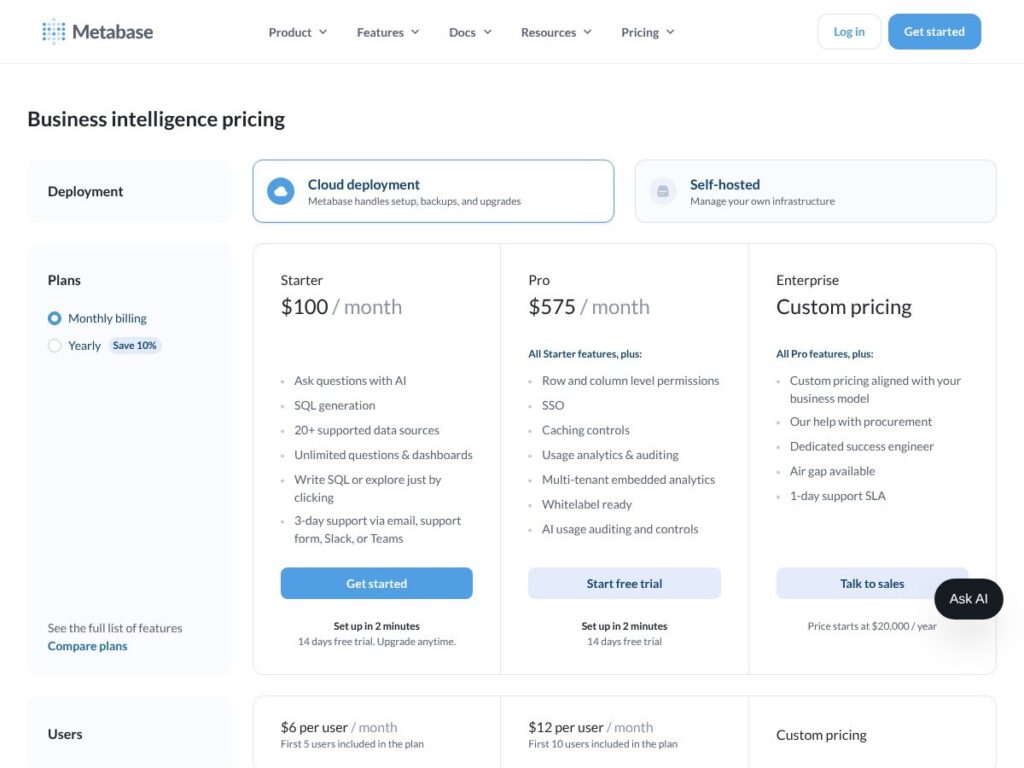
Metabase pricing runs from $0 self-hosted to Enterprise contracts starting around $20,000 a year, and the AI features bill on two separate meters. The four plans:
- Open Source (free): self-hosted with unlimited users; you pay for a server and your own upgrades
- Starter ($100/month): for teams that want hosting handled; $90/month on annual billing, 5 users included, then $6 per extra user
- Pro ($575/month): for customer-facing embeds and compliance requirements; $517.50/month on annual billing, 10 users included, then $12 per extra user
- Enterprise (from about $20,000/year): custom contracts, Metabot bundled in
| Plan | Monthly | Annual billing | Users included | Extra user | Key gate |
|---|---|---|---|---|---|
| Open Source | $0 | $0 | Unlimited | n/a | Self-hosted only; you own patching |
| Starter | $100 | $1,080/year ($90/mo) | 5 | $6/month | No row-level security, no SSO mapping |
| Pro | $575 | $6,210/year ($517.50/mo) | 10 | $12/month | Row and column security, SSO attribute mapping |
| Enterprise | Custom | From ~$20,000/year | Custom | Custom | Metabot bundled, air-gapped deployment |
The metered AI Service costs $3.75 per 1M tokens with the first 1M free, published on Metabase’s own pricing page. Metabot, the natural-language query add-on, is a separate charge: third-party pricing trackers put it around $100/month for 500 requests on paid Cloud plans, with higher request tiers above that and bundled into Enterprise contracts. Only the token meter is published plainly, so confirm that add-on figure on the pricing page before budgeting. Transforms add $0.01 per run after 1,000 included runs ($0.02 for advanced Transforms), and result storage costs $2 per 1M rows after the first million.
Is Metabase Good Value for Money?
- Against Looker: Looker prices at enterprise scale, while a 10-person team on Metabase Starter pays $130/month
- Against Apache Superset: Superset is also free with SAML and LDAP included, but its learning curve costs non-technical users the afternoon Metabase saves them
- The per-user math decides tiers: at 20 users, Starter is $190/month and Pro is $695/month; that $505 gap is the price of row and column security
Author’s Testing Notes 📝
Start on Open Source or Starter. Buy Pro the day a named gate bites, and for most teams that gate is row-level security for customer-facing embeds: the moment tenant A must never see tenant B’s rows, the $575/month tier stops being optional. Until then, bank the difference.
— Panoply reviewer
Best for: teams under roughly 20 users who want predictable BI spend, and self-hosters comfortable owning upgrades. Skip it if: you need row-level isolation or SSO on day one and $575/month reads steep; price Superset’s free SAML support first.
My Experience With Metabase
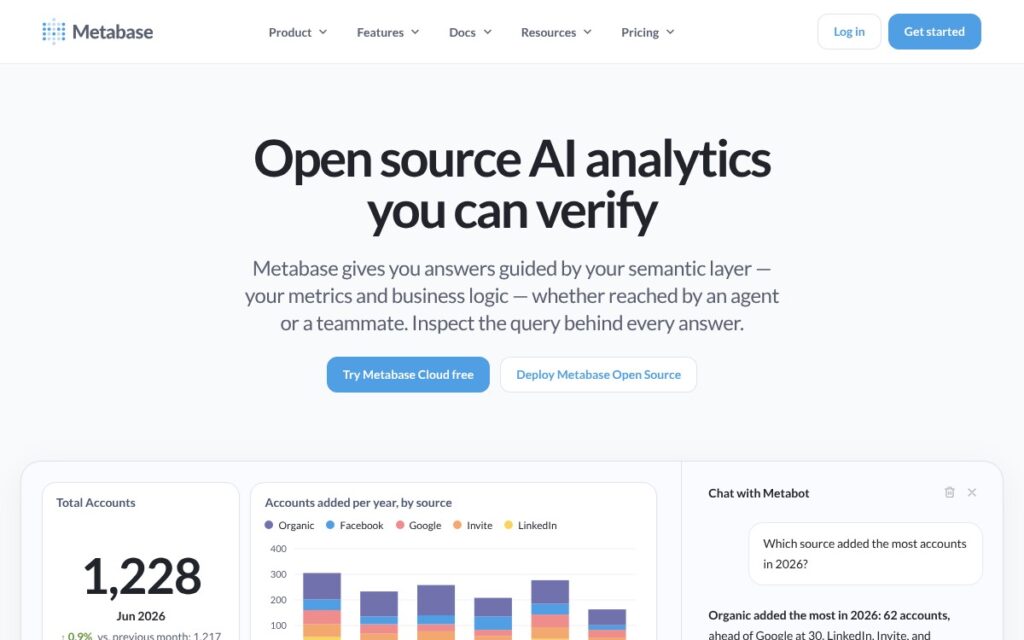
Setup is one Docker command. I ran the metabase/metabase container, the same image sitting at 100M+ pulls on Docker Hub, and had the setup screen open in a browser within minutes. I connected a Postgres database rather than the embedded H2 default (H2 is for trials, nothing more), and Metabase scanned the schema and surfaced the tables without any modeling work from me. Production app databases can be Postgres, MySQL, or MariaDB; picking one at setup saves a migration later.
Asking My First Questions
The question builder works the way a pivot table thinks: pick a table, choose an aggregation, group by a column, and the chart renders. I built a count-of-orders-by-week question without touching SQL, saved it, and pinned it to a new dashboard next to three more cards. Dashboards, alerts, and scheduled reports cover the everyday reporting loop from there.
[Screenshot needed: query builder building a simple aggregate on an orders table] The question builder handled a weekly orders aggregate without a line of SQL. Source: Panoply
Analysts get an escape hatch one click away. The native SQL editor sits beside the visual builder, so any query the builder cannot express gets written by hand and saved to the same dashboard, which keeps SQL-fluent and SQL-free teammates in one tool instead of two.
[Screenshot needed: assembled dashboard with 3-4 cards] Four saved questions pinned into a first dashboard. Source: Panoply
Where It Slowed Down
Against a large connected schema, the Data Model admin page lags badly enough that two GitHub issues, #21985 and #7663, track it as a known problem rather than a one-off complaint. Aggregated reviews on G2 and Capterra echo the pattern: slow loads and lag once datasets grow past the small-warehouse comfort zone, with some users reporting dashboards becoming unresponsive during exploration.
Author’s Testing Notes 📝
Bump the JVM memory before anything else. Metabase wants 2GB of RAM as a floor and 4-8GB for real query loads; set the heap with JAVA_OPTS (for example, -e “JAVA_OPTS=-Xmx2g” on the Docker run). An under-provisioned heap is what turns heavy queries into JVM crashes.
— Panoply reviewer
On setup speed Metabase matches Tableau, and my own Docker-to-dashboard run did nothing to argue otherwise.
Dashboards, Modeling, and Data Studio
The classic Metabase failure: two people build “monthly active users” in two separate questions, the definitions drift, and a quarter later the numbers disagree in a board deck. Until March 2026 the honest fix lived outside Metabase. Releases 59 through 61 changed the terms.
📊 From Questions to Models
Models curate raw tables into governed starting points that non-analysts can query without seeing the joins underneath, and Metabase renders them across roughly 25 chart types, polished but well short of Superset’s 30+. Release 62 (June 2026) added a plugin SDK for custom chart types, which is the escape hatch for that gap. The structural limit is join pruning, or rather its absence: every join defined in a model executes on every query even when no column from the joined table is used, and fact tables at different grains need workarounds rather than native handling. On a warehouse like Snowflake, those unused joins show up on the bill.
🧮 Transforms and the Metrics Explorer
Metabase 59 (March 2026) shipped Data Studio, a governance workbench with a semantic layer library, dependency graphs, and diagnostic tools, plus Transforms: SQL or Python scripts that write persistent tables back to the database for use as sources. It is dbt-adjacent work inside Metabase itself, and teams already defining truth in dbt can keep doing so and point questions at those models. Release 60 (April 2026) added a metrics explorer with side-by-side metric comparison and drill-down, and 61 (May 2026) extended it with metric math, arithmetic across defined metrics.
That narrows the metric-drift gap without closing it. For governed consistency at enterprise scale, Looker‘s LookML layer still wins. Metabase gives you metric standardization without the feedback mechanisms that keep definitions consistent long term.
Metabase AI: Metabot, MCP, and the Ceiling
Release 60 (April 2026) made Metabase’s AI features open source instead of gating them behind Enterprise pricing, the opposite of the category’s standard playbook. The lineup since: Metabot answers natural-language questions in Slack; an official MCP server connects Claude, ChatGPT, Cursor, and VS Code directly to a live instance; and release 62 (June 2026) renders interactive charts inside the AI client rather than static images. Release 61 added a governance layer with per-group AI access controls, token and message limits, Metabot system-prompt customization, and AI usage analytics. Those group controls are what let you hand Metabot to a finance team while the rest of the instance stays AI-free.
Billing runs on the two meters covered in the pricing section above: the $3.75-per-1M-token AI Service plus the separately marketed Metabot add-on. Self-hosters can plug their own Anthropic key into Metabase and pay only for their tokens.
Definite’s engineering analysis draws the line cleanly: “Metabase is a tool that reads databases. Its AI inherits that scope.” Metabot cannot modify data models, govern metric definitions across tools, or build new data infrastructure. It observes faster. It does not act. That puts Metabase among the AI-adjacent tools, a chatbot on top of BI, rather than the AI-native ones whose agents can change the foundation underneath.
Good AI for asking, not for acting. If you want agents that restructure your pipeline, Metabot is not that. If you want the fastest natural-language window into an existing warehouse, releases 60 through 62 delivered a serious one, governance controls included.
Self-Hosting Metabase Without Getting Burned
Metabase has shipped two separate pre-authentication vulnerabilities in three years, and they are two different bugs, not one flaw resurfacing. CVE-2023-38646 was a critical remote code execution hole (CVSS 9.8) in versions before 0.46.6.1: an unpatched install left its setup token live, letting an unauthenticated attacker execute commands through a crafted JDBC string. OX Security’s March 2026 scan found more than 17,000 Metabase instances still publicly exposed, many on vulnerable versions three years after the fix shipped.
CVE-2026-72898 is the newer one: an unauthenticated SQL injection in the /reset_password endpoint that hands a remote attacker administrator access, rated a maximum 10.0 by NIST on both CVSS 3.1 and 4.0. Exploitation began August 3, 2026; CISA added it to its Known Exploited Vulnerabilities catalog on August 11. Framework disclosed that attackers took customer names, emails, phone numbers, and physical addresses through the bug, and n8n reported 136 customer records taken the same way. Metabase shipped a patched build on every supported line, from 1.58.24 up to 1.63.5.
The production playbook that keeps the free tier free:
- Run a real application database: Postgres, MySQL, or MariaDB, never the embedded H2 default
- Size for concurrency: roughly 1 CPU core and 1GB RAM per 40 concurrent users on the app database
- Give the JVM room: 2GB minimum, 4-8GB recommended, tuned via JAVA_OPTS
- Put SSO in front early, before the first offboarding scramble
- Patch on a fixed schedule: both CVEs concentrated their damage in instances that lagged on updates
If nobody on your team owns that patch schedule, buy Cloud and make the pager Metabase’s problem. Starter at $100/month costs less than one breach disclosure letter.
How Does Metabase Compare to Competitors?
Every rival in this shortlist wins a named niche; Metabase wins the start.
- Apache Superset ships 30+ chart types (Sankey diagrams, treemaps, geospatial choropleths) and free SAML and LDAP under Apache 2.0, with no vendor-run cloud to match Metabase’s. It wins once someone owns a semantic layer and the dashboard count heads toward the hundreds.
- Redash is effectively frozen in 2026. Adopting a project with no development trajectory is a choice you will have to explain to your team next year, so it is defensible only if you already run it and migration cost decides.
- Looker wins governed metrics: LookML gives an enterprise one modeled source of truth and ends the data-trust disputes Metabase’s question-level metrics invite. The sticker price funds years of Metabase Pro.
- Tableau wins visual storytelling, with the most flexible drag-and-drop dashboards and the widest library of design patterns in this group, at the cost of the heaviest admin overhead.
- Power BI wins inside Microsoft and Excel shops, with strong functionality at a very competitive price and the easiest adoption curve for existing Excel users; outside that stack the advantage evaporates.
Metabase is the best first BI tool in this lineup, not the last one. Start there and graduate deliberately: dbt underneath for metric truth, Looker only when governance must precede the first dashboard.
How We Test Data and AI Tools
We combine independent analysis, data collection, and hands-on testing to review data and AI tools. For Metabase that meant standing the tool up ourselves, running a real task end to end, comparing it directly against Superset, Looker, Tableau, and Power BI, and weighing sustained user sentiment across G2, Capterra, and community forums rather than launch-week reactions. We weigh pricing mechanics, modeling depth, deployment and security posture, AI maturity, and crowd sentiment.
I set up the open-source container, connected a database, and built questions and dashboards myself before writing a word of this Metabase review. Prices current as of September 2026.
Metabase Review: Should You Run Your Analytics on Metabase?
Among the BI and analytics tools in our directory, Metabase is the one we point first-time buyers at: the open-source tier is genuinely free at unlimited users, the question builder gets a non-analyst to a working dashboard in an afternoon, and the 2026 release pace (Transforms, metrics explorer, MCP server, open-sourced AI) shows a vendor still shipping. The costs are equally concrete: no join pruning, a Data Model page that lags on large schemas, and a patching burden proven twice over by CVE-2023-38646 and CVE-2026-72898.
The split: small teams, first BI deployments, and SaaS products that need embedded analytics with row-level isolation on Pro should buy it. Warehouse-scale shops that need governed metric definitions before the first dashboard belong with Looker. SQL-heavy analyst teams whose main complaint is chart variety should price Superset first.
Next action: run the free Docker container against a copy of your production schema for a week. If the Data Model page stays responsive and nobody misses row-level security, you have your answer before spending the first $100.
FAQ
Is Metabase’s AI free, metered, or an add-on?
Both meters exist. The AI Service (SQL generation, summarization) is metered at $3.75 per 1M tokens with the first 1M free, per the vendor’s pricing page. Metabot, the natural-language add-on, is marketed separately: third-party trackers put it around $100/month for 500 requests on paid Cloud plans, bundled into Enterprise. Confirm the add-on figure on the pricing page before budgeting.
Is the 2023 Metabase vulnerability still a risk in 2026?
Yes, for unpatched self-hosts. OX Security’s March 2026 research found more than 17,000 Metabase instances still publicly exposed, many on versions vulnerable to CVE-2023-38646. The August 2026 breaches at Framework and n8n came from a different, newer bug: CVE-2026-72898, a pre-auth SQL injection rated CVSS 10.0. Two separate vulnerabilities, one lesson: patch on a schedule.
When should I pick Superset or Redash instead of Metabase?
Superset when someone owns a semantic layer. It ships 30+ chart types and free SAML and LDAP, at the cost of a steeper learning curve for non-technical users. Redash is only defensible if you already run it; development is effectively frozen in 2026. See the competitor section above for the full breakdown.
What does production self-hosting actually require?
A real application database and a patch schedule. Run Postgres, MySQL, or MariaDB instead of the embedded H2 default, give the JVM at least 2GB of RAM (4-8GB recommended), and size the app database at roughly 1 CPU core and 1GB RAM per 40 concurrent users. Put SSO in front early and patch on a fixed cadence.